


Setting Effective Therapy Goals for Adjustment Disorder

If you’re searching for goals for therapy adjustment disorder, here are the most common therapeutic targets:
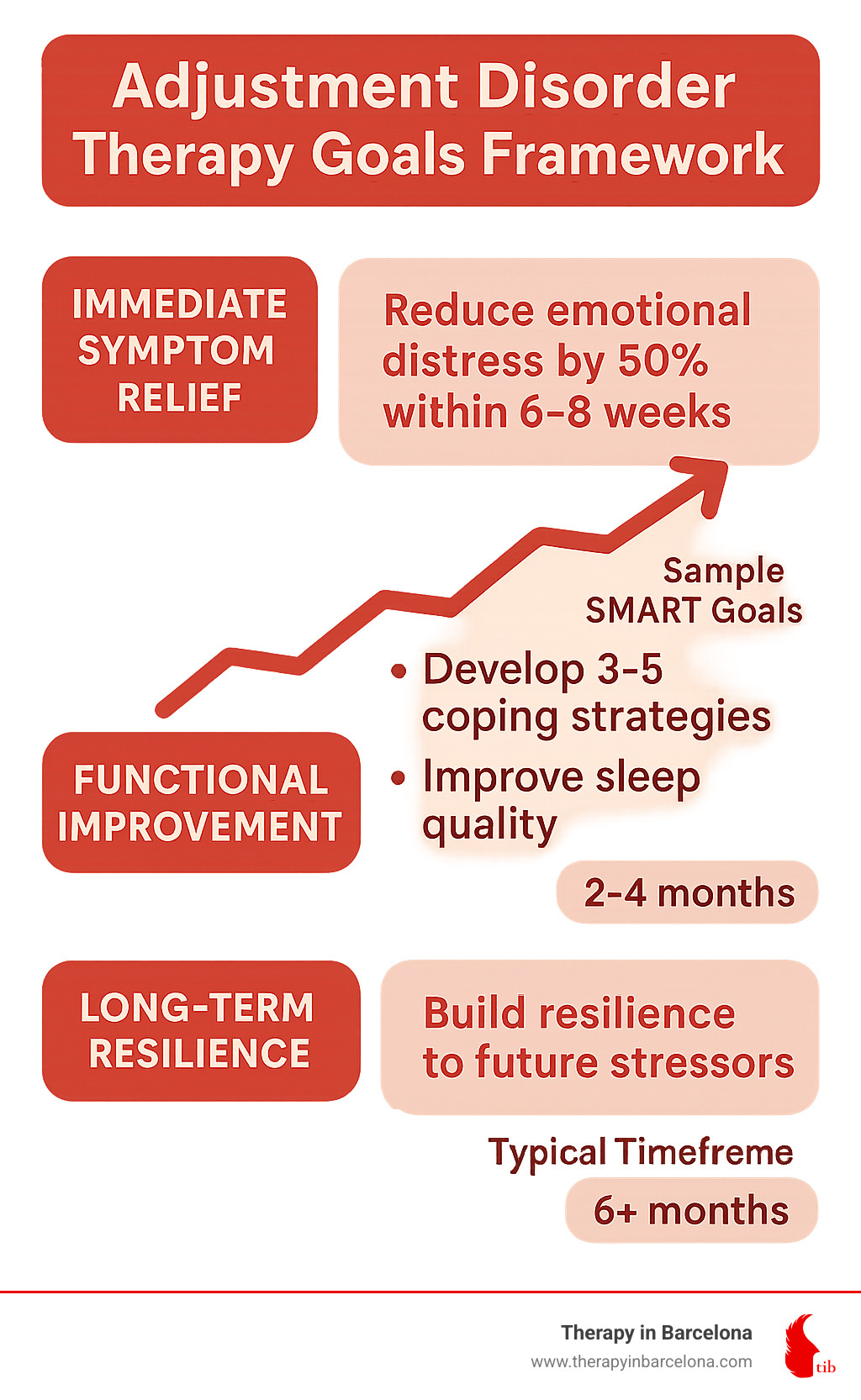
- Reduce emotional distress (anxiety, depression, anger) by 50% within 6-8 weeks
- Develop 3-5 effective coping strategies to manage stress reactions
- Improve sleep quality and establish consistent sleep routine
- Return to pre-stressor level of functioning in work, social, and personal domains
- Build resilience to prevent similar reactions to future stressors
- Process and integrate the meaning of the stressful event
Life changes such as relocating to a new country, changing jobs, relationship transitions, or health challenges can create significant stress. While most people adapt to these changes within a few months, goals for therapy adjustment disorder become essential when emotional or behavioral reactions persist and interfere with daily functioning.
Adjustment disorder occurs when your response to a life stressor is more intense or longer-lasting than expected, causing significant distress and impairment in your daily life. As an international in Barcelona, you may face unique stressors – navigating bureaucracy in a foreign language, building a new social network, or reconciling cultural differences – that can trigger adjustment difficulties.
“If no improvement is noted by the third session of therapy for adjustment disorder, further assessment and modification of the treatment plan is recommended, as lack of early improvement predicts poor outcomes,” notes clinical research. This highlights why setting clear, measurable goals from the start is crucial for effective treatment.
A well-structured therapy plan for adjustment disorder typically includes short-term goals for immediate symptom relief, mid-range goals for functional improvement, and long-term goals for building lasting resilience. Your therapist will help you develop these goals collaboratively, ensuring they’re custom to your specific challenges and circumstances.
What Makes Adjustment Disorder Different from “Normal” Stress?
Have you ever wondered if what you’re feeling is just the usual stress of life changes, or something more? When you’re navigating life in a new country like Spain, it’s natural to experience stress – but how do you know when your reactions have crossed into something that might need professional support?
Adjustment disorder is more than just feeling stressed. It has specific characteristics that set it apart:
- Your symptoms begin within 3 months after a clear stressor (like moving to Barcelona)
- Your emotional reactions are stronger than what would typically be expected
- These reactions significantly disrupt your daily life and functioning
- The symptoms don’t better fit another mental health condition
- Once the stressor ends or you adapt to it, symptoms typically improve within 6 months
“Adjustment disorders are among the most common psychiatric disorders, particularly in primary care and medical settings,” according to research. Yet many people struggle to recognize when their stress response has evolved into something that might benefit from therapy.
What’s particularly concerning is that research indicates “the progression from suicidal ideation to behavior has been found to be faster in adjustment disorder than in major depression,” highlighting why setting clear goals for therapy adjustment disorder is so important for timely intervention.
Common Emotional & Physical Signs
Adjustment disorder manifests differently for each person, but common signs include persistent anxiety, low mood, irritability, excessive worry, or feelings of hopelessness. You might notice behavioral changes like withdrawing from friends, struggling at work, or experiencing more conflicts in your relationships.
Many people also experience cognitive difficulties – trouble concentrating, making decisions, or breaking free from negative thought patterns. Your body might react too, with physical complaints like disrupted sleep, constant fatigue, headaches, muscle tension, or digestive problems.
Typical Challenges for Internationals in Spain
Living abroad brings unique stressors that can trigger adjustment difficulties. As an international in Spain, you might be facing relocation stress, language barriers, cultural adjustment challenges, identity shifts, homesickness, and administrative problems that can create ongoing stress that compounds over time.
Leigh Matthews, founder of Therapy in Barcelona and an Australian psychologist who relocated to Barcelona in 2011, understands these challenges firsthand. “As an expat myself, I experienced the complex emotions that come with building a new life abroad. These aren’t just everyday stressors—they can fundamentally shake your sense of identity and security.”
When these challenges begin to overwhelm your coping resources, setting clear goals for therapy adjustment disorder becomes essential for finding your footing again and rebuilding your sense of stability and well-being in your new home.
Why Clear Goal-Setting Accelerates Recovery

When you’re navigating adjustment disorder, having a clear roadmap for recovery isn’t just helpful—it’s transformative. Setting specific goals for therapy adjustment disorder creates a powerful foundation that can significantly speed up your healing journey.
Think of goal-setting as the compass that guides both you and your therapist through the sometimes foggy landscape of emotional distress. Without this direction, therapy sessions might meander, leaving you feeling uncertain about your progress.
“I’ve seen how structured goals transform the therapy experience for internationals adjusting to life in Barcelona,” shares Leigh Matthews, founder of Therapy in Barcelona. “When clients can clearly see where they’re heading, they become active participants in their own recovery rather than passive recipients of support.”
Research strongly supports this approach. Studies on measurement-based care (MBC) show that tracking progress toward specific goals leads to faster symptom improvement, higher remission rates, and shorter treatment timelines. This evidence-based approach isn’t just a nice addition to therapy—it’s a crucial component that significantly impacts outcomes.
When we establish clear goals for therapy adjustment disorder together, you’ll experience several key benefits:
- Direction and focus that keeps sessions productive and targeted on what matters most to you
- Improved motivation that naturally emerges when you can see the path forward
- Measurable progress that allows you to recognize improvements, even on difficult days
- Adaptive treatment that evolves as you do, with regular goal reviews
- Personal empowerment that comes from taking an active role in your recovery
Evidence Behind Goal-Setting in Adjustment Disorder
The research supporting structured goal approaches for adjustment disorder is compelling. Cognitive Behavioral Therapy (CBT), which emphasizes clear goal-setting, consistently shows effectiveness in reducing adjustment disorder symptoms and improving daily functioning.
Particularly interesting is research indicating that progress should be visible by your third therapy session. If you’re not seeing movement toward your goals by this point, it’s a signal that we need to reassess and potentially revise our approach. This early checkpoint helps ensure we’re on the right track from the beginning.
At Therapy in Barcelona, our approach to goal-setting is uniquely attuned to the expatriate experience. As internationals ourselves, we understand that adjustment disorder in an expat context comes with specific challenges that require culturally sensitive goals.
Goals for Therapy Adjustment Disorder – The SMART Framework
When you’re struggling with adjustment disorder, having clear goals for therapy adjustment disorder can make all the difference in your recovery journey. As expats ourselves, we understand how overwhelming life transitions can feel when you’re far from home. That’s why we recommend using the SMART framework to transform vague wishes into achievable targets:
Specific goals pinpoint exactly what you want to change, rather than broad aspirations. Instead of “feeling better,” you might aim to “reduce anxiety during work presentations.”
Measurable goals include concrete ways to track your progress. Using rating scales (like rating your anxiety from 0-10) helps you and your therapist see improvements even on difficult days.
Achievable goals are realistic given your current circumstances. While complete elimination of all stress might not be possible during a major life transition, reducing its impact certainly is.
Relevant goals address the challenges that matter most to you right now. As an expat, this might include building a social network or managing homesickness.
Time-bound goals include a reasonable timeline, creating momentum and a sense of purpose in your therapy.
Here’s how the SMART approach transforms vague hopes into powerful objectives:
| Vague Goal | SMART Goal |
|---|---|
| “Feel less anxious” | “Reduce anxiety from 8/10 to 4/10 on a subjective distress scale within 6 weeks by practicing daily breathing exercises and gradually facing avoided situations” |
| “Sleep better” | “Establish a consistent sleep routine by going to bed at 11pm and waking at 7am, 5 nights per week, resulting in less than 30 minutes to fall asleep by the end of 4 weeks” |
Short-Term “First-Aid” Goals for Therapy Adjustment Disorder
The initial phase of therapy focuses on providing immediate relief – think of it as psychological first aid. These early goals for therapy adjustment disorder might include:
- Reducing distress levels by 30-50% within the first month
- Building emotional regulation skills that you can use anywhere, anytime
- Improving sleep quality through consistent routines and relaxation techniques
- Creating a safety plan if you’re experiencing thoughts of self-harm
- Identifying avoidance patterns that might be maintaining your distress
Mid-Range Functional Goals for Therapy Adjustment Disorder
Once your distress levels have decreased, therapy shifts toward rebuilding your daily functioning and confidence. These mid-range goals for therapy adjustment disorder often include:
- Returning to pre-stressor levels of performance at work or school
- Re-engaging with social connections, both locally and back home
- Improving communication skills to express needs effectively in new cultural contexts
- Developing practical problem-solving strategies for ongoing challenges
- Establishing healthy routines that support your wellbeing
Long-Term Resilience Goals for Therapy Adjustment Disorder
The final phase of therapy focuses on preventing relapse and building lasting resilience. These longer-term goals for therapy adjustment disorder transform your experience into a foundation for growth:
- Developing a flexible repertoire of coping skills that you can adapt to various situations
- Creating a values-based plan for meaningful engagement in your international life
- Building self-awareness around your personal triggers and early warning signs
- Establishing a relapse prevention plan with specific strategies for future challenges
- Integrating your adjustment experience into a coherent personal narrative
Tailoring Goals to Symptom Profile & Severity
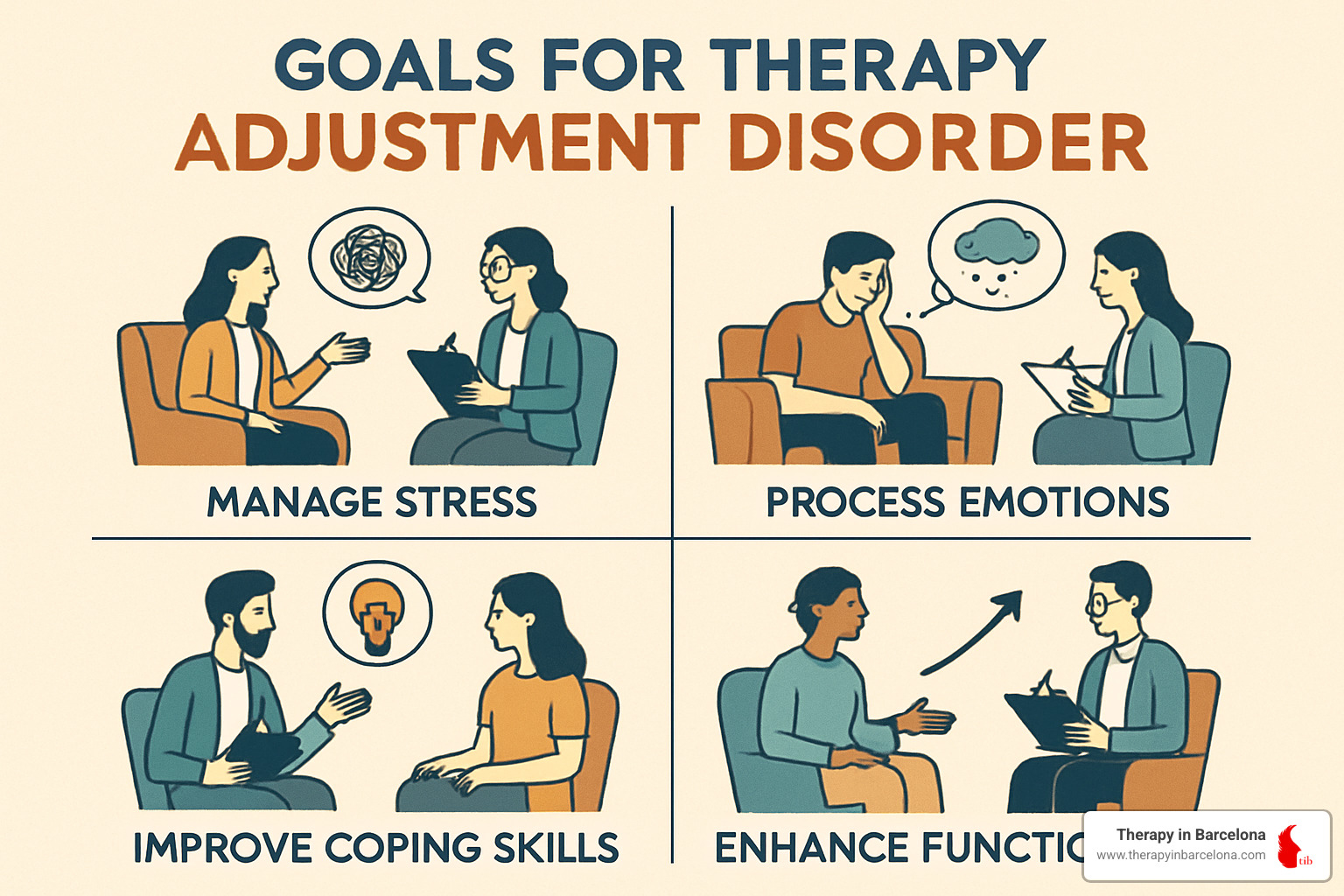
When it comes to creating effective goals for therapy adjustment disorder, one size definitely doesn’t fit all. Your unique symptom profile and severity level are crucial in shaping a treatment plan that truly works for you.
Adjustment disorder typically falls into one of five subtypes:
- With anxiety
- With depressed mood
- With mixed anxiety and depressed mood
- With disturbance of conduct
- With mixed disturbance of emotions and conduct
The severity of your symptoms—whether mild, moderate, or severe—will also influence how intensive your therapy goals need to be and how quickly you might expect to see progress.
Setting Goals for Adjustment Disorder with Anxiety
If anxiety is your primary symptom, your therapy goals might focus on calming your nervous system and building confidence in managing uncertainty.
“Many of our international clients find that the uncertainties of navigating life in a new country amplify their anxiety,” notes Leigh Matthews, founder of Therapy in Barcelona. “We often work on creating a gradual path back to feeling safe and capable.”
For anxiety-predominant adjustment disorder, we typically focus on goals like reducing physical tension through regular relaxation techniques and decreasing the frequency of worry through structured approaches like scheduled worry time. Building an exposure hierarchy can help you gradually face feared situations while developing greater tolerance for uncertainty through mindfulness practices.
Research from Dutch practice guidelines highlights that Stress Inoculation Training works particularly well for adjustment disorder with anxiety. This approach systematically builds your coping skills through graduated exposure to stressors—perfect for the ongoing challenges of expat life.
Setting Goals for Adjustment Disorder with Depressed Mood
When low mood dominates your experience, your therapy goals will likely center around rebuilding motivation, challenging negative thought patterns, and reconnecting with sources of joy and meaning.
If you’re struggling with depression symptoms, we might work together on increasing behavioral activation by scheduling pleasant and meaningful activities that align with your values. Many clients find that establishing a regular exercise routine provides a natural mood boost, while rebuilding social connections helps counter the isolation that often accompanies depression.
Research consistently shows that Cognitive Behavioral Therapy (CBT) effectively reduces depressive symptoms in adjustment disorder while improving daily functioning. At Therapy in Barcelona, we blend these evidence-based approaches with cultural sensitivity to address the unique challenges faced by internationals.
Mixed Emotional & Conduct Symptoms: Combined Goal-Plan
For those experiencing both emotional difficulties and behavioral challenges, we typically develop a more comprehensive set of goals that address both areas.
This might include developing greater emotional awareness to recognize triggers for problematic behaviors and learning impulse control strategies to pause before acting. Many clients benefit from improving their communication skills for expressing difficult emotions appropriately, especially when navigating cross-cultural relationships.
Tracking Progress & Preventing Relapse

When working toward goals for therapy adjustment disorder, keeping track of your progress isn’t just helpful—it’s essential. Research consistently shows that therapy outcomes improve significantly when we measure and monitor progress along the way.
Think of tracking as your personal roadmap through recovery. Without it, you might miss important signs of improvement or not notice when you need to adjust your course. At Therapy in Barcelona, we use several evidence-based tools to help you see your progress clearly.
Many of our clients find standardized assessments particularly helpful. These include questionnaires like the PHQ-9 for tracking depressive symptoms or the GAD-7 for anxiety. There’s even a specific scale called the Brief Adjustment Disorder Scale (BADS) designed especially for monitoring adjustment symptoms. These tools give you concrete numbers to track your journey.
“I was surprised to see my anxiety score drop from 18 to 11 in just three weeks,” shared one of our clients. “Seeing that number change made me realize the breathing techniques were actually working, even when I still felt stressed sometimes.”
We also use simple daily mood ratings, where you score your feelings from 0-10. These can reveal patterns you might otherwise miss—like noticing your mood improves after certain activities or worsens following specific triggers.
Clinical research emphasizes that if you don’t see improvement by your third therapy session, it’s time to reassess and possibly modify your approach. This early check-in point is crucial—which is why we build progress monitoring into our therapy from day one.
Building Everyday Resilience
Recovery from adjustment disorder isn’t just about feeling better in therapy sessions—it’s about building skills that support your wellbeing every day.
Think of resilience as your emotional immune system. Just as physical exercise strengthens your body against illness, certain daily practices strengthen your mind against stress. As an expatriate, you face unique challenges that require specific resilience strategies.
Establishing consistent self-care routines is foundational. This isn’t about occasional indulgences—it’s about regular practices that nourish your physical and emotional health. For many of our international clients, this includes finding exercise options that work in their new environment and creating sleep routines that accommodate cultural differences.
Building a support network is equally crucial. This might involve connecting with both fellow expatriates who understand your experience and locals who can help you steer your new culture. Many clients find that joining international social groups or volunteering helps combat isolation while building meaningful connections.
“Adjustment disorders, though challenging, are not impossible and can be addressed through building mental resilience,” notes clinical research. The skills you develop during therapy become lifelong tools for managing future stressors.
Frequently Asked Questions about Goals for Therapy Adjustment Disorder
How quickly should I expect improvement once goals are set?
Every healing journey is unique, but there’s good news about adjustment disorder treatment. Research shows that with clear goals for therapy adjustment disorder, many people notice some positive changes within the first 2-3 sessions.
This early progress is important. If you’re not experiencing any relief by the third session, it might be time to talk with your therapist about adjusting your approach. Most people show significant improvement within 8-12 weeks of starting goal-directed therapy, though complete resolution may take longer—especially if your stressor continues or is particularly challenging.
What if my stressor is still ongoing—can I still meet my therapy goals?
Absolutely yes! This is such a common concern, especially for internationals.
While adjustment disorder is defined as a response to a stressor, therapy can be remarkably effective even when the stressor persists. For many expatriates in Barcelona, certain stressors like language barriers, cultural differences, or distance from family may continue for months or even years.
In these cases, your goals for therapy adjustment disorder will focus on improving how you respond to these ongoing challenges rather than eliminating them entirely. Your therapist will help you develop coping strategies, challenge unhelpful thought patterns, and build resilience that allows you to thrive despite continuing challenges.
Do I need medication to reach my therapy goals?
Most people with adjustment disorder respond very well to psychotherapy alone without medication. Research consistently shows that evidence-based approaches like Cognitive Behavioral Therapy (CBT) are highly effective for adjustment disorder.
However, there are some situations—particularly when symptoms are severe or include significant anxiety or depression—where short-term medication might be helpful alongside therapy. This decision is always made collaboratively between you, your therapist, and a medical provider, with clear goals for both the medication’s effects and eventual discontinuation.
Conclusion

Your journey through adjustment disorder doesn’t have to be walked alone. Setting personalized goals for therapy adjustment disorder creates a roadmap that transforms overwhelming stress into manageable steps toward healing and growth.
For internationals navigating life in Barcelona and beyond, adjustment challenges often intertwine with questions of identity, belonging, and finding your place in a new culture. These aren’t just ordinary stressors—they touch the core of who you are and how you see yourself in the world.
What makes our approach at Therapy in Barcelona unique is that we’re not just therapists who’ve read about expatriate life—we’re living it alongside you. As psychology-trained professionals who are also expats ourselves, we understand the nuanced reality of cultural adjustment, language barriers, and rebuilding your sense of home from the ground up.
The good news about adjustment disorder is its typically time-limited nature. With thoughtful, goal-directed therapy, most people not only return to their previous level of functioning but often develop greater resilience than they had before. The coping skills and insights you gain become valuable tools for navigating future life transitions with more confidence and self-awareness.
Seeking support isn’t a sign of weakness but of wisdom. The expatriate journey comes with unique challenges that even the most resilient person may struggle to steer alone. By working with a therapist who understands both the psychological aspects of adjustment and the lived reality of international life, you’re giving yourself the best chance to not just survive but thrive in your new home.
To learn more about our therapy services and how we can support your adjustment and growth, visit Therapy in Barcelona.
