


Starting Your Spanish Adventure from Ireland

For many, emigrating to Spain from Ireland is a dream of swapping green landscapes for sun-drenched coasts. With nearly 15,000 Irish citizens already calling Spain home, the appeal is clear. This guide will help you steer every step of this journey, from the initial paperwork to settling into your new community.
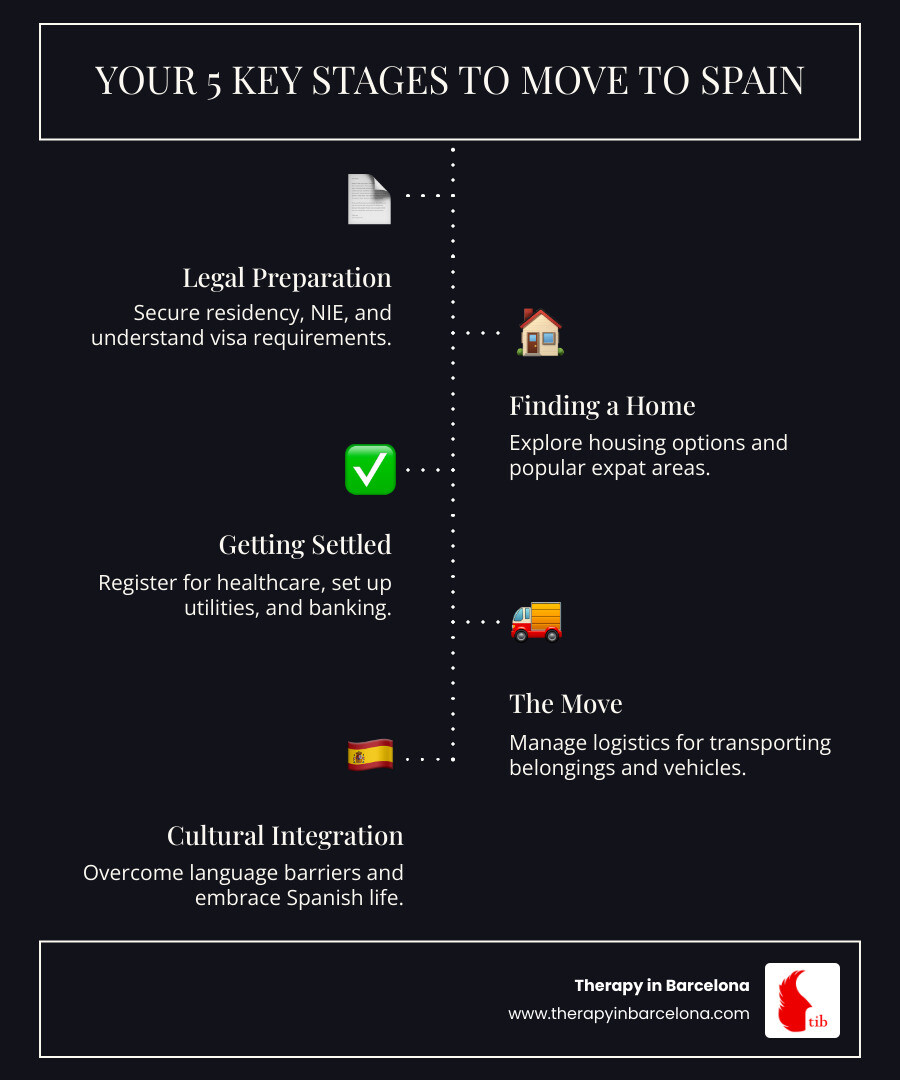
If you’re considering a move, these are the essential stages you’ll encounter:
- Legal Preparation: Securing your residency, NIE number, and understanding visa requirements.
- Finding a Home: Exploring housing options and popular expat areas.
- Getting Settled: Registering for healthcare, setting up utilities, and banking.
- The Move: Managing logistics for transporting belongings and vehicles.
- Cultural Integration: Overcoming language barriers and embracing Spanish life.
Moving country is a big step, full of practical challenges and personal growth. This guide offers advice to make your transition smoother, acknowledging the emotional journey that comes with starting anew. We’ll cover everything from vital documents to finding your community, so you feel prepared and supported.
The Legal Lowdown: Residency, Paperwork, and Your Rights
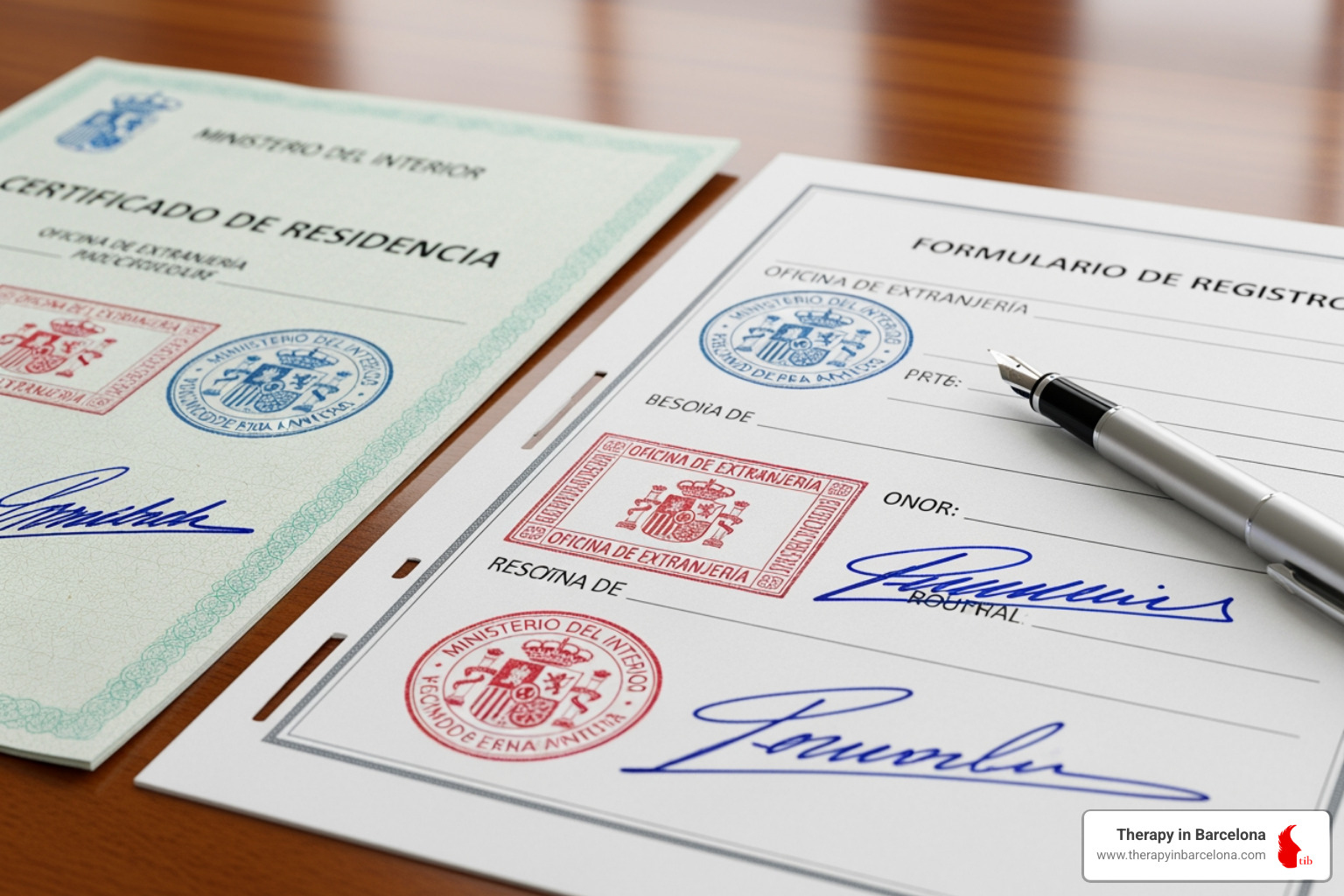
As an Irish citizen, EU freedom of movement simplifies your move to Spain, but you’ll still need to handle some paperwork. Understanding the essential forms and deadlines is key to a hassle-free start.
Residency and Visa Requirements for Irish Citizens
As an Irish citizen, you can move to Spain without needing a visa. If you intend to stay for more than 90 days, you will need to register your residence. The key document is the Certificado de Registro de Ciudadano de la Unión, often known as the green residency certificate. This confirms your status as an EU citizen living in Spain, so keep it safe with your other important documents.
A vital early step is getting your NIE (Número de Identidad de Extranjero). This foreigner ID number is needed for many everyday tasks in Spain, including opening a bank account, signing a rental agreement, buying property, and setting up utilities. You can usually apply for it in Spain through the police or from Ireland via the Spanish consular system.
To get residency, you must prove you can support yourself (proof of sufficient financial means) and have comprehensive health insurance. If you aren’t working, you’ll need to show regular income or savings. The minimum proof of funds for non-workers is based on Spain’s IPREM (Public Income Indicator), which is updated annually.
The Key Difference: Republic of Ireland vs. Northern Ireland
While citizens from the Republic of Ireland enjoy full EU benefits, those from Northern Ireland with only British passports face different rules post-Brexit. As ‘third-country nationals’, they need a TIE (Tarjeta de Identidad de Extranjero) for long-term residency. For short visits, an ETIAS travel authorisation is expected to be required from 2025. Check your passport’s nationality to determine your requirements.
Your Step-by-Step Guide to Spanish Residency
Applying for residency is manageable if you take it step-by-step.
- Gather Documents: You’ll need your valid Irish passport, proof of a Spanish address (rental contract), proof of financial means, and proof of health insurance. Documents may need to be translated into Spanish.
- Get Your NIE: This is a prerequisite for most other steps.
- Book an Appointment (Cita Previa): Book online at your local Oficina de Extranjería or police station. Be persistent, as appointments in popular areas like Valencia or Madrid can be hard to get.
- Complete Forms: Fill out the Modelo EX18 application form and the Modelo 790 code 012 to pay the fee (around €12) at a bank.
- Attend Your Appointment: Bring all original documents, photocopies, and proof of payment. If successful, you’ll receive your green certificate.
After getting residency, you must complete your Empadronamiento. This is your registration at the local town hall (Ayuntamiento), which is mandatory and necessary for accessing public services like healthcare and schools.
Registering for Tax and Social Security
If you live in Spain for more than 183 days a year, you become a tax resident and must declare your worldwide income to the Tax Authority (Agencia Tributaria). Register as a taxpayer using Modelo 030. Ireland and Spain have a double taxation agreement to prevent you from being taxed twice on the same income. It’s wise to consult a tax advisor.
Registering with the Social Security System (Seguridad Social) is essential if you’re working. Your employer usually handles this. If you’re self-employed (autónomo), you must register yourself using Form TA1. Contributions cover healthcare, unemployment benefits, and your pension.
Setting Up Your New Life: Housing, Healthcare, and Banking

With the legal paperwork underway, it’s time to make Spain feel like home. This means finding a place to live, understanding the healthcare system, and getting your finances sorted.
Finding a Home in the Sun
Spain offers a huge variety of places to live, from the city buzz of Barcelona and Madrid to coastal spots on the Costa del Sol or in Valencia and Alicante. Other popular communities include Marbella, the Canary Islands, Sevilla, and Zaragoza.
Renting is often the simplest way to get started, especially if you want flexibility while you settle in. You will usually sign a rental contract (contrato de alquiler) and pay a security deposit (fianza) of one or two months’ rent. Property sites like Idealista can help you begin your search. In high-demand areas, homes move quickly, so it is smart to start early.
Navigating the Spanish Healthcare System
Spain’s public healthcare system is excellent. As a resident working and contributing to social security, you and your family have full access. Register at your local health centre (centro de salud) to get your health card (Tarjeta Sanitaria Individual or TSI).
Irish pensioners can access the system using an S1 form from Ireland. If you’re not working or a pensioner, the Convenio Especial allows you to pay a monthly fee for public access. Your European Health Insurance Card (EHIC) is only for temporary stays. For those not covered by the public system, private health insurance is often a residency requirement and offers more flexibility.
Banking, Bills, and Staying Connected
Opening a Spanish bank account is a priority and is easier once you have your NIE. A local account is essential for paying bills and receiving a salary. Compare banks to find the best fit, and ensure you open a resident account.
Setting up utilities like electricity, water, and gas is straightforward with your NIE and bank details. For your phone, a local Spanish SIM card is much more affordable for calls and data. Shop around for the best internet and mobile deals.
On the Move: Logistics of Emigrating to Spain from Ireland

Once you’ve found your home, it’s time to plan the physical move. Getting yourself and your belongings to Spain requires some planning, but it’s manageable.
Getting Your Belongings (and Yourself) to Spain
When emigrating to Spain from Ireland, you’ll need to decide how to move your belongings. International removal companies can handle the entire process, including customs. For large moves, sea freight is often the most economical option, but book it several months in advance.
Moving costs vary, and customs duties may apply to certain items. Some people prefer to fly with essentials and ship the rest later. Don’t forget your pets! Transporting pets to Spain requires a microchip, up-to-date vaccinations, and a valid pet passport. Start this process well in advance.
Driving in Spain: Licences and Cars
Your Irish driving licence is valid for the first six months of your residency. After that, you must exchange it for a Spanish one. The process involves an application, a fee, and a psychophysical aptitude report (psicotécnico), which is a straightforward medical test. You can find guidance on the official DGT (Spanish Traffic Authority) website: exchange your Irish driving licence.
Importing an Irish car is complex and involves taxes, registration, and a technical inspection (ITV). Many expats find it easier and more cost-effective to sell their car in Ireland and buy a Spanish-registered vehicle upon arrival.
Special Considerations for Moving with Children
Spain is a great place for families. The Spanish school system includes free public schools (colegios públicos) for full immersion, and fee-paying private schools (colegios privados).
International schools are also popular in expat hubs like Barcelona, Madrid, and the Costa del Sol. They typically follow British or other international curricula, teaching primarily in English. These can be expensive and often have waiting lists, so research them early. Enrolling your children in any school requires their residency documents and your empadronamiento.
Thriving, Not Just Surviving: Culture, Community, and Wellbeing

Beyond the practicalities, settling into Spanish life and looking after your wellbeing are crucial for a successful move. It’s about building a life where you truly thrive.
Embracing the Culture: Language and Integration
One of the most rewarding parts of emigrating to Spain from Ireland is embracing a new culture. Learning Spanish will open doors, enrich daily life, and help you make local friends. People are incredibly supportive when they see you making an effort.
- Language Learning: Consider a language school in cities like Barcelona, Madrid, or Valencia, or use apps like Duolingo. Intercambios (language exchanges) are a practical way to build confidence with native speakers.
- Cultural Etiquette: Spain often runs on a more relaxed daily rhythm. Evening meals are usually later, and while not every area still follows a formal siesta, afternoon breaks are common in some places. Sundays are often family-focused, so many shops may be closed. Punctuality is still appreciated, especially for appointments and social plans.
- Making Friends: Building a social circle takes time and intention. Joining local clubs, sports groups, hobby meet ups, or expat communities can help you meet both locals and other internationals.
Your Rights and Responsibilities as a Resident
As an Irish citizen in Spain, you can vote in Spanish municipal (local) and European Parliament elections. You’ll need to be registered on the padrón and the electoral roll (censo electoral). Irish citizens abroad generally can’t vote in Irish elections unless they are officials posted overseas.
Your main responsibility as a tax resident is to declare your worldwide income to Spanish authorities.
Looking After Yourself: Finding Support When Emigrating to Spain from Ireland

The excitement of moving can gloss over the emotional challenges. Feelings of culture shock, homesickness, and loneliness are common for expats. It’s okay to feel overwhelmed, and reaching out for support is a sign of strength.
Finding English-speaking psychological support can be helpful as you adjust. Here are some options:
Public System Clinicians Spain’s public healthcare system provides psychological support via a GP referral. While available, you may face long wait times, and finding English-speaking therapists can be difficult, especially outside major cities.
Large Online Platforms These platforms offer convenience, but therapists may lack local knowledge of Spain or an understanding of expat life. Privacy practices can also vary, with some platforms potentially sharing user data.
Local Practices Private therapy practices in Spain cater to expats, but the quality and languages offered can vary. It may take some searching to find a practice that understands the challenges of living abroad.
Therapy in Barcelona This practice offers a personalised approach, starting with bespoke therapist matching to connect you with a professional who understands your needs. They prioritise strict privacy, ensuring your data is never sold. Therapy in Barcelona focuses on expat-focused, culturally sensitive, multilingual care. We speak English, and some of our therapists also speak German, French, Spanish, Afrikaans, Portuguese, Austrian‑German and Swiss‑German.
We’re a group practice of qualified, psychology-trained therapists. We use evidence-based approaches including CBT, ACT, Schema Therapy, Systemic Therapy, and Psychodynamic Therapy. For couples, we draw on methods such as the Gottman Method and Imago Relationship Therapy.
Therapy in Barcelona offers support for individuals, couples, families, and teens, with online worldwide sessions (including USA and Canada) and in-person appointments in Barcelona. Founded by Leigh Matthews, an Australian Psychologist who has supported internationals in Barcelona since 2011, the practice focuses on private, personalised care. Some therapists may also offer sliding scale fees depending on financial need.
Many Irish expats arrive in Spain full of energy, then find that the excitement gives way to loneliness or disorientation. That shift is common. Building a new life in a different country can be rewarding, but it can also feel emotionally heavy. Support from a therapist who understands the expat experience can help you navigate isolation, stress, and culture shock. Whether you’re in Barcelona, Madrid, Valencia, or Malaga, the right support can help you settle in and thrive.
Frequently Asked Questions about Emigrating to Spain from Ireland
It’s natural to have questions when planning such a big move. Here are some common queries from those emigrating to Spain from Ireland.
What are the main reasons Irish citizens move to Spain?
The main draws are a significant lifestyle change and better weather. Many also find exciting career opportunities, a lower cost of living, and a higher quality of life. Spain’s rich culture, vibrant social scene, and delicious food are also major factors.
Can I use my Irish driving licence in Spain?
Yes, you can use your valid Irish driving licence for the first six months of your residency. After this period, you are legally required to exchange it for a Spanish one. Driving on an unexchanged licence after six months can lead to fines, so it’s best to handle it promptly.
What are the voting rights for Irish citizens in Spain?
As an EU citizen living in Spain, you can vote in local (municipal) elections and European Parliament elections. To do so, you must be over 18 and registered on both the municipal census (padrón) and the electoral roll (censo electoral). Irish citizens living abroad generally cannot vote in Irish general elections or referendums.
Conclusion
Emigrating to Spain from Ireland is a life-changing step, one that brings sunshine, new experiences, and personal growth. From getting your NIE in Valencia or Málaga to learning to order coffee like a local, every stage of the journey shapes you.
Moving abroad isn’t just about ticking off tasks. It’s also about the moments of homesickness, language barriers, or self-doubt. These feelings are a normal part of the adventure.
Your emotional wellbeing is as important as your residency certificate. If you struggle with loneliness, cultural adjustment, or the stress of starting over, reaching out for support is a strength. Whether you’re in Barcelona, Madrid, Alicante, or anywhere else in Spain, you don’t have to face these challenges alone.
If you’d like support, book a Free Discovery Call. Therapy in Barcelona offers online therapy worldwide (including USA and Canada) and in-person sessions at our office in Barcelona. Our psychology-trained therapists are expats themselves, so they understand the unique challenges of life abroad. We’re here to help you thrive in your new Spanish home.
