


Is Moving to Barcelona from the US Right for You?

Moving to Barcelona as an American is a complete lifestyle shift. Thousands of Americans have made the leap, drawn by the Mediterranean sun and the promise of a better work-life balance. But relocating involves more than booking a flight.
You’ll need a visa to stay over 90 days, essential documents like a NIE (foreigner ID number), and a grasp of the language reality—both Catalan and Spanish are official languages. It’s wise to start the visa process 3–6 months before you plan to move.
This guide covers the practical steps and the emotional side of the journey, because adjusting to life abroad affects your mental health as much as your bank account.
Many Americans are drawn to Spain’s culture, where people truly work to live. This means a minimum of 22 paid days off plus 14 public holidays. While salaries are lower than in the US, the lower cost of living often balances this out. The job market has opportunities in tech, tourism, and education, but fluency in Spanish significantly expands your options. Be prepared for major cultural differences, like late meal times (dinner is around 9–11 pm) and a slower pace of bureaucracy.
Overall, the pros often include a superior work-life balance, rich culture, and affordable healthcare. The cons can involve lower salaries, bureaucracy, a language barrier, and a transient expat community. If Barcelona isn’t the right fit, other Spanish cities like Valencia, Málaga, and Madrid offer thriving international communities with their own unique appeal.
Cost of Living: Barcelona vs. Major US Cities
Barcelona is more affordable than major US cities. Housing is the biggest expense; according to data from portals like Numbeo, a one-bedroom flat can range from €800 to over €1,300 per month depending on the neighbourhood. Groceries, dining out, and transport are also cheaper.
A monthly public transport pass is relatively affordable by big-city standards, and you can check current fares on TMB. Healthcare, including the private insurance often required for visas, is usually far less expensive than typical US premiums. Numbeo estimates a comfortable lifestyle for one person may fall around EUR1,500 to EUR2,500 per month, well below many major US cities.
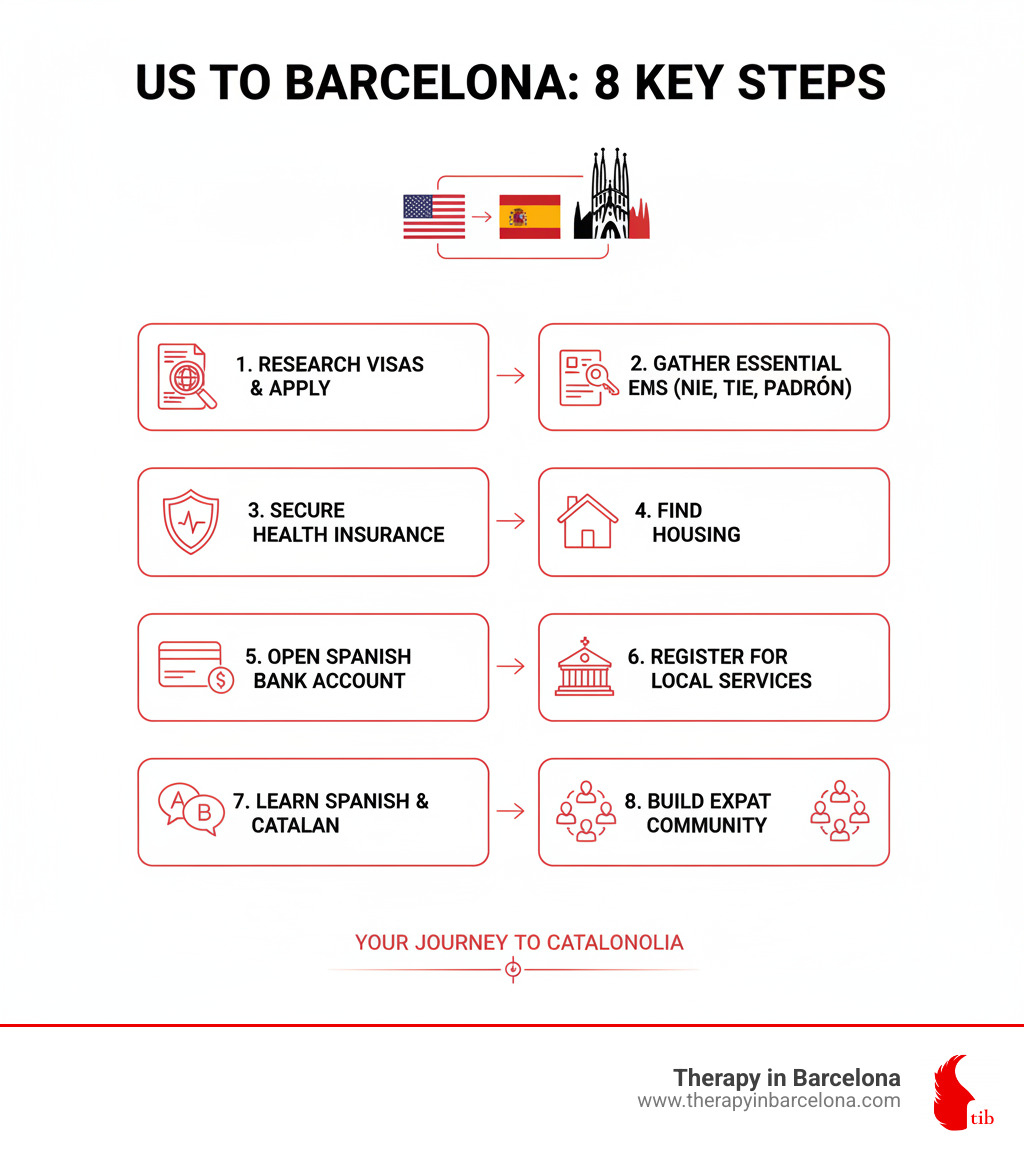
Your Step-by-Step Guide to Moving to Barcelona as an American
Once you’ve decided that moving to Barcelona as an American is right for you, the real work begins. The process involves careful planning and patience with bureaucracy. Here’s how to handle each essential step.
Securing Your Visa: Your Ticket to Spain
To stay in Spain for more than 90 days, you need a visa. The process can be slow, so start early. Many Americans consult an immigration lawyer or a relocation service like Moving to Spain for guidance.
- The Non-Lucrative Visa is for those with passive income who won’t work in Spain. For 2024, you need to prove a passive annual income of at least €28,800 (400% of Spain’s IPREM indicator), plus extra for each family member.
- The Digital Nomad Visa is for remote workers. You must earn at least €2,646 monthly (200% of Spain’s minimum wage for 2024) from a non-Spanish company and have a degree or three years of relevant experience. Freelancers can have Spanish clients, but this work can’t exceed 20% of your total business.
- A Student Visa allows you to stay for your studies and, with prior authorisation, work up to 30 hours per week.
- The Work Permit requires a job offer from a Spanish company that can prove no qualified EU resident is available for the role, making it more challenging to get.
For all visas, you’ll apply at a Spanish consulate in the US. Most require an in-person appointment, financial proof, and private health insurance.
Essential Paperwork for Americans Moving to Barcelona
After your visa, you’ll need to tackle Spain’s paperwork. Your NIE (Número de Identificación de Extranjero) is your foreigner ID number, and you’ll need it for basics like banking, signing a lease, and many official processes. You can learn more about the NIE and, in many cases, it’s smart to start the process through a Spanish consulate in the US before you arrive.
The TIE (Tarjeta de Identidad de Extranjero) is your physical residency card. You must apply for it within one month of arriving in Spain. Getting an appointment can be difficult, often requiring persistence.
Empadronamiento is registering your address at the local town hall. This is essential for accessing public services like healthcare and enrolling children in school. You’ll need proof of address, like a rental contract.
Many expats hire a gestor (an administrative consultant) for help. Official documents also require certified translations from a sworn translator, which services like Translayte can provide.
Understanding the Spanish Healthcare System
Spain’s public healthcare system is known for its quality and affordability. As a resident, you gain access through your empadronamiento and social security contributions. However, most visa applications require private health insurance from a Spanish provider. Companies like Innoinsure, Feather, and ASSSA specialise in policies for expats. For flexible travel and nomad insurance, SafetyWing is another option.
When choosing a private plan, you’ll find two types. Copago (co-payment) plans have lower monthly premiums but you pay a small fee per service. Sin copago (no co-payment) plans have higher premiums but all covered services are included. Many expats use a hybrid approach, relying on the public system for major issues and private insurance for faster access to specialists and English-speaking doctors.
Finding Your Feet: Housing, Neighbourhoods, and Getting Around
Once your legal paperwork is sorted, the next step is finding a home and learning your new city. This is where the excitement of moving to Barcelona truly begins, along with some practical challenges.
The Barcelona Housing Market: Renting vs. Buying
Barcelona’s housing market is competitive, with rising costs due to high demand and tourism. A small studio in a central area can easily cost over €1,000 per month. Rental scams are common, so always insist on a written contract, see the flat in person before paying a deposit, and create a paper trail for rent payments. Be aware that landlords have a reputation for not returning deposits, so document the flat’s condition thoroughly. Subletting is common but offers little legal protection.
Renting is sensible for newcomers. It allows you to explore different neighbourhoods before committing. For your search, use trusted platforms like Idealista or Fotocasa. For furnished, shorter-term stays, consider Spotahome or Flatio. Rent Remote specialises in flats set up for remote work.

Choosing Your ‘Barrio’: Best Neighbourhoods for Americans
Where you live will shape your daily experience. It’s worth taking time to find the right fit.
- Gràcia: A bohemian, village-like feel, popular with a younger, international crowd.
- Eixample: Central and busy, known for its grid layout and modernist architecture.
- El Born: A trendy, historic area with boutiques, bars, and a lively atmosphere.
- Poblenou: A modern, industrial-chic vibe near the beach, popular with digital nomads.
- Sants: A calmer, more traditional residential area with excellent transport links.
While historic, the Gothic Quarter and El Raval can be crowded with tourists and have safety concerns at night. Families may prefer quieter, more residential areas.
Navigating the City Like a Pro
Getting around Barcelona is easy and affordable. The public transport network, including the metro, buses, and trams, is excellent. A monthly TMB travel card (T-usual) currently costs around €22 for one zone due to government subsidies (source: TMB).
Barcelona’s Bicing bike-sharing system is a handy option for short trips around the city. If you buy your own bike, invest in a strong lock, since bike theft does happen. Barcelona is also very walkable, which is one of the best ways to discover small plazas, local shops, and quiet side streets.
For trips beyond the city, car hire is available (compare deals with DiscoverCars). High-speed trains connect you to other Spanish cities like Valencia and Madrid in under three hours, making weekend exploration easy.
From Tourist to Local: Embracing Barcelona’s Culture and Lifestyle
Settling into Barcelona means embracing a culture that operates on a completely different rhythm.
¡Hola! O… Bon Dia? Language in Barcelona
Barcelona has two official languages: Spanish (Castellano) and Catalan. You’ll hear Catalan everywhere, and learning a few phrases like “Bon dia” (good morning) shows respect. While you can get by with English in the city centre and international companies, learning Spanish is essential for true integration and handling daily life. Language exchange events (tandems) are a great way to practise, and apps like Mondly or tutors from Preply can give you a head start.
The Spanish Schedule and Social Norms
Get ready for a new schedule. Lunch is from 2 pm to 4 pm, and dinner doesn’t start until 9 pm or later. Nightlife kicks off around 1 or 2 am. Tipping is not obligatory; around 10% for excellent service is appreciated but not expected. Socialising happens in public spaces like parks and plazas, rather than in homes, especially early in a friendship. Family is central to Spanish life, and social circles can be close-knit, which can sometimes make it harder for newcomers to break in.

Building Your Community as an American in Barcelona
Barcelona has a large, diverse international community, making it easier to find like-minded people. You’ll likely make friends quickly among fellow expats, but building deep connections with locals can take more time. Meetup groups and expat Facebook communities are excellent resources for finding events and people with shared interests.
Be aware that the expat scene can be transient, which can be emotionally challenging. Beyond Barcelona, cities like Valencia, Málaga, and Madrid also have thriving international communities.
Safety, Scams, and Seeing the Real City
Barcelona is generally safe, but petty crime is an issue. Pickpocketing is common in tourist areas and on public transport. Keep your belongings secure. Theft of items valued under €400 is classified as a minor offence (delito leve) rather than a felony, but it is still a crime. Police response can be limited, so prevention is your best defence. Also, watch out for rental scams and misleading phone contracts. Avoid tourist traps on Las Ramblas, which are known for overpriced, low-quality food.
To experience the real Barcelona, venture beyond the obvious. Explore Gaudí’s masterpieces like Park Güell and La Sagrada Familia (for a great photo, visit the Sercotel Hotel Rosellon terrace). Relax on Barceloneta Beach and wander through local markets. The real city is in the side streets, neighbourhood bars, and plazas where locals gather.

Navigating the Expat Experience: Challenges and Finding Support
Moving to Barcelona as an American is an adventure, but it also comes with emotional challenges. Culture shock, homesickness, and isolation are common, even in a vibrant city.
The Emotional Side of Moving to Barcelona as an American
You might grapple with identity shifts, different social norms, and relationship strain—often called the “expat blues.” Many newcomers find that after the initial excitement fades, building deeper connections takes longer than expected. If that’s you, you’re not alone.
Finding the Right Support for You in Spain
When handling the challenges of expat life, finding the right mental health support is vital. You have several options.
The Spanish public health system offers mental health services, but you may face long waiting lists and language barriers. Large online therapy platforms offer convenience, but may lack therapists who understand the specific cultural context of living in Spain.
Therapy in Barcelona offers something different. We are a group practice of highly qualified, psychology-trained expat therapists who understand the international journey because we’ve lived it. Our founder, Leigh Matthews, an Australian Psychologist, established the practice in 2011 after her own move to the city and her struggle to find English-speaking support.
We provide culturally sensitive care in English and other languages. Unlike large platforms that may have questionable data privacy policies, we guarantee strict confidentiality and offer bespoke, personalised therapist matching to ensure you connect with someone who fits your needs.
We work with adults, couples, teens, and families, offering both online therapy (worldwide, including the USA and Canada) and in-person sessions at our office in Barcelona’s Eixample district. Our team uses a range of evidence-based approaches, including Cognitive Behavioural Therapy (CBT) and Acceptance and Commitment Therapy (ACT), to address issues like cultural adjustment and isolation. This is a private-pay service, and some therapists offer sliding scale fees.
If you’re finding the adjustment difficult, seeking support is a sign of strength. We are here to help. You can find more info about our therapy services here.

Frequently Asked Questions about Moving to Barcelona as an American
What is the biggest challenge for Americans moving to Barcelona?
The biggest challenges are often the slow Spanish bureaucracy (getting your NIE/TIE), adjusting to lower local salaries, and the language barrier. While English is spoken in international circles, daily life is much smoother with conversational Spanish. Learning some Catalan is also highly appreciated by locals.
Can I get by with only English in Barcelona?
Yes, you can manage with English, especially in the city centre and the expat community. Many international companies also operate in English. However, to truly integrate, handle administrative tasks, and build deeper connections with locals, learning at least conversational Spanish is highly recommended. It opens doors and makes Barcelona feel more like home.
How much money do I need to move to Barcelona?
This varies, but a good starting point is to have at least €5,000–€7,000 saved. This should cover initial costs like visa fees, your flight, a rental deposit (typically 2–3 months’ rent), the first month’s rent, and living expenses for the first couple of months.
If you’re applying for a visa like the Digital Nomad Visa, you’ll also need to meet specific income requirements, such as proving a monthly income of at least €2,646.
Your Next Step on the Journey to Barcelona
Moving to Barcelona as an American is a rewarding journey, but it requires preparation and a strong support system. Looking after your mental health is just as important as sorting out your paperwork. The emotional challenges of adjusting to a new culture are a normal part of the expat experience, and support from people who understand is readily available.
Our team of expat therapists at Therapy in Barcelona is here to help you with these unique challenges, offering culturally sensitive support in English. We understand because we’ve been there too.
Book a Free Discovery Call with our team of expat therapists today. We offer online therapy worldwide, including the USA and Canada, and in-person sessions in Barcelona.
