


Starting Fresh: What You Need to Know About How to Get Spanish Residency

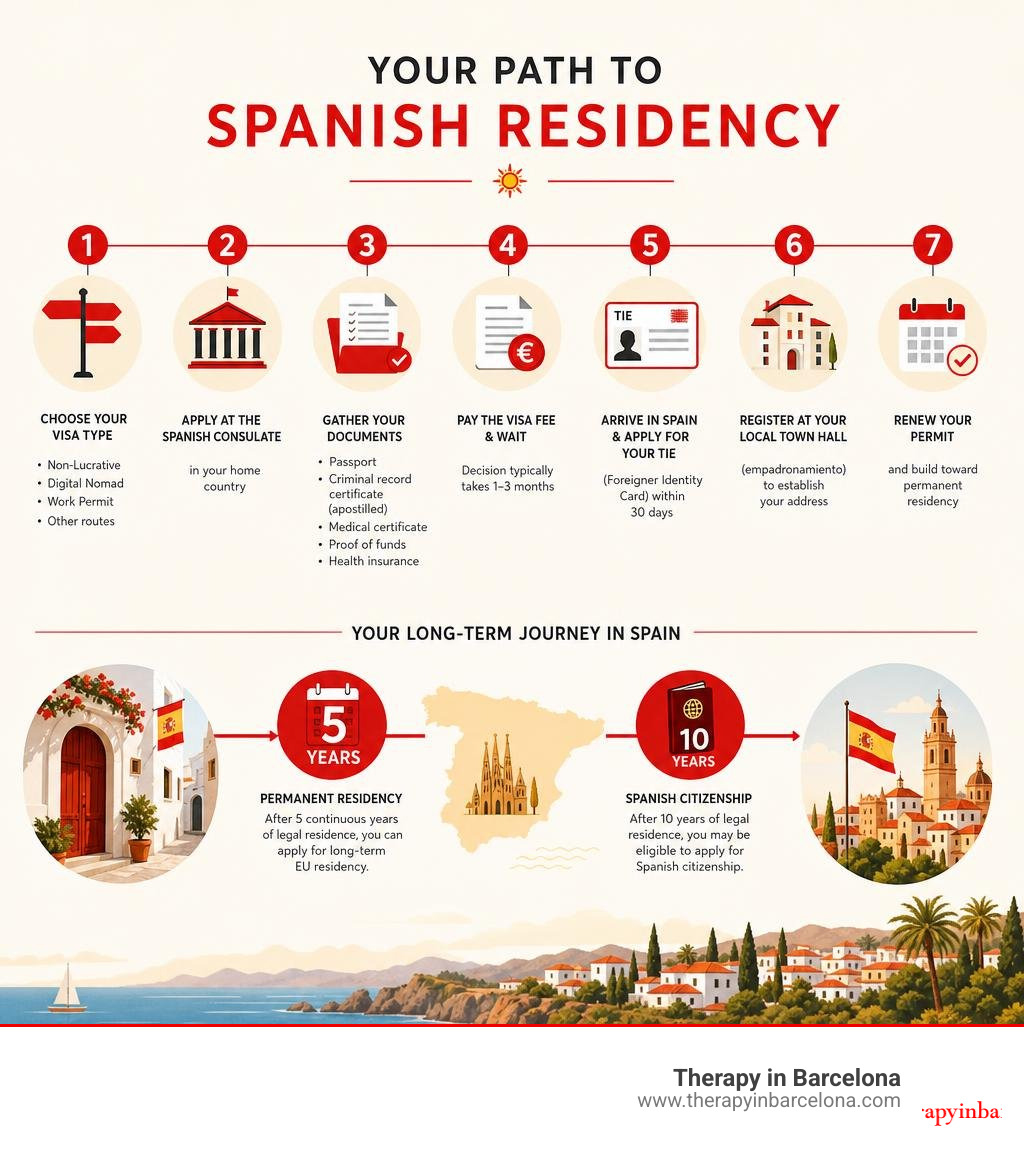
If you’re trying to figure out how to get Spanish residency, here is a quick overview of the main steps:
- Choose your visa type – Non-Lucrative, Digital Nomad, Work Permit, or another route based on your situation
- Apply at the Spanish consulate in your home country before you move
- Gather your documents – valid passport, criminal record certificate (apostilled), medical certificate, proof of funds, and Spanish health insurance
- Pay the visa fee and wait for a decision (typically 1-3 months)
- Arrive in Spain and apply for your TIE (Foreigner Identity Card) within 30 days of arrival
- Register with your local town hall (empadronamiento) to establish your address
- Renew your permit and build towards permanent residency after five continuous years
Spain issued over one million residence permits to non-EU citizens in 2023 alone — a 9.4% increase from the year before, according to official data from the Spanish Ministry of Migration. That number tells you something: thousands of people every year are making the same leap, working through the same paperwork, and building new lives in a country known for its food, climate, and quality of life.
Relocating to Spain is often about much more than booking a flight. For many internationals, navigating visa options, financial requirements, and complex paperwork can be one of the most stressful parts of the process. The uncertainty and administrative demands of an international move can feel overwhelming long before arrival.
This guide outlines the main residency pathways available to non-EU citizens in 2026, key requirements, and what to expect throughout the process. It also explores the emotional side of relocating and where to find support as you adjust to life in Spain.
The Main Pathways: How to Get Spanish Residency
Before packing your bags, you need to identify the pathway that fits your lifestyle, career, and financial situation. Spain offers several distinct routes for non-EU nationals to secure legal residency.
To help you get started on the right foot, it is highly recommended to read A practical guide to moving to Spain to map out your initial relocation logistics. You can also explore the official pathways outlined in the Spanish Residency: Get a Spain Residence Permit | IAS guide to understand the broader legal framework.
The Non-Lucrative Visa: A Popular Route for Retirees
The Non-Lucrative Visa (NLV) is designed for individuals who wish to reside in Spain without engaging in any work or professional activity. It is the premier option for retirees, early retirees, and those living off passive income streams like rental properties, investments, or pensions.
To qualify for this visa in 2026, you must prove you have sufficient financial means. Spain calculates this using the Public Multiple Effects Income Indicator (IPREM), as detailed by the Spanish Ministry of Foreign Affairs.
The main applicant must demonstrate a monthly income of 400% of the IPREM, which translates to €2,400 per month (or €28,800 annually). Each additional family member requires an extra 100% of the IPREM (€600 per month or €7,200 annually).
Crucially, this visa explicitly prohibits any form of employment or teleworking. If you are hoping to work remotely for a foreign company, this is not the visa for you.
Additionally, you must secure a private Spanish health insurance policy with full coverage and no co-payments. For a comprehensive breakdown of the application steps and requirements, refer to the Spain Non-Lucrative Visa 2026: Complete Guide for Retirees & Passive Income Holders — ALY Abogados.
The Digital Nomad Visa: Working Remotely in Spain
If you want to keep your job while enjoying the Spanish lifestyle, the Digital Nomad Visa (DNV) is a highly attractive option. Launched to accommodate the rise of remote work, this visa allows non-EU freelancers and remote employees to live in Spain legally.
To be eligible, you must work for companies located outside of Spain. Your income must come primarily from foreign entities, though freelancers are allowed to earn up to 20% of their income from Spanish clients.
Financially, you must prove a monthly income equal to at least 200% of the Spanish minimum wage (SMI). In 2026, with the minimum wage set at €1,221 per month according to the Spanish Ministry of Labour and Social Economy, the minimum income threshold for a single digital nomad is €2,442 per month.
The DNV offers a major advantage: a fast-track processing timeline of just 20 days when applied for directly from within Spain. For more details on how this remote work pathway operates, check out Spain’s digital nomad visa approved.
Other Options: Work Permits and the Golden Visa Transition
Securing a standard work permit as an employee of a Spanish company is another traditional route, though it remains highly competitive. The employer must prove that the position cannot be filled by a Spanish or EU citizen, unless the profession is on Spain’s shortage occupation list.
For those planning to invest, the landscape has shifted significantly. The popular Spanish Golden Visa programme, which granted residency in exchange for a €500,000 real estate investment, was discontinued on April 3, 2025, as announced on the official La Moncloa government portal. In 2026, investors looking for residency must pivot to other business-oriented pathways, such as the Entrepreneur Visa or the Highly Qualified Professional Visa.
If you are curious about how the investment landscape used to look and how it affects current expats, read The Golden Visa in Spain: A simple guide for 2024.
Step-by-Step Application and Long-Term Pathways
Once you have chosen your pathway, the administrative work begins. Managing the paperwork systematically is the key to preventing delays.

Preparing Your Documents and Getting Your TIE
The initial application for most temporary residence visas must be submitted at the Spanish consulate in your home country. To ensure you do not miss a single requirement, use Your ultimate moving to Spain checklist – don’t miss a step to organise your documents.
The standard document package includes:
- A national visa application form and fee payment.
- A valid passport with at least one year of validity remaining.
- An FBI or national criminal record certificate (no older than 3 to 6 months depending on the consulate), which must be apostilled and translated by a certified Spanish translator (traductor jurado).
- A medical certificate confirming you do not carry any diseases that pose a threat to public health.
- Proof of private Spanish health insurance with no co-payments.
- Proof of sufficient financial resources (bank statements, tax returns, or pension certificates).
After your visa is approved, you have a specific window to enter Spain. Within 30 days of your arrival, you must apply for your physical Foreigner Identity Card (TIE) at the local police station. This process requires you to register your address at the local town hall, a step known as empadronamiento.
To understand the differences between these acronyms and steps, consult NIE, TIE, CUE and Empadronamiento in Spain: Differences and conditions.
Transitioning to Permanent Residency after Five Years
After living in Spain continuously on temporary permits, you will reach a major milestone at the five-year mark. This is when you can apply for permanent residency (residencia de larga duración), which grants you the right to live and work in Spain indefinitely under the same conditions as Spanish citizens.
To qualify, you must demonstrate five years of continuous legal residence. According to the official Spanish Portal de Inmigración, you cannot be absent from Spain for more than 6 consecutive months, and your total absences across the five-year period must not exceed 10 months.
When you apply, you will submit Form EX-11 and pay a processing fee. For a detailed guide on how to navigate this five-year transition, refer to the Permanent Residency Spain: 5-Year Guide (2026).
The Pathway to Spanish Citizenship
For many expats, the ultimate goal is obtaining a Spanish passport. Generally, you can apply for Spanish citizenship after ten years of continuous legal residence. However, there are significant shortcuts based on your nationality:
- Two years: Nationals of Ibero-American countries, Andorra, the Philippines, Equatorial Guinea, Portugal, or individuals of Sephardic origin can apply after just two years of residence.
- One year: Anyone married to a Spanish citizen can apply after just one year of cohabitation.
To obtain citizenship, you must pass two exams administered by the Instituto Cervantes: the DELE A2 language exam (demonstrating basic Spanish proficiency) and the CCSE exam (testing your knowledge of Spanish history, culture, and the constitution).
Note that Spain generally requires citizens of most non-EU countries to formally renounce their original nationality upon acquiring Spanish citizenship, though enforcement and exceptions vary. To plan your long-term journey, read Spain Permanent Residency and Citizenship: The Complete 2026 Roadmap | JURO Spain.
The Emotional Side of Relocating to Spain
While securing Spanish residency can take up a significant amount of mental energy, the logistical move is only half the battle. The psychological shift of moving to a new country is often far more challenging than the paperwork.

Navigating the Challenges of Expat Life
Once the initial excitement fades, the reality of daily life sets in. Whether you move to a major city, a coastal town, or a cultural hub, you will likely experience the common psychological phases of relocation.
Expats frequently encounter language barriers, which can make simple tasks feel exhausting and lead to a sense of exclusion. Homesickness and isolation are incredibly common, especially when living far from established support networks of family and friends.
For couples, biculturalism and adapting to different family expectations can strain relationships. Many internationals also experience a subtle identity shift, feeling like they no longer fully belong in their home country, yet are not fully integrated into Spanish society either.
Finding Support: How to Get Spanish Residency and Maintain Your Well-being
It is completely normal to feel overwhelmed during this transition. Relocating is not just a change of address; it is a major life disruption. Taking care of your mental health is just as important as keeping your residency documents up to date.
If you find yourself feeling overwhelmed, unmotivated, persistently down, or experiencing a sense of feeling lost in your new home, seeking professional support can make a world of difference. Speaking with someone who understands the unique psychological footprint of the expat experience provides a safe space to process these complex emotions.
Choosing the Right Mental Health Support: How to Get Spanish Residency with Peace of Mind
When looking for therapy in Spain, you have a few different avenues to consider:
- The Public Healthcare System (Seguridad Social): While Spain has an excellent public healthcare system, accessing mental health support can involve long waiting times and a GP referral. Finding an English-speaking therapist through the public system can also be difficult.
- Large Online Directories and Corporate Platforms: These platforms are convenient but may lack local expat expertise, personalised matching, and clear data-privacy protections.
- Local Private Practices: Finding a local private practice that specialises in international life is often the most effective route.
This is where Therapy in Barcelona offers a distinct approach. Founded by Leigh Matthews, an Australian Psychologist and expat who relocated to Barcelona in 2011, the practice was born out of her own experience navigating an intercultural marriage and adapting to a new culture.
Unlike automated corporate platforms, Therapy in Barcelona prioritises a personalised matching process and guarantees strict privacy with absolutely no data selling. They do not simply assign you to the next available practitioner; they take the time to understand your unique background, goals, and struggles to connect you with the therapist who best fits your needs.
The collaborative team consists of highly qualified, psychology-trained therapists who are expats themselves. They understand the challenges of relocating, setting up a new life, and managing the emotional highs and lows of living abroad.
They provide culturally sensitive, private-pay therapy in English, as well as other languages like German, French, Spanish, Portuguese, and German dialects, ensuring you receive support in your native language.
Sessions are available in person at their central Eixample offices in Barcelona, or online for expats living across Spain—including Valencia, Madrid, Málaga, Alicante, and beyond—as well as worldwide. Please note that they do not provide crisis care; for emergencies in Spain, always call 112 or the national suicide prevention helpline at 024.
Frequently Asked Questions about Spanish Residency
Navigating the rules of Spanish immigration can raise many questions. Here are clear answers to some of the most common doubts.
What are the financial requirements for the Non-Lucrative Visa in 2026?
For 2026, the financial requirements are tied to Spain’s IPREM index, as published by the Spanish Ministry of Foreign Affairs. The main applicant must prove a minimum passive income of €2,400 per month (€28,800 per year).
For each additional family member included in the application, you must show an additional €600 per month (€7,200 per year). These funds must come from passive sources, such as investments, pensions, or rental income, and must be proven using official bank statements from the last three to twelve months.
Can I work on a Spanish Non-Lucrative Visa?
No. The Non-Lucrative Visa strictly prohibits any professional or work activity in Spain. This restriction includes working for local Spanish companies, starting a local business, and teleworking or working remotely for foreign employers. If you intend to work while living in Spain, you should apply for the Digital Nomad Visa or a standard work permit instead.
How long does the Spanish residency application process take?
The timeline varies by visa type and consulate. Generally, the initial visa application at a Spanish consulate takes between 1 and 3 months to process. Once you arrive in Spain, booking your appointment for the TIE card and waiting for the physical card to be printed can take an additional 1 to 2 months.
For the Digital Nomad Visa, applications submitted directly from within Spain benefit from a fast-track resolution period of 20 working days.
Moving Forward with Confidence
Securing residency in Spain takes patience, organisation, and a clear understanding of your options. Whatever pathway you choose, taking the process one step at a time can make it more manageable.
But establishing your physical home is only the first part of settling in. Building an emotional home, adapting to a new culture, and maintaining your mental well-being are just as vital to your success abroad.
If you are adjusting to this transition and would like professional, culturally sensitive support from a team that truly understands the expat experience, the team at Therapy in Barcelona is here to help. You can easily book a Free Discovery Call today to get matched with a therapist who can support you on your journey.
