


What FWB and NSA Actually Mean (And Why It Matters)

If you’ve ever come across FWB NSA meaning in a dating profile and felt like you were decoding a foreign language, you’re far from alone. Here’s the short version:
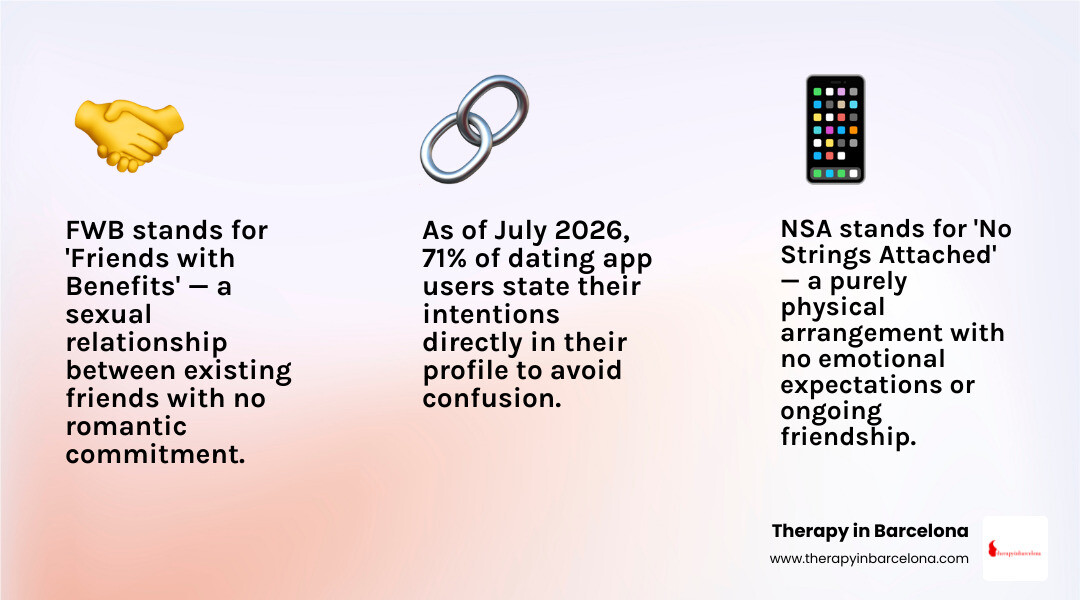
- FWB (Friends with Benefits) — two people who share an existing friendship and a physical relationship, without romantic commitment
- NSA (No Strings Attached) — a purely physical arrangement with no emotional expectations, no ongoing friendship required, and no obligation to follow up
Those two definitions look similar on the surface. In practice, they describe quite different experiences — and mixing them up is one of the fastest ways to end up hurt, confused, or ghosted.
Modern dating has developed its own shorthand, and acronyms like FWB and NSA are now standard vocabulary on apps, in texts, and across social media.
As of July 2026, 71% of dating app users state their intentions directly in their profile, according to Bumble’s annual dating trends report — a sign that people are getting more deliberate about naming what they want before things get complicated.
But clarity isn’t always easy, especially if you’re dating in a new city, a new country, or a new life chapter. For expats in Barcelona, Valencia, Madrid, or anywhere else in Spain, these terms carry extra weight.
When you’re already dealing with cultural differences and a new social environment, an undefined situationship can quietly take a real toll on your mental health.
This guide breaks down exactly what FWB and NSA mean, how they differ, who tends to choose them, and what to do when the emotional lines start to blur.
Decoding the Acronyms: What Do FWB and NSA Stand For?
To understand how to manage these dynamics, we need to look past the abbreviations and examine what these arrangements actually look like in daily life.
The term “Friends with Benefits” has deep roots in modern relationship culture, even being popularised in the late 1990s by pop culture references. According to the Wikipedia on Friends with Benefits entry, it describes an arrangement where two people who have a platonic friendship decide to add a sexual component to their dynamic.
The key word here is friends. There is a baseline of mutual respect, shared social circles, or at least a genuine liking of each other as human beings outside the bedroom.
On the other hand, “No Strings Attached” has a very different focus. As outlined in the guide What is NSA Dating? No Strings Attached Meaning, Rules, an NSA arrangement is strictly physical.
It is designed to strip away the emotional labour, late-night deep chats, and social expectations of dating. In an NSA setup, there is no pre-existing friendship to protect, and communication between meetups is usually minimal or entirely optional.
When you look closely at the FWB Meaning | What It Really Means & How to Use It (With Real Examples), the distinction becomes clear: FWB requires some level of emotional safety and ongoing connection, while NSA prioritises convenience, physical satisfaction, and personal autonomy.
Understanding the FWB NSA Meaning on Dating Apps
On modern dating apps, these acronyms act as a digital shorthand to filter out incompatible matches quickly. Mainstream platforms often oversimplify relationship intents into rigid binaries like “serious” or “casual.” This is why users have taken matters into their own hands, using terms like “FWB” or “NSA” to negotiate precise boundaries without formal commitment.
If you are looking for a casual connection, being specific pays off. Data from 2026 published in Tinder’s Future of Dating Report shows that dating profiles with explicit intent tags get 3.4 times more replies than profiles that stay vague. Stating your preferences directly prevents the awkward “What are we?” conversation later on.
However, as highlighted in the article NSA? FWB? BFF? We Need a New Lexicon for Modern Dating, our shared relationship vocabulary is still struggling to keep up with how people actually connect.
When someone writes “looking for NSA” or “FWB only,” they might mean something slightly different than you do. For some, a “friend with benefits” is just a polite term for a late-night booty call. For others, it means a trusted companion they regularly go to the cinema with before heading home together.
This is why understanding the NSA vs FWB vs Hookup: The Real Differences in 2026 distinction is so important. Without explicit communication, you risk entering an arrangement where one person expects a warm, friendly connection and the other expects a transactional, highly private encounter.
FWB NSA Meaning: The Core Differences Explained
To help you decide which arrangement aligns with your current emotional bandwidth, let us break down the behavioural boundaries that separate them.
The Emotional Investment
In an FWB dynamic, there is a moderate level of emotional investment. You care about the other person’s well-being, ask how their week was, and offer a listening ear. In an NSA dynamic, emotional investment is close to zero. The connection is built entirely on physical attraction and mutual consent, with no expectation of emotional support.
The Cuddle Factor and Sleepovers
What happens after the physical intimacy is a major differentiator. FWB arrangements often involve cuddling, pillow talk, and sometimes staying the night. In an NSA setup, sleepovers are rare. Once the encounter is over, one person usually calls an Uber. The focus is on physical satisfaction, not post-sex bonding.
Exclusivity
While neither arrangement involves romantic exclusivity, FWB partners sometimes agree to be “exclusive FWBs” to protect their sexual health while avoiding romantic commitment. In contrast, NSA arrangements are almost never exclusive; both parties maintain complete autonomy to play the field as they please.
Longevity and Consistency
FWB relationships can last for months or even years because they are anchored by a genuine friendship. They can also transition back to a platonic friendship when the physical aspect ends. NSA arrangements tend to be shorter-lived, highly spontaneous, and can end abruptly without any social fallout.

To explore these differences further, the NSA vs FWB: Which Casual Relationship Fits You? (2026 Guide) offers excellent practical scenarios on how these boundaries play out in real-world dating.
Who Chooses Casual Arrangements and Why?
Casual relationships are no longer just a phase for university students. In 2026, the fastest-growing demographic for NSA dating is actually adults aged 35 to 55, as highlighted in demographic studies by the Pew Research Centre.
This group often includes busy professionals, single parents, or individuals transitioning out of long-term marriages who want physical intimacy but do not have the time or emotional energy to restructure their lives around a new partner.
These dynamics are also incredibly common within international communities. When people move to vibrant Spanish cities like Valencia, Madrid, or Málaga, they often face unique expat dating challenges. Adjusting to a new culture, building a career, and settling into a new lifestyle can be exhausting, leaving little room for a high-maintenance romantic relationship.
Consider a fictional composite example of a 34-year-old software engineer from the UK who recently relocated to Valencia. In the first few months abroad, they felt deeply lonely and wanted companionship, but a demanding job and learning Spanish made traditional dating difficult.
A Friends with Benefits arrangement with a fellow expat provided trusted companionship, a reliable physical connection, and the freedom to focus on cultural adjustment without the pressure of building a long-term relationship.
Navigating the Emotional Risks of Casual Connections
While casual arrangements offer freedom and fun, they are not without emotional challenges. The human brain is wired for connection, and sometimes biology overrides our logical agreements.
During physical intimacy, the body releases oxytocin—often called the “cuddle hormone”—which naturally promotes bonding, trust, and emotional attachment. This means you can enter an NSA arrangement with the firmest intentions of keeping things casual, only to find yourself catching feelings after a few encounters.
Your personal relationship style also plays a massive role in how you handle these dynamics. If you tend to feel anxious or insecure when connecting with others, undefined boundaries can trigger deep feelings of worry, leaving you hyper-focused on response times or worrying about rejection.
If you are considering or currently in this type of arrangement, reading about FWB Uncovered: What Friends with Benefits Means for You can help you reflect on your emotional readiness. Additionally, exploring Friends with Benefits: The Good, the Bad, and the Beneficiary offers valuable insights into balancing your physical desires with your psychological well-being.
Why Knowing the FWB NSA Meaning Prevents Emotional Distress
Understanding the specific boundaries of these terms is not just about dating app etiquette; it is a form of emotional self-defence. When you clearly define the rules of engagement from the start, you protect yourself from mismatched expectations.
Entering a casual arrangement requires high levels of self-awareness and assertiveness. You must be able to state your needs clearly, ask for what you want, and—most importantly—say “no” when a boundary is crossed.
If you struggle to speak up or find yourself agreeing to casual setups because you hope the other person will eventually change their mind, it might be worth exploring how you establish boundaries. Learning about setting healthy boundaries in therapy can provide you with the tools to handle these conversations. Cultivating assertiveness in relationships empowers you to express your true feelings without fear of conflict or rejection.
Frequently Asked Questions about Casual Dating
Can an FWB or NSA arrangement turn into a committed relationship?
Yes, but the odds depend heavily on the format. Statistics from research published in the Journal of Sex Research show that roughly 23% of casual arrangements overall evolve into committed relationships within six months.
However, FWB setups are much more likely to transition into romance than NSA arrangements. Because FWB involves an existing friendship, shared social circles, and emotional closeness, the foundation for a relationship is already there.
NSA arrangements, which have minimal ongoing contact and very little “time-on-task” outside of physical encounters, rarely transition into committed partnerships.
How do FWB and NSA compare to situationships or booty calls?
Modern dating exists on a broad spectrum. Here is how these terms compare:
- Booty Call: A recurring, strictly physical encounter between acquaintances. Unlike FWB, there is no active, platonic friendship. Unlike NSA, it is often spontaneous and lacks clear, pre-negotiated boundaries.
- Situationship: An undefined romantic relationship without clear labels or expectations. This often leads to confusion, emotional uncertainty, and unmet expectations.
- Hookup: A single, one-off physical encounter (like a one-night stand) with no expectation of future contact.
What should I do if I catch feelings in a casual relationship?
If you find yourself checking their social media constantly, feeling jealous, or wanting more of their time, you need to pause and reflect.
Be honest with yourself first: are these genuine romantic feelings, or is it a temporary rush of dopamine and oxytocin? If the feelings persist, you must communicate them directly to your partner in a non-sexual setting.
If they share your feelings, you can discuss transitioning into dating. If they do not, the healthiest step is to end the arrangement immediately. Lingering in a casual setup hoping someone will eventually fall in love with you is a recipe for resentment and heartbreak.
If you find yourself struggling to process these feelings or let go of a connection, speaking with a professional who specialises in sex therapy or relationship counselling can help you find clarity and heal.
Finding a Path That Works for You
Exploring the casual dating scene as an expat in Spain can be an exciting journey of self-discovery, but it can also bring unexpected emotional challenges, loneliness, and confusion.
If you are finding it difficult to set boundaries, coping with the emotional fallout of an undefined relationship, or struggling to connect in a new country, you do not have to figure it out alone. While some people look to public health systems or large online platforms, these options often lack the specialised, culturally sensitive care that internationals need.
At Therapy in Barcelona, we provide a private-pay, highly personalised alternative. Unlike large online platforms or public systems, we guarantee strict privacy with absolutely no data selling, offer bespoke therapist matching to ensure you find the right fit, and provide culturally sensitive support in your native language.
Founded in 2011 by Leigh Matthews—an Australian Psychologist and expat who has spent over 14 years supporting the international community in Spain—our practice is dedicated to helping expats, digital nomads, and international students thrive.
Our team of psychology-trained therapists understands the unique challenges of living abroad firsthand. We offer multilingual therapy both online worldwide and in-person at our central office in Barcelona’s Eixample district.
We take the time to carefully match you with the right therapist to ensure you get the exact support, warmth, and evidence-based strategies you need.
If you would like support in managing your relationships, building self-esteem, or finding your footing abroad, Book a Free Discovery Call with us today.

