


Why Intimacy Matters More Than You Think

Intimacy exercises are structured activities designed to help couples build deeper emotional, physical, and spiritual connections. Here are some effective exercises you can start today:
Quick intimacy exercises to try:
- Eye gazing – Look into each other’s eyes for 3-5 minutes without talking.
- Six-second kiss – Hold a kiss for at least six seconds daily.
- Weekly relationship check-ins – Discuss what’s working and what needs attention.
- Gratitude sharing – Express appreciation for small, daily actions.
- Mindful touch – Non-sexual touching focused on sensation and connection.
When Emily, a composite character representing the experiences of many expats, moved to Barcelona three years ago, she thought the hardest part would be learning Catalan. But as the initial excitement faded, she realised the daily pressures of a new culture, language, and work were eroding the spark in her relationship.
Sound familiar? You’re not alone.
Living abroad amplifies relationship challenges. When you’re both dealing with cultural adjustment, homesickness, and the mental load of constant adaptation, intimacy is often the first casualty. Research shows that a significant number of adults struggle with intimacy avoidance, and for expats, this can be even more pronounced.
But here’s the thing: intimacy isn’t just about sex or grand romantic gestures. It’s about feeling truly seen, heard, and connected to your partner. It’s the foundation that helps couples weather life’s storms—including the unique pressures of building a life in a foreign country.
The good news? Small, intentional actions can rebuild that connection. Whether you’ve been together for two years or twenty, these evidence-based exercises can help you find each other again and strengthen your bond.
Understanding the Foundations of Intimacy
Couples often chase grand gestures to reconnect, but true intimacy is built in the small, daily moments of emotional and physical closeness. It’s woven together through countless small interactions that make you feel truly seen by your partner.
Why does intimacy matter so much? Research consistently shows that couples with higher levels of intimacy experience greater relationship satisfaction, reduced symptoms of depression and anxiety, and better conflict resolution skills. When you feel connected, you’re not just happier together—you’re better equipped to handle life’s challenges.
For expats in Barcelona, these challenges can feel particularly intense. Between navigating visa stress, homesickness, and the mental load of living in a foreign language, intimacy often suffers.
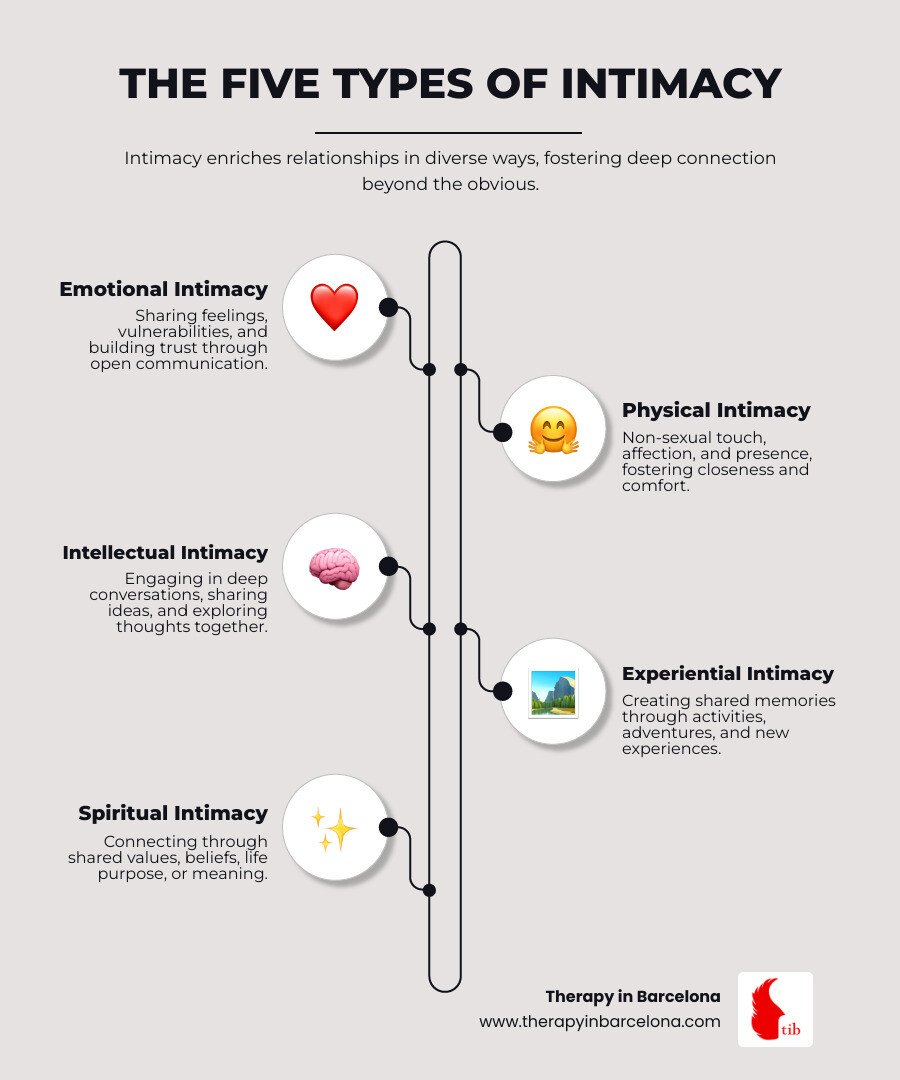
Understanding intimacy means recognising its different dimensions.
- Emotional intimacy is about trusting your partner with your deepest fears and joys without fear of judgement.
- Physical intimacy encompasses everything from holding hands during a walk through Gràcia to sexual connection, all centred around touch and presence.
- Intellectual intimacy develops through sharing thoughts and perspectives.
- Experiential intimacy blooms through shared activities, like learning to make paella together.
- Spiritual intimacy connects you on shared values and beliefs.
Many couples struggle with what psychologists call intimacy avoidance, a challenge that can be heightened for expats. This fear often stems from past experiences, like an avoidant attachment style or relationship betrayals. It can manifest as difficulty trusting, avoiding closeness, or keeping conversations on a surface level.
Another barrier is communication breakdown. When partners can’t articulate their needs, misunderstandings multiply, leading to anger and distance. For expat couples, language barriers can compound this, leaving you feeling isolated even within your relationship.
The good news? Intimacy exercises offer a structured way to rebuild these connections. They create safe spaces to explore desires and provide a roadmap for couples who want to reconnect but aren’t sure where to start.
Vulnerability is the cornerstone of intimacy. It’s about letting your partner witness the real you—your insecurities about not speaking perfect Spanish, your homesickness, or your fears about whether this expat trip will work out. This willingness to be vulnerable doesn’t happen overnight. For deep-seated fears, professional support can provide the safety needed to explore these patterns. Our guide on couples communication therapy offers strategies for fostering clearer dialogue.
If you recognise patterns of intimacy avoidance, awareness is the first step. Building intimacy is a practice—one that requires patience, consistency, and courage.
Emotional and Communication Exercises to Deepen Your Bond

Emotional intimacy and effective communication are the bedrock of a thriving relationship. When you feel heard, understood, and safe, your bond deepens. These intimacy exercises focus on fostering vulnerability and building trust.
Mindfulness—being fully present in the moment without judgement—is key. True intimacy happens in these real-time interactions, free from distractions like phones or racing thoughts. Vulnerability is also crucial. It’s the courageous act of revealing your inner self, your fears and desires. This personal disclosure is essential for feeling truly connected.
Here are some communication exercises to try:
The Relationship Check-In
Inspired by the renowned Gottman Method, this weekly ritual helps couples proactively manage their relationship health. Start by celebrating what’s working and what you’ve appreciated about your partner. This reinforces positive behaviours. Then, move to “growth opportunities”—areas needing attention. This isn’t about blame; it’s about collaboratively identifying challenges and creating actionable steps. This fosters a team mentality and ensures both partners feel heard.
Asking Deeper Questions
Beyond daily logistics, cultivating intellectual intimacy means diving into each other’s inner worlds. People change, so staying curious is vital for emotional intimacy.
Use question prompts to spark deeper conversations. For instance, ask:
- “What two things do you hope we do together that we haven’t tried?”
- “What two things are you most insecure about?”
- “What two things do you want to do together this week?”
These questions invite personal disclosure, helping you feel seen, heard, and understood. Research shows that without this kind of sharing, people can still feel lonely, highlighting the importance of these candid exchanges.
Gratitude and Appreciation Rituals
Expressing gratitude is a simple yet profound way to strengthen your bond. In long-term relationships, it’s easy to stop appreciating each other, leading to feelings of being taken for granted.
Make it a habit to say “Thank You” for small gestures. Leave little love notes or send appreciative texts. The Gottman Institute’s Fondness & Admiration system encourages couples to actively vocalise their appreciation. What you focus on expands; orienting towards your partner with gratitude fosters closeness and creates a more positive relational environment.
For more insights, read about Building a culture of appreciation.
Powerful Physical Intimacy Exercises to Reconnect

Physical touch is a fundamental way of connecting. When life gets overwhelming, especially for couples navigating expat life, physical connection can become an afterthought. Yet non-sexual touch can be just as powerful as sexual intimacy in rebuilding your bond.
The science behind touch is remarkable. A simple hug reduces stress hormones like cortisol while releasing oxytocin (the “bonding hormone”) and boosting serotonin. These chemical changes promote feelings of happiness and connection. A German study from the 1980s even found that men who kissed their wives goodbye before work lived longer and earned more. While we can’t promise these results, the message is clear: physical affection matters.
The key to these intimacy exercises is presence. When you’re holding your partner, be fully there. Notice the warmth of their skin and the rhythm of their breathing. This mindful awareness transforms simple gestures into profound moments of connection.
Mindful Touch: A Foundational Intimacy Exercise
One of the most transformative physical exercises is Sensate Focus, developed by researchers Masters and Johnson. It removes all pressure around sexual performance and instead focuses purely on exploration and sensation.
Take turns being the “giver” and “receiver.” The giver explores their partner’s body with non-sexual touch (stroking arms, back, legs), focusing on what different touches feel like. The receiver’s job is to simply notice the sensations and communicate preferences (“That feels lovely,” or “Could you try lighter pressure?”). This non-goal-oriented approach helps reduce anxiety, clarify boundaries, and build physical trust. It’s particularly helpful for couples who feel pressure around sexual intimacy.
For more ideas, explore our guide on Why At-Home Couples Therapy Ideas Can Transform Your Relationship.
The Six-Second Kiss: A Simple Daily Intimacy Exercise
Relationship expert John Gottman introduced one of the simplest intimacy exercises: the six-second kiss. This isn’t a quick peck but a deliberate, passionate kiss that lasts a full six seconds. It’s long enough to feel meaningful and create a genuine moment of connection. During those six seconds, you’re pausing your day, releasing bonding hormones, and reaffirming your commitment.
Try incorporating this into your daily routine. It becomes a mini-ritual that consistently reminds you both that your relationship is a priority. For more on how kissing benefits relationships, check out this Study on the benefits of kissing.
Eye Gazing (Soul Gazing)
Perhaps no exercise feels as vulnerable—or as powerful—as eye gazing. This practice involves looking into each other’s eyes for several minutes without speaking.
To practise this, sit comfortably facing each other and set a timer for 3-5 minutes. To keep your gaze steady, focus on your partner’s left eye. Try to synchronise your breathing, with one partner setting a rhythm for the other to match. You’re not trying to solve problems, just being present and allowing yourselves to be seen. The vulnerability you feel is the gateway to deeper connection. Many couples find eye gazing helps them feel more emotionally connected, and the shared breathing can have a calming effect on your nervous systems.
Experiential and Playful Exercises to Reignite the Spark

Consider Sarah and Marcus, a fictional couple whose story reflects a common expat experience. When they first moved to Barcelona, their life was an trip. But soon, the pressures of bureaucracy and cultural adaptation settled their relationship into a predictable routine of Netflix and takeaway.
Sound familiar? Long-term relationships, especially under the pressures of expat life, can lose the sense of novelty and exploration that once made your hearts race. The good news is that shared activities and new experiences can breathe fresh life into your connection.
As relationship therapist Esther Perel discusses, desire thrives on a balance between familiarity and mystery. Too much routine can dim the spark. These intimacy exercises help you lean into trip, creating new memories and reminding you why you fell in love. They’re about breaking routines and stepping outside your comfort zone together.
Plan a “Novelty” Date
Recapture that feeling of trip by deliberately seeking out new experiences. A “novelty” date is about stepping outside your usual routine and trying something completely fresh.
This could be a cooking class in Barcelona, a flamenco lesson in Madrid, or a spontaneous weekend trip to Valencia. The key is novelty—doing something new together. Taking turns planning these dates adds an element of surprise and anticipation that can be powerful for reigniting desire. This shared sense of trip creates fresh memories and gives you new things to talk about, fostering the shared exploration that relationships crave.
For more ideas, check out Love in Action: Activities to Do as a Couple.
Explore Desires and Fantasies Safely
One of the most powerful intimacy exercises involves improving sexual communication by creating a safe space to share desires. For many couples, sexual intimacy can become routine or fade under stress.
Creating a judgement-free zone is essential. The goal isn’t to act on every fantasy, but to deepen understanding. Start by individually reflecting on your desires. Then, create a comfortable space to share. Set ground rules: no interruptions, no judgement, and understanding that sharing isn’t the same as consent to act.
This exercise allows partners to discuss boundaries while exploring their desires. You might find interests you never knew your partner had. Using card decks or prompts for couples can make these conversations feel less intimidating and more like a fun exploration.
The Gottman Institute offers excellent resources for this, including their Enriching Your Sex Life materials. The power of this exercise lies in the vulnerability and trust required to share. When you can speak openly about your desires, you create a deeper intimacy that extends far beyond the bedroom.
When to Seek Professional Support
While these intimacy exercises are powerful, sometimes couples need professional guidance to break through deeper barriers. If you feel stuck in patterns that seem impossible to shift on your own, it may be time to seek help.
Signs include persistent disconnection, communication gridlock where arguments go in circles, or stonewalling, where one partner emotionally withdraws. If these exercises consistently feel too difficult or lead to more conflict, it may indicate underlying issues. Resistance to intimacy can be rooted in fear from past trauma or attachment wounds that are best steerd with a skilled therapist.
Similarly, unresolved sexual concerns benefit from professional guidance. A qualified sex therapist provides a safe, non-judgemental space to explore these topics.
As one client said: “Me and my partner manage to stop a loop of being angry between each other due to bad communication. Our therapist made the right questions… ending up in active listening and more understanding in our relationship.”
For expats, the challenges run deeper. Cultural adjustment, isolation, and the mental load of living abroad add significant stress. While large online platforms or the public health system are options, they often lack the nuanced, culturally sensitive support that expats need. Founded by Leigh Matthews, an Australian psychologist and expat herself, Therapy in Barcelona was created specifically to provide this kind of personalised care. Our team comprises qualified professionals who are also expats and understand these unique pressures firsthand.
Seeking therapy is a sign of strength. It’s an investment in your relationship’s health. A skilled couples counsellor can help you identify patterns, teach effective communication, and guide you through difficult conversations in a safe environment.
For more insights, explore The Art of Healing: How Couples Therapy Works. Our multilingual services are available in-person at our central Eixample office and online, custom for the international community in Barcelona and beyond.
Frequently Asked Questions about Intimacy Exercises
How often should we do intimacy exercises?
The secret is consistency over intensity. Think of it like learning a language: ten minutes daily is more effective than cramming once a month. Start small, like a 6-second kiss every morning or five minutes of eye gazing once a week. The goal is to weave connection naturally into your everyday lives.
Listen to your relationship’s rhythm. Some couples thrive with daily rituals, while others prefer weekly check-ins and occasional novelty dates. The aim isn’t to tick boxes, but to make intimacy feel essential and effortless.
What if my partner is hesitant to try these exercises?
It’s normal for a partner to be reluctant. Intimacy exercises can feel intimidating because they require vulnerability. Start with a gentle, honest conversation. Frame it with your hopes, not frustrations. Try saying, “I miss feeling close and would love to try something to help us reconnect.”
Explain your “why” and choose low-pressure activities first. Eye gazing might feel too intense, but sharing three things you appreciate about each other is less daunting. Lead with your own vulnerability by acknowledging any awkwardness: “This might feel a bit silly at first, but I’m willing to try if you are.” Framing it as an experiment rather than serious work can help you both relax.
Can intimacy exercises help if we’re in a long-distance relationship?
Absolutely. Intimacy exercises can be beautifully adapted for long-distance relationships. In fact, couples separated by distance often develop stronger communication skills out of necessity.
Virtual intimacy becomes an art form. Schedule video calls for eye gazing. Cook the same meal together over video, or watch a film simultaneously while texting. These shared experiences create the experiential intimacy that strengthens your bond.
Technology is your intimacy toolkit. Send voice messages, share photos, or write descriptive texts. Deeper questions become lifelines for staying connected to each other’s evolving thoughts and dreams. Long-distance relationships, while challenging, can deepen your capacity for intimate communication that will serve you well when you’re reunited. The key is consistency and creativity.
Conclusion
Intimacy exercises are not magic fixes but gentle invitations to reconnect. Intimacy is a living practice, built through small, consistent moments: a lingering kiss that releases bonding hormones, a weekly check-in that prevents resentment, or mindful touch that reminds you you’re partners, not just roommates. This journey of reconnection is especially meaningful for couples navigating life abroad.
Some days, the exercises will feel natural; other days, they might feel awkward. That’s perfectly normal. Intimacy requires vulnerability, and vulnerability often feels uncomfortable at first. The couples who thrive are the ones who lean into the discomfort together, knowing that deeper connection lies on the other side.
For couples navigating life’s complexities, especially the unique pressures of living abroad, professional guidance can provide a safe space to rebuild your bond. At Therapy in Barcelona, our team of psychology-trained therapists—many of whom are expats themselves—understand the delicate balance of maintaining intimacy while adapting to a new culture.
Whether you’re struggling with communication, feeling disconnected, or simply wanting to deepen your connection, culturally sensitive support can make all the difference. We offer both in-person sessions at our Eixample office and online therapy for internationals worldwide.
Your relationship deserves this investment. If you’re ready to explore how professional support can improve your intimacy and help you thrive as a couple abroad, we invite you to take the first step. Explore our couples counselling services in Barcelona and book a free discovery call today. Because sometimes, the most intimate thing you can do is ask for help—together.
Understanding the Legal Landscape:
Before delving into the practical steps, it is crucial to familiarise yourself with the legal framework governing divorce in Spain. Spanish law recognises both mutual consent divorce (divorcio de mutuo acuerdo) and contentious divorce (divorcio contencioso). Mutual consent divorce typically involves an amicable agreement between both parties, while contentious divorce entails more conflict and requires litigation.
Engage Professional Guidance:
As an expat, it is essential to seek professional guidance to understand the legal implications specific to your situation. Hiring an experienced family lawyer who specializes in international divorce cases can help you navigate the Spanish legal system effectively. They can guide you through the paperwork, ensure your rights are protected, and provide valuable advice on the division of assets, child custody matters, and alimony.
Consider Mediation:
Mediation can be an excellent alternative to a lengthy court battle, particularly if both parties are willing to cooperate. Mediation involves working with a neutral third party, facilitating open communication and negotiation to reach mutually agreeable terms. This approach can help minimise conflict, maintain a more amicable relationship, and potentially reduce legal costs.
Protect Your Rights and Assets:
During the divorce process, it is crucial to safeguard your rights and financial interests. Gather all relevant financial documentation, including bank statements, tax returns, property deeds, and investment portfolios. If you suspect hidden assets or non-compliance, inform your lawyer, who can take appropriate legal action to ensure a fair division of assets.
Child Custody Considerations:
If children are involved, the well-being and best interests of the child should be the primary focus. Spanish law emphasises joint custody, aiming to ensure both parents have equal involvement in their children’s lives. To avoid unnecessary conflict, work towards a parenting plan that considers the children’s routines, education, and extracurricular activities. Maintaining open lines of communication and a child-centred approach will be vital in reaching a satisfactory arrangement.
Navigating Language Barriers:
Language barriers can complicate the divorce process for expats in Spain. While English is commonly spoken in larger cities, legal proceedings may be conducted in Spanish. Ensure you have a competent translator or interpreter available during meetings with lawyers, court appearances, and other legal proceedings. This will help you fully comprehend the details of your case and make informed decisions.
Seek Emotional Support:
Divorce can be emotionally challenging, and it’s essential to prioritise your mental well-being throughout the process. Reach out to friends, family, or support groups for emotional support. Consider seeking professional counselling or therapy to help navigate the emotional complexities associated with divorce. Therapy in Barcelona can help. Expatriate communities or online forums can provide a safe space to connect with others who have experienced similar situations.
Embrace Life Changes:
Divorce brings significant life changes, and as an expat, you may face additional adjustments. Embrace the opportunity to reinvent yourself, explore new interests, and build a supportive network. Engaging in social activities, joining local clubs or organisations, and seeking out professional opportunities can help facilitate a positive transition.
Divorce is a challenging experience, but with careful planning, professional guidance, and emotional support, expats in Spain can effectively manage the process.
By understanding the legal landscape, engaging legal professionals, considering mediation, protecting rights and assets, prioritising child custody considerations, overcoming language barriers, and seeking therapy to support emotional and mental well-being, expats can navigate the complexities of divorce in Spain with greater ease and resilience.
Remember to prioritise open communication, cooperation, and the best interests of any children involved. While the process may be difficult at times, it also presents an opportunity for personal growth and new beginnings.
Embrace the changes, lean on your support network, and take advantage of the resources available to you. With time, patience, and self-care, you can emerge from this chapter of your life stronger and ready to embrace the future with optimism.
