


Why Active Listening Transforms Couples Therapy

Active listening is a powerful approach that goes beyond simply hearing your partner’s words. It’s about fully understanding their emotions, needs, and perspective to create deeper connection and resolve conflicts more effectively.
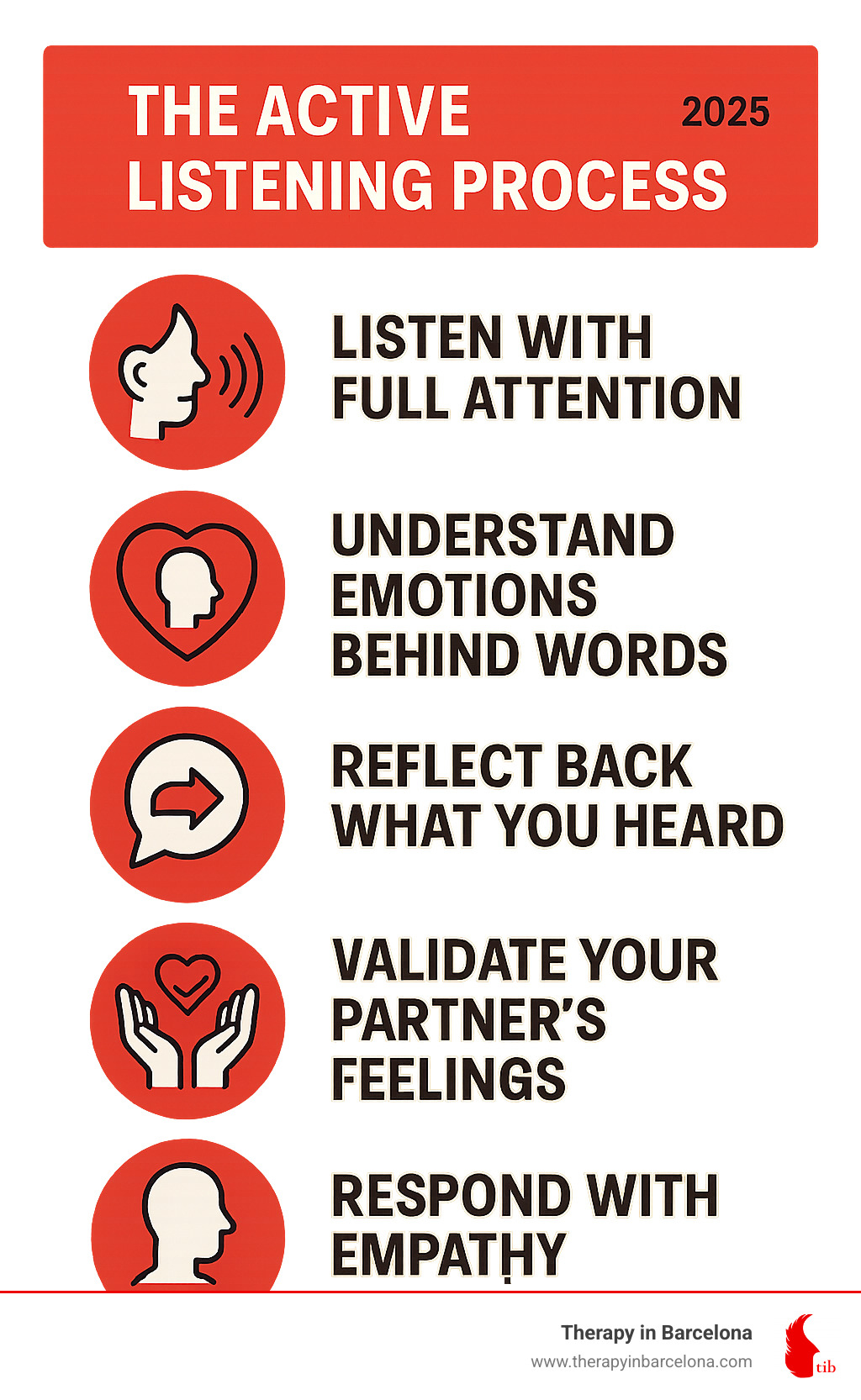
Key elements of active listening in couples therapy:
- Full presence – giving undivided attention without distractions
- Emotional validation – acknowledging and affirming your partner’s feelings
- Reflective paraphrasing – summarising what you heard to confirm understanding
- Non-defensive listening – staying open even when hearing difficult feedback
- Empathetic responding – connecting with your partner’s emotional experience
Have you ever felt like you and your partner are speaking different languages, even when you’re using the same words?
For expats navigating relationships in Barcelona – whether you’re dealing with the stress of cultural adjustment, language barriers, or the isolation that comes with building a new life abroad – communication challenges can feel even more intense.
The research is clear: couples who communicate well have happier, longer relationships. Those with higher communication satisfaction also report greater sexual satisfaction and stronger emotional bonds.
But here’s what makes active listening different from regular listening: it’s not about waiting for your turn to speak or formulating your response. It’s about creating a safe space where your partner feels genuinely heard and understood.
This transforms moments of tension into opportunities for deeper connection – exactly what couples therapy aims to achieve.
What is Active Listening in Couples Therapy?
Active listening is more than hearing your partner’s words. In couples therapy, it means giving focused attention, asking thoughtful questions, and reflecting back what you understand with empathy. The goal is simple: help your partner feel heard, not judged. It’s an active skill, and with practice, it can turn tense conversations into moments of clarity and connection.
Beyond Just Hearing: The Essence of Active Listening Couples Therapy
At its core, active listening couples therapy means giving your partner your full, undivided attention. It’s about really trying to understand their entire message – not just the words they choose, but also the feelings behind them, their intentions, and those often unspoken needs. Think of it as truly “seeing” and acknowledging their world.
Unlike just hearing or waiting for your turn to speak, active listening asks you to pause your own thoughts, quiet your judgments, and truly focus on them. You’re trying to interpret what they’re saying, picking up on both their verbal cues and their nonverbal cues – like their body language or tone of voice. This deep presence is crucial.
For couples, this commitment to active listening creates a wonderfully safe space where both partners feel genuinely understood, validated, and valued. It allows for empathy to flourish, showing you care about their feelings, and encourages reflection on what’s being shared.
This level of understanding fosters an environment where vulnerability can thrive, and partners can explore difficult topics without fear of judgment or immediate rebuttal. It’s truly the essence of building a stronger, more connected relationship.
You can learn more about the APA’s definition of active listening here.

Why Active Listening is Crucial for Relationship Health
Active listening isn’t just another communication technique—it’s the foundation that can transform your entire relationship. When you truly listen to your partner, you’re not just hearing words; you’re building the emotional bridge that connects two hearts, even when life feels overwhelming.
The Transformative Power of Active Listening for Couples
Think about the last time you felt genuinely heard by someone. That warm feeling of being understood, valued, and seen—that’s exactly what active listening creates in your relationship. It transforms those heated moments that could spiral into destructive arguments into opportunities for deeper connection and understanding.
Active listening helps couples replace assumptions with understanding. Conflicts calm down when both partners feel heard and validated. Over time, this builds trust, respect, and a stronger sense of connection.
Active listening matters because it changes the emotional climate of a relationship. When couples communicate well, they feel safer, closer, and more respected. Small moments of listening can prevent misunderstandings from turning into resentment. Over time, that sense of being heard builds trust and intimacy. And when partners feel emotionally connected, it often becomes easier to talk openly about affection, desire, and physical closeness.
For expats living in Barcelona—or anywhere abroad—these communication skills become even more vital. You’re already navigating the stress of cultural adjustment, language barriers, and the isolation that often comes with building a new life far from home. These unique pressures can intensify relationship challenges, making clear and empathetic communication not just helpful, but essential for relationship survival and growth.
Active listening should provide a sanctuary. It turns moments of tension—whether about adapting to Spanish bureaucracy, missing family back home, or feeling lost in a new culture—into opportunities for partners to support each other more deeply. Instead of each person struggling alone, active listening creates a team approach to navigating life’s challenges together.
To explore how professional support can help you develop these crucial communication skills, you can find more information about couples counselling in Barcelona.

Practical Steps to Implement Active Listening
Learning to practice active listening techniques isn’t something that happens overnight. It requires conscious effort, patience, and consistent practice—especially during those heated moments when you’d rather defend yourself than truly hear what your partner is saying. But here’s the thing: these challenging conversations are often when active listening matters most.
Mastering Active Listening Couples Therapy Techniques
Think of active listening as a skill you’re building, like learning to drive or speak a new language. At first, it feels awkward and requires your full attention. But with practice, it becomes more natural. Here’s how to start developing this transformative communication skill:
Being fully present forms the foundation of everything else. This means putting away your phone, turning off the TV, and finding a quiet space where you won’t be interrupted. Your partner deserves your undivided attention—not the leftover focus after you’ve scrolled through your messages.
Maintain gentle eye contact (not an intense stare, which can feel confrontational) and keep your body language open. Uncrossed arms and facing your partner signals that you’re receptive to what they’re sharing.
The next crucial shift is listening to understand rather than to reply. This might be the hardest part for many couples. Your natural instinct when your partner is speaking—especially if they’re upset—is to start formulating your defence or planning your rebuttal. But resist this urge. Your goal in this moment isn’t to win an argument or prove your point. It’s to genuinely understand their perspective, feelings, and needs.
Once your partner has finished speaking, paraphrasing and summarising what you’ve heard shows that you’ve been truly listening. This isn’t about mechanically repeating their words back to them—that can feel patronising. Instead, reflect back the essence of their message in your own words.
You might say something like, “So, if I’m understanding correctly, you’re feeling overwhelmed by managing the household tasks and would appreciate more support from me with the evening routine?” This gives your partner the opportunity to clarify or elaborate if you’ve missed something important.
Validate emotions, even when you disagree. Validation means recognizing your partner’s feelings as real, not admitting fault. Try: “I can see why that felt frustrating” or “That sounds really painful.”
Asking clarifying questions demonstrates your genuine curiosity about your partner’s experience. Open-ended questions like “Can you tell me more about how that made you feel?” or “What would help you feel more supported right now?” invite deeper sharing and show that you care about understanding their full experience.
When it is your turn to respond, use “I” statements to share your feelings without blaming your partner. Instead of saying, “You always ignore me when you’re on your phone,” try, “I feel disconnected when I’m sharing something important and you’re distracted.” This keeps the focus on your experience, not your partner’s character.
Managing your own defensiveness is often the most challenging aspect of active listening. When your partner expresses frustration or disappointment, your natural reaction might be to feel attacked and immediately defend yourself. Practice self-soothing techniques like taking a few deep breaths or silently counting to ten. Your partner’s feelings are valid, even if you disagree with their interpretation of events.
Finally, pay attention to non-verbal cues. Your partner’s posture, facial expressions, eye contact, and tone can reveal feelings their words may not fully express. Notice signs like tense shoulders, a strained voice, or looking away. These cues can help you respond with more care and understanding.
For additional support in developing these skills, try simple communication exercises such as paraphrasing, asking open-ended questions, and practising validation during low-stress conversations. If you’re finding it difficult to manage defensiveness or truly hear your partner, guidance on becoming a better listener can also help you build steadier, more compassionate communication habits.
Becoming skilled at active listening takes time and practice. Be patient with yourself and your partner as you both learn to communicate in this deeper, more connected way.
Overcoming Barriers and Sustaining Active Listening Habits
Even with the best intentions and knowledge of techniques, active listening can be challenging to implement consistently, especially during times of stress, fatigue, or when discussing highly sensitive topics. It’s a bit like learning to drive – you might understand the theory perfectly, but putting it into practice when emotions are running high requires patience and persistence.
Common barriers often arise that can derail even the most well-intentioned couples. Defensiveness is perhaps the most universal challenge – when feeling criticised or blamed, our natural instinct is to protect ourselves, making it incredibly difficult to truly hear and absorb what our partner is trying to communicate. It’s as if our emotional shields go up, blocking out the very connection we’re trying to create.
Distractions pose another significant hurdle in our hyper-connected world. External distractions like phones, work emails, or children demanding attention can fragment our focus, while internal distractions – anxiety, mental to-do lists, or replaying yesterday’s argument – can make giving undivided attention feel like a rare luxury.
During intense disagreements, emotional flooding can completely overwhelm our capacity for active listening. When our emotional brain takes over, rational thought diminishes, and we may react impulsively, making genuine listening almost impossible. It’s like trying to have a thoughtful conversation while standing in a thunderstorm.
Perhaps most challenging of all are past patterns – those long-standing, ingrained communication habits such as interrupting, mind-reading, or withdrawing. These patterns feel automatic because they’ve been reinforced over years, sometimes decades, making them particularly difficult to rewire.
Sustaining Active Listening in Your Relationship
The good news is that these barriers aren’t impossible. With intentional effort and the right strategies, couples can overcome these challenges and sustain active listening habits over time.
Agreeing on communication rules before difficult conversations begin can create a safer container for dialogue. This might include establishing ground rules like no interrupting, no name-calling, and the right to call for a “time-out” or short break if emotions become too intense – with a commitment to return to the discussion when both partners feel calmer.
Practicing mindfulness helps cultivate the self-awareness needed to recognise when you’re becoming defensive, distracted, or emotionally overwhelmed. Taking a few deep breaths, focusing on your bodily sensations, or even a brief meditation can help you re-centre yourself and return to the conversation with a clearer mind. It’s about creating space between your emotional reaction and your response.
Scheduling dedicated listening time might seem unromantic, but in busy lives, important conversations often get sidelined or rushed. Intentionally setting aside regular, uninterrupted time – even just 15-20 minutes a few times a week – for meaningful dialogue can create a consistent habit of listening. Think of it as investing in your relationship’s emotional infrastructure.
Learning to self-soothe is crucial for maintaining emotional regulation during difficult conversations. This could involve taking a short walk, listening to music, practicing positive self-talk, or using breathing techniques. The ability to calm your own nervous system when you feel emotional flooding is essential for engaging in productive dialogue.
Incorporating therapeutic approaches can provide structured frameworks for improvement. Many evidence-based couples therapy models, such as the Gottman Method and Emotionally Focused Therapy (EFT), heavily integrate and teach active listening skills.
The Gottman Method offers practical communication tools, including “softened startups” for discussions – approaching complaints gently rather than harshly – and emphasises the critical importance of “turning towards” each other’s bids for connection. They provide structured resources like the Aftermath of a Fight Guide and the Fondness & Admiration Guide to help couples process conflict and build positive sentiment.
Emotionally Focused Therapy (EFT) focuses on understanding the underlying emotional needs and attachment styles that drive communication patterns. Active listening in EFT helps partners uncover these deeper needs, allowing them to express vulnerabilities and respond to each other from a place of empathy and secure attachment.
For expats navigating the additional complexities of cultural adjustment and potential isolation, these skills become even more vital. The stress of adapting to a new country can intensify communication challenges, making structured approaches to active listening particularly beneficial.
Therapy in Barcelona offers personalised guidance in developing these skills within a culturally sensitive framework. You can explore more about how structured approaches can help strengthen your communication by checking out our article on 21 couples therapy activities.
When to Seek Professional Help for Communication
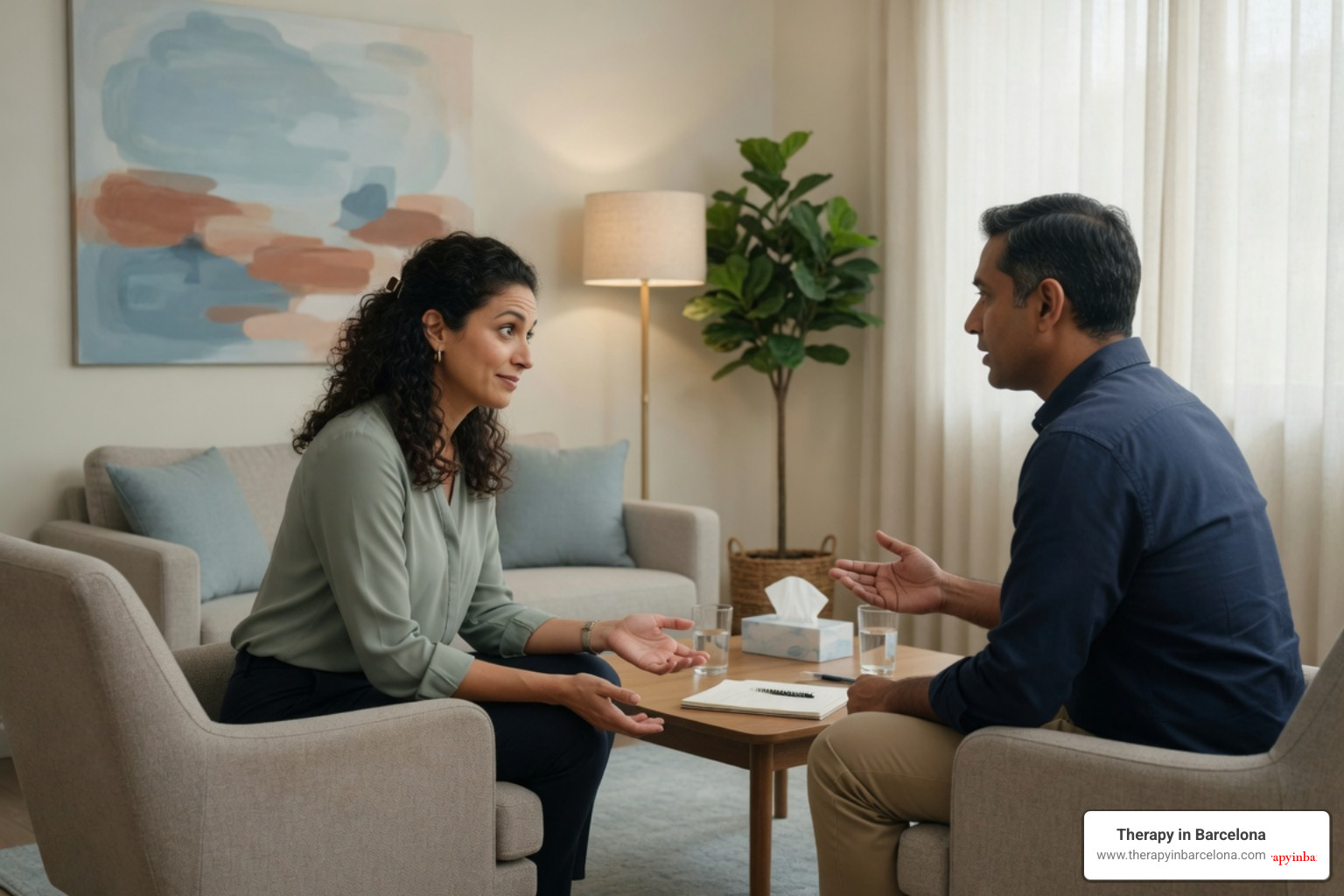
Active listening is a powerful skill couples can practice at home. But when conflicts keep repeating or emotions feel too intense, support can help. A couples therapist can guide the conversation, slow things down, and help you both feel heard.
The Role of Couples Therapy in Enhancing Active Listening
A couples therapist can help when communication feels stuck. Consider support if you keep having the same unresolved arguments, feel more resentful after trying to talk, or notice growing emotional distance and loneliness in the relationship.
Seek help if conversations often turn into shouting, blame, or emotional outbursts. It may also be time for support if one or both of you feel unheard, avoid hard topics, or face major stressors like moving abroad, job changes, parenthood, or family crises.
A couples therapist can offer a neutral, confidential space to practice active listening without blame or judgment. They can help you spot communication patterns, learn practical tools, and talk through difficult topics more safely. They can also help uncover the deeper fears, needs, or hurts driving the conflict.
For expats, a culturally sensitive therapist can make communication work feel safer and more relevant. Therapy in Barcelona offers tailored support for couples navigating language barriers, culture shock, and the stress of building a life abroad, with therapist matching based on your needs.
If you’re ready to take the first step towards a more connected and understanding relationship, you can book a consultation online. To dig deeper into how professional guidance can truly transform your relationship, explore more about the art of healing: how couples therapy works, and remember the flexibility and accessibility that online therapy offers.
Frequently Asked Questions about Active Listening in Relationships
We often hear common questions about how active listening truly plays out in the day-to-day of a relationship. It’s one thing to understand the theory, but another to see its real-world impact. Here are some of the most frequent queries we receive:
How does active listening build trust in a relationship?
Think of trust as a precious garden that needs consistent watering and care. Active listening is like that vital water. When you consistently show up for your partner, truly listening without judgment, and validating their experiences and emotions, you’re sending a clear message: “I see you, I hear you, and your feelings matter to me.”
This reliability and unwavering presence teach your partner that they can indeed be vulnerable with you. They learn that their deepest concerns won’t be met with criticism or dismissal, but with understanding and empathy. This creates a profound sense of safety and emotional security, which are the very bedrock of trust. It’s about building a consistent history of being a safe harbour for their thoughts and feelings.
Can active listening help with sexual intimacy?
Absolutely. It might not seem obvious at first, but emotional safety and physical intimacy are closely connected. Active listening helps partners talk more honestly about sexual needs, desires, discomforts, and boundaries without fear of being dismissed or judged.
When you feel genuinely heard, it becomes easier to be vulnerable. And when your partner feels heard, they are more likely to relax, open up, and share what they really need. Over time, this kind of listening can build trust, reduce pressure, and make intimacy feel more connected, mutual, and emotionally safe.
What if my partner refuses to practice active listening?
It’s completely understandable to feel frustrated and disheartened if you’re putting in the effort to practice active listening, but your partner seems unwilling or unable to engage in it themselves. You can’t force anyone to change, but you can certainly model the behaviour you wish to see.
Continue to practice active listening when they speak, showing them the powerful benefits through your own actions. Calmly and consistently express your needs and feelings using “I” statements. For example, instead of saying “You never listen to me,” try “I feel unheard when I’m trying to share something important and you interrupt me.” This explains the impact of their actions without placing blame.
If this communication imbalance persists and significantly impacts the health and happiness of your relationship, it might be a clear sign that professional support could help. Suggesting couples therapy isn’t about blaming or admitting defeat; it’s about investing in your relationship’s future.
A neutral third party, like a qualified therapist, can help facilitate these difficult conversations, identify the underlying reasons for your partner’s resistance, and teach both of you essential communication skills in a structured, supportive environment. Sometimes, partners need the guidance of a professional to break old habits and learn new, more effective ways of relating.
Therapy in Barcelona offers culturally sensitive support that understands the unique pressures expats face, helping couples steer these challenges together.
Conclusion: Cultivating a Lifetime of Connection Through Active Listening
At its heart, active listening is so much more than just a technique; it’s a powerful way to show your partner deep love, profound respect, and unwavering commitment. Imagine truly hearing and understanding each other – not just the words, but the feelings and needs behind them. When couples can do this, they gain an incredible ability to steer disagreements with greater ease, build a truly deep emotional connection, and forge a resilient bond that can stand strong through all of life’s ups and downs.
This skill is especially transformative for expats, like many of us in Barcelona, who often face unique pressures that can put extra strain on relationships. When you’re far from your usual support systems, the ability to genuinely connect and understand each other’s experiences becomes even more vital for not just surviving, but truly thriving, in a new country. It helps turn moments of potential tension into opportunities for deeper intimacy.
Just like learning to play a musical instrument or speak a new language, active listening requires consistent practice, a good dose of patience, and true dedication. You’ll definitely have moments where it feels hard or frustrating – that’s perfectly normal! But the rewards? A happier, healthier, and profoundly more connected relationship that feels truly supportive and understanding. Those rewards are simply immeasurable.
If you and your partner find yourselves struggling to put these skills into practice on your own, or if long-standing communication habits are proving tough to change, seeking professional support can make all the difference. It provides the essential guidance and tools you need to transform your communication.
Therapy in Barcelona offers culturally sensitive couples counselling, specifically designed to help internationals cultivate stronger connections and thrive together, whether you’re living here in Barcelona or connecting with us online from anywhere else.
To learn more, explore our services or book a free discovery call to discuss support for your relationship journey.
