


Why Your Family’s Cultural Background Matters in Therapy

Moving to Spain can bring families closer, but it can also highlight differences that were previously manageable. Culturally sensitive family therapy respects the cultural values, beliefs, and practices that shape your family’s dynamics, helping you work through challenges in a way that honours your identity.
What makes family therapy culturally sensitive:
- Respect for cultural values: Your therapist understands how culture influences family roles, communication styles, and decision-making.
- Awareness of cultural differences: They recognise that families from different backgrounds may express emotions, handle conflict, and view mental health differently.
- Adapted therapeutic approaches: Therapy techniques are adjusted to fit your family’s cultural context, rather than imposing Western models.
- Cultural humility from therapists: Your therapist acknowledges their own cultural background and commits to learning about yours.
Take the fictional composite family of Priya and Raj, who moved from India to Valencia with their 9-year-old son, Aarav. While they thrive professionally, Aarav struggles with cultural adjustment and feeling caught between his Indian heritage and his new Spanish environment. His parents disagree on how much to preserve their traditions versus encouraging integration—a common challenge for international families.
Family therapy that respects cultural differences helps bridge these gaps. Rather than applying one-size-fits-all approaches, culturally sensitive therapists work with your family’s unique cultural landscape, whether you’re adjusting to life in Barcelona, supporting Third Culture Kids in Madrid, or adapting to life in Málaga.
What is Culturally Sensitive Family Therapy? Core Principles Explained
Culturally sensitive family therapy weaves your family’s cultural background into every conversation and technique. It recognises that your unique blend of values, beliefs, and practices shapes how you communicate, resolve conflicts, and see the world. At its heart, this approach rests on respect, curiosity, and collaboration. Your therapist doesn’t just acknowledge your cultural heritage—they actively learn from it and use it as a foundation for helping your family grow stronger.
Understanding the “Culture” in Therapy
When therapists talk about culture, they mean more than your nationality. Culture is a rich mix of identities: ethnicity, religion, spirituality, gender identity, sexual orientation, and socioeconomic background. For international families, acculturation—the process of adapting to a new environment—is especially important. Parents might hold onto their heritage culture while children adapt more readily, creating tensions that therapy can help address.
Culture also includes your family’s unwritten rules about decision-making, family roles, and how love and respect are shown. A skilled therapist avoids stereotypes and remains curious, asking thoughtful questions rather than assuming they understand your family’s context based on background alone. As the APA guidelines for culturally sensitive care emphasise, effective therapists adapt their approach to match each family’s unique circumstances.
The Core Principles in Practice
These principles translate into concrete actions. Open-mindedness and non-judgement mean your therapist approaches your family with genuine curiosity. Active listening and empathy go deeper than just hearing words; your therapist works to understand your family’s cultural explanations for challenges, respecting your interpretations.
Creating a safe space ensures every family member feels secure expressing their authentic cultural experiences, whether it’s discussing religious obligations, language preferences, or bicultural identity struggles. Cultural humility is perhaps the most crucial principle: your therapist acknowledges their own cultural biases and commits to lifelong learning. They ask for clarification rather than making assumptions and stay informed about global events that might affect your family. These principles build the trust essential for effective family therapy, especially for international families adjusting to life in cities like Barcelona, Sevilla, or Alicante. For a deeper exploration, our guide on Understanding Cultural Sensitivity: A Guide for Therapists can be helpful.
Why Cultural Competence is Essential for Family Therapists
Cultural competence isn’t a box to tick; it’s a continuous process of learning and self-reflection. It requires therapists to constantly examine their own assumptions, learn about different worldviews, and adapt their approach. Without this commitment, therapy can miss the mark or even cause unintended harm.
For international families in Spain, finding a therapist who understands their experience is crucial. Whether you’re raising Third Culture Kids in Madrid or managing an intercultural marriage in Valencia, your challenges are unique. A therapist lacking cultural awareness might misread communication styles, overlook the stress of living between cultures, or offer solutions that clash with your core values.
Therapy in Barcelona was founded because of this gap. Leigh Matthews, the Australian Psychologist who established our practice in 2011, experienced how hard it can be to find culturally sensitive mental health support as an expat. Her journey of adapting to Spanish culture while raising a bicultural child highlighted how much expat families need therapists who truly understand their world.
Our team comprises psychology-trained therapists who are also expats. This isn’t just professional training—it’s lived experience. Many of us are in intercultural relationships or raising Third Culture Kids, adding a depth of understanding you can’t get from textbooks alone. You can learn more about how therapy works at Therapy in Barcelona.
The Therapist’s Role: Beyond Textbooks
A culturally competent therapist does more than learn facts about different cultures. They understand how their own background shapes their perspective and are alert to microaggressions—small, often unintentional comments that can make clients feel judged. They commit to ongoing professional development and, most importantly, learn from their clients. They ask questions like, “How does your family typically handle conflict?” rather than imposing their own cultural assumptions.
The Impact of a Therapist’s Cultural Humility
When a therapist approaches your family with genuine cultural humility, it makes a significant difference. It means acknowledging there’s always more to learn about someone else’s experience. This approach builds trust and creates a stronger therapeutic alliance—the crucial connection between therapist and client that research shows is vital for success. Families feel empowered to explore solutions that align with their values, preventing the harm that cultural misunderstandings can cause. The outcome is a genuine connection, which provides the foundation for lasting, meaningful change. For international families in Spain, this kind of support can be transformative.
How Cultural Differences Shape Family Life and Therapy
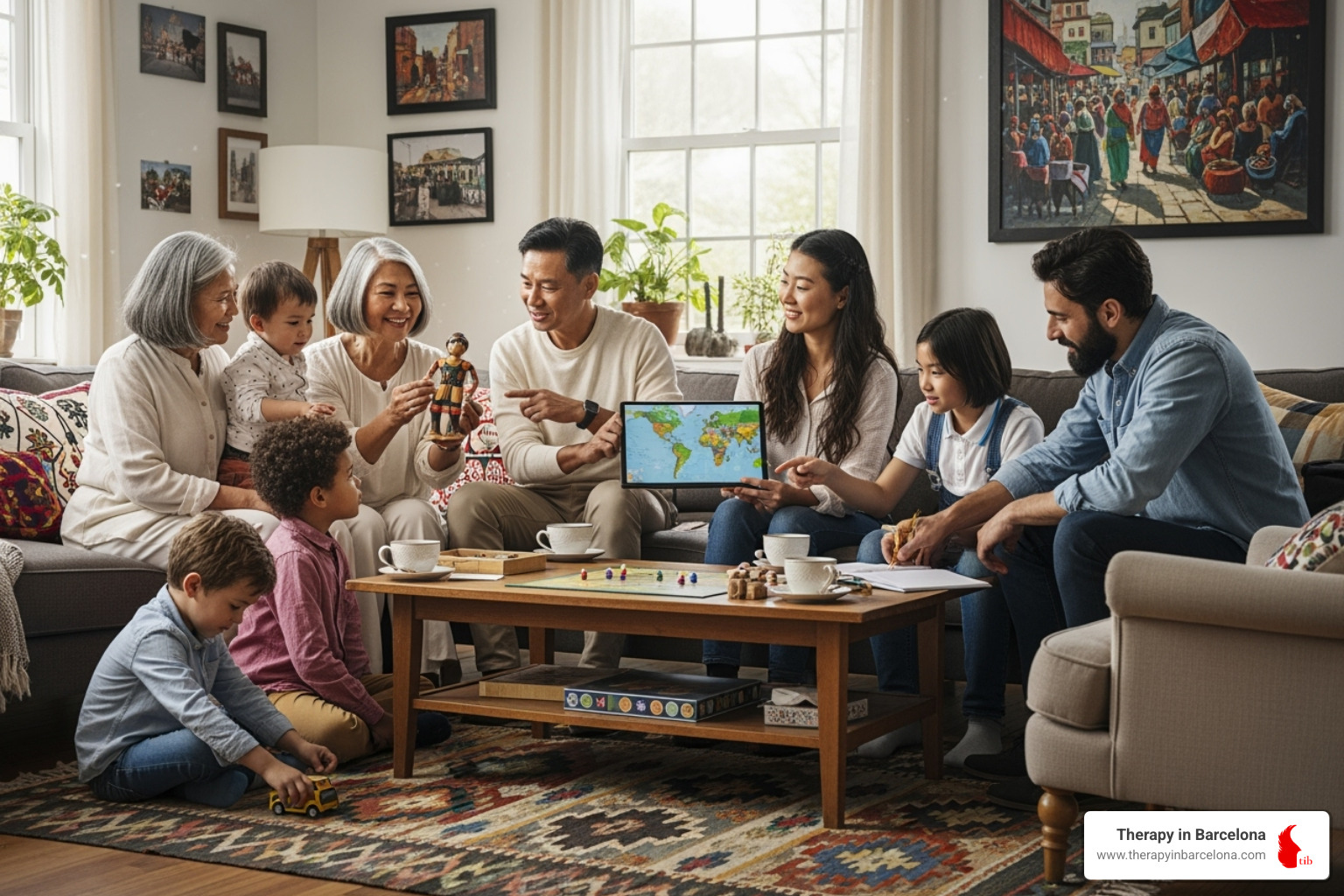
Cultural differences profoundly influence every aspect of family life, from emotional expression to decision-making. For international families, these differences can become particularly pronounced.
Consider the fictional Singh family in Valencia. Priya and Raj moved from India with their children, Aarav (9) and Meera (16). They hold to many traditional Indian values, while Meera is immersed in her Spanish school life, valuing independence and open communication. Aarav, a Third Culture Kid, feels caught between two worlds. This creates friction around communication, discipline, and expressing affection.
This scenario highlights common areas where culture impacts family dynamics:
- Communication Styles: Some cultures favour directness, while others rely on subtle, indirect cues.
- Family Structure and Roles: Norms dictate who holds authority and the importance of the extended family versus the nuclear unit.
- Emotional Expression: Cultures vary on whether emotions are displayed openly or with restraint.
- Mental Health Stigma: Seeking professional help may carry a heavy stigma in some cultures.
- Parenting and Discipline: Approaches to raising children are deeply rooted in cultural values.
- Intergenerational Conflict: Different rates of acculturation between parents and children often lead to clashes over values and lifestyle choices.
Navigating Communication and Family Roles
Communication is a key area impacted by culture. In ‘high-context’ cultures, meaning is often conveyed non-verbally, while ‘low-context’ cultures favour direct, explicit language. A therapist must be aware of these differences. Similarly, family roles are culturally defined. For example, some cultures prioritise the parent-child relationship over the spousal one. A therapist’s goal is not to change a family’s cultural structure but to help them function healthily within it.
Views on Mental Health and Help-Seeking
Cultural attitudes towards mental health are crucial. In many cultures, mental health concerns are stigmatised, leading families to hide struggles or seek support from spiritual healers first. A culturally sensitive therapist acknowledges this, perhaps framing therapy in a way that aligns with the family’s worldview. They might explore how external factors, like racial tension, affect well-being, helping clients feel less censored. Understanding these varied perspectives is vital for building trust, a topic we explore in our article on Therapy for Third Culture Kids: An Expert Roundup.
Key Strategies and Benefits of Culturally Sensitive Family Therapy
When families work with therapists who understand their cultural background, therapy becomes a space to grow while staying true to who they are. Culturally sensitive family therapy creates genuine healing by weaving cultural understanding into every conversation and intervention.
Strategies for a Culturally Sensitive Approach
Effective culturally sensitive therapy requires thoughtful adaptation. Therapists modify established approaches like Structural Family Therapy and Cognitive Behavioural Therapy (CBT) to respect cultural norms. For instance, when working with a traditional Indian family in Valencia, a therapist wouldn’t impose Western ideals about parent-child boundaries. Instead, they’d ask: “How does your culture define healthy boundaries?” This strengthens the family within their own framework.
Language considerations are also key. We offer therapy in English, and some of our therapists also speak German, French, Spanish, Afrikaans, Portuguese, Swedish, Austrian-German and Swiss-German. When families can express themselves in their most comfortable language, therapy is more effective. This is especially true in Spain’s multilingual landscape, as explored in our guide to Navigating the Language Labyrinth in Catalunya.
Using cultural metaphors and storytelling can resonate more deeply than clinical terms. Sensitive questioning, such as “What traditions are most important to preserve?”, shows genuine curiosity. Therapists also acknowledge external pressures like immigration stress or discrimination, making them part of the conversation.
The Tangible Benefits for Your Family
Families who engage in this type of therapy often find benefits that extend beyond resolving immediate conflicts.
- Stronger family bonds emerge when everyone feels understood and valued.
- Conflict resolution becomes more effective as underlying cultural misunderstandings are addressed.
- Improved understanding flows both ways, as parents gain insight into their children’s bicultural struggles and vice versa.
- Empowered communication develops as families learn to express their needs in ways that honour their cultural context.
- Celebrating cultural heritage becomes a source of strength. Children learn to integrate their multiple identities with pride.
- Support for children and teens is crucial, as they receive validation for their unique experiences as Third Culture Kids.
These benefits create resilient families who can weather cultural adjustments while maintaining their authentic selves, whether in Barcelona, Valencia, or Sevilla.
Finding the Right Culturally Sensitive Therapist for Your Family
Finding a therapist who understands your family’s cultural context is a crucial step. For international families in Spain, this search requires specific considerations to find someone who gets both family dynamics and the expat experience.
How to Find a Culturally Sensitive Family Therapist
Here’s how to find the right therapist:
- Online Searches: Use specific terms like “culturally sensitive family therapy Barcelona” or “expat family therapist Valencia.”
- Initial Consultation Questions: Use a brief consultation to ask targeted questions:
- “What is your experience working with families from [your cultural background]?”
- “How do you incorporate cultural values into your therapeutic approach?”
- “How do you address your own cultural biases?”
- “What languages do you speak?”
- “Can you give an example of how you’ve adapted therapy for a culturally diverse family?”
- Look for Therapist Matching Services: Practices like Therapy in Barcelona offer a personalised matching service. An initial conversation helps connect you with a therapist whose expertise and personality are the best fit, saving you time.
Your Therapy Options in Spain
When seeking therapy in Spain, you’ll encounter several options:
- Public System Clinicians: Public mental health services may have long waiting lists and may not specialise in expat-specific challenges or offer therapy in multiple languages.
- Large Online Platforms: These offer convenience but may lack the personalised matching and deep understanding of expat life that a specialised practice provides. Check their privacy policies carefully.
- Local Private Practices: These vary widely. Some are excellent but may not focus on multicultural or expat families.
Therapy in Barcelona offers a distinctive approach for the international community:
- Bespoke Therapist Matching: Our intake process ensures you’re matched with a psychology-trained therapist who fits your family’s specific needs.
- Expat-Specific Expertise: All our therapists are expats. They live the experience and deeply empathise with the challenges of cultural adjustment.
- Collaborative Expertise: We’re a group practice of highly qualified psychology-trained therapists who work with adults, couples, teens and families. We share knowledge and support to ensure high-quality care.
- Strict Privacy: We prioritise confidentiality and do not sell your data.
- Private-Pay, Higher-Quality Care: A discreet, private-pay service focused on quality over volume.
- Multilingual Support: We provide services in English, and some therapists also speak German, French, Spanish, Afrikaans, Portuguese, Swedish, Austrian-German and Swiss-German.
- Accessibility: We offer online sessions worldwide and face-to-face sessions at our office in Barcelona.
Challenges and Ethical Considerations
Being aware of potential challenges is important:
- Language Barriers: Even with interpreters, nuances can be lost.
- Therapist Bias: Continuous self-reflection and supervision are essential for therapists to mitigate their own biases.
- Confidentiality: Cultural expectations around privacy can sometimes conflict with therapeutic norms. Therapists must handle this with sensitivity.
- Competence: Therapists must recognise the limits of their cultural competence and be willing to consult or refer when necessary. Ignoring cultural perspectives can devalue ethical guidelines, as highlighted in ethnocultural research.
For more support for international families, you might find our article on By Your Side BCN: Help for International Families in Barcelona helpful.
Culturally sensitive family therapy offers a powerful pathway for international families to strengthen their bonds and thrive in their chosen homes, whether in Barcelona, Valencia, or Málaga. By respecting your family’s unique cultural mix, this approach ensures therapy is not just effective but also deeply affirming.
It helps bridge communication gaps, resolve intergenerational conflicts, and supports family members in integrating their bicultural identities. The result is stronger connections, improved empathy, and a greater capacity to celebrate your heritage while adapting to life abroad.
If your family is seeking support that truly understands the expat experience, Therapy in Barcelona is here to help. We offer online sessions worldwide and face-to-face sessions in our Barcelona office, with a commitment to personalised therapist matching.
If you’d like support, book a Free Discovery Call. Our team of expat therapists is ready to help your family find harmony and strength.
