


What Bilingualism and Biculturalism Actually Mean — and Why They Matter

Bilingualism and biculturalism are two experiences that often travel together, yet they are not the same thing — and understanding the difference can change how you see yourself.
Here is a quick overview of what each term means and how they relate:
- Bilingualism refers to the ability to communicate in two languages — understanding, speaking, reading, or writing in both.
- Biculturalism goes a step further. It describes the experience of internalising two distinct cultural identities: their values, customs, and ways of being in the world.
- Where they overlap: Many bilingual people are also bicultural, but not always. You can speak two languages fluently without fully identifying with both cultures. And you can feel deeply bicultural — through immigration, mixed heritage, or years abroad — without being equally fluent in both languages.
- Why it matters: Research on bilingualism, biculturalism, and positive psychology links dual-language and dual-culture experiences with cognitive flexibility, creativity, and psychological resilience when people have supportive conditions around them.
Bilingual and bicultural life is common, but never one-size-fits-all. For expats and immigrants, it shows up daily: switching languages at work, feeling between cultures, and gaining a wider view of the world.
This article explores how language and culture shape identity, what research says about the benefits and challenges of living between two worlds, and how support — including culturally sensitive therapy — can help you turn that complexity into a genuine strength.
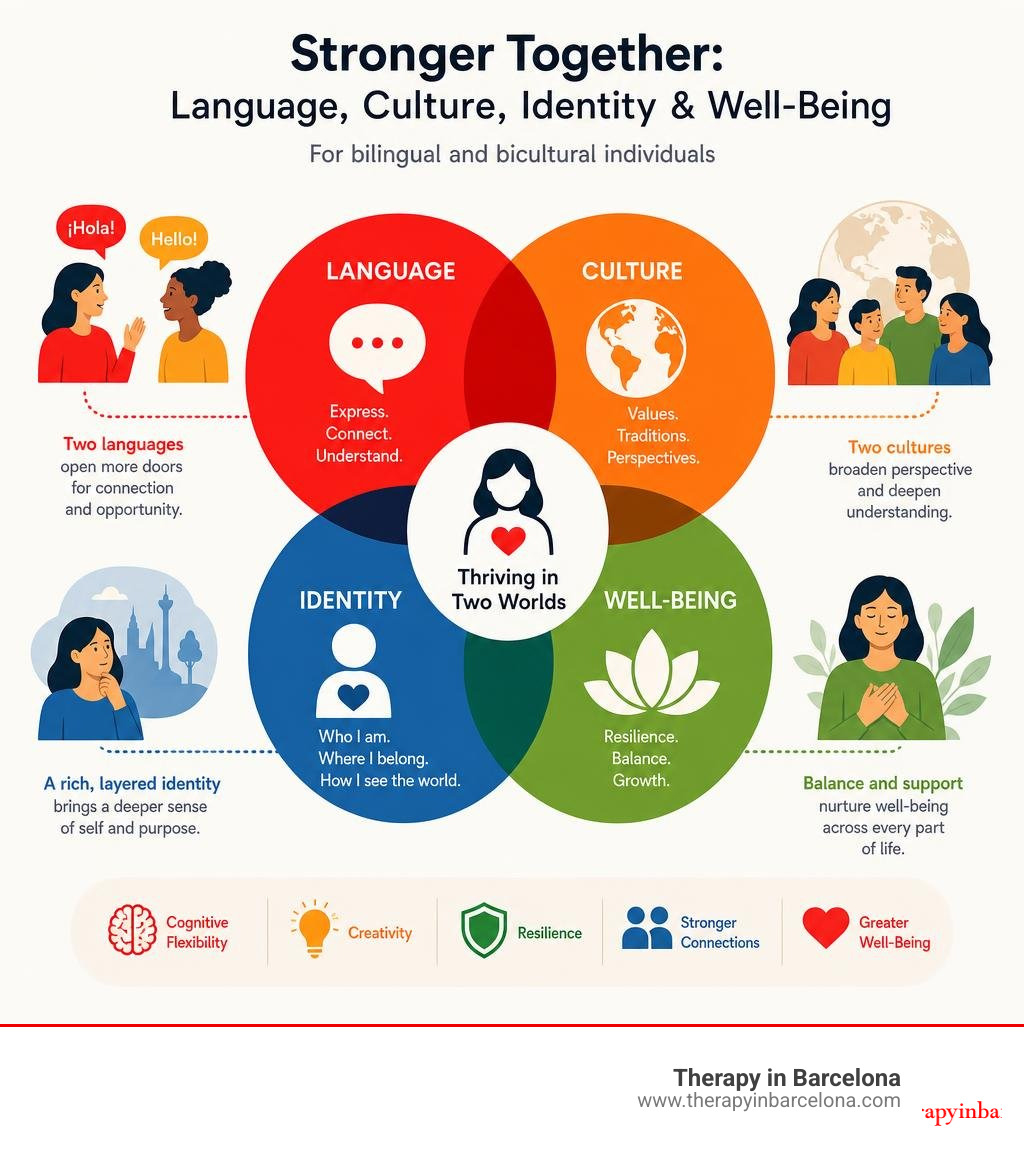
The Dynamic Intersection of Bilingualism and Biculturalism

While language is a tool for communication, culture is the framework through which individuals make sense of the world. When these two forces meet, they shape a person’s inner landscape in profound ways.
To understand this intersection, it helps to look at how we define these terms. Bilingualism is primarily linguistic, focusing on the comprehension and oral production of two languages. On the other hand, Biculturalism entails living with, and often embracing, the values, customs, and traditions of two distinct cultures simultaneously.
For a deeper look into how these concepts shape daily life, read our guides on Two Cultures, One You: A Guide to Bicultural Identity and Double the Fun: Understanding Bicultural Theory.
Globalisation, migration, international relationships, and remote work are making dual identities more visible in everyday life, from multilingual families to international workplaces and expat communities.
Navigating Identity and Self-Concept Across Cultural Contexts
One of the most fascinating aspects of being a bicultural bilingual is the phenomenon of cultural frame-switching. This occurs when an individual shifts their cognitive schemas, behavioural patterns, and even aspects of self-presentation depending on the language they are speaking or the cultural context they find themselves in.
Research on Bicultural bilinguals shows that these individuals do not possess two separate minds, but rather a unified, dynamic system where languages and cultural frameworks wax and wane depending on the environment. For more on this, explore The Dual Identity: Exploring the Core Aspects of Biculturalism.
Psychologists study this experience through the lens of Bicultural Identity Integration (BII). BII focuses on two main dimensions:
- Blendedness vs. Distance: The degree to which an individual feels their two cultural identities overlap and merge, rather than remaining separate and compartmentalised.
- Harmony vs. Conflict: The level of compatibility or tension felt between the two cultures.
In daily life, this can feel very personal. You might speak one language with family and another with friends, and notice your humour, confidence, or emotional tone shift. That does not mean one version of you is false. It means your identity is responding to context. The real challenge is learning how to hold all these parts together without feeling divided.
The Role of Linguistic Awareness in the Bilingualism and Biculturalism Experience
Linguistic awareness goes beyond simply knowing vocabulary; it involves metalinguistic awareness — the conscious understanding of how language works, how it is structured, and how it can be adapted to different social situations.
For bilinguals, this awareness often manifests as code-switching, the seamless transition between languages within a single conversation. Far from being a sign of linguistic confusion, code-switching can reflect social belonging, shared identity, and emotional nuance.
This linguistic flexibility has a direct impact on mental well-being and therapeutic support. To learn more about this connection, you can read Speak Your Mind: The Importance of Multilingual Psychological Services.
In therapy, language choice matters. A native language can bring up early memories and deep emotion. A second language can create useful distance. For expats, switching languages in session can help regulate intensity, making it easier to approach difficult experiences at a manageable pace.
The Cognitive, Psychological, and Social Benefits of Dual Identities

Living with a dual identity offers far more than just practical travel advantages; it can reshape how a person processes information and relates to society.
From a cognitive perspective, managing two languages requires regular mental effort. The brain must select one language while inhibiting another, and research has explored links between bilingualism and several areas of cognitive performance, including:
- Attentional control: The ability to focus on relevant tasks while ignoring distractions.
- Cognitive flexibility: Shifting between different rules or mental tasks.
- Creativity: Generating diverse associations and novel solutions to problems.
These cognitive strengths can translate into social and psychological benefits. According to a comprehensive review of Biculturalism and adjustment among U.S. Latinos: A review of four decades of empirical findings, roughly 78% of empirical studies show a positive link between biculturalism and psychological adjustment.
Living with two cultures can help individuals build a richer repertoire of social behaviours, making them more adaptable across different settings. To explore this dynamic further, read our article on Embracing Biculturalism: The Unexpected Benefits of Being the Odd One Out.
To thrive in two cultures, individuals develop what researchers call bicultural competence. This involves six core skills:
- Knowledge of cultural beliefs and values: Understanding the underlying assumptions of both cultures.
- Positive attitudes toward both groups: Valuing both identities without feeling forced to choose between them.
- Bicultural efficacy: Feeling confident in one’s ability to move between both social worlds successfully.
- Communication ability: Linguistic and non-verbal fluency in both cultural contexts.
- Role repertoire: Having a diverse range of socially appropriate behaviours for different situations.
- A sense of being grounded: Feeling secure in one’s own skin, regardless of the cultural setting.
How Bilingualism and Biculturalism Foster Positive Psychology and Well-Being
For decades, some early psychological research viewed bilingualism and biculturalism through a deficit lens, assuming that living between two worlds created confusion, delay, or strain. Modern positive psychology offers a more balanced view, reframing dual identities as potential psychological assets when people feel supported and able to integrate both sides of themselves.
Research links integrated bicultural identity with higher life satisfaction, self-esteem, and resilience. Other studies suggest people who feel less torn between cultures often report better psychological adjustment and less ongoing sadness or worry.
For an expat living in Madrid or Málaga, this kind of integration can act as a buffer against culture shock and isolation. Rather than seeing cultural differences only as obstacles, bicultural individuals may also come to view them as opportunities for personal growth and exploration.
The GEAR Model: A New Framework for Dual Assets
To better understand how these linguistic and cultural advantages work together, researchers have proposed the GEAR model (Growth, Exploration, Awareness, Reinforcement). This model moves away from deficit-based approaches and maps out how bilingualism and biculturalism can function as dynamic, positive resources.
The GEAR model is built on the idea that language and culture are not just skills we possess, but active processes that shape how we grow, learn, and connect.
The Four Dimensions of the GEAR Model
The GEAR framework divides the benefits of dual identities into four interconnected, dynamic dimensions:
- Psychological Growth: This dimension focuses on personal development, emotional resilience, and self-actualisation. Adapting to a new culture — such as moving to Alicante or Sevilla — can help individuals build a stronger sense of personal agency and self-efficacy.
- Cognitive Exploration: This refers to the open-mindedness, curiosity, and creativity that can come from managing two distinct worldviews. Bilinguals often have a wider variety of mental associations for a single concept, allowing for more flexible thinking.
- Linguistic Awareness: This covers metalinguistic skills and code-switching. As language proficiency grows, many bilingual people become more aware of how language is structured, how meaning shifts across contexts, and how communication changes depending on the setting.
- Social Reinforcement: This dimension highlights the ability to build, maintain, and move between diverse social networks. By speaking multiple languages and understanding different cultural norms, individuals can form meaningful connections across social divides.
Rather than operating in isolation, these four dimensions interact constantly. For example, linguistic awareness can support cognitive exploration, which in turn may foster social reinforcement and personal growth.
Addressing Research Limitations and Future Directions
While research into dual identities is promising, current studies still have limitations. As noted in The Wiley Encyclopedia of Personality and Individual Differences, many historical studies relied on small, highly specific samples — often focusing heavily on particular immigrant groups while overlooking others.
Additionally, short-term studies can miss how identity changes over time. To address this, a daily diary study on Biculturalism dynamics and psychosocial functioning (PMC) tracked participants day by day. The researchers found that daily fluctuations in cultural harmony and blendedness were linked with well-being and inward distress.
Future research using the GEAR model aims to explore these short-term dynamics more deeply, helping psychologists design targeted support for expats, third-culture kids, and multicultural families at different stages of life.
Supporting Dual Identities: Education, Workplaces, and Therapy
Understanding the benefits of dual identities is only half the battle; the real challenge lies in creating environments that support and nurture these assets.
In educational settings, supporting bilingual and bicultural children means moving beyond simple language classes. Schools that actively promote biliteracy and celebrate diverse cultural heritages help children build a secure, integrated sense of self. When a child’s home language and culture are valued in the classroom, it can boost their academic confidence and emotional well-being.
International workplaces gain from bicultural employees’ creativity and social flexibility. But they may also carry a “cultural double shift”: translating, smoothing misunderstandings, or representing a whole culture without recognition. Inclusive teams in Barcelona, Madrid, or Málaga should notice this labour, value it, and avoid making it automatic.
Finally, in mental health, culturally sensitive therapy plays a vital role. When individuals struggle with conflicting cultural values, identity confusion, relocation stress, or feeling caught between different expectations, having a space to explore these challenges without judgement is essential.
Choosing the Right Support: Comparing Your Options
If you are looking for support while living abroad, it is helpful to look at the different options available. Here is a realistic comparison:
Option 1: The Public Health System Spain’s public health system is professional and accessible, but therapy can involve long waits, limited language options, and less choice over therapist fit. For expats, finding consistent support in a native language may be difficult.
Option 2: Large Online Therapy Platforms Convenient and often cheaper, but matching may feel impersonal. Some clients also have concerns about therapist turnover and data privacy.
Option 3: Specialised Expat Therapy with Therapy in Barcelona Therapy in Barcelona offers bespoke therapist matching for expats and internationals. Our psychology-trained therapists understand cross-cultural life, provide multilingual support where possible, and follow strict privacy standards. Sessions are available in person in Barcelona and online worldwide.
Frequently Asked Questions about Bilingualism and Biculturalism
What is the main difference between being bilingual and being bicultural?
Being bilingual is primarily about linguistic skill—the ability to speak and understand two languages. Being bicultural is about internalizing and identifying with the values, beliefs, and daily practices of two distinct cultures. While many people are both, you can be bilingual without feeling bicultural, or feel deeply bicultural even if you are still working on your language skills.
Can you be bicultural without being fully bilingual?
Yes, absolutely. Many heritage speakers or individuals raised in multicultural environments feel a deep connection to two cultures, even if they have gaps in their language proficiency. Accepting these linguistic limitations is an important part of identity integration; you do not need perfect fluency to claim and celebrate your cultural heritage.
How does language choice affect therapy for expats?
Language shapes what feels easy, safe, or painful to say. Your native language may bring you closer to early memories and emotions. A second language can sometimes create useful distance when a topic feels overwhelming. Multilingual therapy lets you move between languages when needed, so the session fits your real emotional world.
Final Thoughts
Living between two languages and two cultures is a rich, complex journey. While it can sometimes feel like standing in a liminal space – not entirely “here” nor “there” – this dual perspective can also become a profound psychological asset. It can build flexibility, foster empathy, and support a deeper, more nuanced sense of self.
If expat life feels heavy, you do not have to manage it alone. Therapy in Barcelona was founded by Leigh Matthews, an Australian psychologist in Barcelona since 2011, to help internationals find thoughtful, English-speaking support for cross-cultural life, relationships, identity, and family transitions.
Whether you prefer face-to-face sessions at our welcoming office in the Eixample district of Barcelona or online therapy from anywhere in Spain or worldwide, we are here to support you.
If you would like to explore how we can help you integrate your dual identities and build a fulfilling life abroad, book your Free Discovery Call today to find your ideal therapist match.
