


Understanding How Solution-Focused Therapy Transforms Adjustment Disorder

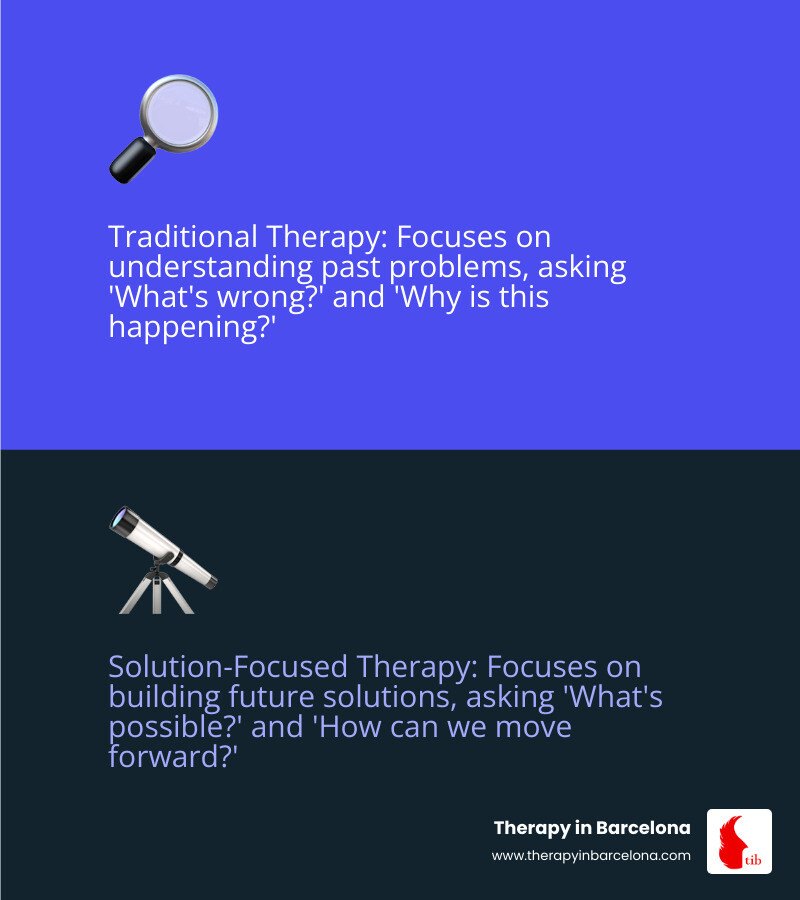
Solution focused therapy for adjustment disorder offers a refreshing approach to managing life’s overwhelming transitions. Unlike traditional therapy that dwells on problems, this method focuses on building solutions and leveraging your existing strengths to steer challenging life changes.
Key Benefits of Solution-Focused Therapy for Adjustment Disorder:
- Brief and effective: Typically 5-8 sessions vs. months of traditional therapy
- Future-focused: Concentrates on where you want to be, not past problems
- Strengths-based: Uses your existing coping skills and resilience
- Goal-oriented: Creates clear, actionable steps forward
- Collaborative: You’re the expert on your own life and solutions
Life changes can feel overwhelming, especially when you’re navigating them in a foreign country. Whether you’ve recently moved to Barcelona, started a new job, ended a relationship, or faced any significant stressor, adjustment disorder can leave you feeling anxious, depressed, or simply “stuck.”
The beauty of solution-focused brief therapy (SFBT) lies in its practical approach. Instead of spending months analysing why you’re struggling, this method helps you identify what’s already working in your life and builds on those strengths. It’s particularly effective for adjustment disorder because both the condition and the therapy are naturally time-limited.
As Leigh Matthews, an Australian psychologist who founded Therapy in Barcelona after her own expat journey, often explains to her international clients: “You already have more resilience and coping skills than you realise. SFBT helps you recognise and expand on these strengths rather than focusing on what’s not working.”
This approach transforms your relationship with change from something that happens to you into something you can actively steer through.
Understanding Adjustment Disorder: When Life’s Changes Feel Overwhelming
Relocating, changing jobs, or ending a relationship can shake even the most seasoned expat. Most of the time we adapt, yet sometimes the emotional wave feels too big. When a clear stressor triggers persistent worry, low mood, or out-of-character behaviour, professionals often refer to this cluster of reactions as adjustment disorder. It is not a life-sentence label, simply a way to describe a temporary, situational struggle.
Typical emotional signs include:
- Ongoing anxiety or nervousness.
- A flat or tearful mood.
- Irritability, anger, or a sense of hopelessness.
Behavioural signs might be:
- Disturbed sleep or concentration.
- Pulling away from friends and social events.
- Leaning on alcohol, screens, or other quick fixes more than usual.
For internationals in Spain, common triggers are culture shock, language barriers, starting a new job, or supporting loved ones back home. Any of these can leave you feeling stuck, making work performance and social life harder than usual. If the list above feels familiar, our guides on Navigating Change as an Expat in Barcelona: Strategies for Adaptation and Growth and The Ultimate Guide to Cultural Adjustment Therapy offer extra support.

Untreated, these feelings can snowball into deeper distress. The encouraging news? Because adjustment difficulties are linked to a specific life event, they usually respond quickly to focused support. Brief approaches—especially solution-focused therapy—offer practical tools so you can regain balance and move forward. If you are unsure whether to reach out, Signs It’s Time for Therapy can help you decide.
Introducing Solution-Focused Brief Therapy (SFBT): A Shift in Perspective
If traditional therapy sometimes feels like digging endlessly through the past, SFBT is more like planting seeds for the future. Developed in the 1980s by Steve de Shazer and Insoo Kim Berg, Solution-Focused Brief Therapy asks, “What will life look like when this problem is smaller—or gone?”
Key ideas in a nutshell:
- Future over past – sessions centre on where you want to go, not on analysing childhood stories.
- Strengths over deficits – you are viewed as capable and resourceful; therapy shines a light on skills you already possess.
- Brevity by design – most people need only 5–8 meetings (sometimes up to 20) to feel better equipped.
- Therapist as collaborator – we guide the conversation, but you are the expert on your life.

Three guiding principles keep sessions nimble:
- If it isn’t broken, don’t fix it – we leave the functional parts of your life alone.
- Do more of what works – identify times the stress felt lighter and repeat whatever helped.
- If it doesn’t work, try something different – experiment until you notice progress.
Because SFBT zeroes in on practical change, it dovetails perfectly with expat life, where time, visas, and schedules are often limited.
The Perfect Match: Why Solution-Focused Therapy for Adjustment Disorder Works
Both adjustment struggles and SFBT are time-limited, goal-oriented, and geared toward swift relief—making them a natural pair.
How SFBT helps in real life:
- Practical coping tools you can test between sessions.
- Hope and momentum by picturing small wins rather than ruminating on setbacks.
- Confidence through recognising the resilience you already used to move abroad.
Clear Goals for a Temporary Challenge
Adjustment reactions often ebb within six months once you find your footing. SFBT respects this natural timeline by setting concrete, achievable targets—such as “have three relaxed coffee chats this week”—instead of open-ended objectives.
Building on Strengths
Rather than asking “Why can’t I handle this?” we might ask “When have you handled something similar before?” Identifying those exceptions reminds you that you already hold many of the tools required for change. Our article From Stress to Success: Defining Goals for Adjustment Disorder Therapy dives deeper into this strengths-based mindset.
Your Toolkit for Change: Key SFBT Techniques and Questions
SFBT sessions feel like a constructive conversation sprinkled with smart questions that redirect attention from problems to possibilities.
1. The Miracle Question
“Suppose tonight, while you sleep, a miracle happens and the overwhelm is gone. How will you notice tomorrow that life is better?” Describing that scene in detail paints a vivid destination and uncovers the first small steps. Try it yourself with the Download a Miracle Worksheet.
2. Exception & Coping Questions
- Exception: “Tell me about a recent moment—no matter how brief—when the stress felt lighter. What was different?”
- Coping: “Given everything on your plate, how have you managed to stay afloat so far?”
These prompts spotlight what works and the resilience already present. You can explore further with our Exceptions to the Problem Worksheet.
3. Scaling Questions & Genuine Compliments
Rate progress on a 0–10 scale: “If today is a 4, what would make it a 5?” Even tiny upticks build motivation. Therapists also offer sincere compliments—acknowledging effort, courage, or creativity—to reinforce each step forward. A handy Scaling Questions Worksheet can help you track changes between sessions.
SFBT vs. Cognitive Behavioural Therapy (CBT) for Adjustment Disorder
When you’re navigating the choppy waters of adjustment disorder, it’s natural to wonder which type of support might be best for you. Two highly effective and widely recognised therapeutic approaches often come into conversation: Solution-Focused Brief Therapy (SFBT) and Cognitive Behavioural Therapy (CBT). While both are powerful tools for healing and growth, especially when life’s changes feel overwhelming, they really do approach things from different angles.
At Therapy in Barcelona, we understand that finding the right fit is crucial. Our team offers both SFBT and CBT, among other modalities, because we know that what works wonderfully for one person might not be the perfect match for another. The best choice often depends on your unique preferences, your personality, and the specific nature of the challenges you’re facing. Think of it like choosing the right map for your journey – both will get you there, but they highlight different landmarks along the way.
To give you a clearer picture, here’s a quick comparison of how these two approaches generally operate:
Primary Focus
SFBT: Solutions, strengths, resources, and a preferred future.
CBT: Identifying and changing unhelpful thought patterns and behaviours.
Key Techniques
SFBT: Miracle Question, Scaling Questions, Exception Questions, Coping Questions, Compliments.
CBT: Thought Records, Behavioural Experiments, Exposure, Cognitive Restructuring, Relaxation Techniques.
Therapist Role
SFBT: Facilitator, curious interviewer, collaborator. Helps client find their own solutions.
CBT: Teacher, coach. Guides client in identifying and challenging irrational thoughts and unhelpful behaviours.
Typical Duration
SFBT: Brief, often 5–8 sessions (can be up to 20).
CBT: Short-term, typically 12–20 sessions, but can vary.
Goal
SFBT: To help clients build solutions and amplify what’s already working; to equip them with skills quickly.
CBT: To help clients develop healthier thinking patterns and coping strategies; to reduce symptoms by changing thoughts and behaviours.
Approach to Problem
SFBT: Acknowledges the problem but minimises “problem-talk” in favour of “solution-talk.”
CBT: Directly addresses and analyses the problem (thoughts, feelings, behaviours) to understand and change its components.
Emphasis
SFBT: Client’s inherent resources and future possibilities.
CBT: The interconnectedness of thoughts, feelings, and behaviours, and how they influence well-being.
As you can see, the core difference lies in their starting point. While CBT might encourage you to examine the specific anxious thoughts or avoidance behaviours that have popped up since your adjustment period began, SFBT quickly pivots to asking: “What would life look like if these worries were gone? And what small steps can we take to get you there?”
Both approaches are incredibly effective at alleviating distress and improving how you function day-to-day. For someone struggling with solution focused therapy for adjustment disorder, SFBT’s direct, optimistic, and brief nature can be incredibly appealing – a quick way to regain your footing and look forward. On the other hand, CBT’s structured approach to understanding and then actively changing unhelpful thought patterns can provide a deeper, tangible sense of control over your emotional landscape.
The goal for both is to help you feel better and steer life’s transitions with greater ease. At Therapy in Barcelona, our team of qualified, expat-aware therapists are here to listen to your story, understand your needs, and help you determine the best path forward for your unique situation. We’re dedicated to providing culturally sensitive support that truly resonates with the international community in Barcelona and beyond.
Frequently Asked Questions about Solution-Focused Therapy for Adjustment Disorder
Thinking about therapy is a big step, and it’s completely normal to have a few questions swirling around, especially when you’re exploring a new approach like solution focused therapy for adjustment disorder. We get it! Here are some of the most common questions we hear, and our answers to help you feel more at ease:
How long does solution-focused therapy for adjustment disorder typically take?
One of the truly wonderful things about solution focused therapy for adjustment disorder is how efficient it is. Unlike some longer-term therapies, SFBT is designed to be brief and to the point. We’re talking an average of just 5 to 8 sessions for many clients.
The aim isn’t to keep you in therapy indefinitely, but to equip you with practical skills and fresh perspectives quickly. It’s all about helping you steer your current adjustment challenges effectively and empowering you to move forward. While every person’s journey is unique and the exact duration can be custom to your specific needs, the focus is always on rapid progress and getting you back to feeling like yourself, faster.
Is SFBT effective for everyone with adjustment disorder?
We’re happy to say that solution focused therapy for adjustment disorder boasts high effectiveness rates for many individuals. It shines particularly bright when your distress is connected to clear, situational stressors – like moving to a new country, starting a new job, or navigating a significant life change, which many expats can relate to.
It tends to be a fantastic fit for those who feel ready to make changes and are open to focusing on building solutions, rather than extensively exploring past problems. It’s about looking forward and using your innate strengths.
However, just like finding the perfect pair of shoes, one therapeutic approach doesn’t fit everyone. For very complex mental health conditions, or if you’re dealing with deep-seated trauma, other therapeutic paths or a blend of approaches might be more suitable. The good news? At Therapy in Barcelona, we offer a range of therapies. A friendly chat with one of our qualified therapists can help you explore your unique situation and figure out if SFBT is indeed the best next step for you, always considering your personal preferences, goals, and existing strengths.
What if I don’t know what the “solution” is?
Oh, this is such a common question, and it’s completely, wonderfully normal to feel this way! Please know that you absolutely don’t need to arrive at your first session with a fully-formed ‘solution’ in mind. That’s part of the process, and it’s where the magic of SFBT truly comes alive.
Your therapist isn’t there to tell you what to do, or to hand you a ready-made answer. Instead, they act as a compassionate guide, walking alongside you in a truly collaborative journey of findy. Using powerful techniques like the Miracle Question, they’ll gently help you envision a preferred future – even if it feels far away right now. This helps open up possibilities you might not have considered.
By exploring ‘exceptions’ (those moments when your problem felt a little less heavy) and shining a light on your already incredible coping skills, your therapist will help you uncover resources and insights you didn’t even realise were tucked away inside you. It’s all about finding your way forward, not about already knowing the destination. Many of our clients are genuinely surprised by the clarity and direction they gain, feeling empowered to take those first brave steps towards feeling better.
Conclusion: Moving Forward with Confidence and Hope
Life, especially when lived across borders, is a beautiful, messy trip filled with constant change. Sometimes, these transitions can feel like a tidal wave, leaving us struggling to find our footing. When you’re experiencing adjustment disorder, it’s a clear sign that life’s shifts are hitting you hard. But here’s the good news: as we’ve journeyed through this article, we’ve seen how solution focused therapy for adjustment disorder offers a powerful, hopeful, and incredibly practical path forward.
SFBT isn’t about dwelling on the storm; it’s about helping you find your compass and strengthen your sails. It gently shifts your focus from the “problem” to the “solution,” empowering you to tap into your own incredible strengths. By using techniques like the thought-provoking Miracle Question, finding those bright “exceptions” when things felt better, and using simple scaling questions to track your progress, SFBT equips you with a real toolkit for change. It’s about building your resilience, giving you practical skills you can use right away, and fostering a deep sense of empowerment. It transforms the often overwhelming experience of adjustment into a genuine opportunity for growth and self-findy.
At Therapy in Barcelona, we truly get it. We know the unique twists and turns of expat life – the cultural nuances, the occasional loneliness, the triumphs, and the challenges. Many of our psychology-trained therapists are expats themselves, so they bring a deep, lived understanding and cultural sensitivity to your experience. We believe that finding the right person to talk to makes all the difference, which is why we focus on personalised matching, ensuring you connect with a therapist who truly understands your world and can guide you effectively.
Taking that first step towards feeling better can sometimes feel like the heaviest one. But it’s also the most courageous. It’s a step towards regaining control, finding your footing, and refinding the joy in your new life. Whether you’re right here with us in Barcelona or navigating your expat journey from anywhere else in the world, our compassionate team is ready to support you through Online Therapy.
If you’re ready to accept change with renewed confidence and hope, and explore how solution-focused therapy can work its magic for you, don’t hesitate to contact us. We’re here to help you move forward.
