


Finding Real Mental Health Support Without Borders

Remote therapy in Europe has become a practical solution for expats, digital nomads, and international residents who struggle to access mental health support in their native language. For many, it offers convenient access to English-speaking therapists, wherever they are.
Here is a quick overview of how remote therapy in Europe works and what to expect:
- What it is: Online therapy delivered via video call, audio call, or secure messaging with a licensed therapist, accessible from anywhere in Europe.
- Who it is for: Expats, internationally mobile professionals, third-culture kids, couples in different cities, and anyone who cannot easily access local in-person care.
- How to access it: Through specialist expat directories, therapist-led platforms, or private practices that offer online sessions alongside in-person appointments.
- What it costs: This is a private-pay service. Session fees vary by therapist and country. Some therapists offer sliding scale fees for those with financial need — it is always worth asking.
- Is it effective? Yes. Online support is widely recognised by professionals as being highly effective, offering a similar quality of care to in-person sessions for those experiencing persistent worry, low mood, trauma-related stress, or relationship difficulties.
- Key things to check: Therapist licensing, data privacy practices, cultural competence, and whether they have experience working with expats or multicultural clients.
Living abroad can be exhilarating. It can also be quietly exhausting in ways that are hard to explain to people who have not done it. The loneliness that creeps in after the honeymoon phase, the identity questions that surface when you are caught between two cultures, the relationship strain that builds when one partner thrives and the other quietly struggles — these are real, and they deserve real support.
The good news is that geography no longer has to stand between you and a therapist who actually understands your experience. This guide walks you through everything you need to know: which platforms and directories exist across Europe, how licensing and regulation work across borders, what to look for in a therapist, and how to get started from wherever you are right now.
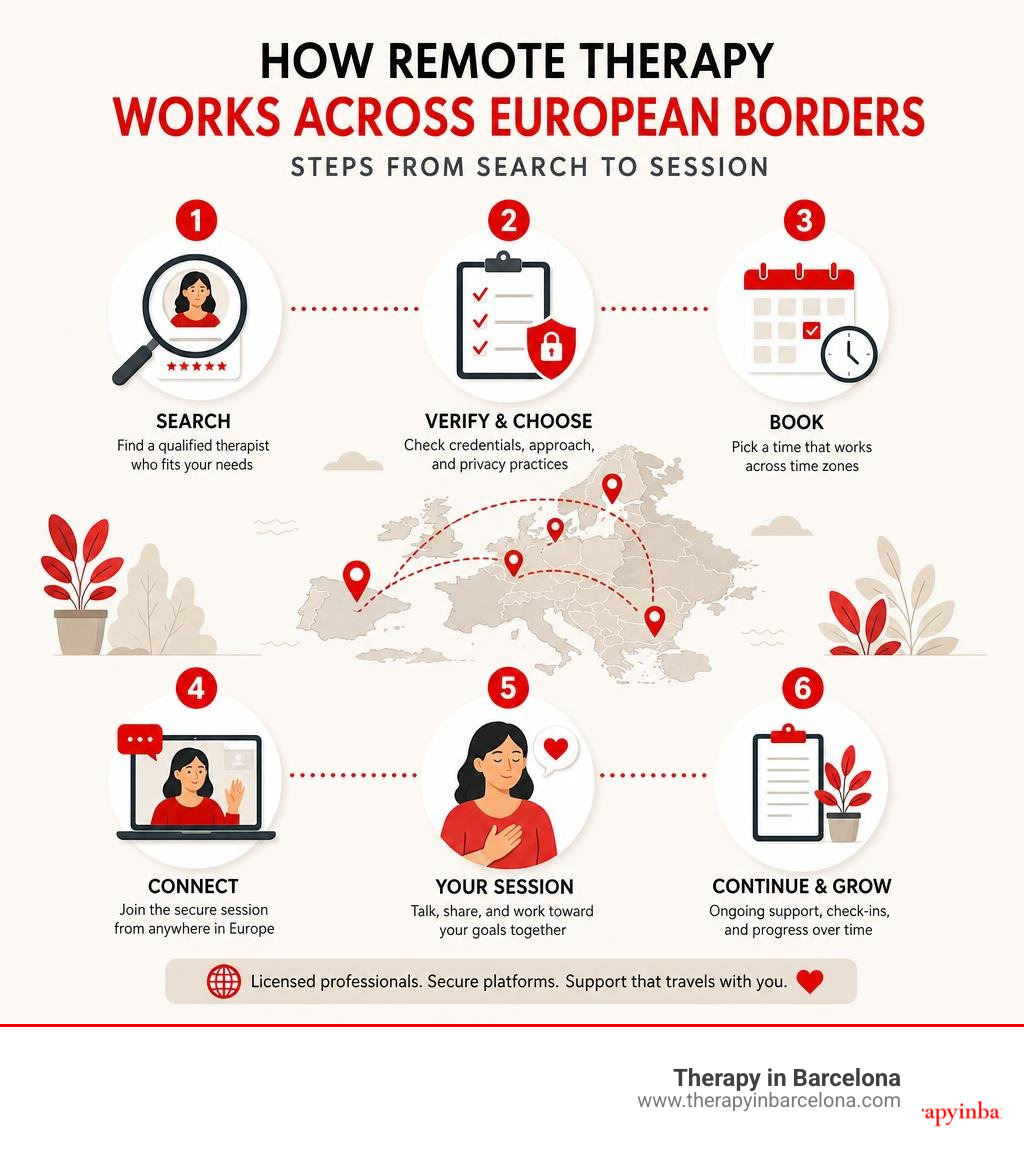
What is Remote Therapy Europe and How Does It Work?
At its core, online therapy is professional mental health support delivered over the internet. Instead of travelling to a physical clinic, you connect with your therapist using a secure digital platform. This can happen through live video sessions, audio-only calls, or secure text messaging.
For expats, digital nomads, and international students, this model is a practical alternative to local, in-person therapy.
In many European countries, accessing public mental health services in English can involve long waiting lists. Private local therapists might not speak your native language or understand the unique stress of moving abroad. Remote sessions help bridge this gap by connecting you with professionals who share your language and understand the expat lifestyle.
To understand how this fits into modern mental health care, you can read this Guide to digital age healing.
Traditional vs. Online Therapy
The primary difference between traditional and remote therapy is the setting. Traditional therapy takes place in a physical office, providing a dedicated, neutral space. Online therapy brings that space to your couch, desk, or hotel room.
While some clients miss the physical transition of travelling to an office, others find that being in a familiar, comfortable environment makes it easier to open up. For those with busy work schedules or family commitments, saving travel time is a significant advantage.
Equivalence of Care
Many people wonder if online therapy is as effective as sitting in the same room with a practitioner. As explored in this Guide to digital age healing, online support is widely understood to be highly effective, with the therapeutic alliance — the quality of the relationship and trust between you and your therapist — translating remarkably well to video and audio formats.
Whether you are addressing persistent worry, low mood, difficult life events, or relationship struggles, the therapeutic process remains structurally the same. The focus is on communication, evidence-based interventions, and collaborative goal-setting.

Navigating the Landscape of Online Therapy Platforms in Europe
When looking for support, you will generally encounter three main avenues: public health systems, large global platforms, and specialised local private practices.
- Public Health Systems: While affordable or free, public mental health systems in European countries often suffer from long waiting times. Administrative processes are almost always conducted in the local language, making them difficult for new arrivals to navigate.
- Large Online Platforms: Companies operate on a high-volume subscription model. They match you with therapists using automated algorithms. While convenient, these platforms sometimes face criticism for impersonal matching, high therapist turnover, and concerns regarding data privacy.
- Local Private Practices and Directories: These offer a more personalised, human-centred approach. They focus on tailored matching and employ therapists who specialised in cross-cultural challenges.
Unlike large subscription platforms that may sell or share user data, or public health systems with long waiting lists and language barriers, specialised practices like Therapy in Barcelona offer strict privacy (with absolutely no data selling), bespoke therapist matching, and culturally sensitive support in your native language.
If you are moving around frequently, you can read this Digital nomad therapy guide to see how to maintain continuity of care on the road.
Comparing European Online Therapy Options
To help you understand your choices in 2026, here is an honest, mobile-friendly breakdown of the prominent directories and platforms available across Europe.
Expat Therapy 4U
This directory focuses specifically on the international expat community. It features a network of private therapists who have personal and professional experience with the challenges of living abroad.
- Matching Process: Clients can browse the directory or use search filters to find a therapist based on language, location, and area of expertise.
- Pricing: This is a private-pay directory. Fees are set individually by each therapist, though many offer sliding scale options based on financial need.
- User Experience: Straightforward, directory-style search that allows you to contact therapists directly. You can explore their profiles on Expat Therapy 4U.
It’s Complicated
A therapist-founded directory designed to provide a highly transparent and human-centric matching experience.
- Matching Process: Offers a free matching survey that is reviewed with human assistance rather than relying solely on automated algorithms.
- Pricing: Private-pay system where therapists set their own rates. Some practitioners offer lower sliding-scale rates for students or those under financial strain.
- User Experience: Highly customisable filters, secure messaging, and a focus on therapist-client compatibility. You can explore it here.
BetterHelp
The largest global subscription-based online therapy platform.
- Matching Process: Uses an automated algorithmic questionnaire to match you with a therapist.
- Pricing: Weekly subscription fees billed monthly.
- User Experience: Convenient app-based communication, including text messaging and video sessions, though matches can sometimes feel less tailored to specific expat nuances. Explore here.
TherapyRoute
A global directory that helps clients locate mental health professionals based on geographic proximity and clinical specialities.
- Matching Process: Self-directed search using location, language, and therapeutic framework filters.
- Pricing: Private-pay; fees are negotiated directly with the chosen practitioner.
- User Experience: Simple, map-integrated directory that covers both online and in-person options worldwide.
Licensing, Regulation, and Privacy Across European Borders
One of the most complex parts of remote therapy in Europe is how licensing and regulation work across different countries. Unlike the United States, where therapists are usually restricted to the state where they are licensed, Europe has a more varied regulatory landscape.
Some European countries have highly regulated professional titles, while others have fewer restrictions on who can call themselves a counsellor. For example, therapists registered under German BDP standards or other formal national registers are subject to professional codes of conduct. These standards help protect clients and support ethical practice.
Data privacy is another key point. Any professional platform operating in Europe must comply with the General Data Protection Regulation (GDPR). This helps ensure your personal information, session notes, and communication logs are stored securely and are not shared or sold.
You can read the European Commission overview of GDPR and data protection rules for more background.
To learn more about how secure platforms protect your confidentiality, see this Guide to secure online therapy.

How to Verify Credentials for Remote Therapy in Europe
Because professional titles vary, you should always take a few steps to verify your therapist’s qualifications before starting:
- Check their professional registration: Ask which national regulatory body or professional association they are registered with, such as the BDP in Germany, the NIP in the Netherlands, or equivalent bodies in Spain.
- Review their training background: Ensure they hold a university degree in psychology, clinical psychology, psychotherapy, or an equivalent recognised qualification.
- Inquire about expat experience: A highly qualified therapist who has never worked with internationals may struggle to understand the specific stresses of relocation.
- Use local directories: Trusted professional directories often vet qualifications beforehand. For example, if you are looking for local support in Spain, you can search for a registered English-speaking therapist in Malaga or find vetted therapists in Las Palmas de Gran Canaria.
Practical Considerations for Starting Remote Therapy Europe
To get the most out of your online sessions, keep these practical tips in mind:
- Time Zones: If you are travelling or working across borders, make sure your therapist’s availability aligns with your schedule. Many online therapists are used to working across European time zones, including CET, GMT, and EET.
- Technical Setup: Test your internet connection, camera, and microphone before your first session. Using headphones can improve audio quality and help keep your conversation private.
- Private Spaces: Choose a quiet, secure room where you will not be interrupted. Avoid public spaces like cafes or shared offices. Your therapist needs to know you are in a safe, confidential environment to do deeper therapeutic work.
- Somatic Alignment: For body-aware therapies, try to position your camera so your upper body is visible. This allows your therapist to observe somatic cues like breathing patterns and posture.
For a deeper dive into setting up your therapy space in Spain, read this Online therapy in Spain guide. You can also explore how these digital connections fit into a broader lifestyle in this article on the Global wellness web.
The Expat Experience: Addressing Culture Shock, Identity, and Language Barriers
Living abroad is a complex emotional journey. While it brings adventure, it also brings unique mental health challenges that are often misunderstood by those who have never relocated.
Common Expat Mental Health Challenges
- The Loss of a Support Network: Leaving behind friends, family, and familiar routines can trigger intense feelings of isolation.
- Identity Confusion: When you are no longer defined by your old job, language, or social circle, you may struggle with who you are in your new environment.
- Language Barriers in Vulnerable Moments: Expressing complex emotions, grief, or difficult life events is incredibly difficult in a second language. Emotional processing often needs to happen in your native tongue.
- The “Trailing Spouse” Dynamic: When one partner relocates for a career and the other has to rebuild their life from scratch, it can create unexpressed resentment and relationship strain.
- Third-Culture Kid (TCK) Challenges: Children growing up between multiple cultures often face unique questions of belonging and home.
Many people who move abroad experience challenges that are difficult to anticipate. The excitement of a new job or lifestyle can be accompanied by loneliness, persistent worry, and the pressure to appear happy, especially when life seems perfect on social media. These experiences are common and can make adjusting to a new country more emotionally demanding than expected.
Many people looking for support abroad encounter long waiting lists and language barriers in the local healthcare system. Remote therapy in Europe makes it easier to connect with an English-speaking therapist who understands the unique emotional challenges of expat life. This support can help people process feelings of isolation, adapt to a new environment, and rebuild their confidence.
These experiences are common among internationals living in Spanish cities such as Málaga, Alicante, and Madrid. Whether you are navigating life in a bustling capital or a coastal town, working with a therapist who understands your cultural background can make therapy more effective and meaningful.
Frequently Asked Questions About Online Therapy in Europe
Is online therapy as effective as in-person sessions?
Yes. Experience and professional consensus show that online sessions are highly effective, producing excellent outcomes for a wide range of concerns, including persistent worry, low mood, and stress.
The most critical factor in therapy is the relationship you build with your therapist. This connection can be established just as deeply over a secure video or audio link as it can in an office.
How much does remote therapy cost in Europe and is it covered by insurance?
Because this is a private-pay service, fees vary depending on the therapist’s location, qualifications, and area of expertise. Some therapists offer sliding scale fees for those with financial need, such as students or those experiencing job transitions. It is always worth asking about this during your initial contact.
For insurance, many private international plans offer partial or full reimbursement for therapy sessions. If you plan to claim, ask your therapist if they can provide official receipts with the necessary professional registration numbers for your provider.
Can I access specialised support like couples or teen therapy online?
Absolutely. Online therapy is highly adaptable. Many couples find online sessions easier to coordinate, especially if one partner travels for work or if they are living in different cities. Online therapy also works well for teenagers and international students who are comfortable using digital platforms.
If you are looking for specific support, you can read these dedicated guides:
Finding Your Way Forward
Finding the right mental health support when you are living abroad does not have to be an overwhelming task. While public systems can be slow and automated platforms can feel impersonal, personalised matching offers a supportive way forward.
At Therapy in Barcelona, we understand that life abroad can be beautiful, messy, and challenging all at once. Founded in 2011 by Leigh Matthews — an Australian psychologist, expat, and supervisor who moved to Spain and experienced these transitions — our practice is built on empathy, professional excellence, and a deep understanding of the international experience.
We are a collaborative group of highly qualified, psychology-trained therapists who are expats ourselves. We provide online therapy to English-speaking internationals worldwide, including the USA and Canada, as well as in-person sessions at our welcoming office in Barcelona.
Our team draws on a wide range of evidence-based approaches, including Cognitive Behavioural Therapy (CBT), Acceptance and Commitment Therapy (ACT), Schema Therapy, and Internal Family Systems (IFS). We take the time to gather information during our intake process to ensure we make a personalised match between you and the therapist best suited to your unique goals.
You do not have to navigate the ups and downs of living abroad alone. If you would like support, Book a Free Discovery Call today to find a therapist who truly understands your journey.
