


What Are Therapeutic Interview Questions — and Why Do They Matter for Your Job Interview?

Therapeutic interview questions are intentional prompts therapists use to build rapport, gather information, and support client insight and change. In a therapist job interview, you’ll also be expected to demonstrate how you use these questions effectively.
Here’s a quick overview of what hiring panels typically want to see:
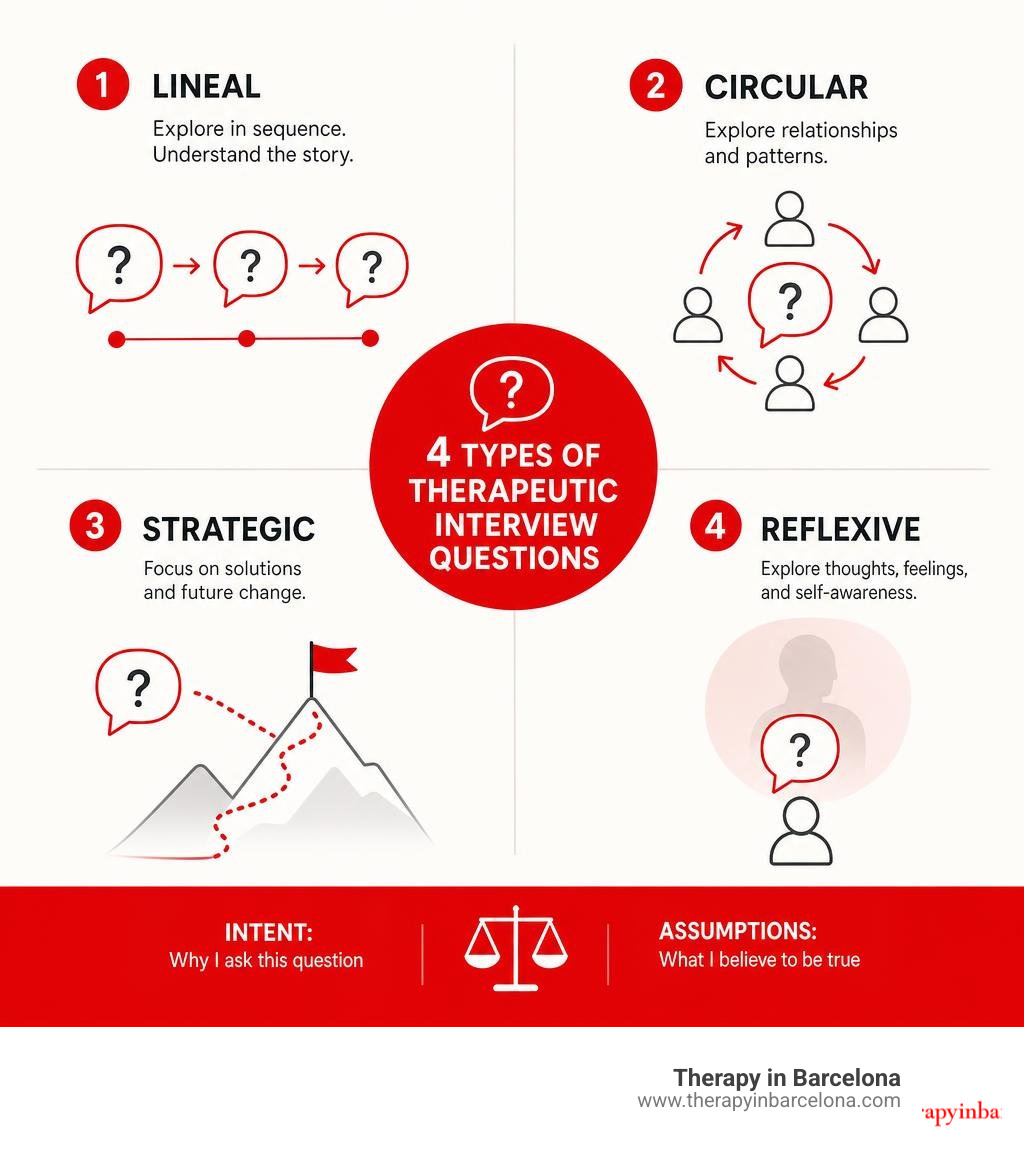
- Your practice framework — Can you explain the difference between lineal, circular, strategic, and reflexive questions, and when to use each?
- Your modality expertise — Are you comfortable with CBT Socratic questioning, solution-focused techniques, or systemic approaches?
- Your ethical judgement — How do you handle intrusive questions, client resistance, or crisis moments?
- Your cultural competence — Can you adapt your questioning style across diverse and multicultural client populations?
- Your self-awareness — Do you understand how your own assumptions shape the questions you ask?
That covers the essentials. Read on for a deeper breakdown of each area, with practical guidance on how to answer the toughest questions with clarity and confidence.
Getting a therapist role is genuinely competitive. Most candidates prepare answers about their experience and qualifications — but fewer think carefully about how they talk about the act of questioning itself.
Yet according to research published in the *British Journal of Psychiatry*, the specific types of questions a practitioner asks have measurable effects on therapeutic alliance and client outcomes. Interviewers at good practices know this.
The good news is that preparation makes a real difference. Therapists who can articulate a coherent, evidence-informed approach to questioning tend to come across as more mature in their practice — not because they’ve memorised a script, but because they’ve actually reflected on their practice. That reflection is exactly what this guide is designed to support.
Whether you’re applying for a role in Barcelona, Valencia, Madrid, or anywhere else in Spain, the principles here apply. The practice frameworks are universal; the cultural sensitivity is something you’ll want to tailor.
Understanding the Core Framework of Therapeutic Interview Questions
To talk confidently about therapeutic interview questions in a job interview, you need a solid grasp of how questions function. A therapist’s questions are never neutral. They are shaped by underlying assumptions and carry distinct therapeutic intentions.
Karl Tomm’s classic framework offers a brilliant way to categorise these questions along two main axes: the therapist’s intent (orienting vs. influencing) and the therapist’s assumptions (lineal vs. circular).
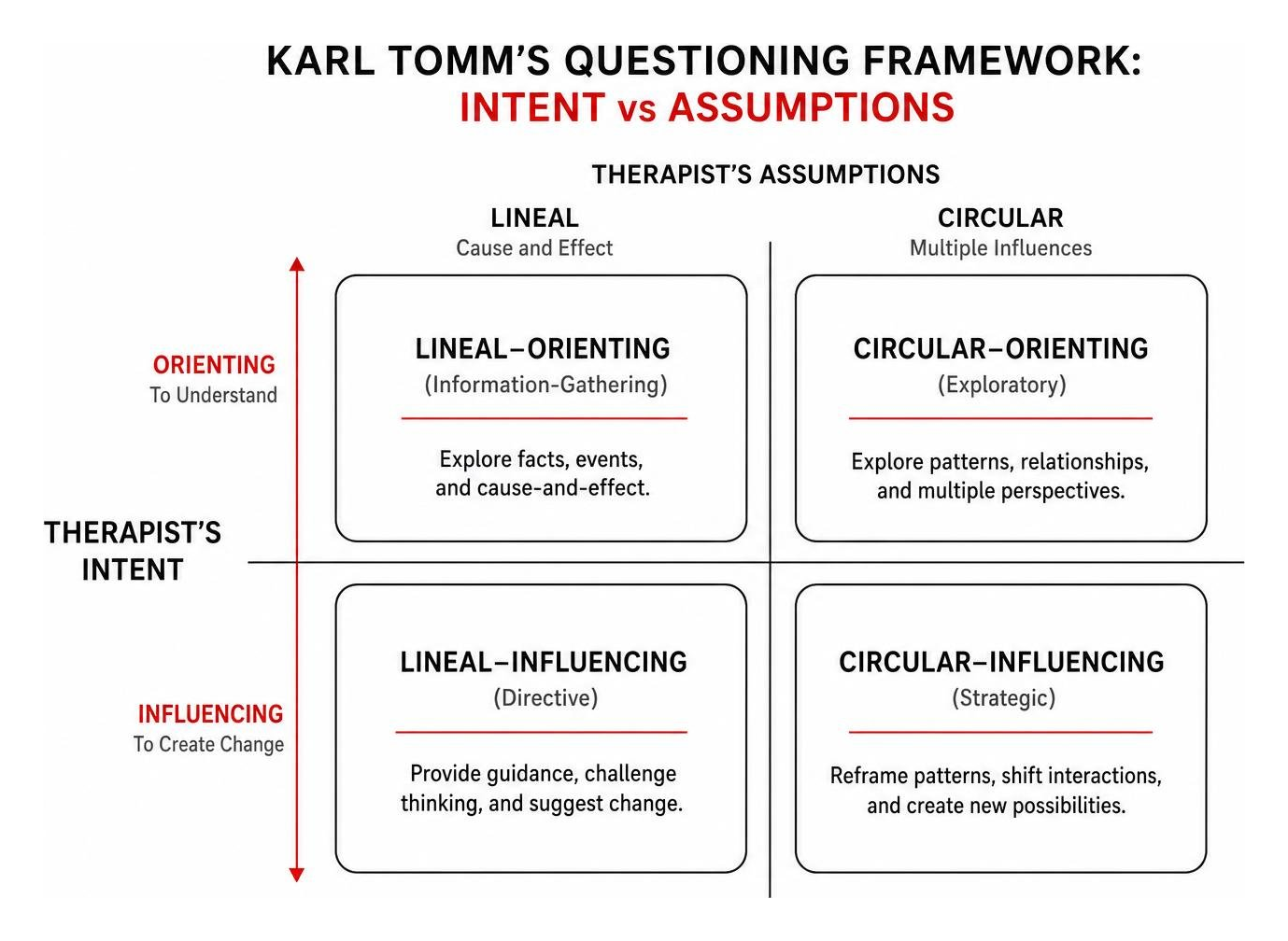
When you understand this framework, you can explain to an interviewer exactly why you choose a specific question at any given moment in a session.
Lineal Questions
- Intent and Assumptions: Lineal questions are based on linear, cause-and-effect assumptions. The therapist’s intent is primarily to orient themselves to the client’s situation (information-gathering).
- Effect on Client: These questions gather key information but, if overused, can make clients feel judged or defensive by focusing on blame or cause.
- Practice Example: “What specific feelings of worry have you experienced this week?” or “When did this difficulty first start?”
Circular Questions
- Intent and Assumptions: Circular questions explore relationships and recurring patterns, helping therapists understand how people influence one another within a system.
- Effect on Client: These questions promote neutrality, curiosity, and systemic exploration. They help clients see their struggles as part of an interactive web rather than an individual defect, which reduces self-blame.
- Practice Example: “How does your partner react when you become quiet during an argument?” or “Who worries the most when you get stressed?”
Strategic Questions
- Intent and Assumptions: Strategic questions aim to guide clients toward a specific insight or change the therapist believes is helpful.
- Effect on Client: These are highly directive and confrontational. They can be useful for challenging avoidance, but they risk disrupting the therapeutic alliance if used too early or too aggressively.
- Practice Example: “Why don’t you try going for a walk instead of staying in bed when you feel low?”
Reflexive Questions
- Intent and Assumptions: Reflexive questions encourage clients to reflect on their perspectives, consider alternatives, and generate their own insights for change.
- Effect on Client: These questions respect client autonomy and foster self-discovery. They trigger internal reflection rather than directing a specific behaviour, keeping the client in the driver’s seat of their own healing.
- Practice Example: “If you were to show yourself a bit more compassion next week, how might that change the way you respond to your mistakes?”
The Impact on Alliance and Adherence
Linguistic research highlights the power of syntax in therapeutic conversations. A landmark study on the Effect of questions used by psychiatrists on therapeutic alliance and adherence showed that different question formats yield vastly different outcomes.
While open-ended questions support exploration, declarative questions that reflect a client’s experience are linked to stronger therapeutic alliances and better treatment adherence.
Conversely, an over-reliance on rigid “wh-” questions (who, what, where, why) can sometimes feel interrogative and actually damage the alliance, especially with highly anxious or distressed clients.
How to Demonstrate Mastery in Your Job Interview

When you sit down for an interview, the hiring panel isn’t just looking for a list of modalities you’ve studied. They want to see how you think on your feet, how you build a therapist-client relationship, and how you translate theory into real-time decisions.
To prepare effectively, it is helpful to review resources like Before the Interview to ground your professional presentation, and study common Therapist Interview Questions to understand what employers are looking for.
During the interview, highlight your commitment to active listening. Explain that while questions are a powerful tool, they must always serve the therapeutic relationship. A great therapist knows when to stop asking questions and make space for silence, reflection, or simple validation.
You can also discuss how you use Essential Counseling Questions to Actually Get Students Talking or adults opening up, showing that your questioning style is always tailored to the client’s developmental stage.
Answering Questions on Modality-Specific Therapeutic Interview Questions
Interviewers will likely ask how you integrate different therapeutic modalities into your questioning style. Be ready to give concrete examples of how you shift your language based on the model you are using:
- Cognitive Behavioural Therapy (CBT): Highlight your use of Socratic questioning to help clients examine their automatic thoughts, evaluate the evidence, and develop more balanced perspectives.
- Acceptance and Commitment Therapy (ACT): Focus on values-based questioning. Show how you help clients clarify what matters to them and explore their willingness to carry difficult emotions in service of those values.
- Solution-Focused Brief Therapy (SFBT): Show how you use future-oriented questions, such as scaling and the Miracle Question, to help clients envision their preferred future.
- Systemic and Family Therapy: Explain how you use circular questioning to map relational patterns and shift the focus from an “identified patient” to the broader family system.
Handling Tough Scenarios and Ethical Dilemmas in Therapeutic Interview Questions
One of the most common ways interviewers test professional maturity is by throwing a difficult scenario at you. They might ask: “How do you handle a client who asks you highly personal, intrusive questions?” or “What do you do if a client becomes highly distressed by a question you’ve asked?”
To answer these questions with ease:
- Prioritise Safety and Containment: Explain that if a client is in crisis, your questioning shifts immediately to safety-specific, structured inquiries to assess risk and establish a plan.
- Maintain Clear Ethical Boundaries: If clients ask personal questions, validate their curiosity and gently redirect the focus to their experience.
- Repair Alliance Breaches Quickly: If a question causes distress, pause, validate the client’s feelings, and explore their reaction together rather than pushing forward.
Adapting Your Questioning Style to Diverse and Expat Populations

For international clients, demonstrate cultural sensitivity and awareness of expat challenges, including isolation, identity shifts, and bicultural relationship stress.
Consider a fictional composite example representing common expat challenges: a person who moved abroad for a fresh start but found themselves feeling overwhelmed, unmotivated, and persistently low while struggling to adapt to the local work culture.
A rigid, highly structured intake process may feel alienating for expat clients. Instead, use culturally sensitive, open-ended questions to explore their sense of belonging, connection to their home country, and the grief that can come with relocation.
When interviewing for roles in diverse Spanish hubs — whether in Barcelona, Málaga, or Alicante — show that you understand these dynamics. Explain how you adapt your therapeutic interview questions to:
- Acknowledge Language Barriers: If a client is processing deep emotional pain in their second or third language, questions must be simpler, slower, and highly patient.
- Explore Cultural Adjustments: Use questions that look at the intersection of the client’s native values and their new environment.
- Foster Self-Awareness: Help clients map their strengths as survivors of a major life transition, utilising frameworks like The Ultimate List of Therapeutic Questions for Self-Awareness.
Frequently Asked Questions about Therapist Job Interviews
What is the difference between open and closed questions in a therapeutic setting?
Open-ended questions (e.g., “How have you been coping with the move to Madrid?”) invite the client to share their story in their own words, which is crucial for building a strong therapeutic alliance and gathering rich qualitative data.
Closed questions (e.g., “Have you experienced panic attacks this week?”) require simple, specific answers. While closed questions are helpful for rapid information gathering and safety assessments, they can feel clinical and restrictive if overused.
Striking a balance — and incorporating declarative questions to show empathy — is key to maintaining a warm, collaborative dialogue.
How do I handle a client who is hesitant to answer questions?
Client resistance is usually a sign that the pace of therapy is moving faster than the level of trust. If a client is hesitant to open up, the best approach is to step back, show empathy, and slow down the pacing.
Instead of pushing for answers, validate their discomfort: “I notice it feels quite difficult to talk about this right now, and that is completely okay. We don’t have to go there until you feel ready.” Shifting to collaborative, non-threatening topics helps rebuild safety and strengthens the therapeutic relationship.
How should I prepare for a mental health job interview?
Focus on preparing structured frameworks for common scenarios, and be ready to discuss your commitment to ongoing professional development, peer review, and supervision.
Additionally, highlight your personal self-care practices. Mental health work can be emotionally demanding, and directors want to hire therapists who are proactive about preventing burnout and managing secondary trauma.
Finding the Right Fit
Mastering the art of the therapeutic interview is an ongoing journey. When you can talk about your questioning style with a blend of theoretical clarity, ethical integrity, and genuine human warmth, you will stand out in any job interview.
If you are an expat therapist looking for a supportive, professional community, or an international client seeking a safe space to heal, finding the right fit is everything.
At Therapy in Barcelona, founded in 2011 by Australian Psychologist Leigh Matthews, we understand this deeply. Leigh moved to Spain in 2011 and experienced the challenges of cultural adjustment firsthand.
Unable to find the culturally sensitive, English-speaking support she needed, she founded the practice to serve the international community.
Today, Therapy in Barcelona is a trusted group practice of highly qualified, psychology-trained expat professionals. We offer multilingual therapy (including English, German, French, Spanish, Portuguese, and more) both online worldwide and in-person at our central offices in Barcelona.
Comparing Your Support Options in Spain
When navigating mental health support in Spain, it is helpful to understand how different services compare:
- Public System Clinicians: While free, the public health system in Spain often involves long waiting lists, strict limits on session frequency, and a lack of choice regarding your therapist’s language or cultural background.
- Large Online Platforms: These platforms offer convenience, but they often rely on automated matching, have high therapist turnover, and raise valid concerns regarding data privacy and the selling of personal information.
- Local Generalist Practices: Local clinics can be excellent, but they may lack specific expertise in the unique challenges of the expat experience, such as cultural adjustment, isolation, and bicultural relationship dynamics.
- Therapy in Barcelona: We offer personalised therapist matching, complete privacy, and experienced expat-focused professionals. Sliding scale fees are also available to support accessibility.
If you are ready to take the next step in your professional or personal journey, we would love to connect.
Book your Free Discovery Call today to find out how our team can support you.
