


Why the Hardest Questions in Therapy Are Often the Most Important

Knowing the right hard questions to ask your therapist can genuinely change the quality of your care — but most people never ask them. They show up, answer what they’re asked, and quietly wonder whether any of it is working.
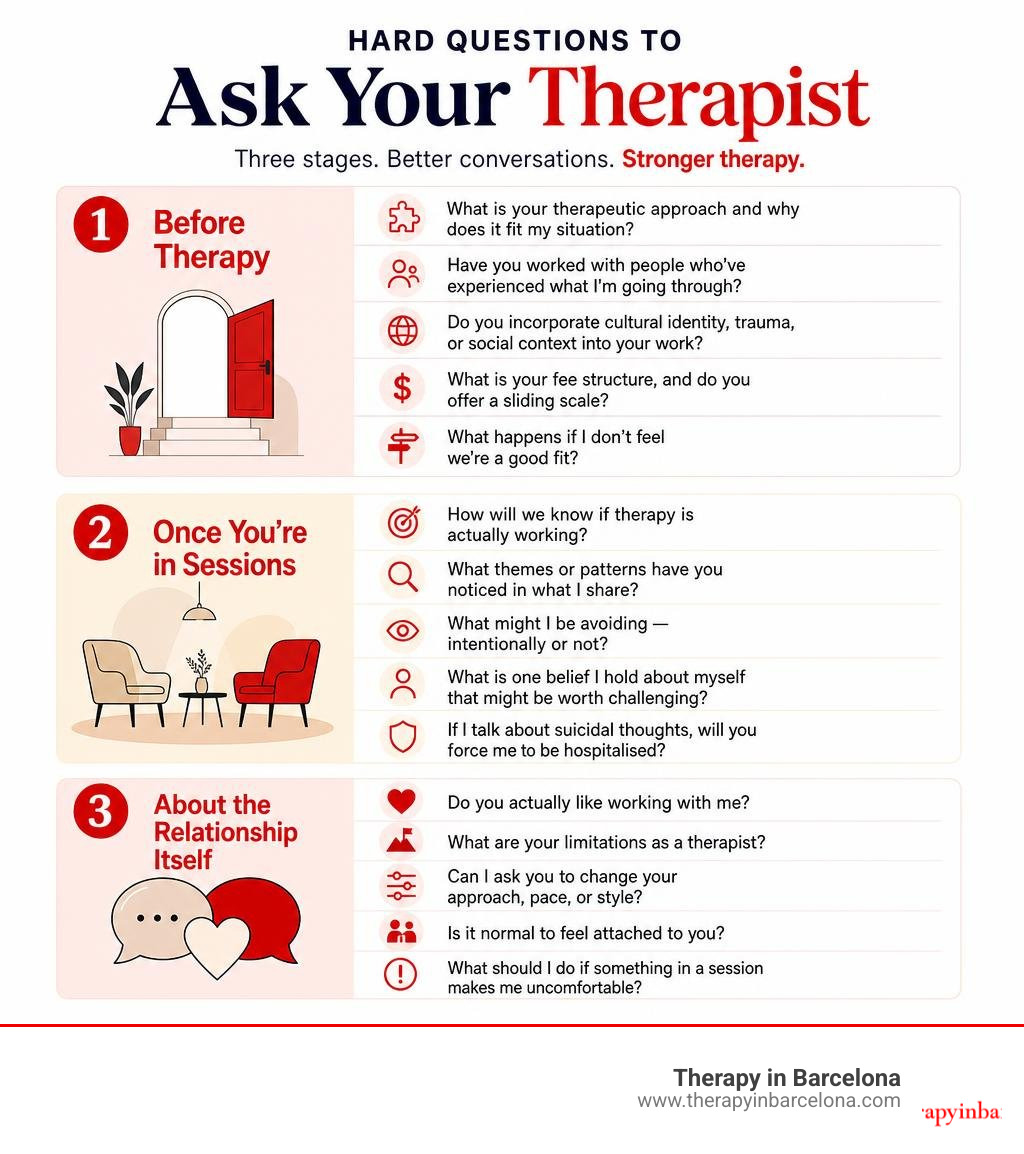
Here are the most important hard questions to bring into therapy, organised by when to ask them:
Before you begin:
- What is your therapeutic approach and why does it fit my situation?
- Have you worked with people who’ve experienced what I’m going through?
- Do you incorporate cultural identity, trauma, or social context into your work?
- What is your fee structure, and do you offer a sliding scale?
- What happens if I don’t feel we’re a good fit?
Once you’re in sessions:
- How will we know if therapy is actually working?
- What themes or patterns have you noticed in what I share?
- What might I be avoiding — intentionally or not?
- What is one belief I hold about myself that might be worth challenging?
- If I talk about suicidal thoughts, will you force me to be hospitalised?
About the relationship itself:
- Do you actually like working with me?
- What are your limitations as a therapist?
- Can I ask you to change your approach, pace, or style?
- Is it normal to feel attached to you?
- What should I do if something in a session makes me uncomfortable?
Many people assume therapy is something that happens to them, but meaningful progress depends on active collaboration. One of the strongest predictors of positive outcomes is the therapeutic alliance—the trust, connection, and partnership between you and your therapist. How you engage in the process matters.
Asking questions isn’t a sign of distrust or awkwardness. It’s self-advocacy. And in therapy, that kind of active participation is exactly what makes the work land.
This is especially true if you’re living abroad — in Barcelona, Valencia, Madrid, or elsewhere in Spain — navigating sessions in a second language, or processing experiences that feel hard to explain to someone who hasn’t lived them. The questions you bring into the room shape the care you receive.
Hard Questions to Ask Your Therapist Before You Begin

Choosing a therapist can feel like a guessing game. You scroll through directories, read short bios, and hope for the best. But you have every right to interview your potential therapist during your first conversation or intake session. Asking targeted questions early on helps you assess their competence, structure, and suitability for your specific goals.
According to guidelines from the Ten Questions to Ask Your Psychotherapist – NAMI , a skilled clinician should be able to answer fundamental questions about their training, methods, and expectations clearly and without defensiveness by the third session at the very latest.
Asking About Modality, Experience, and Cultural Context
When you start therapy, you want to know that your therapist isn’t just “shooting from the hip.” Different mental health concerns require different tools.
For example, if you are struggling with panic, a structured approach like Cognitive Behavioural Therapy (CBT) might be highly effective. If you are trying to understand deep-seated relationship dynamics, a psychodynamic or systemic lens might fit better.
Here are a few specific questions to ask:
- “What is your primary therapeutic modality, and how does it fit my specific concern?” A qualified professional will explain their methods — whether it’s CBT, Acceptance and Commitment Therapy (ACT), or Internal Family Systems (IFS) — in plain, jargon-free English.
- “Have you worked with people who have experienced my specific issues before?” It is entirely reasonable to ask about their experience with your exact struggles, whether that is expat burnout, bicultural relationship stress, or complex trauma.
- “Do you incorporate cultural identity, trauma, or social context into your work?” For internationals, it’s important to find a therapist who understands how relocation, language barriers, and cultural adjustment can affect your wellbeing and shape the therapeutic process.
Hard Questions to Ask Your Therapist About Boundaries and Personal Disclosures
Therapy is a unique relationship. It is deeply intimate, yet entirely one-sided. This boundary can sometimes feel unnatural, leading to unexpressed doubts or confusion. Bringing these questions into the open helps clarify the “rules of engagement.”
- “Can I ask you personal questions about your life?” Different therapists have different boundaries around self-disclosure. Some practice strict neutrality, while others share small personal details if they believe it serves your growth. Asking this directly helps you understand their boundaries.
- “What is your availability, cancellation policy, and fee structure?” Clear, transparent fees help build trust. As a private-pay practice, Therapy in Barcelona offers personalised care with a strong focus on privacy. Some therapists also offer sliding scale fees for clients experiencing financial hardship.
- “Am I allowed to request extra sessions, change topics, or share creative work I have made?” Yes. Sharing journal entries, artwork, or music that reflects your emotional experience can be valuable and help create a more collaborative therapeutic process. For more on setting these expectations, see 3 Key Questions to Ask a New Therapist or Coach .
Tough Questions About the Therapeutic Relationship and Fit

Even after finding a therapist with the right credentials, the day-to-day relationship can bring up doubts. Perhaps they said something that didn’t sit right, or maybe you feel the pace is too fast.
According to a guide on What should you do if you have doubts about your therapist? | Psyche Guides , doubts are a normal part of the process. Sometimes, they arise because therapy is working — bringing buried feelings to the surface. Other times, they point to a genuine mismatch in style or expertise.
Navigating Discomfort, Ruptures, and Changing the Pace
A “rupture” is any moment where the connection between you and your therapist feels strained, misunderstood, or broken. How a therapist handles a rupture is the ultimate test of their professional maturity.
- “What should I do if I feel uncomfortable or unsure about something that happens in our sessions?” A good therapist will actively encourage you to voice this. Repairing a rupture in therapy is often where the deepest healing happens, as it models how to handle conflict safely in your outside life.
- “What is your role in sessions versus mine, and how do you like to begin?” Some therapists expect you to lead the conversation completely, while others provide a clear, collaborative structure. Knowing this upfront prevents the awkwardness of wondering who is supposed to speak first.
- “Can I ask you to change your approach, pace, or style if it is not working for me?” Absolutely. Therapy is your time. If you feel you need more practical coping strategies and fewer reflective questions, say so. If you need inspiration on how to structure these conversations, read about 7 Proven Ways to Decide What to Discuss in Therapy.
The Hardest Question: Suicidal Thoughts and Hospitalisation
One of the most terrifying barriers to being completely honest in therapy is the fear of consequences. Many people experience passive suicidal thoughts — a desire to disappear, sleep, or escape pain — without any active intent or plan to end their life. Yet, they stay silent out of fear of being locked away.
- “If I talk about suicidal thoughts, will you force me to be hospitalised?”
An experienced, ethical therapist will answer this with nuance and compassion. Forced hospitalisation is incredibly rare and is reserved strictly as a last resort for imminent, active danger where a person has a clear plan, intent, and immediate means to harm themselves.
In almost all other cases, sharing these thoughts is met with safety planning, emotional support, and a collaborative effort to ease your pain. Discussing your fears about this protocol upfront can create a massive sense of relief and safety.
How to Ask If Your Therapy Is Actually Working
Therapy shouldn’t feel like an endless loop of venting without change. While healing is rarely linear, you should see shifts in how you relate to yourself and others over time.
As highlighted in Is Your Therapy Working? Ask These 4 Questions | Psychology Today , effective therapy operates like transparent healthcare. It requires clear plans, collaboration, and structured goals rather than just open-ended conversation.
Measuring Progress and Handling Plateaus
To keep your therapy on track, you must be able to discuss progress openly. You can ask your therapist:
- “How do you know when therapy is working, and how do you measure our progress?” A skilled clinician won’t rely on vague feelings. They will point to concrete shifts: changes in your symptom frequency, how you handle triggers, or your ability to set boundaries.
- “What can I expect from our work together in the short-term and long-term?” Short-term therapy focuses on immediate challenges and coping skills, while long-term therapy explores deeper patterns and lasting change. Agreeing on your goals and timeline helps keep therapy on track. For practical check-in prompts to use during your sessions, consult Mind Over Matter: Essential Therapeutic Check-In Questions for Your Next Session.
What To Do When You Feel Stuck or Want to Shift Approaches
It is incredibly common to hit a plateau. You might feel like you’ve run out of things to say, or that the current approach has taken you as far as it can.
- “How do you help clients when they feel stuck, overwhelmed, or want to shift how we work together?”
If you feel stuck, name it. A professional therapist will welcome this feedback. It might mean it’s time to shift from a reflective talk therapy approach to something more experiential, like Somatic IFS or Art Therapy. If your therapist gets defensive or blames you for “not doing the work,” it is a significant yellow flag.
Deep Questions to Ask Your Therapist About Yourself
Once you have established a strong therapeutic alliance, you can use the relationship as a mirror to explore your inner world. These are the deep, self-reflective questions that accelerate personal growth. You can find more inspiration for these deeper conversations in this guide on Unlock Your Inner World: Deep Therapy Questions for Adults.
Unpacking Your Patterns, Triggers, and Avoidance
Your therapist observes you objectively for 50 minutes at a time. They notice how your voice changes when you talk about certain people, when you hold your breath, and what topics you quickly steer away from.
- “What themes, patterns, or strengths have you noticed in the things I share?” Often, we are too close to our own lives to see the patterns. Your therapist can help you connect the dots between your childhood dynamics and your current relationship struggles.
- “Why do I tend to react so strongly to certain triggers, and what might I be avoiding?” Avoidance may bring short-term relief but can slow long-term progress. Asking your therapist to help you recognise these patterns is a valuable step toward greater self-awareness.
Finding Disconnected Parts and Challenging Core Beliefs
We all carry internal narratives that dictate how we show up in the world. Often, these beliefs were formed in childhood to keep us safe, but they no longer serve us as adults.
- “Are there parts of myself I seem disconnected from, and how can I practice more self-compassion?” If you grew up needing to be “the strong one,” you might be deeply disconnected from your vulnerable, emotional parts. Your therapist can help you welcome these parts back without judgment.
- “What is one belief I hold about myself that might be worth challenging, and what is one small shift I could try between sessions?” Real change happens in the days between your therapy appointments. Asking for one micro-action or shift in perspective ensures that your insights translate into real-world change.
Frequently Asked Questions About Therapy Dynamics
What If I Feel Too Nervous to Ask These Hard Questions to Ask Your Therapist?
It is entirely normal to feel nervous. Asking a professional direct questions can feel confrontational, especially if you struggle with people-pleasing.
The easiest approach is to acknowledge the awkwardness. You can say, “I have a question that feels difficult to ask, but I know it’s important,” or write it down beforehand. A supportive therapist will help you explore it without judgment.
Can I switch therapists if the fit doesn’t feel right?
Yes, absolutely. If a therapist isn’t the right fit, it’s okay to move on. Staying in therapy out of obligation is unlikely to be helpful and can waste both your time and resources.
An ethical therapist will support your decision, help you clarify what you need, and offer a structured, professional referral to someone whose style or modality might suit you better.
Is it normal to feel attached to my therapist?
Yes, it is incredibly common. For many people, therapy is the first place where they feel completely seen, heard, and accepted without conditions. This creates a powerful sense of safety, which naturally fosters attachment.
An experienced therapist will not be frightened by your attachment. They will normalize it and use it as a safe laboratory to explore your relational patterns, helping you build healthy, secure attachments in your life outside the clinic.
Choosing the Right Path: Comparing Your Mental Health Support Options in Spain
Finding the right support in a foreign country can be confusing. To help you make an informed decision, here is a clear comparison of the primary mental health options available to internationals in Spain.
Public System Clinicians
- Overview: Mental health services provided through the Spanish public healthcare system (CatSalut in Catalonia, or regional equivalents in Madrid, Valencia, and Andalusia).
- Pros: Fully funded and free at the point of care for registered residents paying into the social security system.
- Cons: Extremely long waiting lists (often months between appointments), limited session frequency, and a very high likelihood of not being able to access therapy in English or your native language.
Large Online Platforms
- Overview: Global, tech-driven directory and therapy platforms operating internationally.
- Pros: High immediate availability, instant booking systems, and lower initial price points.
- Cons: Automated matching algorithms that do not account for the nuanced expat experience. These platforms often suffer from high therapist turnover, brief sessions, and potential concerns regarding data privacy and the selling of personal information.
Local Generalist Practices
- Overview: Standard private therapy clinics located within Spanish cities.
- Pros: Face-to-face sessions in a professional local office setting.
- Cons: Often geared primarily toward Spanish residents, with limited understanding of the specific psychological impacts of relocation, cultural adaptation, and the unique isolation felt by the international community.
Therapy in Barcelona (Our Bespoke Approach)
- Overview: A specialised private-pay group practice founded in 2011 by Australian Psychologist Leigh Matthews, dedicated entirely to the international community.
- Pros: Bespoke, human-led therapist matching (no automated algorithms); highly qualified, psychology-trained therapists who are expats themselves; deep cultural sensitivity; strict privacy with absolutely no data selling; and sessions available both in-person in Barcelona and online worldwide (including USA and Canada).
- Cons: Private-pay service, though some of our therapists offer sliding scale fees for those with financial need.
Finding Your Sanctuary with Therapy in Barcelona
Living abroad is an incredible adventure, but it can also be incredibly isolating. When you are navigating culture shock, career transitions, or relationship strain far from home, you deserve a therapeutic space that truly understands your world.
Therapy in Barcelona was founded by Australian Psychologist and expat Leigh Matthews, who moved to Barcelona in 2011. After struggling to find an English-speaking therapist who understood the challenges of relocation, intercultural relationships, and life abroad, she created Therapy in Barcelona to provide specialised support for internationals.
Today, our team of psychology-trained expat therapists provides culturally sensitive support to adults, couples, teens, and families across Spain. We offer therapy in English, German, French, Spanish, Afrikaans, Portuguese, Austrian-German, and Swiss-German, helping internationals feel understood wherever they are.
We don’t believe in one-size-fits-all therapy. We take the time to carefully match you with the therapist best suited to your unique personality, struggles, and goals.
If you are ready to stop guessing and start building a collaborative, effective therapeutic relationship, we invite you to take the first step.
Book a Free Discovery Call today, and let us help you find the support you deserve.
