


The Foundation of Connection: Trust-Building Exercises for Couples

Building a strong relationship relies heavily on trust, and effective trust building exercises for couples can help you deepen your bond. Whether you’re looking to strengthen an already healthy connection or rebuild after a difficult period, these exercises offer practical ways to foster intimacy and understanding.
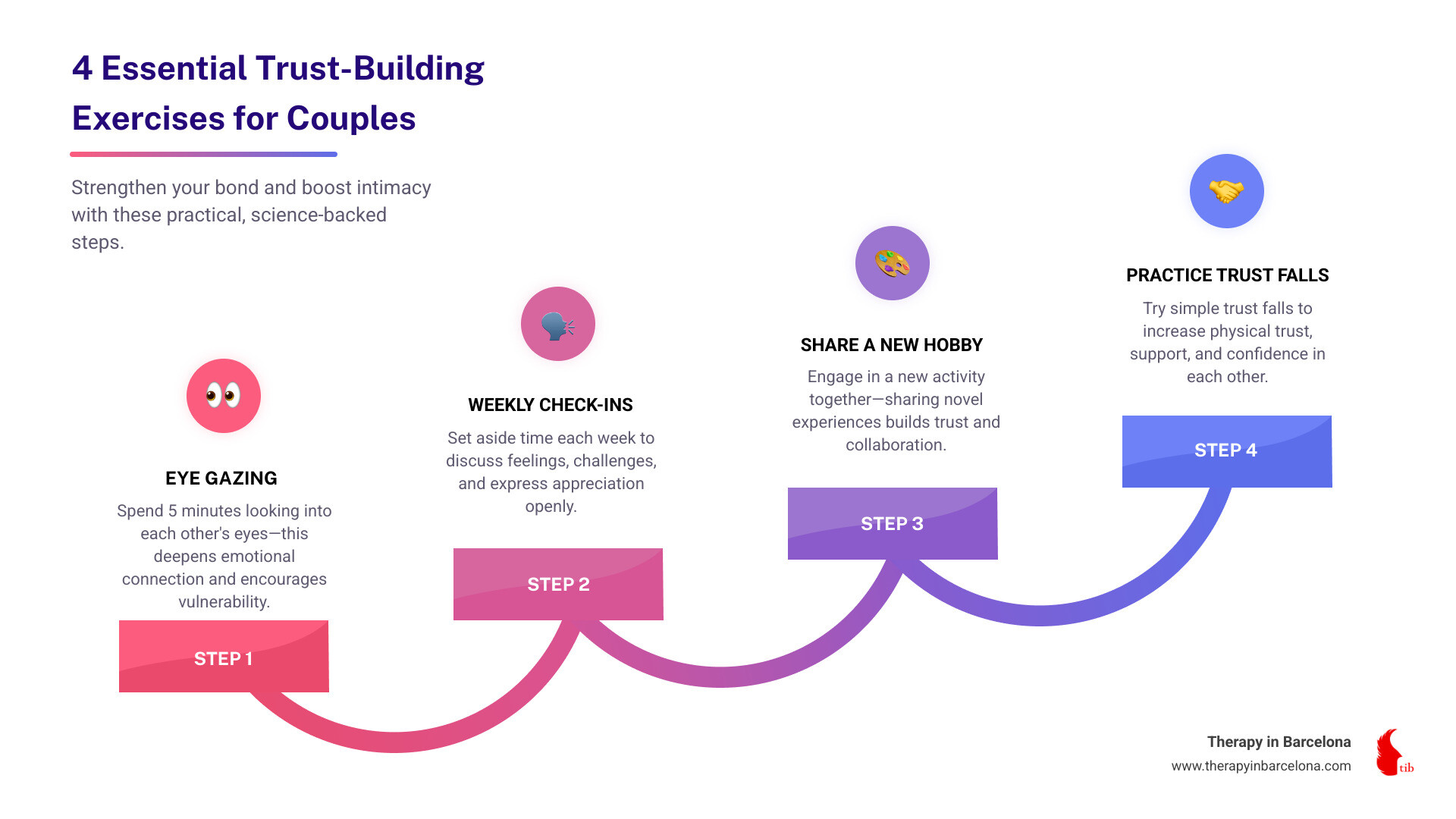
Here are some effective trust building exercises for couples:
- Eye Gazing: Spend a few minutes silently looking into each other’s eyes to deepen emotional connection.
- Weekly Check-Ins: Set aside regular time to openly discuss feelings, challenges, and appreciation.
- Share a New Hobby: Explore something new together to build shared experiences and reliance.
- Simple Trust Falls: Practice physical trust with a partner, building confidence in mutual support.
- Storytelling: Share personal stories or co-create narratives to foster empathy and understanding.
Trust is a cornerstone of any loving partnership. It allows for vulnerability, open communication, and the confidence that your partner has your best interests at heart. When trust is strong, relationships flourish, leading to greater intimacy and satisfaction.
This guide will explore why trust is so vital, how to assess its current level in your relationship, and dive into specific, engaging exercises you can try together.
Why Trust Matters in Love
Trust is the quiet confidence that your partner will be there for you—not just physically, but emotionally, mentally, and spiritually. It’s the belief that they’ll honour their commitments, speak truthfully, and have your best interests at heart. In romantic relationships, trust isn’t just important; it’s the foundation upon which everything else is built.
Think of it this way: you wouldn’t construct a beautiful home on shaky ground, would you? The same principle applies to love. Without trust, even the most passionate feelings can crumble when life gets challenging.
Here’s what might surprise you: research on trust in romantic relationships suggests that trust is one of the foundations that makes deep love possible. Love may create closeness, but trust helps you feel safe enough to be vulnerable, honest, and emotionally open with each other.
When trust is present, something magical happens. Your nervous system relaxes, sending signals to your brain that it’s safe to be vulnerable. This safety allows you to share your deepest fears, wildest dreams, and most authentic self without fear of judgment or betrayal. This vulnerability, in turn, creates the intimacy that makes love flourish.
Trust also creates a positive feedback loop with communication. When you trust your partner, you’re more likely to express your thoughts and feelings openly, knowing they’ll be heard and respected. This honest communication then strengthens trust even further, creating an upward spiral of connection.
The science behind this is fascinating. Trust triggers the release of oxytocin—often called the “bonding hormone”—which deepens emotional connection and promotes feelings of safety and attachment. When couples engage in trust building exercises, they’re literally rewiring their brains for deeper intimacy.
Unfortunately, when trust breaks down, the impact ripples through every aspect of the relationship. Betrayal doesn’t just hurt emotionally; it activates the same pain centres in your brain as physical injury. It can lead to hypervigilance, communication breakdown, and a devastating sense of isolation—even when you’re sitting right next to your partner.
For expats and international couples, trust takes on additional layers of complexity. You might be navigating cultural differences, language barriers, or the stress of building a life together in a foreign country. These challenges can either strengthen your bond or create unexpected friction points that test your foundation.
Building trust with your partner often goes hand-in-hand with developing self-trust. When you trust yourself—your instincts, your boundaries, your worth—you’re better equipped to create healthy relationship dynamics. This self-awareness helps you communicate your needs effectively and recognise when something feels off.
For a deeper dive into the fascinating science behind trust and bonding, you can explore scientific research on why trust matters. Understanding these mechanisms can help you appreciate why investing in trust isn’t just good for your relationship—it’s essential for your emotional and physical wellbeing.
How to Gauge Your Current Trust Level
Before diving into these trust building exercises, it’s helpful to understand where your relationship stands. Think of this as taking the temperature of your trust—not to assign blame, but to identify areas where you can grow together. This process requires honest self-reflection and, perhaps more importantly, open communication with your partner.
Start by having a gentle conversation about some deeper questions. Can you both openly discuss your fears, passions, and goals without fear of judgment? Notice whether you feel truly heard and understood when you share something deeply personal. Pay attention to how your body responds during these conversations—do you feel relaxed and open, or do you notice tension creeping in?
Consider your partner’s reliability in everyday moments. Do you feel confident that they’ll follow through on their promises, whether it’s picking up groceries or supporting you through a difficult time? When you’re facing challenges or difficult decisions, do you genuinely believe your partner has your best interests at heart, even when it might mean they have to sacrifice something they want?
Vulnerability is often the truest test of trust. Are you comfortable sharing all aspects of your life with your partner—your deepest secrets, past mistakes, or current insecurities? More importantly, is there anything you regularly find yourself hiding? These patterns can reveal a lot about the current state of trust in your relationship.
The physical signals your body sends can be incredibly telling. When discussing sensitive topics, do you maintain comfortable eye contact, or do you find yourselves looking away? Do you feel a sense of ease settling into your body, or does tension build up? These non-verbal cues often reveal underlying feelings about trust that we might not even be consciously aware of.
Understanding your attachment style can offer valuable insights too. Someone with an insecure attachment style might naturally struggle more with trust, potentially leading to anxiety or avoidance in relationships. Recognising these patterns isn’t about labeling yourself—it’s about understanding your tendencies so you can work with them rather than against them.
Healthy boundaries actually strengthen trust rather than diminish it. When partners respect each other’s boundaries around personal space, time, or emotional capacity, it creates a foundation of mutual respect. Notice how you and your partner handle boundaries—do you honour each other’s needs, or do you find yourselves pushing against them?
If you’re struggling to discuss these questions openly, or if you find significant differences in how you each perceive trust in your relationship, don’t worry. These findies simply point to areas where trust building exercises can be most beneficial. Learning how and when to use “I statements” can be incredibly helpful in these conversations, allowing you to express your feelings without your partner feeling attacked or defensive.
This assessment isn’t about achieving perfection—it’s about creating awareness. Every relationship has areas that could use strengthening, and acknowledging them is actually a sign of a healthy partnership willing to grow together.

7 Fun Trust Building Exercises for Couples
Ready to strengthen your connection through some engaging activities? These trust building exercises are designed to be enjoyable, meaningful, and perfectly adaptable to your unique relationship dynamic. The beauty lies not in achieving perfection, but in showing up consistently with curiosity and playfulness.
Before diving in, mutual consent is essential for any exercise. Create a safe space where both partners feel comfortable expressing their boundaries and needs. This foundation of safety makes everything else possible.
Trust building exercises for couples: 5-Minute Eye Gazing
There is something almost magical about sustained eye contact, even when it feels awkward at first. This simple practice can support connection by helping partners tune into each other’s facial expressions, emotions, and attention. Eye contact is also linked with social bonding processes, including oxytocin-related responses, according to scientific research on eye contact. For couples, that makes eye gazing a small but powerful way to practice presence, vulnerability, and trust.
Getting started: Find a comfortable spot facing each other, about an arm’s length apart. You can hold hands if it feels natural. Set a timer for five minutes (or start with two or three if that feels less intimidating). Close your eyes briefly, take a few deep breaths, and set an intention to truly see your partner. When you’re ready, open your eyes and gently focus on one of your partner’s eyes – some research suggests the left eye connects more directly with the brain’s emotional centre.

Try to resist the urge to make silly faces or fill the silence with words. Simply breathe and be present with whatever arises. You might feel vulnerable, giggly, or deeply moved – all of these responses are perfectly normal. This exercise creates space for non-verbal intimacy and helps you see your partner beyond the daily routines and conversations.
Weekly 30-Minute Relationship Meeting
Consistency builds trust like nothing else can. A weekly relationship meeting gives you a dedicated space for connection that goes beyond logistics and daily life. When you show up regularly, listen carefully, and follow through on small promises, your partner learns something important: I can count on you.
Creating your ritual: Choose a sacred 30-minute slot each week – perhaps Sunday evening over tea or Monday morning before the week begins. This time is yours; phones go away, distractions disappear. Think of it as relationship maintenance rather than crisis management.
Keep it simple:
- Share 1-2 things you appreciated this week.
- Review practical stuff like chores, plans, or money.
- Talk about hopes, stress, or anything feeling tender.
- Use “I feel” statements, not blame.
- End with one small request for connection, affection, or quality time.
This regular practice demonstrates accountability and commitment to your relationship’s ongoing health. It prevents small issues from becoming big problems and reinforces your sense of being a team working towards shared goals.
Storytelling Ritual
Sometimes the most profound insights come through creative expression. Storytelling offers a unique pathway to rebuild trust and deepen empathy by allowing you to explore complex emotions through fictional characters and scenarios.
How it works: Set aside 1-2 hours for this exercise, ideally writing by hand as this often promotes deeper reflection. You can use structured approaches like the Rebuilding Trust Through Storytelling worksheet. Together, create characters and a narrative that mirrors or explores trust dynamics within a safe, fictional context.
Try writing about two characters rebuilding trust after a hurt. Turning your experience into a story can create distance, spark empathy, and help you see new ways forward together.
Apology Language & Love Language Swap
Understanding how your partner gives and receives love – and how they prefer to apologise and be apologised to – can transform your communication and repair processes. The concept of apology languages beautifully complements the popular love languages by identifying how individuals prefer to both offer and receive apologies.
Finding your languages: Both partners should take the apology language quiz alongside love language assessments. Once you understand each other’s primary languages, discuss what they mean in practice. If your partner’s apology language is “Expressing Regret,” they need to hear specific words like “I’m genuinely sorry I hurt you.” If yours is “Making Restitution,” you need to see concrete actions that make amends.
The five apology languages include Expressing Regret (“I am sorry”), Accepting Responsibility (“I was wrong”), Making Restitution (“What can I do to make it right?”), Genuinely Repenting (“I will try not to do that again”), and Requesting Forgiveness (“Will you please forgive me?”).
This exercise helps you tailor your expressions of care and repair in ways that genuinely resonate with your partner, moving beyond generic responses to targeted actions that build trust and deepen connection.
Blindfold Obstacle Course
Sometimes trust is best built through playful, physical experiences that highlight the importance of clear communication and mutual reliance. This exercise requires one partner to fully trust the other’s guidance whilst in a vulnerable state.
Setting up your course: Create a simple obstacle course using household items like cushions, chairs, or garden features. One partner wears a blindfold whilst the other provides verbal guidance through the course without physical touch. Focus on precise, clear instructions and remember to inject humour – laughter makes everything easier.
Take turns being the blindfolded person and the guide. The blindfolded partner learns to surrender control and rely completely on their guide’s words, whilst the guide practises being responsible, patient, and precise in their communication. It’s a wonderfully playful way to experience giving and receiving trust in a tangible, memorable way.
Shared Novel Hobby
Novelty sparks connection in ways that routine simply cannot. When you engage in new experiences together, you create fresh opportunities for mutual support, shared learning, and collaborative problem-solving.
Choosing your trip: Brainstorm activities that are genuinely new for both of you – perhaps learning to cook a cuisine neither of you has attempted, taking dance lessons, trying pottery, exploring hiking trails, or creating a joint vision board for your future dreams. The key is equal footing; you’re both beginners together.
When you learn something new as a team, you witness each other in different lights – perhaps struggling with unfamiliar skills, perhaps excelling in unexpected ways, but always supporting one another.
This fosters teamwork and mutual reliance whilst reinforcing that you’re a united front capable of facing challenges and growing together. It also provides a relaxed environment to practise patience, encouragement, and effective communication. You can find more inspiration for Love in Action: Activities to Do as a Couple.
Trust building exercises for couples: At-Home Trust Fall Remix
The classic trust fall gets a relationship makeover in this exercise that builds both physical and emotional trust. It’s about surrendering control and relying on your partner to catch you – a powerful metaphor for emotional support in your relationship.
Building gradually: Start small and increase the challenge as your confidence grows. Begin with a back-to-back sit where you stand back-to-back and slowly lower into a seated position using each other’s support, then push back up together. Progress to gentle leaning where one partner stands behind whilst the other closes their eyes and slowly leans backwards, trusting they’ll be caught.

If you both feel safe, try the full fall: one partner stands with their back turned, eyes closed, and falls straight back into the other’s arms. Make sure the catcher is strong enough and use a soft landing area. It’s a simple, physical way to practice emotional trust: “I can let go, and you’ll be there.”
These trust building exercises for couples work best when approached with patience, consistency, and genuine curiosity about each other. Trust isn’t built overnight – it’s cultivated through countless small moments of showing up for one another.
Rebuilding After Betrayal—Low-Cost vs High-Cost Behaviours
When trust has been significantly breached—whether through infidelity, deception, or other betrayals—the path forward can feel overwhelming. The journey to rebuild trust requires immense effort, transparency, and patience from both partners, though the primary responsibility often rests with the person who caused the breach to demonstrate consistent, meaningful change.
After betrayal, it helps to separate low-cost and high-cost trust-building behaviours. Low-cost actions are small daily signals of reliability; high-cost actions require more effort or sacrifice. The betrayed partner should help choose what would feel most reassuring.
Low-cost behaviours are small, consistent actions that show honesty and follow-through. Examples include sharing passwords, checking in when plans change, being clear about whereabouts, attending therapy, reading about trust repair together, or creating simple daily rituals for connection.
These behaviours are called “low-cost” not because they’re unimportant, but because they don’t require major life changes or significant sacrifices. They’re often the foundation upon which deeper trust can be rebuilt.
High-cost behaviours involve major sacrifices, like changing jobs, moving, ending harmful friendships, deleting social media, or making big lifestyle changes to protect the relationship and rebuild trust.
The key is that high-cost behaviours should be chosen carefully and only when truly necessary for healing. They represent significant commitments to change and shouldn’t be demanded lightly or offered as quick fixes.
| Behaviour Type | Description & Examples |
|---|---|
| Low-Cost | Daily check-ins, password sharing, transparent scheduling, therapy attendance, reading recovery books together, new connection rituals |
| High-Cost | Job changes, relocating, ending friendships, major lifestyle overhauls, complete social media elimination |
The rebuilding process isn’t linear, and what works for one couple may not work for another. Some partners find that a combination of both low-cost and high-cost behaviours helps them feel secure enough to begin healing. Others might focus primarily on consistent low-cost behaviours that demonstrate daily commitment to change.
Patience is crucial throughout this process. Trust that took years to build and was broken in moments won’t be restored overnight. The betrayed partner needs time to process their emotions, and the betraying partner needs time to prove their commitment through consistent actions rather than just words.
For couples navigating this difficult journey, especially with the added stresses of expat life, professional support can be invaluable. Therapy in Barcelona offers couples therapy to help you rebuild trust with skilled, compassionate guidance. If you feel stuck or unsure where to start, you can book a free discovery call.
