


A Quick Way to Find Online International Counselling

Online international counselling is professional therapy provided remotely, usually by secure video, for people living, working, studying, or moving between countries. It can help you keep care in a language you are comfortable using, even when local options are limited.
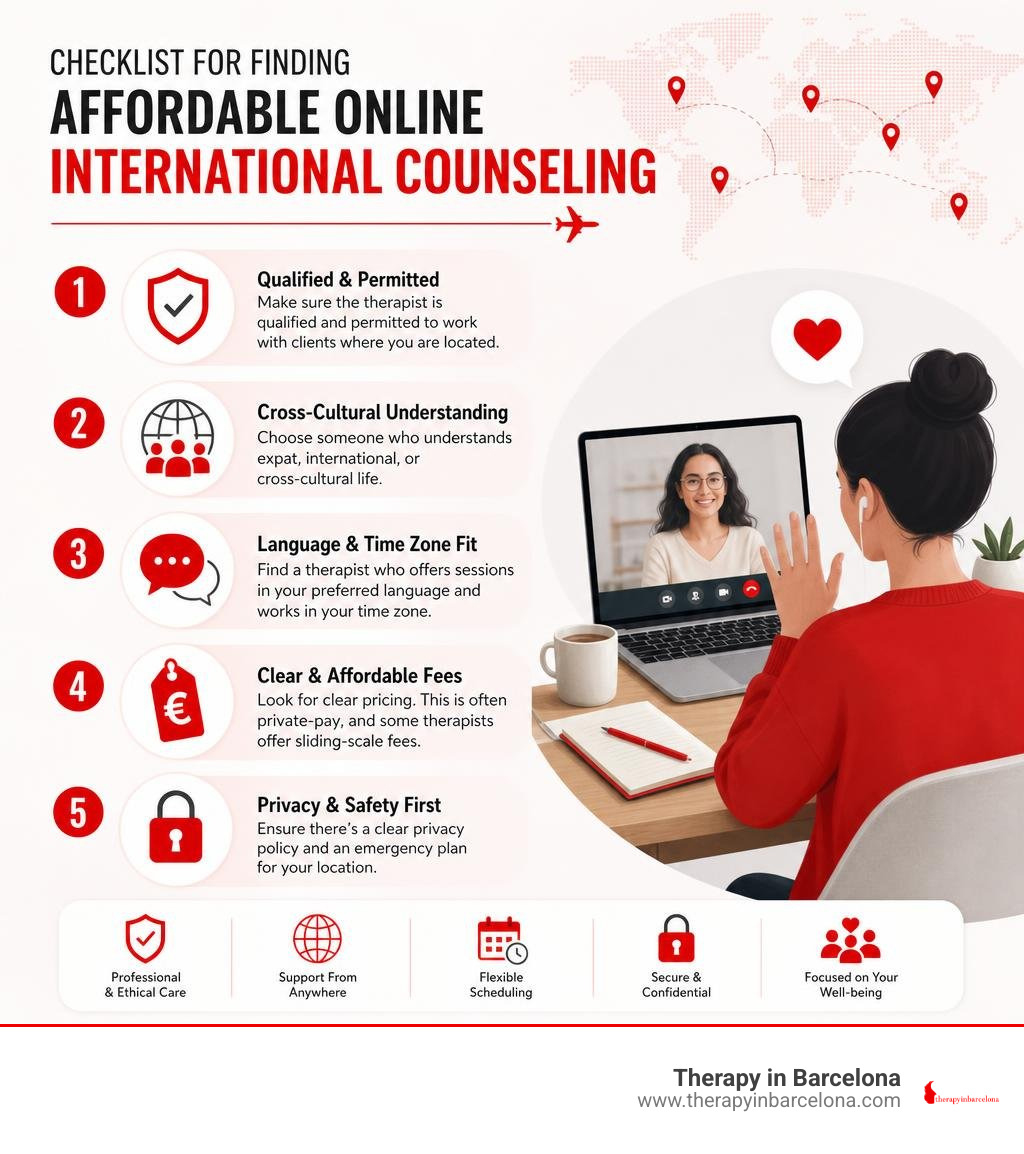
For an affordable and suitable option, check that the therapist:
- Is qualified and permitted to work with clients where you are located.
- Understands expat, international, or cross-cultural life.
- Offers sessions in your preferred language and workable time zone.
- Explains fees clearly. This is often a private-pay service, though some therapists offer sliding-scale fees for financial need.
- Has a clear privacy policy and an emergency plan for your location.
Research reviews have found that video-based therapy can achieve outcomes comparable with in-person care for many common concerns when it is delivered by a trained professional and there is a strong working relationship between client and therapist.
Therapy in Barcelona is a trusted group practice in Spain, established in 2011. It offers psychology-trained multilingual care in English, German, French, Spanish, Afrikaans, Portuguese, Romanian, Austrian-German, and Swiss-German. The team works online with clients worldwide, and offers face-to-face sessions in Barcelona, with careful matching for adults, couples, teens, and families. If you’d like support, book a Free Discovery Call.
Online counselling is not emergency care. If you are at immediate risk or need urgent help, contact local emergency services or go to the nearest emergency department; 112 is the emergency number across Spain and the EU.
Why Online International Counselling Is Essential for Expats and Nomads
Moving across borders brings exciting opportunities, but it also alters daily routines and social circles. Traditional face-to-face therapy requires physical presence in a local clinic. This setup can be difficult when living in a new city where healthcare systems are unfamiliar or where local practitioners do not speak your preferred language.
Remote therapy bridges these physical gaps by connecting clients with professionals over secure video platforms. Whether living in Barcelona, settling in Madrid, or moving through smaller coastal towns, virtual care allows individuals to maintain psychological support. To learn more about how remote care supports international moves, read The Expat’s Guide to Online Therapy: Bridging Distances, Building Connections.
Many internationally mobile individuals experience quiet stress or persistent internal pressure while remaining high-achieving. On the outside, career goals and international moves look successful. On the inside, managing bureaucracy, loneliness, and career stress can build emotional fatigue. Online international therapy provides a private space to discuss these adjustment challenges before they turn into severe emotional exhaustion.
Key Benefits of Online International Counselling
Maintaining regular mental health sessions provides stability during major life shifts. Relocating between cities often breaks healthcare routines. Online sessions allow individuals to keep working with the same practitioner regardless of country borders or frequent travel schedules.
Language plays a vital role in therapeutic success. Expressing complex emotions or childhood memories in a second language can feel limiting. Receiving care in a native tongue allows for natural communication and emotional expression. Explore the full list of advantages in What are the benefits of online therapy for internationals living in Spain?.
Flexible scheduling helps professionals manage busy working hours across different time zones. Therapists working internationally often accommodate early morning or late evening appointments to fit surrounding schedules.
Who Benefits Most from Online International Counselling?
Expatriates, digital nomads, Third Culture Kids (TCKs), international students, and accompanying spouses face distinct psychological adjustment periods. Each group navigates different degrees of social isolation, boundary shifts, and changing identities.
To illustrate these dynamics, consider Sarah. Sarah is a fictional composite character, not a real client, created to highlight common expat struggles. After moving to Spain for work, she felt isolated despite enjoying her new surroundings. Finding an English-speaking practitioner allowed her to process identity shifts without needing to explain basic expat dynamics.
Digital nomads also benefit from consistent online support as they travel across jurisdictions. Discover more about mobile care in Roam Free, Heal Freely: A Digital Nomad’s Guide to Remote Therapy. When choosing support, look for a therapist with training and experience in cross-cultural adaptation, identity shifts, and the emotional demands of international life.
Checklist Criteria: How to Choose a Qualified International Therapist
Finding the right professional requires evaluating qualifications, cultural understanding, and clinical boundaries. Not every licensed practitioner understands the reality of living far from primary support networks.
Use this checklist to evaluate prospective providers:
- Verified Qualifications: Holds a university degree in psychology, counselling, or psychotherapy from a recognised institution.
- Cultural Competence: Possesses personal or clinical experience with cross-cultural moves, relocation stress, and expat dynamics.
- Language Alignment: Provides fluent care in your native or preferred language.
- Transparent Billing: Operates as a clear private-pay service or provides superbills for out-of-network insurance reimbursement.
- Data Protection: Uses secure, encrypted platforms compliant with privacy frameworks such as GDPR.
Cultural Competence, Expat Experience, and Language Matching
Cultural competence goes beyond basic language skills. It involves understanding how cultural norms, migration loss, and language barriers affect emotional wellbeing. Practitioners who have lived abroad themselves often establish quicker rapport because they understand relocation dynamics firsthand.
Processing deep emotional patterns or past painful experiences is often easiest in a mother tongue. Speaking in a native language reduces cognitive effort and allows subtle feelings to surface naturally.
If you are looking for localised international support in major cities, search for clear information about language, qualifications, professional background, and expat experience. This is especially useful when comparing options for an English-speaking therapist in Madrid, Valencia, Málaga, or other Spanish cities where international communities may need culturally sensitive care.
Licensing, Insurance, and Cross-Border Legalities
Licensing regulations vary significantly across national borders. Practitioners must adhere to ethical codes, maintain professional indemnity insurance, and respect jurisdictional guidelines regarding online practice.
Regarding payment, international teletherapy is generally a private-pay service. However, many US health insurance plans with out-of-network benefits (such as PPO plans) reimburse a portion of therapy costs overseas. Practitioners can supply itemised receipts or superbills with administrative codes for submission. Prospective clients with financial needs can also inquire whether sliding-scale fee options are available.
Practitioners operating across borders must also maintain strict data security. Services handling European clients must comply with General Data Protection Regulation (GDPR) standards, ensuring that private health data is never sold or shared without consent. Independent practitioners emphasise secure, direct therapeutic support tailored to international clients.
Top Platforms for Finding Affordable Online Therapy Abroad
Finding quality care involves choosing between different service models. Options include local public health systems, large global teletherapy apps, independent therapist directories, and specialised group practices.
Public health systems provide essential regional care, but long waiting lists and local language requirements can pose barriers for internationals. Large global platforms offer fast matching via automated algorithms, but session lengths, therapist continuity, and privacy standards can vary, with some platforms commercialising user data. Independent directories allow direct searching, though clients must vet credentials independently. Specialised group practices, like Therapy in Barcelona, focus on bespoke therapist matching, strict privacy with zero data selling, and culturally sensitive support delivered in the client’s native language.
Independent Networks and Specialised Expat Services
Specialised practices prioritise careful human matching rather than automated algorithms. They focus on matching clients based on therapeutic goals, personality fit, and cultural background.
- Therapy in Barcelona: Founded in 2011 by Leigh Matthews, an Australian Psychologist who moved to Barcelona in 2011. As an expat herself, Leigh recognised the need for culturally sensitive mental health care tailored to English-speaking internationals. The practice features a team of psychology-trained multilingual therapists speaking English, German, French, Spanish, Romanian, Afrikaans, Portuguese, Austrian-German, and Swiss-German. They work online with clients worldwide and provide face-to-face sessions in Barcelona. Services cover adults, couples, teens, and families using evidence-based approaches like Cognitive Behavioural Therapy (CBT), Acceptance and Commitment Therapy (ACT), and Internal Family Systems (IFS).
- Expat-focused matching services: Some services match expats with native-language psychologists who have lived abroad. Check whether they explain practitioner qualifications, privacy policies, emergency limits, and fee structures before booking.
- Therapist-led networks: Some global networks list independent practitioners across many countries and languages. These can be useful for comparing options, but clients should still verify credentials, legal permissions, and the suitability of online care for their location.
- Lower-cost online therapy providers: Some international providers advertise structured online sessions at lower starting fees. Review session length, therapist training, continuity of care, and whether the service offers a proper intake process.
Global Platforms and Directory Resources
Directories and platforms provide searchable listings where clients can filter providers by language, location, and specialisation.
- International directories: These can help mobile people identify therapists who work with TCKs, expats, and internationally mobile individuals across different countries.
- Large teletherapy platforms: These may offer quick access and broad availability, though the level of personal matching, session structure, and practitioner continuity can vary.
- Peer support and emotional support networks: Some global services provide 24/7 listener chats alongside paid therapy options. These may offer informal support, but they are not a substitute for personalised therapy with a qualified professional.
For more guidance on European online care, read How to Access Remote Therapy Across Europe Without Leaving Your Couch.
Limitations, Safety Protocols, and the Role of Global Associations
While remote counselling offers high convenience, it is important to recognise its operational limits. Technical disruptions, time zone conflicts, and distance boundaries require clear protocols from the outset.
Handling Crisis Care and Emergency Protocols
Online international counselling is designed for ongoing psychological support and personal growth. It is not suitable for acute safety risks or active crisis situations.
Because an online therapist may be located in a different country, they cannot dispatch local emergency teams directly. Responsible practitioners collect local emergency contact details during intake and provide crisis disclaimers. If an individual experiences a severe mental health crisis, they should contact local emergency numbers immediately (such as 112 in Spain and across Europe) or visit the nearest hospital emergency room.
The Role of Professional Bodies Like the IAC
International organisations help set ethical guidelines and professional standards for global practice.
The International Association for Counselling (IAC), founded in 1966, holds United Nations consultative status and works to map counselling standards across 196 countries. To improve cross-cultural care, the IAC provides specialised courses like its 20-hour Transcultural Counselling programme, awarding Continuing Education Units (CEU) to practitioners worldwide.
Belonging to recognised professional organisations ensures that therapists adhere to clear ethical codes, continuing education requirements, and client protection standards.
Frequently Asked Questions About International Teletherapy
Is online therapy as effective as in-person therapy for expats?
Yes. Peer-reviewed research demonstrates that online video therapy produces clinical outcomes comparable to traditional in-person therapy for feelings of anxiety, persistent low mood, and adjustment difficulties.
The strength of the therapeutic alliance—the trust and rapport between client and practitioner—is the primary driver of therapeutic success.
How do I use health insurance to reimburse international therapy sessions?
Most international online therapy operates on a private-pay basis. However, if you hold a US-based PPO insurance plan or international private cover, you may qualify for out-of-network reimbursement.
You pay for your session directly and request an itemised receipt or superbill from your therapist. This document includes standard billing and procedure codes (such as CPT codes). You submit the superbill directly to your insurer, which may reimburse a significant portion of out-of-network costs depending on your specific policy.
What should I do if I experience a mental health emergency abroad?
Online international therapy platforms are not equipped for immediate crisis intervention. If you or someone you know is in immediate distress:
- Call local emergency services immediately (dial 112 in Spain and across the European Union).
- Go directly to the nearest hospital emergency department (urgencias).
- Contact a local crisis hotline or regional mental health emergency centre.
Always keep local emergency numbers saved on your phone when moving to or living in a foreign country.
Conclusion
Finding affordable, high-quality online international counselling comes down to matching your specific needs with a qualified practitioner who understands life abroad. By verifying credentials, confirming cultural competence, checking data security, and clarifying fee structures, you can build a stable therapeutic relationship wherever life takes you.
Whether you are living in Barcelona, working remotely from Valencia, or residing anywhere else in the world, professional support is accessible. If you’d like support, book a Free Discovery Call.
What is one small step you can take today to prioritise your emotional wellbeing abroad?
