


Is Online Therapy in Europe Right for You? Here’s What to Know First

Online therapy in Europe has become one of the most practical and effective ways for English-speaking expats and international residents to access quality mental health support — without language barriers, long waiting lists, or the stress of finding a local clinic in an unfamiliar city.
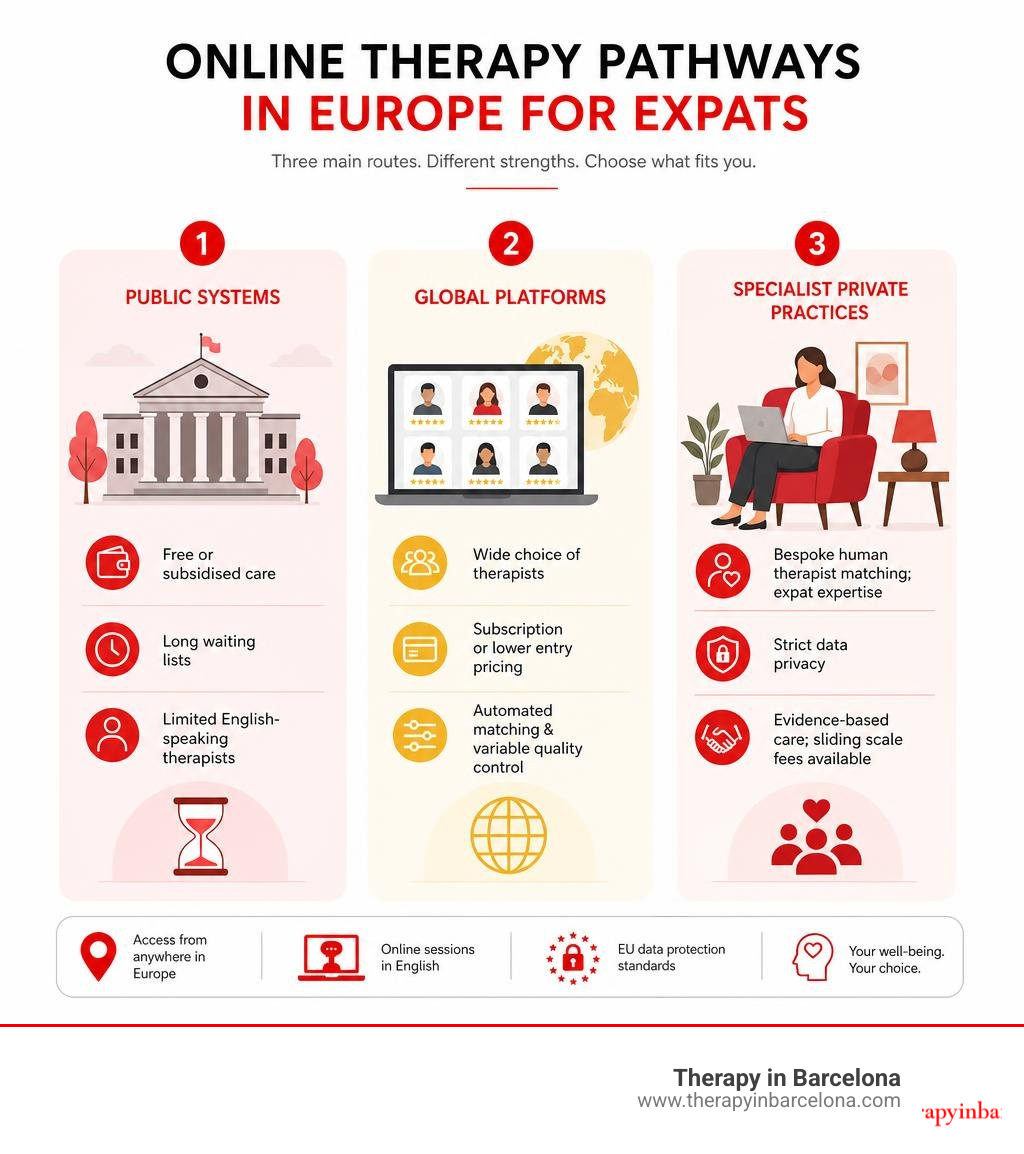
Here is a quick overview of your main options:
- Specialised private group practices (such as Therapy in Barcelona) — bespoke human therapist matching, expat-specific expertise, strict data privacy, evidence-based care; private-pay with sliding scale fees available on request
- Large global directories and subscription platforms — wide therapist volume, sometimes lower entry pricing, but often automated matching and variable quality control
- Public health systems — free or subsidised care, but typically long waiting lists and limited English-speaking practitioners
Moving abroad is one of the most exciting things a person can do. But after the first flush of novelty fades, the emotional weight of starting over — building friendships from scratch, navigating a new culture, and feeling like a permanent outsider — can quietly accumulate.
For many expats living in Barcelona, Valencia, Málaga, or anywhere else across Europe, that weight eventually needs somewhere to go. The problem is that finding a qualified, English-speaking therapist in a country where you barely speak the language can feel like yet another exhausting task on an already long list.
That is exactly where online therapy changes things. Online therapy produces outcomes comparable to in-person sessions for feelings of anxiety, persistent low mood, relationship difficulties, and life transitions, while offering significantly greater convenience. For internationally mobile people especially, it removes two of the biggest barriers at once: location and language.
This guide is here to help you cut through the noise. Whether you are newly arrived in Spain, settled but struggling, or somewhere in between, you will find a clear, honest comparison of your options — so you can spend less time searching and more time actually getting support.
Why Expats and Residents Choose Online Therapy
Living the dream abroad often comes with an uninvited guest: emotional overwhelm. When you are dealing with a new language, unfamiliar administrative systems, and the absence of your usual support network, even minor setbacks can feel monumental.
For English-speaking internationals, finding a local therapist who truly understands your cultural background is incredibly difficult. If you live in a bustling metropolis like Madrid or Barcelona, you might find a few options, but if you are based in smaller hubs or coastal towns like Alicante, Marbella, or Zaragoza, the local pool of English-speaking practitioners shrinks rapidly.
Choosing therapy online helps bridge the gap between where you are and the support you need. Rather than settling for a local therapist simply because they speak English, virtual therapy allows you to choose a practitioner based on their actual expertise, therapeutic modality, and cultural fit.
Furthermore, online therapy offers unparalleled geographic flexibility. Whether you are a digital nomad moving between co-living spaces in Gran Canaria, a retiree settling down in Málaga, or a student adjusting to university life in Valencia, your therapy can travel with you. You do not have to restart your therapeutic journey every time you cross a border or move to a new flat.

To explore how this flexibility can support your specific lifestyle, you can read more about the practical advantages in this guide on 5 Reasons to Choose Online Therapy or check out this tailored resource on Guide to remote therapy for digital nomads. For those balancing work and wellness in the modern world, the Working Remotely, Healing Remotely: Your Guide to Therapy in the Digital Age offers deeper insights into making virtual sessions work for you.
Overcoming the Unique Challenges of Living Abroad
The challenges of expat life go beyond logistics. Relocation often brings an emotional toll, including feeling disconnected from your identity, navigating bicultural relationship dynamics, or remaining in survival mode long after the move.
To illustrate how these challenges manifest in daily life, let us look at Sarah.
This fictional composite avatar represents common expat challenges, not a real client. A 31-year-old digital marketer from the UK recently relocated to Málaga for a sunnier lifestyle and a fresh professional start. While enjoying the coastal views and relaxed pace of life, she struggles with a persistent sense of loneliness.
Back home, she had a close-knit circle of friends, but in Spain, building meaningful connections has taken far longer than expected. The constant effort of starting over has become exhausting, and without a local support system, work burnout has begun to set in.
While this is a fictional composite avatar, the story reflects the lived experiences of thousands of expats who seek support each year. For many, finding an English-speaking therapist who understands the nuances of culture shock, homesickness, and expat burnout is the first step toward feeling like themselves again.
Key Factors to Consider When Choosing a Virtual Platform
When searching for the right virtual mental health support, it is easy to get overwhelmed by the sheer number of directories and apps available. However, not all virtual platforms are created equal. To ensure you receive safe, ethical, and effective care, there are several essential criteria to keep in mind.
First and foremost are therapist qualifications. In Europe, licensing laws vary dramatically from one country to another. A platform should clearly display the credentials, educational background, and professional registrations of its practitioners. You want to ensure your therapist is highly qualified, psychology-trained, and bound by a strict code of ethics.
Second is data privacy and security. Your therapy sessions are highly personal, and your data must be treated with the utmost care. Any platform you use must be fully compliant with the General Data Protection Regulation (GDPR) in the European Union.
This means they should use secure, end-to-end encrypted video software and have a transparent privacy policy that guarantees your data is never sold to third parties or used for targeted advertising.

Finally, consider the communication methods and scheduling flexibility offered. Some people prefer structured video sessions, while others find comfort in hybrid models.
If you are a student, for instance, you might need a platform that accommodates a changing class schedule. You can learn more about how virtual sessions fit into academic life in this guide on how to Unlock Your Best Self: Online Therapy Made Easy for Students.
Finding the Right Fit: Personalised Matching vs. Algorithms
Decades of psychological research point to one undeniable fact: the single most important predictor of successful therapy is the therapeutic alliance. This is the quality of the relationship, trust, and connection between you and your therapist. If you do not feel safe, understood, and respected, even the most advanced therapeutic techniques will have limited impact.
This is why therapist matching matters. Many large directories use automated questionnaires to quickly assign you to the next available practitioner. While efficient, this approach can overlook the nuances of your personality, cultural background, and emotional needs.
In contrast, human-led, personalised matching takes a different approach. A trained professional reviews your intake details, listens to your concerns, and hand-picks a therapist who is genuinely suited to your unique situation. This process respects that you are an individual, not a data point.
If you want to understand how to navigate this search effectively, take a look at this comprehensive Finding a Therapist Online: Your Guide to Virtual Support or read Your Guide to Finding the Right Therapist Near You to learn what to look for in a professional relationship.
Navigating Your Options: Comparing Online Therapy Pathways in Europe
To make an informed decision about your mental health care, it helps to understand the different pathways available to expats and residents in Europe. Each pathway has its own set of advantages and limitations.
Pathway 1: Public Health Systems
Most European countries have robust public healthcare systems that offer mental health support.
- How it works: You typically begin by visiting a local general practitioner (GP) to request a referral to a psychologist or psychiatrist within the state system.
- Pros: The primary advantage is cost. Public mental health care is usually free or highly subsidised by state insurance.
- Cons: The downsides are significant for expats. Waiting lists can stretch for several months, and you have almost no control over which practitioner you are assigned. Most importantly, unless you are fluent in the local language, you are highly unlikely to find an English-speaking therapist within the public system, especially outside of major metropolitan areas.
Pathway 2: Large Global Directories and Subscription Platforms
These are high-volume online platforms and directories that list large numbers of therapists across different countries.
- How it works: You sign up online, search listings or complete an intake form, and are then matched with a therapist through an automated system or choose from available profiles. Some services use subscriptions, while others charge per session.
- Pros: They offer a large volume of listed profiles, quick matching times, and sometimes lower entry-level pricing.
- Cons: The experience can feel impersonal, with therapist availability and continuity varying across large platforms. For expats navigating cultural transition, homesickness, language barriers, or bicultural relationships, they may also lack the specialised understanding these challenges require.
Pathway 3: Specialised Private Group Practices (The Therapy in Barcelona Difference)
These are boutique, dedicated group practices that specialise specifically in international and expat mental health.
- How it works: You reach out directly to the practice, participate in a thoughtful intake process (often starting with a Free Discovery Call), and are hand-matched with a highly qualified professional.
- Pros:
- Bespoke Human Matching: Instead of letting an algorithm decide, an Intake Coordinator takes the time to match you with the therapist best suited to your personality and goals.
- Expat-Specific Expertise: The therapists are expats or have been expats themselves. They do not need you to explain what it feels like to navigate visa anxiety, language exclusion, or the grief of leaving a former self behind – they live it too.
- Strict Privacy Standards: Your data is fully protected under GDPR, with absolute confidentiality and no commercial data sharing.
- Diverse, Evidence-Based Modalities: You have access to evidence-based approaches tailored to your needs, including CBT, ACT, Schema Therapy, Internal Family Systems (IFS), and the Gottman Method for couples therapy.
- Multilingual Care: Support is available in English, and several therapists also speak other languages, including German, French, Spanish, Afrikaans, Portuguese, Austrian-German, and Swiss-German.
- Cons: These are private-pay services. However, they represent a higher-quality, deeply personalised investment in your well-being. For those facing financial difficulties, some therapists offer sliding scale fees based on individual circumstances, which you can inquire about during your initial contact.
To understand how a specialised practice operates across different regions, you can read Connect from Anywhere: Your Guide to Online Therapy in Spain or explore our main Online Therapy page. For a deeper look at how virtual therapy fits into your home life, read Online Mental Health Therapy: Your Couch is the New Therapist’s Office.
Frequently Asked Questions About Online Therapy in Europe
Is online therapy as effective as in-person therapy?
Yes. A growing body of clinical research shows that online psychotherapy can produce outcomes comparable to traditional face-to-face treatment for many common concerns, including feelings of anxiety, low mood, stress, burnout, and relationship difficulties.
For example, a systematic review and meta-analysis on videoconferencing psychotherapy found strong support for its clinical effectiveness and therapeutic alliance.
The key to successful therapy is a strong therapeutic relationship built on trust, safety, and collaboration. This can be developed just as effectively online, and many clients find it easier to open up from the comfort and privacy of home.
How does insurance coverage work for online therapy in Europe?
Because specialised expat practices operate on a private-pay basis, sessions are paid for directly by the client. However, navigating reimbursement through private insurance is possible.
Many international private health insurance plans, as well as some corporate wellness packages, offer partial or full reimbursement for out-of-network mental health care.
If you plan to claim your sessions, you can request official receipts or invoices from your practice.
We highly recommend contacting your insurance provider before starting therapy to ask:
- Do you cover out-of-network mental health counselling?
- What specific credentials must the therapist hold for sessions to be eligible?
- What documentation is required to submit a reimbursement claim?
What should I do in a mental health crisis?
Online therapy platforms, directories, and private practices are not equipped to provide crisis or emergency care. If you or someone you know is experiencing a mental health crisis, severe thoughts of self-harm, or a life-threatening emergency, seek immediate emergency support instead.
In an emergency, you should contact local emergency services immediately. If you are in Spain (including Barcelona, Madrid, Valencia, Málaga, Alicante, Sevilla, Marbella, Gran Canaria, or Zaragoza), you can dial 112 for free, 24/7 emergency assistance. Y
ou can also visit the emergency department of your nearest local hospital or reach out to dedicated international crisis hotlines that offer immediate, confidential support.
Finding Your Path to Healing Abroad
No matter where your journey in Europe has taken you, you do not have to navigate the emotional challenges of living abroad alone. Whether you are seeking to understand yourself better, heal past wounds, or simply find your footing in a new culture, professional support can help you move forward with clarity and confidence.
Since 2011, Therapy in Barcelona has provided compassionate mental health support for the international community. Founded by an Australian psychologist and expat, the practice was built on firsthand experience of relocating, adapting to a new culture, and creating a trusted, high-quality service tailored to internationals.
Today, our collaborative team of highly qualified, psychology-trained expat therapists offers culturally sensitive, evidence-based care. We understand that your background, language, and personal history shape how you experience the world.
If you are looking for support that goes beyond standard directories, we invite you to explore how we can help. For those who feel more comfortable speaking their native tongue or want to address bicultural relationship dynamics, you can read more about finding the right fit in our guide on Beyond Near Me: How to Find the Right Spanish Speaking Therapist Online or In Person.
We offer both in-person sessions at our welcoming office in the heart of Barcelona’s Eixample district and online therapy sessions to expats and internationals worldwide (including the USA and Canada).
If you are ready to take the next step on your path to well-being, we would love to support you. Please reach out to us to book a Free Discovery Call, and let us help you find your ideal therapist match.
