


When Words Stop Working: Finding the Right Therapy for Communication Issues

Therapy for communication issues covers a broad range of professional support designed to help you express yourself more clearly, listen more effectively, and connect more deeply — whether in a romantic relationship, a family, or your own inner world.
If you’re looking for a quick overview before reading further, here’s what you need to know:
- What it helps with: Recurring arguments, emotional distance, passive-aggressive patterns, stonewalling, difficulty expressing needs, and feeling chronically misunderstood
- Who it’s for: Individuals, couples, families, and anyone whose relationships — personal or professional — are suffering because of communication breakdowns
- Main approaches used: Cognitive Behavioural Therapy (CBT), Emotion-Focused Therapy (EFT), the Gottman Method, Imago Relationship Therapy, assertiveness training, and active listening techniques
- Where to find it: Private practices, online therapy platforms, and services like Therapy in Barcelona that offer personalised therapist matching for internationals — this is a private-pay service, though some therapists offer sliding scale fees for those with financial need
- What to expect: An initial assessment, skill-building exercises, and gradual, consistent progress over weeks to months
Most people don’t realise how much is lost in translation — not just between languages, but between people who speak the same one. A comment lands wrong. A silence stretches too long. Someone shuts down. Someone else pushes harder. What starts as a small misunderstanding can, over time, quietly hollow out a relationship.
This is especially true for people living abroad. If you’re an expat in Barcelona, Valencia, Madrid, or anywhere else in Spain, you’re already navigating cultural norms, a new language, and a social landscape that doesn’t always map onto what you grew up with. Those pressures don’t stay neatly outside the front door. They follow you into your conversations, your relationships, and your closest connections.
The good news is that communication is a skill — not a fixed personality trait. With the right support, the patterns that keep you stuck can genuinely change. This guide will walk you through how to find therapy for communication issues that actually delivers results, not just temporary relief.
Why Communication Breaks Down in Relationships
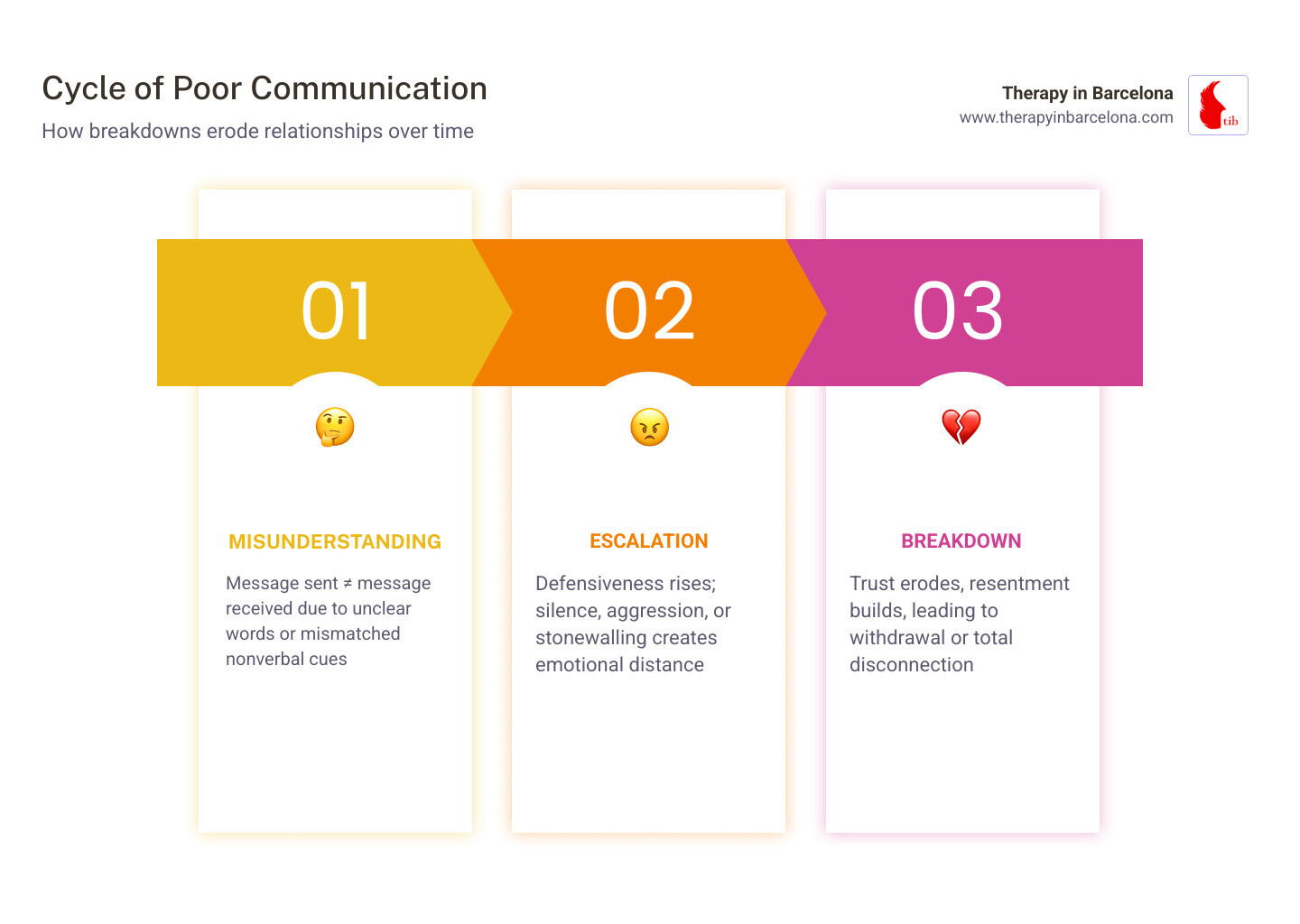
Communication can break down fast when what one person means is not what the other person hears. Tone, facial expressions, body language, timing, and stress all shape the message. If those signals feel critical, dismissive, or unsafe, a simple conversation can quickly turn into conflict.
Many communication problems are not just about a lack of skill; they are often rooted in deep-seated patterns. Some people learn early in life to “swallow” their feelings to avoid conflict, while others might use aggression to ensure they are heard. Over time, these habits can lead to emotional withdrawal or a total collapse of trust.
A vital finding in scientific research on the vital role of repairing ruptures in therapy is that the success of therapy often depends on the ability to repair “ruptures” in the therapeutic alliance. This same principle applies to your personal life.
Beyond Words: Elevating Your Communication Game explores how moving past simple vocabulary and focusing on the underlying emotional intent can transform these interactions.

Common signs of poor communication
Recognising the symptoms of a breakdown is the first step toward fixing it. You might notice:
- Frequent arguments: Fights that erupt over minor issues like the dishes or a missed text, often masking deeper unmet needs.
- Walking on eggshells: Feeling like you have to monitor every word to avoid upsetting your partner or family member.
- Feeling unheard: You speak, but the other person seems to be “waiting for their turn to talk” rather than truly listening.
- Assumptions and mind-reading: Believing you already know what the other person thinks, which prevents honest inquiry.
- Passive-aggressive styles: Using sarcasm, the “silent treatment,” or subtle jabs instead of direct honesty.
- Stonewalling: Shutting down or physically leaving a conversation when things get difficult, leaving the other person feeling abandoned.
The Expat Factor: Culture, Trauma, and Mental Health
For internationals living in hubs like Valencia or Madrid, communication issues often carry an extra layer of complexity. Living away from your home country can strip away your usual support networks, making your primary relationship bear the weight of all your emotional needs.
Culture plays a massive role in how we speak and listen. It shapes our “cognitive constraints” — our worldviews and frames of reference. For instance, a person from a culture that prizes directness might seem “rude” to someone from a culture that values subtle, indirect politeness. These behavioral and emotional constraints can lead to significant friction, even if both parties are speaking English.
Trauma and childhood experiences also act as silent filters. If someone grew up in a household where expressing needs led to rejection, they might struggle with assertiveness as an adult. The Intercultural Compass: Navigating Relationships and Communication in Therapy highlights how these cultural and personal histories intersect in the therapy room.
How mental health impacts our words
Mental health conditions can fundamentally alter the way we interact with the world.
- Anxiety: Can lead to overthinking every word, seeking constant reassurance, or avoiding difficult conversations entirely.
- Depression: Often results in social isolation or a “flat” communication style that others may mistake for lack of interest.
- Low self-esteem: Might cause someone to settle for passive communication, feeling their opinions aren’t worth sharing.
When these issues persist, individual therapy services can provide a safe space to untangle personal mental health from relationship dynamics.
Evidence-Based Therapy for Communication Issues
Finding therapy for communication issues that works means looking for evidence-based approaches. Modern therapy doesn’t just involve “venting”; it provides a structured framework to rebuild your “communication toolkit.”
How Cognitive Behavioural Therapy (CBT) provides therapy for communication issues
CBT is highly effective for communication because it targets the link between thoughts, feelings, and behaviours. If you think, “My partner always ignores me,” you will likely feel resentful and behave defensively. CBT helps you:
- Identify Triggers: Recognising what specific phrases or situations cause you to shut down or lash out.
- Challenge Cognitive Distortions: Questioning “all-or-nothing” thinking (e.g., “You never listen”) and replacing it with more accurate reflections.
- Behavioral Experiments: Trying out new communication styles in low-stakes situations to build confidence.
- Reframing: Shifting from blame-heavy language to “I” statements that focus on your own experience.
The role of active listening in therapy for communication issues
Active listening is more than just staying quiet while someone else talks. It is an active, empathetic process. In therapy, you learn to use reflective statements — repeating back what you’ve heard to ensure accuracy before responding. This reduces defensiveness and makes the other person feel validated.
Techniques like Assertive Communication teach you how to be clear and direct about your needs without being aggressive. It’s about finding the “middle ground” where your rights are respected, and so are the rights of others.
Choosing the Right Path: Couples, Family, or Individual Support
Not every communication problem requires the same type of therapy. The choice depends on where the breakdown is most visible.
- Couples Therapy: Ideal for identifying the “negative cycles” two people get stuck in. A neutral therapist can point out patterns that are invisible to the couple themselves. From Misunderstandings to Meaningful Conversations provides a deeper look at this process.
- Individual Therapy: Sometimes, the best way to improve a relationship is to work on yourself. By changing your own communication habits, you often force the entire “system” of the relationship to shift.
- Family Therapy: Focuses on the dynamics between parents, children, and siblings. It is particularly useful for navigating parent-teen conflicts or the complexities of blended families.
Navigating Your Therapy Options
When seeking professional help in Spain, it is important to understand the different avenues available. Each has its own benefits and limitations.
Public Health Systems (e.g., CatSalut) In regions like Catalonia, the public system offers mental health support. However, these services are often overstretched. You may face long waiting lists, and you typically cannot choose your specific therapist. Furthermore, support in English or other foreign languages is rarely guaranteed.
Large Global Online Platforms Apps and websites that connect you with therapists worldwide offer convenience and often lower price points. However, these platforms can feel impersonal. They often use algorithms rather than human insight to match you, and there are frequent concerns regarding data privacy and the high turnover of clinicians.
Local Private Practices Small local practices offer a more personal touch. The challenge for expats is finding a practice that truly understands the international experience. A therapist who hasn’t lived abroad may struggle to empathise with the specific stresses of relocation, visa issues, or the “third culture” identity.
Therapy in Barcelona Founded by Australian Psychologist Leigh Matthews, this private-pay practice supports Barcelona’s international community with tailored therapist matching. You’re paired with a psychology-trained professional who fits your needs, background, and communication goals.
Addressing communication in family therapy
Family dynamics often involve “stuck” roles. A teenager might be labeled “the rebel,” while a parent becomes “the nag.” Therapy helps break these labels. Techniques like positive reinforcement and role-playing allow family members to practice new ways of interacting in a safe environment.
If you are struggling with these dynamics, you can find more info about family therapy services to help bridge the gap between generations.
Maximising Your Progress: Preparation and Self-Help
Therapy is most effective when you take the lessons learned in the session and apply them to your daily life. It is a collaborative process, not a passive one.
What to expect from professional therapy for communication issues
Your journey usually begins with an initial assessment. The therapist will ask about your history, your current struggles, and your goals. From there, sessions focus on:
- Identifying Triggers: What makes you lose your cool or shut down?
- Skill-Building: Practicing “I” statements (e.g., “I feel overwhelmed when the kitchen is messy” instead of “You never clean up”).
- Homework: You might be asked to journal your interactions or try a specific listening exercise before the next session.
- Progress Tracking: Regularly reviewing whether your communication is actually improving.
Self-help strategies can complement your sessions. Journaling is a powerful tool for self-reflection; it allows you to see patterns in your thoughts before they become spoken words.
Frequently Asked Questions about Therapy for Communication Issues
How does therapy actually improve communication?
Therapy works by uncovering the “why” behind your words. A therapist helps you identify deep-rooted patterns from childhood, teaches active listening, and provides tools like assertiveness training. By understanding your emotional triggers, you can respond to others with intention rather than reacting out of habit.
What if my partner refuses to attend therapy?
This is a common concern. While couples therapy is ideal for relationship issues, individual therapy is still highly effective. When you change your own communication patterns — for example, by refusing to engage in a circular argument or by expressing your needs more clearly — it often shifts the dynamic of the entire relationship.
How long does it take to see results?
Communication is a muscle that needs training. While some tools (like the “stop and breathe” technique) can be used immediately, long-term change usually requires several months of consistent practice. Most clients begin to notice a shift in the “temperature” of their conversations within 6 to 10 sessions.
Is therapy available in English in other parts of Spain?
Yes. While our physical offices are in Barcelona, we provide online therapy to expats across Spain, including those in Málaga, Alicante, Sevilla, Marbella, and the Canary Islands. We also support internationals worldwide.
Conclusion
Communication issues can make the world feel like a very lonely place, especially when you are living far from home. But you don’t have to stay stuck in cycles of misunderstanding and resentment. Whether you are navigating an intercultural marriage, struggling to connect with your teenager, or simply want to feel more confident in your professional interactions, help is available.
At Therapy in Barcelona, we understand the messiness of expat life. Our team of psychology-trained therapists are expats themselves, bringing a unique blend of professional expertise and lived empathy to every session. We offer multilingual support and a personalised matching process to ensure you find a therapist you truly connect with.
If you’re ready to move from misunderstanding to meaningful conversation, we are here to guide you.
If you’d like support, book a Free Discovery Call.
