


When the Right Words Make All the Difference

Therapeutic communication questions are at the heart of every meaningful clinical interaction — the difference between a patient who feels heard and one who shuts down.
Here is a quick overview of the most important therapeutic communication techniques:
- Active listening – Give your full attention; watch for verbal and nonverbal cues
- Open-ended questions – Invite the patient to lead (“Tell me more about what worries you”)
- Restating – Repeat the patient’s words to confirm understanding (“You’ve been feeling like a failure for a while?”)
- Reflecting – Mirror the feeling behind the words, not just the content
- Clarifying – Ask for a specific example when something is ambiguous
- Validating – Acknowledge the emotion before attempting to solve anything
- Silence – Allow space for the patient to process without rushing to fill it
- Avoiding non-therapeutic blocks – Cut false reassurance, advice-giving, and “why” questions
These techniques apply whether you are a nursing student preparing for the NCLEX, a practitioner working in an acute clinical setting, or someone exploring how communication shapes the therapeutic relationship in broader mental health care.
Think about this scenario: a patient scheduled for their first round of chemotherapy tells their nurse, “I’ve changed my mind. I don’t want to do this. The side effects are too scary.” The instinct might be to reassure them, or to call the doctor, or to explain the medical rationale.
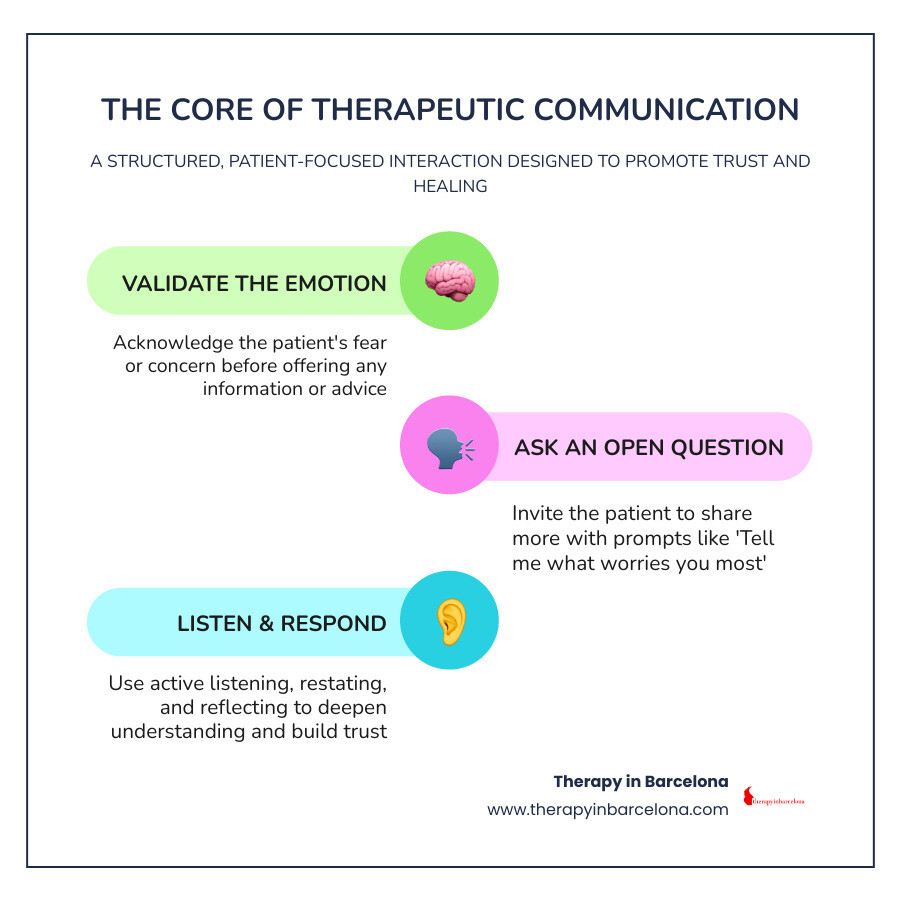
But research published in the Journal of Compassionate Health Care consistently shows that the most effective first response is simpler and harder: validate the fear, then ask an open question. Something like, “The thought of side effects can be frightening. Can you tell me more about what specifically worries you?”
That one shift — from advice to empathy, from talking to listening — is what therapeutic communication is built on. And it is a skill that can be learned, practised, and refined.
This guide breaks down the core techniques, the common pitfalls, and the high-stakes scenarios where getting the communication right genuinely matters.
What is Therapeutic Communication and Why Does It Matter?
Therapeutic communication is not just a polite conversation or a social exchange. In a clinical environment, it is a structured, goal-directed, and patient-focused interaction.
Unlike social interactions where two people share the floor for mutual benefit, therapeutic communication is entirely dedicated to the patient’s physical, mental, and emotional well-being. It is a dual exchange of information designed to promote collaboration, foster clinical trust, and support the patient’s autonomy.
In clinical settings and nursing practice, the way a professional communicates directly influences patient outcomes. When a patient feels safe and understood, they are far more likely to share accurate symptoms, adhere to treatment plans, and experience lower levels of anxiety.
Establishing this emotional safety is vital because physical health and psychological well-being are deeply intertwined. Whether a practitioner is working in an emergency department, a specialised mental health ward, or a community clinic, mastering these techniques is a core clinical competency.
In fact, professional examinations place immense weight on this skill, as seen in resources like the Therapeutic Communication Techniques NCLEX Practice Quiz & Reviewer, which tests a candidate’s ability to select the safest, most empathetic response in complex patient scenarios.
While these concepts are heavily prioritised in nursing, they share their foundation with broader mental health support and communication therapy. The ultimate goal is always the same: to help individuals make sense of their struggles, express their emotional pain, and find a constructive path forward.
Core Techniques and Therapeutic Communication Questions
To communicate therapeutically, a practitioner must move beyond standard conversational habits. It requires using evidence-based techniques that encourage patients to explore their feelings without fear of judgement.
Active listening is the cornerstone of this process. It involves more than just hearing words; it requires observing the patient’s entire presentation. Nonverbal communication—including eye contact, posture, and facial expressions—plays a vital role.
An open body posture, such as sitting facing the client with uncrossed legs and relaxed hands, signals interest and warmth, whereas crossed arms or shifting eyes can convey disinterest or defensiveness.
Using targeted verbal prompts helps unlock a patient’s internal experience. By incorporating specific open-ended questions in counseling, practitioners give patients the agency to direct the narrative. Instead of asking closed questions that yield simple “yes” or “no” answers, using a structured list of therapeutic questions for self-awareness allows patients to identify their own coping mechanisms and emotional triggers.
Here are the most common techniques used to build this clinical bridge:
- Restating: Repeating the main idea of what the patient said to confirm understanding. If a patient says, “I can’t sleep. I stay awake all night worrying,” the practitioner might restate: “You have difficulty sleeping because of worry?”
- Reflecting: Mirroring the emotional undertone of the patient’s statement back to them. If a patient looks down and says, “My family hasn’t visited me once this week,” a reflective response is: “You feel lonely and abandoned by your family?”
- Exploring: Encouraging the patient to delve deeper into a specific feeling or experience. For example: “Can you tell me more about how that situation made you feel?”
- Offering Self: Making oneself available to show care and presence without demanding anything in return. For instance: “I will sit here with you for a while.”
- Silence: Intentionally pausing to give the patient time to organise their thoughts and process heavy emotions.
How to Use Therapeutic Communication Questions to Explore Patient Concerns
When a patient makes a vague or emotionally charged statement, a practitioner must help them unpack it. This is done through clarifying and focusing. Clarifying helps resolve ambiguity (e.g., “Can you give me an example of what you mean by ‘useless’?”), while focusing helps direct the conversation to a single, critical point when a patient is jumping between topics.
Another vital technique is presenting reality. When a patient is experiencing distressing thoughts or seeing or hearing things that others do not, a practitioner must gently present objective reality without validating these experiences or arguing with the patient.
If a patient says, “There are spiders crawling all over the walls,” a therapeutic response is: “I know they feel real to you, but I do not see any spiders on the wall.” This maintains trust, ensures clinical safety, and respects patient autonomy by validating the emotional distress without reinforcing a false perception.
Avoiding Non-Therapeutic Communication Blocks
Just as certain techniques open doors, others slam them shut. Non-therapeutic communication blocks create defensive reactions, shut down dialogue, and make patients feel dismissed.
The most common blocks to avoid include:
- Giving False Reassurance: Saying things like, “Everything will be fine,” or “Don’t worry, you’re in good hands.” This devalues the patient’s real fears and discourages them from sharing further.
- Giving Advice: Telling the patient what they should do (e.g., “If I were you, I would take the medication”). This fosters dependency, terminates the conversation, and implies the patient is incapable of making their own decisions.
- Asking “Why” Questions: Asking “Why do you feel that way?” or “Why did you refuse your treatment?” “Why” questions sound accusatory, putting the patient on the defensive and forcing them to justify their emotions.
- Defensive Responses: Avoid defending staff or treatment when a patient complains. Instead, acknowledge their feelings first: “It must have been upsetting to feel ignored.”
Managing High-Stakes Clinical Scenarios with Empathy
In acute settings, practitioners frequently face high-stakes situations that require rapid, highly skilled communication. When a patient is highly anxious, the best approach is to stay calm, use short, simple sentences, and remain present.
If a patient is refusing treatment, such as a life-saving medication or surgery, the practitioner’s primary role is to explore the decision non-judgmentally. Patients have a legal and ethical right to refuse care.
Coercing them or immediately escalating the situation to a doctor abdicates the primary caregiver’s responsibility to assess. The practitioner should ask open-ended questions to uncover the underlying worry: “What concerns you most about this treatment?”
When a patient expresses thoughts of ending their life or feelings of deep worthlessness (e.g., “I wish I could just go to sleep and never wake up”), the priority response is direct and clear. The practitioner must ask plainly: “Are you thinking about killing yourself?”
Asking directly does not plant the idea; instead, it establishes safety, shows that the practitioner is strong enough to hold their pain, and allows for immediate risk assessment.
For patients who are angry, hostile, or shouting, the practitioner must validate the frustration while setting firm, professional boundaries. Acknowledge the emotion first, then redirect: “I can see you are very angry. However, I cannot continue this conversation while you are shouting at me. Let’s step into a quieter space to talk.”
To explore more of these scenarios, practitioners often review the Therapeutic Communication NCLEX Practice Questions to see how these principles are applied under strict clinical testing standards.
Navigating the Phases of the Nurse-Patient Relationship
A therapeutic relationship is dynamic and evolves over time. It is structured into three distinct, sequential phases, each requiring a different communication focus.
- Orientation Phase: This is the trust-building stage. The practitioner introduces themselves, establishes professional boundaries, defines the purpose of the relationship, and assesses the patient’s immediate needs.
- Working Phase: This is where therapeutic work takes place. Together, the patient and practitioner explore feelings, develop coping strategies, and work toward health goals.
- Termination Phase: This phase occurs as the relationship comes to an end (e.g., discharge or end of therapy). The focus shifts to reviewing progress, reinforcing newly learned coping skills, and managing any feelings of loss or anxiety related to ending the connection.
Standardised Exams and Clinical Practice: The NCLEX Strategy
For nursing students, mastering therapeutic communication is crucial for passing the NCLEX. Standardised board exams heavily test these skills within the Psychosocial Integrity domain because safe, compassionate communication is directly linked to patient safety.
When tackling exam questions, looking directly for the “correct” answer can sometimes lead to traps. A far more effective test-taking strategy is using a systematic process of elimination to weed out non-therapeutic blocks first.
The most reliable formula for these questions is the “acknowledge and invite” pattern. The correct therapeutic response almost always does two things:
- It acknowledges and names the patient’s underlying feeling (empathy).
- It invites the patient to say more using an open-ended or reflective prompt.
How to Master Therapeutic Communication Questions on the NCLEX
To consistently identify the priority response on professional exams, keep these clinical safety tips in mind:
- Eliminate any option that gives advice, offers false reassurance, asks “why”, or changes the subject.
- Eliminate options that focus on the practitioner’s feelings or personal experiences rather than the patient’s.
- Choose responses that address the patient’s immediate emotional state before attempting to teach, explain, or provide technical data.
- For situations involving strongly held beliefs that do not align with reality, pick the answer that presents reality gently without arguing or validating those beliefs.
Candidates can sharpen their skills by reviewing resources such as the Therapeutic Communication Practice Test 12 – Nclex Guide or exploring detailed rationales in the Therapeutic communication NCLEX-RN Practice Questions and the Therapeutic Communication Practice Questions & NCLEX Review.
These practice banks show how subtle shifts in wording make one option vastly superior to another under modern healthcare standards.
Culturally Sensitive Communication: Support for Internationals
While clinical communication is structured in hospitals, deep empathy is just as vital in everyday life—especially for expats, digital nomads, and international students facing the challenges of living abroad.
Many internationals who move to Spain for a fresh professional start face common expat challenges. These struggles are shared by thousands of people living in major Spanish hubs like Madrid, Valencia, Málaga, Alicante, Sevilla, Marbella, Gran Canaria, and Zaragoza.
For expats who feel like this, standard local mental health care can sometimes feel out of reach due to cultural differences or language barriers. When you are feeling lost, having to translate your deepest emotional pain into a second language can make you feel even more misunderstood.

This is where specialised, culturally sensitive care becomes essential. Therapy in Barcelona was sounded to address this exact gap. Today, the practice provides a supportive sanctuary for internationals, offering personalised therapist matching to ensure clients are paired with a professional who truly understands their journey.
To understand how to access this support, it helps to look at how different mental health options compare for internationals:
The Public Healthcare System
- Accessibility: Often free or low-cost for registered residents.
- Language: Primarily conducted in the local language (Spanish or Catalan), which can create significant barriers for English speakers.
- Wait Times: Often features long waiting lists, with limited session frequency and short appointment times.
- Focus: Highly medicalised and focused on clinical labels, often lacking the flexibility to address adjustment-related struggles.
Large Online Platforms
- Accessibility: Highly convenient, offering quick sign-ups and app-based messaging.
- Language: Offers English-speaking therapists, but matching is often automated by algorithms.
- Privacy: Frequently raises data-privacy concerns, with some platforms historically selling user data.
- Relationship: Can feel transactional and disconnected from the local expat community or the realities of living in Spain.
Local Generalist Practices
- Accessibility: Easily found in major cities, offering face-to-face sessions.
- Language: Some local therapists speak English, though nuances or cultural idioms can still get lost in translation.
- Expat Expertise: May lack specific training in the psychological impact of migration, bicultural relationships, or relocation stress.
Therapy in Barcelona
- Accessibility: Private-pay service with sliding scale fees available for those with financial need.
- Language: Fully English-speaking, multilingual team offering culturally sensitive care.
- Bespoke Matching: Takes the time to match clients with the right therapist based on their specific personality and goals, rather than assigning the next available professional.
- Privacy & Quality: Strict privacy standards with zero data-selling, combined with a collaborative group practice of psychology-trained expat professionals.
Frequently Asked Questions about Clinical Communication
Why are ‘why’ questions considered non-therapeutic?
Asking “why” is considered non-therapeutic because it carries an underlying accusatory tone. When a patient is asked, “Why did you miss your appointment?” or “Why do you feel anxious about this?”, they instinctively feel judged.
This triggers defensiveness, causing them to withdraw or construct justifications rather than freely exploring their feelings. Replacing “why” with open-ended “what” or “how” prompts (e.g., “What makes it difficult to attend your appointments?”) invites a much more honest and collaborative dialogue.
What is the difference between empathy and sympathy in care?
Clinical empathy involves understanding the patient’s internal experience and reflecting those feelings back to them, keeping the focus entirely on the patient (e.g., “It sounds like you are feeling completely overwhelmed right now”).
Sympathy, on the other hand, involves expressing the practitioner’s own feelings of pity or sorrow (e.g., “I feel so sorry for you; it breaks my heart to see you like this”). Sympathy shifts the focus away from the patient and onto the caregiver, which can inadvertently make the patient feel helpless or burdened by the caregiver’s emotional reaction.
How does nonverbal communication affect patient trust?
Nonverbal communication is the most authentic reflection of a patient’s true emotional state, and they read yours just as closely. If a practitioner is giving verbal reassurance but maintaining closed body language — such as crossed arms, avoiding eye contact, or checking the clock — the patient will perceive a lack of genuine interest.
Maintaining soft eye contact, nodding, and adopting an open, relaxed posture are active components of active listening that show the patient they are safe, respected, and truly heard.
Finding the Right Support for Your Journey
Whether you are learning to use therapeutic communication in a professional clinical setting or trying to manage your own emotional challenges as an international living abroad, having the right support makes all the difference.
At Therapy in Barcelona, the team provides a safe, compassionate, and completely non-judgemental space tailored to the international community.
With a team of highly qualified, psychology-trained expat professionals, they offer both in-person sessions at their offices in the heart of Eixample and online therapy to clients worldwide (including the USA and Canada).
Life abroad can be beautifully exciting, but it can also be incredibly challenging. If you are struggling with cultural adjustment, isolation, relationship issues, or anxiety, you do not have to go through it alone.
If you’d like support, book a Free Discovery Call today to get matched with the perfect therapist for your unique journey.
