


Why Anger Explodes at Home: The Hidden Crisis for Expat Families

Anger management family therapy helps families transform destructive anger patterns into healthy communication and emotional connection. This evidence-based approach addresses the root causes of family conflict while teaching practical skills that benefit everyone in the household.
Quick Guide to Anger Management Family Therapy:
- What it is: Therapeutic approach that treats anger as a family system issue, not just individual problem
- Success rate: Approximately 75% of families see significant improvement
- Main techniques: CBT, DBT, family systems therapy, mindfulness training
- Duration: Typically 12-20 sessions over 3-6 months
- Who participates: All family members, though individual needs are considered
“You know those moments when anger takes over your home? When your partner snaps or your kids throw fits over minor disagreements, and family dinners turn into shouting matches?” This familiar scenario affects countless families worldwide, but it’s particularly challenging for expat families navigating cultural adjustment, language barriers, and isolation.
Living abroad amplifies anger triggers. The stress of adapting to new cultures, missing extended family support, and managing multiple languages creates a perfect storm for family tension. When Emily (a composite example of our typical clients) moved to Barcelona with her family, she noticed their previously manageable disagreements escalated into daily battles – a pattern many international families recognise.
Research shows that unresolved anger damages family relationships through communication breakdown, emotional disconnection, and cycles of resentment. Children learn anger patterns from their parents, creating intergenerational transmission of unhealthy emotional responses.
The good news? Anger management family therapy provides concrete tools to break these cycles. Unlike individual anger management, this approach recognises that family anger rarely happens in isolation – it’s a system-wide issue requiring system-wide solutions.
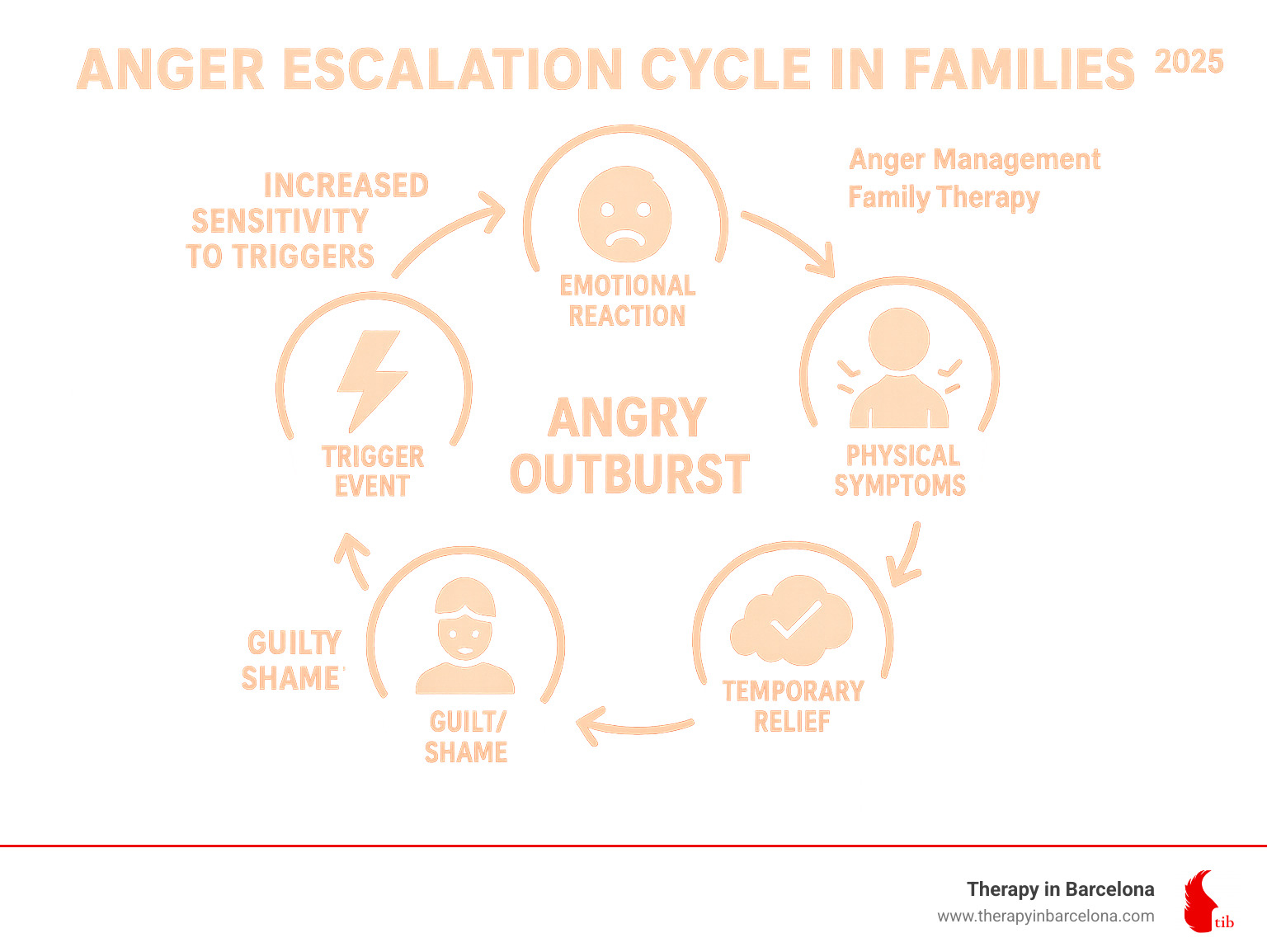
Why Does Anger Explode at Home? Getting to the Roots
Have you ever wondered why the people we love most seem to trigger our biggest emotional reactions? Anger management family therapy reveals that family anger rarely happens by accident – it grows from deeper roots that need our attention and care.
Think about it: your family is supposed to be your safe space, yet it’s often where emotions run highest. For expat families, this pattern becomes even more intense. The stress of cultural adjustment, language barriers, and missing extended family support creates a perfect storm for anger to flourish.
Research shows three main roots feed family anger: emotional disconnection, unrealistic expectations, and boundary breakdowns. Understanding these roots helps families move from reactive anger to conscious connection.
Emotional Disconnection: Feeling Unheard Hurts
When family members feel emotionally distant from each other, anger often becomes their way of reaching out. It’s like a desperate knock on a door that seems permanently closed. Emotional disconnection creates loneliness within the family unit, and that loneliness hurts deeply.
Picture this: Dad comes home exhausted from navigating work in a second language, Mum is overwhelmed by managing school communications she barely understands, and the kids are processing their own cultural adjustment challenges. Everyone needs connection, but no one has the emotional energy to give it.
Scientific research on family emotional process shows that emotional distance creates a cycle where family members feel increasingly isolated from each other. When children can’t express their need for connection directly, they often act out through anger instead.
For expat families, this disconnection intensifies because everyone is dealing with their own adjustment stress simultaneously. Parents may have less emotional bandwidth for family relationships whilst managing visa paperwork, finding new doctors, or learning local customs. Children might struggle to communicate complex feelings about missing friends or adapting to new schools, so these emotions emerge as anger.
Unrealistic Expectations & Role Strain
Families often carry invisible rule books about how everyone should behave, perform, or adapt. These unrealistic expectations create pressure that builds until it explodes in angry outbursts. Parents might expect children to adapt quickly to new cultures, whilst children expect parents to solve all their adjustment challenges immediately.
Scientific research on unrealistic expectations demonstrates how perfectionist expectations create chronic stress in families. When reality doesn’t match these expectations, disappointment transforms into anger.
Gender roles and cultural expectations add another layer of complexity. Expat families often juggle expectations from their home culture with new cultural norms, creating internal conflict about family roles and responsibilities.
Boundary Breakdowns
Healthy boundaries help families function like a well-oiled machine, but when boundaries break down, anger often fills the gap. Some families inadvertently reward angry behaviour by giving in to tantrums or avoiding conflict altogether. Others struggle with people-pleasing patterns that prevent honest communication about needs and limits.
Boundary issues become particularly complex for expat families navigating different cultural approaches to family hierarchy, independence, and conflict resolution. What felt normal in their home culture might not work in their new environment, creating confusion about appropriate boundaries.
The beautiful thing about understanding these roots is that families can address them directly. Anger management family therapy helps families recognise their patterns, understand their triggers, and develop healthier ways of connecting with each other.
Anger Management Family Therapy: What It Is & How It Heals
When families find themselves trapped in cycles of explosive arguments and hurt feelings, anger management family therapy offers a lifeline. Unlike traditional anger management that focuses on one person, this approach recognises a fundamental truth: family anger rarely happens in isolation. It’s a dance where everyone plays a part, and healing requires everyone to learn new steps together.
Think of it this way – when one family member struggles with anger, it affects the entire household. Children walk on eggshells, partners withdraw, and family dinners become minefields of tension. Anger management family therapy addresses these patterns by treating the family as a connected system, not just a collection of individuals.
The evidence speaks for itself. Research shows that approximately 75% of people receiving anger management therapy experience significant improvement. When families work together in therapy, these success rates often climb even higher. Why? Because family members become allies in each other’s healing journey, practising new skills together in their daily lives rather than trying to change in isolation.
This therapeutic approach weaves together several evidence-based methods. Cognitive Behavioural Therapy (CBT) helps families spot and challenge the thoughts that fuel anger explosions. Dialectical Behaviour Therapy (DBT) teaches everyone how to regulate intense emotions without causing damage. Family Systems Therapy examines the invisible patterns and dynamics that keep anger cycles spinning. Mindfulness training develops the pause between trigger and reaction – often the difference between connection and conflict.
For expat families, the stakes feel even higher. Cultural transitions, language barriers, and social isolation create unique pressure points that traditional therapy might miss. That’s why culturally sensitive practice becomes essential. Therapists need to understand how homesickness, cultural identity struggles, and the stress of constant adaptation contribute to family anger patterns. More info about Family Therapy Barcelona offers this specialised understanding for international families navigating these complex waters.
Main Goals of Anger Management Family Therapy
Reducing aggressive behaviour forms the foundation of this work. Families learn to recognise the early warning signs – the tightening jaw, the racing thoughts, the urge to blame – before they escalate into destructive outbursts.
Improving communication becomes the bridge to deeper connection. Many families get stuck in patterns where louder equals more heard, but healthy communication works differently. Active listening, expressing needs clearly, and validating each other’s experiences create safety where there was once chaos.
Creating safe expression acknowledges that anger itself isn’t the enemy – it’s often a signal that something important needs attention. Every family member learns to express frustration, disappointment, and hurt in ways that invite understanding rather than defensiveness.
Rebuilding trust requires patience and consistency. Anger often leaves relationship wounds that need careful tending. Families learn to repair these connections through genuine apologies, consistent follow-through on promises, and small daily acts of consideration that rebuild faith in each other.
Core Approaches Inside Sessions
CBT reframing helps families examine the stories they tell themselves about each other’s behaviour. Instead of “My teenager never listens to me,” parents might find “My teenager is learning independence and sometimes needs gentle reminders about family expectations.” This shift from blame to understanding changes everything.
DBT emotion regulation teaches practical skills for managing intense emotions. Families practise techniques like the STOP skill – Stop what you’re doing, Take a breath, Observe what’s happening inside and around you, then Proceed mindfully.
Structural family work examines the invisible rules and roles that govern family life. Sometimes anger erupts because boundaries are unclear, roles are unfair, or communication patterns have become toxic.
Mindfulness training brings families into the present moment during conflicts. Instead of rehashing old grievances or catastrophising about the future, families learn to stay grounded in what’s actually happening right now.
Techniques You Can Practise Today (Before or During Therapy)

Anger management family therapy becomes more effective when families practice techniques at home between sessions. The beautiful thing about these strategies is that they work immediately – you don’t need to wait for your first therapy appointment to start seeing positive changes in your family dynamics.
Many expat families find these techniques particularly helpful because they can be practiced regardless of language barriers or cultural differences. When you’re navigating the stress of living abroad, having concrete tools to manage anger can make the difference between a family crisis and a manageable disagreement.
Calm the Body First
Your body holds the key to breaking the anger cycle. When anger begins to rise, your nervous system activates the fight-or-flight response, flooding your body with stress hormones. The good news? You can interrupt this process with simple breathing techniques that anyone in your family can learn.
Deep breathing works like a reset button for your nervous system. Teach every family member to breathe in slowly for four counts, hold for four, then exhale for six counts. The longer exhale activates your parasympathetic nervous system, naturally calming the anger response.
Box breathing offers another powerful tool, especially for children who like structure. This technique involves equal counts: breathe in for four, hold for four, exhale for four, hold empty for four. It’s like drawing a box with your breath, which helps anxious minds focus on something concrete rather than spiraling anger thoughts.
Scientific research on relaxation & anger confirms that these relaxation techniques significantly reduce anger intensity and help prevent escalation to aggressive behavior.
Reframe the Thoughts
Anger often grows from the stories we tell ourselves about what’s happening. Cognitive restructuring helps family members identify thoughts that fuel anger and practice more balanced thinking. Instead of “This always happens” (which feels hopeless), try “This is frustrating right now, but we can work through it together” (which opens possibilities).
Thought logs create awareness of thinking patterns without judgment. Create a simple chart where family members can write down triggering situations, their automatic thoughts, and more balanced alternatives.
Reframe the Thoughts
When anger flares, our thoughts often twist reality, leading to what we call “cognitive distortions.” These are unhelpful thinking patterns that fuel anger. Learning to spot these distortions and reframe them into more balanced thoughts is a powerful skill. It’s not about denying your feelings, but about expressing them more constructively.
Here’s how common distorted thoughts can be rephrased into more balanced, helpful ones:
- Instead of: “You never listen to me!” Try: “I feel unheard right now. Let’s find a way to communicate better.”
- Instead of: “This family is hopeless!” Try: “We’re having a tough time, but I believe we can learn new skills together.”
- Instead of: “You always do this!” Try: “This behavior is frustrating for me. Let’s talk about what we both need in this situation.”
- Instead of: “I can’t handle this anymore!” Try: “I’m feeling overwhelmed right now. I need support to get through this.”
Communicate With Respect & Boundaries
Healthy communication transforms anger from a destructive force into a bridge for connection. Assertiveness training helps family members express needs clearly without aggression or passive-aggression. Practice using “I” statements like “I feel frustrated when…” rather than “You always…” This simple shift reduces defensiveness and opens space for understanding.
Active listening might sound basic, but it’s essential for angry families. This means putting down phones, making eye contact, and reflecting back what you heard before responding.
Safe word systems provide emergency brakes for heated discussions. Establish a family safe word that anyone can use when conversations become too intense. When someone says the safe word, everyone takes a 10-minute break to calm down.
Time-outs aren’t just for children – they’re essential tools for the whole family. When anger reaches a 7 out of 10 intensity, it’s time to pause. Adults might say “I need a few minutes to cool down” while children can be taught to recognize their anger signals and ask for space.
These techniques work best when practiced regularly, not just during crises. Start with one or two techniques that feel most natural to your family, and gradually add others as these become habits.
When to Seek Professional Help & How to Find It
Sometimes families wonder if their anger issues are serious enough to warrant professional help. The truth is, anger management family therapy can benefit families at various stages – you don’t need to wait until things reach a crisis point.
Daily tension signals that your family might benefit from professional support. When family members find themselves walking on eggshells to avoid triggering someone’s anger, or when explosive outbursts happen multiple times per week, it’s time to seek help.
Violence or fear requires immediate professional intervention. This includes any physical aggression, threats of violence, or situations where family members feel genuinely afraid. Even seemingly minor acts like aggressively throwing objects, slamming doors to intimidate, or using threatening language can escalate quickly without proper intervention.
Health problems often emerge when families live with chronic anger. High blood pressure, frequent headaches, digestive issues, and sleep problems can all result from ongoing family stress.
Stuck patterns frustrate families who find themselves repeating the same conflicts without resolution. When previous attempts at change haven’t worked, or when family members feel hopeless about improving their relationships, professional guidance can break these cycles and introduce new approaches.
Scientific research on online therapy for anger demonstrates that online interventions can be as effective as in-person therapy, making professional help more accessible for families who might struggle with scheduling or transportation.
Anger Management Family Therapy for Expats in Spain

Living as an expat family in Spain brings unique challenges that can intensify anger and family conflict. Understanding these specific stressors helps both families and therapists address the root causes more effectively.
Culture shock affects every family member differently. Parents might struggle with different approaches to work-life balance or educational expectations, whilst children steer new social rules and classroom dynamics.
Language barriers create frustration that extends beyond simple communication difficulties. When family members have different levels of Spanish fluency, everyday tasks become stressful.
Mixed-culture couples often find that their different cultural backgrounds create unexpected conflicts about family roles, parenting approaches, and communication styles.
Social isolation intensifies all these challenges. Without extended family support and established social networks, expat families often rely more heavily on each other for emotional support.
More info about Therapy for Internationals provides specialised support for families navigating these complex adjustment challenges.
Choosing the Right Therapist
Finding the right therapist for anger management family therapy requires careful consideration of several important factors that can make or break your family’s therapeutic experience.
Professional qualifications form the foundation of effective therapy. Look for therapists with specific training in family systems therapy, anger management, and evidence-based approaches like CBT or DBT.
Family-systems training sets family therapists apart from individual therapists. Not all mental health professionals are trained to work with entire families or understand the complex dynamics that contribute to family anger.
Multilingual ability can be crucial for expat families. Having a therapist who speaks multiple languages or deeply understands cultural transitions ensures that all family members can communicate effectively during sessions.
Personal fit significantly impacts treatment success. The therapeutic relationship affects how comfortable family members feel sharing vulnerable experiences and practicing new skills.
At Therapy in Barcelona, our collaborators set their own prices. Once you’re matched to a therapist, we’ll let you know their fees and preferred payment method.
Frequently Asked Questions about Anger Management Family Therapy
How long does anger management family therapy usually take?
The journey of anger management family therapy typically unfolds over 12-20 sessions spanning 3-6 months, though every family’s timeline looks different. Much depends on how deeply rooted the anger patterns are, how many family members are involved, and – perhaps most importantly – how committed everyone is to practising new skills between sessions.
What’s fascinating is that families who actively use their new communication tools throughout the week often see breakthrough moments much sooner than those who only engage during therapy appointments. It’s like learning to play piano – you can’t just show up for lessons and expect to master Chopin without daily practice.
Many families find that even after their main therapy work concludes, periodic “booster” sessions help maintain their progress. Life throws curveballs, and sometimes families need a refresher on their anger management strategies when facing new stressors like job changes, moves, or teenage years.
Can children participate even if only one parent has anger issues?
Absolutely, and it’s often one of the most healing decisions a family can make. When children participate in anger management family therapy, they’re not just observers – they become active contributors to changing their family’s emotional landscape.
Children benefit enormously from this involvement because they learn healthy ways to handle their own big feelings whilst developing skills to respond constructively when others are angry. Rather than feeling helpless during family conflicts, children gain confidence and tools to express their needs safely.
The ripple effects extend far beyond anger management. The whole family develops better communication skills, creating an environment where everyone feels heard and valued. Children often feel empowered when they realise their voice matters in family discussions and that they can contribute to positive changes at home.
Skilled family therapists adapt their approach beautifully to different ages and developmental stages. Younger children might explore feelings through play therapy techniques and drawing, whilst teenagers can engage in more direct conversations about family dynamics and their own emotional experiences.
What if family members live in different cities or countries?
Modern anger management family therapy has evolved to accept families scattered across the globe – a reality many expat families know well. Online therapy platforms now make it possible for everyone to gather in a virtual therapy room, regardless of whether they’re in Barcelona, London, or Sydney.
This flexibility proves particularly valuable for expat families dealing with complex geographical situations. University-age children studying abroad can still participate in family healing work. Parents who travel frequently for work don’t miss sessions. Extended family members who want to support the process can join from their home countries.
The key ingredients for successful online family therapy include reliable internet connections and private spaces where each family member can speak openly without being overheard. Some families find creative solutions, like combining online sessions when geography demands it with in-person meetings when everyone’s in the same location.
For families navigating the unique challenges of international life, online therapy often removes barriers that might otherwise prevent them from accessing the support they need. The convenience factor alone can make the difference between a family getting help and continuing to struggle with destructive anger patterns.
Conclusion

The journey from family fury to family harmony isn’t a destination you reach overnight—it’s a path that unfolds with patience, commitment, and the right support. When families accept anger management family therapy, they’re not just learning techniques; they’re rebuilding the foundation of how they connect, communicate, and care for each other.
Every family that walks through our doors carries their own story of struggle, but they also carry immense potential for change. The research is clear: families who invest in learning new ways to handle conflict consistently see their relationships transform. Children sleep better when home feels safe. Parents refind the joy of family time when it’s no longer overshadowed by tension. Couples remember why they chose each other when anger stops driving them apart.
For international families living in Barcelona, Madrid, Valencia, and across Spain, the challenges feel particularly intense. You’re already managing the stress of cultural adaptation, language barriers, and missing extended family support. When anger takes hold of your home, it can feel like the last straw. But here’s what we’ve learned from years of supporting expat families: your international experience, whilst challenging, also gives you unique strengths. You’ve already shown incredible resilience by building a life in a new country. That same courage can help you build healthier family relationships.
The techniques you’ve learned in this article—from simple breathing exercises to reframing negative thoughts—are tools you can start using today. But remember, seeking professional help isn’t about admitting failure; it’s about giving your family the best possible chance to thrive. Just as you might hire a personal trainer to improve your physical fitness, working with a qualified therapist helps strengthen your family’s emotional fitness.
At Therapy in Barcelona, we understand that every international family’s situation is unique. Our team of expat therapists brings both professional expertise and personal understanding of what it means to build a family life far from home. We’ve walked similar paths, faced similar challenges, and finded that with the right support, families can emerge stronger than ever.
Your family deserves to feel like a sanctuary, not a battleground. When you’re ready to take that step towards healing, we’re here to support you every step of the way. More info about our family-therapy services can help your family begin writing a new chapter—one filled with understanding, connection, and genuine peace.
