


Understanding Your Options for Online Therapy Relocation Spain

Relocating internationally is a major life transition that reshapes your daily environment, relationships, and sense of security. While the practical steps of moving–such as finding an apartment, securing visas, and opening bank accounts–have clear checklists, emotional adjustment moves at its own pace. Accessing online therapy for relocation offers dedicated space to process these complex psychological changes with professional guidance.
Migration-informed therapy focuses on the psychological realities of living across borders. When you move to Spain, your baseline support networks are temporarily suspended. An experienced practitioner helps you rebuild emotional stability while navigating foreign social systems and bureaucratic processes.
Therapy conducted in your native or primary language provides vital cognitive ease. When speaking a second language daily, your brain works overtime to translate words, cultural cues, and social expectations. In therapy, expressing vulnerability and nuanced emotions in your primary tongue eliminates this friction, allowing for deeper self-reflection.
How Expat-Focused Support Differs from Standard Care
Standard therapy often focuses on isolated symptoms without taking physical displacement into account. In contrast, expat-focused care considers how geographic disruption impacts identity, emotional safety, and self-worth. Working with a practitioner who understands the realities of cross-cultural adaptation saves time, as you do not need to explain the emotional toll of foreign bureaucracy or third-culture dynamics.
Therapists who possess lived expat experience bring natural empathy to your sessions. They understand cultural shorthand and the specific strains of international life. Professional associations, clinical registries, and expat-focused group practices can help you identify qualified therapists in Spain who are accustomed to cross-border transitions.
Personalised therapist matching ensures you work with someone aligned with your exact background and communication style. Rather than being assigned to the first available clinician on a generic platform, bespoke matching pairs you with a professional suited to your goals.
Exploring Key Modalities: CBT, ACT, IFS, and Logotherapy
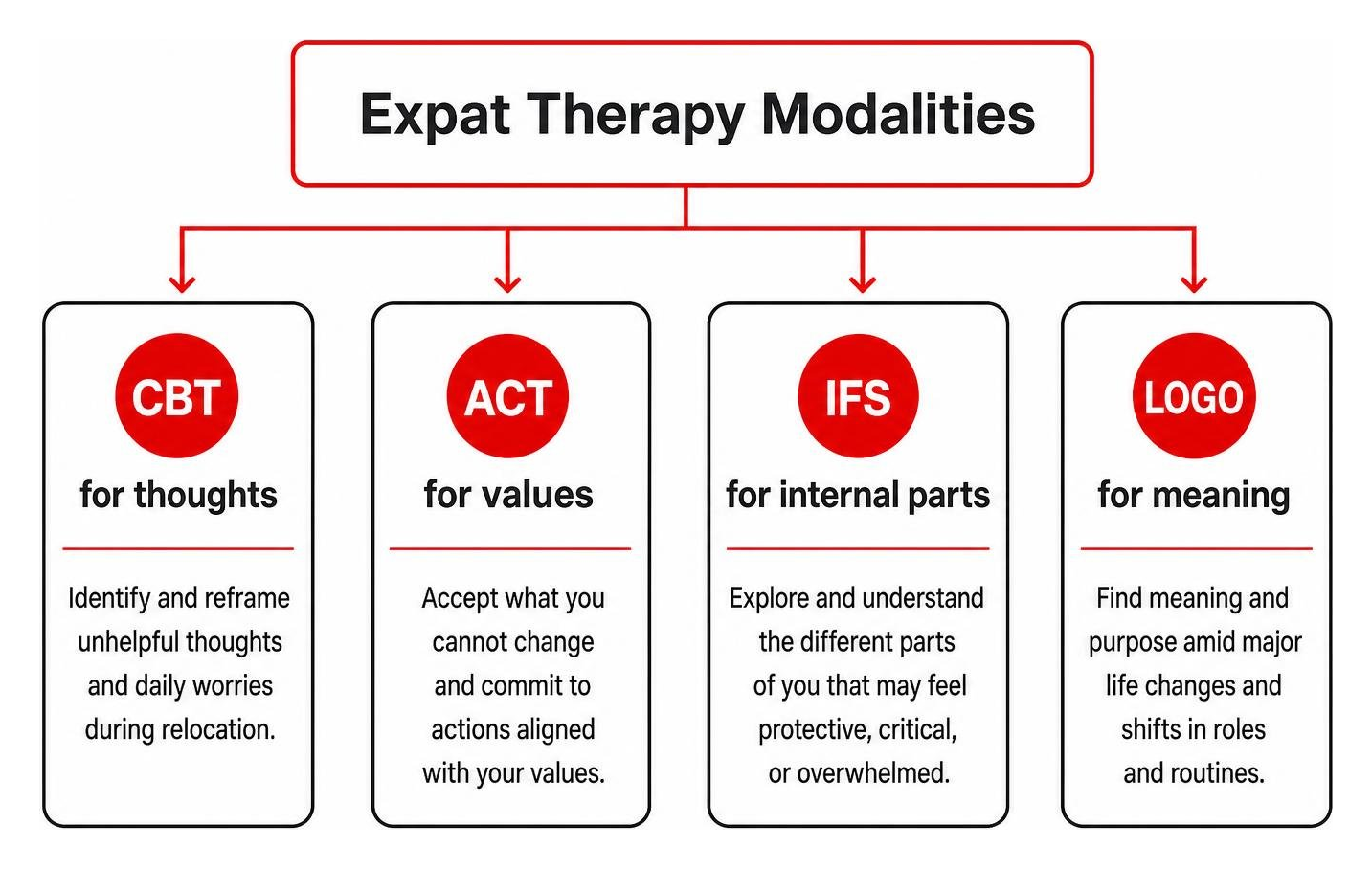
Qualified expat therapists integrate various evidence-based modalities to support cross-cultural adjustment:
- Cognitive Behavioural Therapy (CBT): Identifies and reframes unhelpful cognitive distortions, catastrophic thinking, and practical daily anxieties tied to settling into Spain. Expats facing acute relocation worry can use online therapy for expat anxiety to develop concrete coping mechanisms.
- Acceptance and Commitment Therapy (ACT): Helps you accept unavoidable relocation discomfort while committing to actions aligned with your core values.
- Internal Family Systems (IFS): Explores the internal parts of yourself that may feel protective, overwhelmed, or critical during times of immense external upheaval.
- Logotherapy and Existential Analysis: Developed by Viktor Frankl, this approach centres on meaning-making. It supports individuals whose careers, social roles, or routines have changed significantly following a move abroad.
- Gestalt Therapy: Focuses on present-moment emotional and somatic awareness, helping you understand how your nervous system responds to foreign environments.
Navigating the Emotional Challenges of Moving to Spain
Relocating to Spain often begins with high energy and optimism. As the initial novelty wears off, the realities of daily life can bring unexpected emotional and psychological challenges. Adjusting to a new culture takes time, and feelings of frustration, uncertainty, homesickness or disconnection can be a normal part of the transition. Therapy can provide a supportive space to make sense of these experiences, develop coping strategies and feel more grounded in your new environment.
Managing Culture Shock, Loneliness, and the Relocation Split
Many international residents experience an internal “split.” On paper, life in sunny Spain looks idyllic to friends and family back home. Internally, however, you may struggle with deep loneliness, administrative exhaustion, or loss of professional identity. This gap between external appearances and internal distress often leads to “living the dream” guilt, making people hesitate to seek help.
Relocating to Spain can look idyllic from the outside—weekend tapas, beach runs and the flexibility of remote work. Yet beneath the surface, some internationals experience isolation, low motivation and a persistent sense of disconnection. Social interactions may feel superficial or draining, and this can be compounded by guilt or confusion about not feeling as happy as expected.
Through dedicated online therapy for expat depression, individuals can learn that feeling overwhelmed or emotionally flat abroad may be part of the adjustment process rather than a personal failure. Structured psychological support can help bridge the gap between an outwardly positive lifestyle and the internal challenges of adapting to life in a new country.
Choosing Online Therapy Relocation Spain for Continuity Across Borders
One of the greatest challenges for mobile professionals, digital nomads, and corporate expats is maintaining consistent mental health support. Moving between autonomous communities—such as from Madrid to Sevilla, or Barcelona to Málaga—can disrupt access to local in-person clinics.
Using specialised online therapy for digital nomads guarantees that your care travels with you. Whether changing rental flats, traveling for business, or visiting family back home, online video sessions eliminate the need to restart your personal story with a new therapist every time your location shifts.
Comparing Formats, Providers, and Costs Across Spain
When seeking mental health care in Spain, you have three primary pathways: private expat-focused practices, the public healthcare system, and large international app platforms.
Private Expat Group Practices
- Format & Access: Multilingual online sessions nationwide, with in-person options in major cities like Barcelona.
- Wait Times: Typically immediate, starting within days.
- Language & Cultural Match: Native or fluent language matching with clinicians who understand expat life.
- Cost & Reimbursement: Private-pay; some offer sliding-scale fees for financial need. Invoices can often be claimed back on international private health insurance.
- Data Privacy: Strict clinical confidentiality, compliant with EU GDPR without third-party data commercialisation.
Spanish Public Healthcare (SNS)
- Format & Access: Local health centres (centros de salud) and regional hospitals (urgencias).
- Wait Times: Significant waiting lists (often several months) for outpatient psychological consultations.
- Language & Cultural Match: Consultations are primarily conducted in Spanish or regional languages (e.g., Catalan).
- Cost & Reimbursement: Fully covered for registered public social security holders.
- Data Privacy: Standard medical record confidentiality within the public healthcare database.
Large International Matching Apps
- Format & Access: Subscription-based mobile platforms offering remote video or text messaging.
- Wait Times: Fast matching, often within hours.
- Language & Cultural Match: Variable; relies heavily on algorithmic assignment rather than human intake assessment.
- Cost & Reimbursement: Fixed subscription rates; rarely reimbursable by European or international private insurers.
- Data Privacy: Often governed under overseas jurisdiction terms, raising privacy concerns regarding data usage.
Expats looking to navigate private options throughout the country can consult this resource on online therapy in Spain for comprehensive regional details.
Evaluating In-Person Care Versus Teletherapy Options
Both in-person and online therapy offer distinct clinical benefits:
At Therapy in Barcelona, approximately 70% of local clients prefer face-to-face sessions at our Barcelona office when accessible. However, nationwide online therapy for expats in Spain provides unmatched flexibility. For international residents living in smaller towns, or those balancing tight corporate schedules, teletherapy removes commute times and expands practitioner choice across the country.
Navigating Costs, Private Insurance, and Public Healthcare
Private therapy across Spain typically ranges between €45 and €180 per session, depending on the practitioner’s clinical experience, specialisation, and credentials. Therapy in Barcelona operates on a transparent private-pay model. Prospective clients with specific financial constraints can ask about sliding-scale arrangements during their intake process.
If you carry private international health insurance, you may be able to claim full or partial reimbursement. Insurers usually require that your therapist holds formal health credentials, such as registration as a Psicólogo General Sanitario in Spain or equivalent clinical licensing in their home jurisdiction. To ensure seamless claims, request itemised monthly invoices displaying provider registration numbers, dates of service, and appropriate diagnostic or intervention codes.
Step-by-Step Guide to Finding the Right Expat Therapist

- Clarify Your Immediate Goals: Identify your primary focus, such as managing relocation stress, career burnout, marital tension, or processing past trauma.
- Filter by Native Language Fluency: Choose a therapist who provides care in your native tongue so you can communicate effortlessly without self-censorship.
- Verify Professional Qualifications: Confirm that the clinician holds university psychology training and valid licensing with bodies such as Spain’s Col·legi Oficial de Psicologia, the Dutch NIP, or equivalent international professional boards.
- Confirm Expat Specialisation: Ensure the therapist has explicit training or lived experience in migration psychology, intercultural dynamics, and cross-border adaptation.
- Assess the Therapeutic Alliance: Book an introductory call to gauge interpersonal comfort, empathetic connection, and clinical safety.
- Optimise Your Remote Environment: Set up a quiet, confidential space with high-speed internet, quality headphones, and minimal distractions.
Practical Setup and What to Look for in Credentials
Ensure that your therapist uses secure, GDPR-compliant telehealth platforms rather than unencrypted video calling apps. Ask about their experience with third-culture challenges, their clinical approach, and how they handle cross-border continuity. You can also consult official professional associations or regional registries to verify practitioner standing across different autonomous communities.
Accessing Online Therapy Relocation Spain Outside Major Metros
While major metropolitan areas like Madrid and Barcelona host vibrant international communities, finding English-speaking support in regional provinces, the Costa Blanca, or the Balearic Islands can be difficult. Teletherapy bridges this geographic gap, connecting expats living anywhere in the country with qualified professionals via online therapy in English.
Recognizing Crisis Scenarios and Emergency Resources
Online outpatient therapy is designed for mild to moderate psychological concerns, personal growth, and adjustment support. It is not suitable for acute psychiatric crises, active psychosis, or severe self-harm risks.
If you or someone you know is in immediate danger in Spain, use the following crisis resources:
- National Emergency Services: Dial 112 (multilingual operators available for medical, police, and fire emergencies).
- National Suicide Prevention Helpline: Dial 024 (free, confidential, 24/7 crisis support across Spain).
- Local Hospital Emergency Rooms: Go directly to the nearest hospital emergency department (urgencias hospitalarias).
Frequently Asked Questions About Therapy in Spain
Is online therapy as effective as in-person therapy for expats?
Yes. Online therapy can be an effective way to support people experiencing anxiety, depression and adjustment-related stress. What often matters most is the quality of the therapeutic relationship and whether the client feels understood, supported and comfortable with their therapist, rather than whether sessions take place in person or online.
Does private health insurance in Spain cover online therapy?
Coverage depends on your specific policy terms. While local Spanish basic policies often restrict outpatient mental health, comprehensive international policies frequently reimburse sessions with registered psychologists. Always check with your insurance provider regarding pre-authorisation requirements and annual reimbursement caps.
What happens if I move to another city or country during therapy?
Online therapy offers continuity of care. If you move between Spanish autonomous communities or relocate to another country, you can continue working with your established therapist without restarting your therapeutic journey from scratch.
Supporting Your International Journey
Relocating to Spain is a major life transition that involves emotional adaptation alongside practical logistics. Finding the right therapeutic support can help you navigate culture shock, establish healthy routines, and build a meaningful life abroad.
Therapy in Barcelona was founded in 2011 by Australian Psychologist Leigh Matthews to support Barcelona’s international community. Today, our psychology-trained, multilingual team offers therapy in English, German, French, Spanish, Afrikaans, Portuguese, Austrian-German and Swiss-German.
We work online with clients worldwide, including the USA and Canada, and provide in-person sessions at our welcoming Barcelona office. Through careful, personalised matching, we support adults, couples, teens, and families through every stage of their international journey.
What is one small step you can take today to give your emotional well-being the same care you gave your relocation plans? If you’d like support, book a Free Discovery Call.
