


When You’re Together but Feel Miles Apart

If you feel emotionally alone in your relationship, you are not failing – and you are not imagining it. This kind of loneliness is real, and many people in committed relationships go through it. Feeling disconnected from the person closest to you can be painful, confusing, and hard to explain.
Here is a quick summary of what this usually means and what you can do:
- What it is: Feeling disconnected, unseen, or emotionally invisible despite being physically close to your partner
- Why it happens: Poor communication, unmet emotional needs, mismatched attachment styles, or life stress pulling you in different directions
- How it shows up: Surface-level conversations, feeling like housemates, or dreading the idea of going home
- What helps: Small daily rituals of connection, honest conversations using “I” statements, and — when needed — professional support like couples therapy
This kind of loneliness can feel more painful than being single. When you expect closeness and find distance instead, the gap hits harder.
For expats living in cities like Barcelona, Valencia, or Madrid, this pain can be even more acute. When your partner is your primary social anchor in a new country, feeling emotionally cut off from them leaves very little else to hold onto. The isolation compounds quickly.
What makes this experience so confusing is that nothing dramatic has to happen for it to take root. There is no argument, no betrayal — just two people sitting on the same sofa, absorbed in separate screens, slowly drifting apart. As one source puts it well: you can be in the same room, on the same couch, even in the same bed, and still feel miles apart.
This guide will help you understand why emotional loneliness develops in relationships, how to recognise it, and — most importantly — what you can do about it.
What it means to feel emotionally alone in a relationship
Feeling alone in a partnership is a specific, hollow sensation. It is the gap between the proximity you have and the presence you need. You might share a bed, a bank account, and a Google Calendar, yet feel as though you are shouting from the bottom of a well, and no one is listening.
The “Roommate Phase”
This is often what people mean by the “roommate phase.” The relationship still works on paper: bills get paid, chores get done, plans get made. But emotionally, something feels missing. Most conversations are about tasks, schedules, or responsibilities instead of feelings, comfort, or closeness. You may live together smoothly, yet still feel unseen, disconnected, or alone.
The Weight of Emotional Isolation
This feeling is not “just in your head.” Emotional disconnection can hurt in a very real way. When a partner seems distant or unresponsive, your nervous system may read that as a loss of safety and closeness. That can leave you feeling tense, rejected, or deeply alone, even when you are physically together.
Attachment Hunger
A big part of this pain is attachment hunger: the basic human need to feel seen, comforted, and responded to by someone close to us. When a partner seems distant, distracted, or emotionally flat, it can leave you feeling unsettled, hurt, and eventually shut down. This is one reason emotional loneliness in a relationship can feel so intense.
Common causes of emotional disconnection abroad
Living as an expat adds a unique layer of pressure to a relationship. Whether you are navigating life in the tech hubs of Málaga or the coastal charm of Alicante, the “expat factor” can significantly strain your emotional bond.
The Stress of Relocation
Moving abroad can put even strong relationships under pressure. You may lose daily support from friends, family, and familiar routines, which can make your partner feel like your only source of comfort. That can create strain fast. When one person is coping poorly with culture shock, homesickness, or language barriers, they may shut down or pull away. The other partner can end up feeling overwhelmed, unsupported, and emotionally alone.
Mismatched Attachment Styles
Under the pressure of international life, old attachment patterns often resurface. One partner might have an “anxious” attachment style, pursuing the other for more closeness and reassurance. The other might have an “avoidant” style, pulling away or burying themselves in work to cope with the stress. This creates a pursuer-distancer dynamic where the more one person reaches out, the more the other retreats.
The Impact of Digital Distraction
“Phubbing” (phone snubbing) is a modern intimacy killer. In a new city where you might rely on your phone for navigation, translation, and staying in touch with home, it is easy to let the screen become a wall between you and your partner. When “we-time” is constantly interrupted by notifications, the message sent is: “What is on my screen is more important than you.”
If you are wondering, why do I feel lonely in my relationship?, it is often because these small, daily moments of disconnection have accumulated into a structural deficit. Seeking relationship counselling can help identify which of these factors is most at play in your specific situation.
Warning signs of relationship loneliness
Recognising the signs of emotional isolation is the first step toward change. It often starts subtly before becoming a pervasive cloud over the relationship.

The “Still Face” Effect
In the famous “Still Face” experiment, infants become visibly distressed when their mothers stop responding emotionally to them. Adults experience a version of this too. If you share a piece of good news or a worry, and your partner barely looks up from their laptop, you feel “invisible.” Over time, you stop trying to share, leading to a profound sense of being unseen.
Surface-Level Living
Do you find yourself sticking to “safe” topics? If your conversations are limited to the price of utilities, the grocery list, or the logistics of your next trip to Madrid, you are living on the surface. When you hesitate to share your real feelings because you fear they won’t be received, the emotional depth of the relationship begins to evaporate.
Emotional Off-loading
A major warning sign is when you stop turning to your partner first. If you have a hard day at work and your first instinct is to call a friend back home or vent to a colleague rather than your spouse, you are “off-loading” your emotional needs elsewhere. While having a support network is healthy, a total lack of emotional exchange within the relationship creates a “parallel lives” dynamic.
For those struggling with these patterns, understanding the impact of emotional unavailability can help explain why a relationship starts to feel distant, even when you are still together.
Why the disconnect happens even when you are together
It is a painful irony that you can feel the most alone when your partner is sitting right next to you. This usually happens because of two main factors:
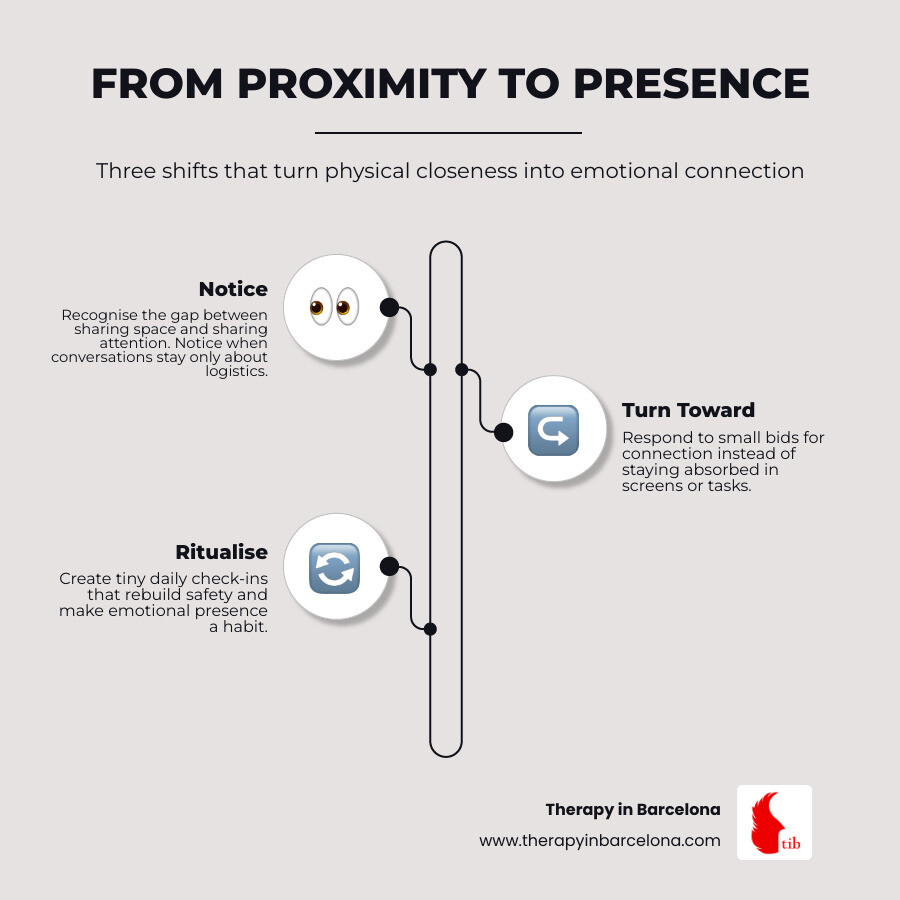
Missing “Bids for Connection”: A bid is a small moment where one partner reaches for attention, comfort, or closeness. It might be sharing a random thought, asking a quick question, making eye contact, or reaching out for a hug. These moments can seem minor, but they help build emotional connection over time. When a partner regularly gets little response, they can start to feel unseen, unimportant, or alone, even when they are together every day.
The “Fix-it” Trap: When someone says they feel lonely, hurt, or disconnected, their partner may respond with advice or problem-solving right away. Even if it comes from a caring place, this can feel dismissive. The person who opened up may feel like their emotions are being managed instead of understood. In many cases, what helps most is not an instant solution, but a response like: “That sounds really hard. Tell me more.”
To start turning this around, you might find it helpful to look at these 21 couples therapy activities designed to reignite connection.
Practical steps to rebuild emotional intimacy
If you feel emotionally alone in your relationship, the road back to connection starts with small, intentional actions. You do not need a grand gesture; you need consistency.

The 5-Minute Check-in
Establish a daily ritual where you spend five minutes (without phones!) asking each other one depth-inviting question. Instead of “How was your day?”, try “What was the most challenging part of your day?” or “What is one thing I can do to make you feel supported this week?” The goal is to be received, not to solve problems.
Micro-vulnerability
If the distance feels vast, start small. Share a minor worry or a small joy that you would normally keep to yourself. This “micro-vulnerability” helps rebuild the muscle of emotional safety without the pressure of a “big talk.”
Tech-Free Zones
Protect your home by creating tech-free zones or times. Perhaps the dinner table is a phone-free area, or you agree to put devices away 30 minutes before bed. This creates a dedicated space for “presence” rather than just “proximity.”
Rebuilding takes time and effort. For more structured guidance, see our guides on rebuilding trust and cultivating healthier relationships.
Communicating your loneliness without conflict
Talking about loneliness can feel like a betrayal of the relationship, especially if your partner is a “good person” who provides for the family. However, naming the gap is the only way to bridge it.
- The “Gentle Startup”: Avoid starting with “You never…” or “Why don’t you…”. This triggers defensiveness. Instead, lead with your own feelings: “I’ve been feeling a bit disconnected lately, and I miss our closeness.”
- Expressing Longing: Frame your request as a positive longing rather than a negative complaint. Instead of “You’re always on your phone,” try “I really value our time together, and I’d love it if we could have some focused time without distractions this evening.”
For more scripts and ideas, check out these topics to discuss in couples therapy or our list of top 10 discussion topics.
Understanding your options for support
Many internationals in Spain feel emotionally alone in their relationship while also feeling unsure where to get help. When you are already drained, trying to navigate a foreign health system, new language, and unfamiliar support options can feel overwhelming. That mix of relationship pain and practical confusion often leaves people feeling stuck, isolated, and unsure of the next step.
When seeking help, it is useful to understand the different pathways available:
Public Health System (CatSalut/SNS) These services are accessible and low-cost. However, they often involve significant waiting lists and may not offer the specific cultural nuance or English-language depth required for internationals living in Spain. In a public setting, you may not get to choose a therapist who understands the specific “expat” experience.
Large Online Platforms These are convenient and accessible via apps, often using algorithms for matching. While they offer speed, they may lack a deep understanding of the specific, multi-layered challenges faced by the international community in cities like Barcelona or Madrid. You might be matched with someone who has never lived abroad and cannot relate to the unique pressures of expat life.
Local Spanish Practices This is an excellent option for those who are fluent in Spanish and fully integrated into the local culture. However, for many English speakers, the nuance of emotional expression — the “fine-tuning” of feelings — can sometimes be lost across language and cultural barriers.
We are a specialised group practice of psychology-trained therapists, many with expat experience themselves. We offer thoughtful therapist matching and culturally sensitive care, face-to-face in Barcelona or online worldwide. As a private-pay service, we provide professional support with a strong focus on privacy.
Frequently Asked Questions
Is it normal to feel loneliness in a long-term relationship?
Yes. It can happen in any long-term relationship. As daily routines, stress, and responsibilities build up, emotional connection can start to fade and the “roommate phase” can creep in. Feeling lonely is often a sign that your relationship needs care, attention, and reconnection, not necessarily a sign that it has to end.
Can a relationship recover from emotional starvation?
Absolutely. By using evidence-based approaches like the Gottman Method or Imago Relationship Therapy, couples can learn to turn toward each other again. Recovery requires both partners to be willing to look at their patterns and practice new ways of connecting. You can start with these reignite your relationship activities.
When should we consider couples therapy?
If you feel like you are living parallel lives, if your “bids” for connection are consistently rejected, or if “i feel emotionally alone in my relationship” has become your daily reality, professional support can help. It is often better to seek help when the first signs of distance appear, rather than waiting for a crisis. You can read more about when it’s time for couples counselling.
About the Founder
Leigh Matthews is an Australian psychologist and founder of Therapy in Barcelona. An expat since 2011, she understands the strain that living abroad can place on relationships. For over 20 years, she has supported individuals and couples with practical, compassionate care.
If you’d like support, book a Free Discovery Call. We offer online therapy sessions worldwide, including the USA and Canada, providing culturally sensitive care for expats everywhere. Whether you are in Barcelona, Valencia, Madrid, or beyond, you don’t have to navigate this alone.
