


Why Intercultural Marriage Is More Complex Than Traditional Unions

Intercultural marriage brings together two hearts, two cultures, and often two completely different ways of viewing the world. While love may be universal, the dynamics of cross-cultural relationships require unique skills, patience, and understanding that go far beyond typical relationship advice.
Key aspects of intercultural marriage dynamics:
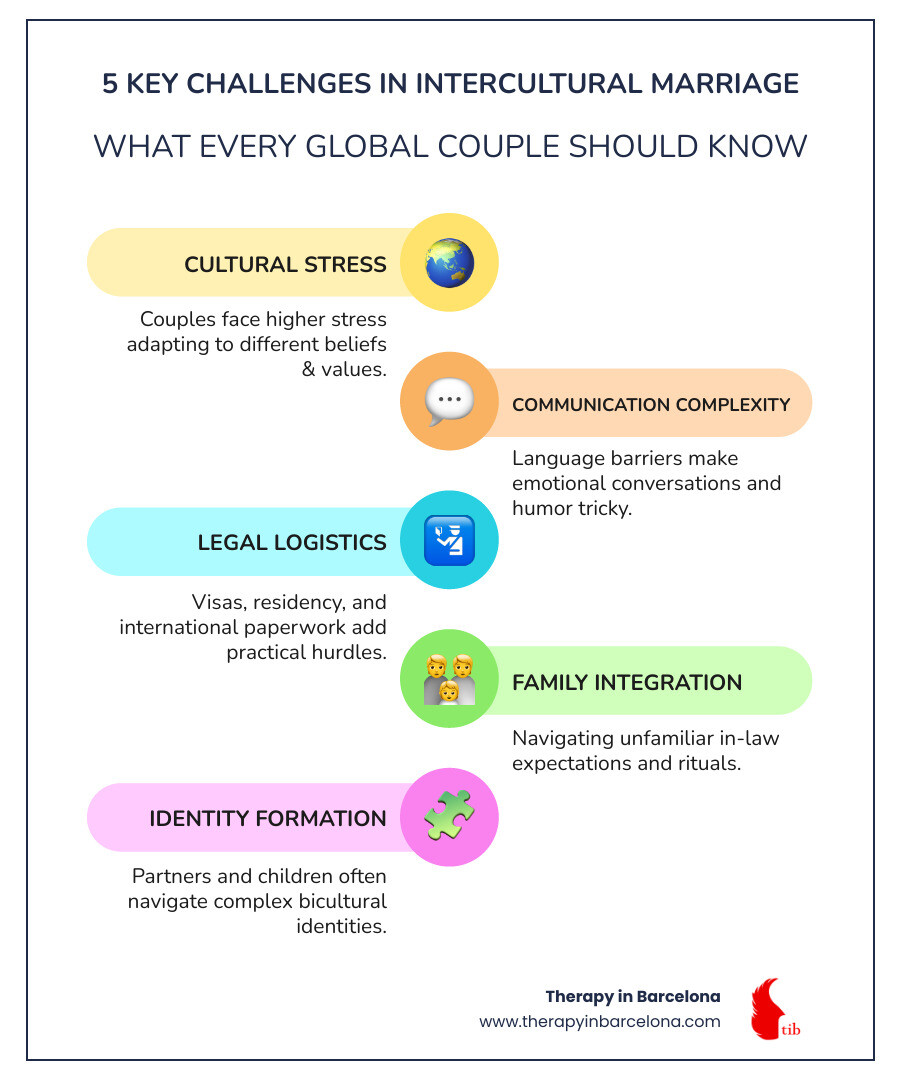
- Cultural stress factors – Research shows intercultural couples experience higher stress levels than same-culture couples
- Communication complexity – Arguments become more heated when emotions impact language use, even when both partners are fluent
- Extended integration – You’re not just marrying a person, you’re marrying their entire cultural background
- Legal considerations – Visa requirements, residency laws, and international documentation add practical complexity
- Family dynamics – Managing relationships with in-laws from different cultural backgrounds requires special navigation skills
- Identity questions – Children and couples often struggle with bicultural identity development
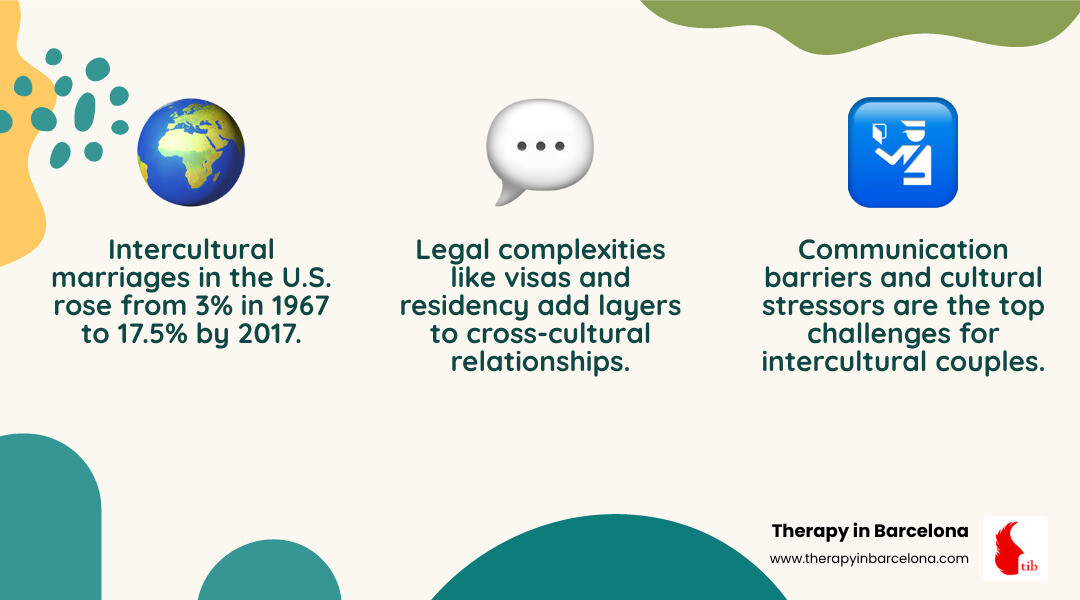
The statistics tell a compelling story of change. In the United States, intercultural marriages have surged from just 3% to 17.5% as of 2017. What’s remarkable is that these unions only became legal across America 50 years ago – as recently as 1966, many states prohibited intercultural relationships entirely.
For expats living in Barcelona or elsewhere in Spain, these challenges often intensify. The excitement of international love meets the reality of visa applications, language barriers during heated discussions, and the complex task of explaining your partner’s culture to family back home.
The good news? With the right tools and support, intercultural marriages can thrive. Many couples find that their cultural differences become sources of strength, creativity, and deeper connection rather than division.
Intercultural Marriage Dynamics: Why Culture Matters After the “I Do”
When two people from different cultures commit to each other, the beauty and complexity of their backgrounds don’t magically fuse on the wedding day. In fact, research shows that many cultural differences become more pronounced after marriage, as partners settle into daily routines and face real-life challenges.
What the Numbers Really Say about Intercultural Marriage
- Growing prevalence: Today, about 1 in 6 new marriages in the U.S. are intercultural or interracial, up from 1 in 33 in 1967. That’s over 2.3 million couples.
- Legal history: Only 50 years ago, many Western countries—including the U.S.—prohibited intercultural marriages. Now, cities like Barcelona, Madrid and Valencia are bubbling with international couples.
- Stress and satisfaction: Studies indicate intercultural couples experience higher stress levels than same-culture couples. However, those who acculturate well—adapting to each other’s language and customs—report higher marital satisfaction.
Comparing Stressors: Intracultural vs. Intercultural Marriages
While all marriages have their ups and downs, intercultural unions often face a unique set of challenges. Here’s a look at how common stressors can differ:
Communication Challenges
- Intracultural Couples: Primarily deal with misunderstandings stemming from individual communication styles, assumptions, or unspoken expectations.
- Intercultural Couples: Steer additional complexities like language barriers, varying non-verbal cues, and different cultural contexts for expressing emotions or ideas.
Family Integration
- Intracultural Couples: Generally integrate into families with familiar rituals, traditions, and established expectations.
- Intercultural Couples: Often need to steer unfamiliar family dynamics, traditions, and expectations from in-laws, which can be a significant source of stress.
Legal Logistics
- Intracultural Couples: Typically handle standard paperwork within a single legal system for marriage, residency, and other matters.
- Intercultural Couples: Frequently face complex legal problems involving visas, residency permits, and the translation and authentication of documents across different countries.
Parenting Approaches
- Intracultural Couples: Usually share similar cultural norms regarding discipline, educational philosophies, and general child-rearing practices.
- Intercultural Couples: May encounter significant differences in discipline styles, educational choices, and how to foster a strong cultural identity in their children.
Money and Values
- Intracultural Couples: Often operate with shared assumptions about financial management, spending habits, and core values.
- Intercultural Couples: Can face challenges from divergent spending/saving habits, expectations around financial support for extended family (remittances), and differing gender roles related to finances.
“You Marry a Person—and Their Culture”
Let’s debunk a common myth: you’re not just marrying your partner, you’re marrying their entire cultural “package.” That includes:
- Traditions and rituals: From holiday customs to wedding ceremonies, daily routines often differ widely.
- Family expectations: Extended family may have opinions about everything from what you eat to how you raise children.
- Societal attitudes: Intercultural couples may encounter stereotypes or even racism, both at home and abroad.
- Identity and adaptation: For expats, moving countries means adapting to a new culture while preserving your own—a balancing act that can be both thrilling and exhausting.
Take “Emily,” our composite client avatar: a Brit who married a Catalan partner and moved to Barcelona. While not a real client, Emily’s story—navigating language, in-laws, and Spanish bureaucracy—mirrors what many expats experience.
Communication & Language: Turning Babel into Bonding
When love speaks multiple languages, the magic happens in the spaces between words. In intercultural marriage, communication becomes an art form that goes far beyond simple translation—it’s about bridging entire worlds of meaning, emotion, and cultural understanding.
Picture this: you’re having a heated discussion with your partner about something important, but the words that perfectly capture your feelings exist only in your native language. Meanwhile, your partner is struggling to express complex emotions in what might be their second or third language. This isn’t just a vocabulary problem—it’s an emotional one that strikes at the heart of feeling truly understood.
The Intercultural Marriage Language Trap
The challenges run deeper than most couples anticipate. Emotion-laden conversations become particularly tricky when feelings are running high. Research shows that arguments in intercultural couples can escalate more quickly because emotions actually impact how we access and use language. Even when both partners are fluent, the subtle meanings behind words—the cultural context that gives language its true flavour—can get lost in translation.
Bilingual arguments create their own unique dynamic. Some couples find themselves “code-switching,” jumping between languages mid-conversation. One moment you’re arguing in English, the next you’ve switched to Spanish because that’s the only way to express your frustration about your partner’s mother’s comments at Sunday lunch. This linguistic dance can help clarify meaning, but it can also leave the less confident speaker feeling excluded or overwhelmed.
Then there’s the humour gap. Jokes, sarcasm, and cultural references don’t always travel well across languages. What’s hilarious in Catalan might sound harsh or completely nonsensical in English. Your partner’s witty comeback might land like a brick, not because it wasn’t clever, but because the cultural context didn’t make the journey.
Even body language and gestures carry different meanings across cultures. A shrug in Spain isn’t always the same as a shrug in Scotland. The way we show affection, express frustration, or signal that we’re listening varies dramatically from culture to culture, adding another layer of potential misunderstanding.
Practical Tools to Keep Talking
The good news? These challenges aren’t impossible. With patience and the right strategies, couples can turn their linguistic differences into strengths.
Active listening becomes crucial when you’re navigating multiple languages and cultural contexts. Instead of assuming you understand, try repeating back what you heard—not just the words, but the meaning behind them. This simple practice of mirroring helps confirm that you’re both on the same page.
Bilingual date nights can transform language differences from obstacles into opportunities for connection. Try alternating languages during your evening out, or dedicate time to learning together. When you’re both students, the playing field becomes more level, and mistakes become moments of laughter rather than frustration.
Research consistently shows that couples who develop a shared language—whether that’s becoming fluent in each other’s mother tongue or creating your own unique blend—report higher marital satisfaction. The key is patience with the process and each other.
Perhaps most importantly, approach misunderstandings with curiosity rather than frustration. When communication breaks down, instead of thinking “Why don’t they understand me?” try “What am I missing here?” This shift in perspective can transform conflicts into opportunities for deeper understanding.
Sometimes, though, you need more than good intentions and patience. Professional support through couples therapy for expat and intercultural couples can provide a neutral space to practice clearer communication and decode the cultural “scripts” that influence how you both express emotions and resolve conflicts.
Every intercultural couple faces these challenges. You’re not failing at communication—you’re just learning to speak the complex language of love across cultures. And that, frankly, makes you rather extraordinary.
Money, Values & Future Planning across Cultures
Money is never just about numbers—especially in an intercultural marriage. For many international couples, financial conversations go to the heart of trust, identity, and family loyalty. When partners come from different backgrounds, what feels “normal” around saving, spending, and even supporting extended family can look very different. It’s little wonder that finances remain one of the leading causes of conflict and divorce worldwide.
Imagine you grew up in a family where every euro was accounted for, planning for tomorrow was a must, and independence was prized. Your partner, on the other hand, might see money as something to be shared freely, especially with family back home, or as a resource for enjoying life today. These differences aren’t just about habits—they reflect deeply held values and cultural scripts.
Budgeting together can quickly become a dance—or a battleground. In some cultures, merging finances is automatic after marriage. In others, keeping separate accounts is the norm. There’s no universal “right way,” but finding an approach that feels fair to both partners is key. Remittances—sending money regularly to relatives in another country—can be an act of love, but it can also create anxiety or resentment if not openly discussed. Add in differences in economic background or views on who should manage the finances or work outside the home, and suddenly those “simple” budget talks get quite complicated.
Arguments about money often mask bigger worries about security, gender roles, or feeling overwhelmed by new responsibilities. Therapy in Barcelona often hears from expat couples who finded, only after relocating, just how differently they viewed financial planning. Sometimes it’s the stress of navigating two currencies, or the shock of Spanish bureaucracy, that brings these issues to the surface!
Budget Battles or Shared Vision?
It helps to remember: every couple writes their own financial story. The key is openness—talking frankly about expectations, worries, and obligations. Is it time to combine accounts, or would separate savings help you both feel safer? Does one of you send money home each month? Do you have family obligations that the other hasn’t experienced before? And how do your childhoods shape your ideas of risk and security?
If you find yourselves circling the same arguments, it isn’t a sign of failure. Many international couples benefit from support—sometimes just having a neutral third party in the room, like a couples therapist, makes it easier to listen and be heard. At Therapy in Barcelona, we see how financial disagreements often become opportunities for growth, once partners step out of “my way versus your way” and get curious about each other’s stories.
Raising Children in an Intercultural Marriage
When children arrive, the cultural mix grows richer—and so do the conversations about values. Questions like, Which language will we speak at home? or Will our children attend a local or international school? come to the fore. For many intercultural couples, raising “third culture kids” means helping children claim identity in more than one world.
Discipline and daily norms can be surprisingly emotional topics. One partner might value independence and free play, while the other prefers structure and clear rules. Religious education, family roles, and expectations for respect or obedience may not always align. These are not minor details—they shape how children see themselves and the world.
But here’s the good news: children growing up between cultures often develop remarkable empathy and resilience. The path can be bumpy, but it’s also full of possibility. Therapy in Barcelona is here for families navigating these complexities, offering support that honours both partners’ cultures and helps parents find common ground.
If talking about money or parenting feels overwhelming, you’re not alone. Many expat couples in Barcelona, Madrid, Valencia, and beyond face the same challenges. Our team—expats and internationals themselves—know how hard, and how rewarding, it can be to build a shared vision for your future.
If you’re feeling stuck, consider reaching out. Therapy in Barcelona offers personalised therapist matching, with multilingual, culturally sensitive professionals who understand the unique dynamics of international families. For more on our current fees, click here.
Remember: In an intercultural marriage, your differences can become strengths. All it takes is patience, honesty—and sometimes, just a little outside support.
Family, Society & Legal Logistics for Love Across Borders
In an intercultural marriage, you don’t just gain a partner—you inherit a whole network of traditions, expectations, and, yes, the paperwork. For many internationals in Barcelona, the joy of blending cultures sometimes comes with a side of spicy challenges, especially when families and legal systems get involved.
Managing In-Laws in an Intercultural Marriage
Family dynamics can feel a little like learning a new language: at first, you might not catch all the “unspoken rules.” For some, meeting the in-laws involves navigating unfamiliar customs—maybe a formal greeting, a certain way to dress, or new rituals around mealtimes and holidays. Even if these traditions feel strange at first, making an effort to respect and honour your partner’s family customs is a powerful act of love.
Yet, blending families also means setting clear boundaries together. Open conversations with your partner about what’s negotiable and what’s not can make all the difference. For some couples, challenges come from family members who are slow to accept an “outsider.” This can include subtle (or not-so-subtle) resistance, or, unfortunately, even racism. If you face this, lean on each other for support. Sometimes, it helps to seek guidance from a therapist—especially one who understands expat life in Spain. You can find practical strategies in our guide to navigating the intricacies of managing in-laws in intercultural relationships in Spain.
Holidays and family gatherings often double up, too. Think two sets of traditions, two different menus, and twice as many expectations to juggle. Flexibility and humour can be your secret weapons here.

Paperwork & Policy: Staying on the Right Side of the Law
Beyond the family table, there’s the less-glamorous side of intercultural love: paperwork. If one of you is from outside the EU, you’ll need to get cosy with Spain’s residency rules. This can mean chasing down marriage visas, filling out endless forms, and learning the difference between the civil registry and church wedding requirements. In Spain, only civil marriages are fully recognised by law, so religious ceremonies sometimes require extra documentation.
You might also come across apostilles (special document stamps) and the need for official translations—details that can feel overwhelming, especially when you’re already adapting to a new culture. For many couples, questions about prenuptial agreements arise; in some cultures, prenups are standard, while in others, they’re taboo. Finding a path that respects both your backgrounds can take patience (and possibly a few deep breaths).
Finally, residency renewals, work permits, and registering children can feel never-ending. Here, patience and a sense of humour go a long way.
If you ever feel like you’re drowning in red tape, remember: you’re not alone. Many have walked this path before, and support is available. In Barcelona and other Spanish cities, there are resources—and professionals—dedicated to helping international couples find their way. And if the stress of juggling families and paperwork starts to take its toll, culturally sensitive therapy can help you find calm amid the chaos.
Strengthening Your Bond: Coping Strategies, Therapy & Support
No couple is born knowing how to handle the unique challenges of intercultural marriage. Here’s what works, according to research and years of supporting expat couples at Therapy in Barcelona.
Knowledge & Education
- Deep curiosity: Go beyond surface-level facts. Ask about your partner’s childhood, family history, and the “why” behind their traditions.
- Ongoing learning: Cultures aren’t static. Keep exploring and sharing new things about yourselves.
Patience & Acceptance
- Respect differences: Some cultural gaps can’t be fully bridged—and that’s okay. Focus on what unites you.
- Accept limits: Not every disagreement needs to be resolved. Sometimes, agreeing to disagree is the healthiest path.
Communication & Support
- Professional help: Couples therapy can be a game-changer, especially with a therapist who understands expat life.
- Peer support: Seek out other intercultural couples—online or in Barcelona’s vibrant international community. Shared experiences are powerful.
When to Seek Intercultural Marriage Counseling
- Warning signs: Persistent misunderstandings, emotional distance, or repeated arguments about culture or family.
- Relocation stress: The move itself can put enormous strain on a relationship.
- Identity struggles: If one or both partners feel lost, isolated, or “neither here nor there,” it’s time to reach out.
- Learn more: Guide to intercultural marriage counseling.
How Therapy in Barcelona Helps Expat Couples Thrive
- Culturally sensitive care: All therapists are expats themselves and understand the unique challenges of international life.
- Personalised therapist matching: Therapy in Barcelona matches you with the right therapist for your background and goals.
- Multilingual sessions: Support is available in English and other languages, both in-person and online.
- Expat community focus: Whether you’re in Barcelona, Madrid, Valencia, or anywhere in Spain, Therapy in Barcelona offers a safe, understanding space for couples and families.
Alternative options: While there are other platforms and local therapists (such as BetterHelp or public system clinicians), Therapy in Barcelona stands out for its custom approach, privacy, and deep understanding of expat life.
Frequently Asked Questions about Intercultural Marriage
Does intercultural marriage have a higher divorce rate?
This is one of the most common worries couples express, and honestly, the research paints a nuanced picture. Some studies do suggest intercultural couples face slightly higher divorce rates, particularly in those crucial early years of marriage. But here’s what’s really happening beneath those statistics.
The liftd stress often comes from the added layers of complexity we’ve discussed throughout this guide—communication problems, family dynamics, visa paperwork, and navigating two sets of cultural expectations. It’s not that intercultural love is doomed; it’s that these relationships require different tools and more intentional effort.
The encouraging news? Couples who invest in acculturation—learning each other’s languages, understanding cultural contexts, and finding their unique blend—often report equal or even higher relationship satisfaction over time. When intercultural couples seek professional support and commit to open communication, they frequently develop stronger bonds than many same-culture couples.
How can we handle language barriers day-to-day?
Language barriers in intercultural marriage go far beyond simple translation issues. You might find yourselves code-switching mid-argument, struggling to express vulnerability in your second language, or missing the subtle humour that bonds couples together.
Start by establishing a “shared language” for important conversations, even if it’s not perfect for both of you. This might mean you always discuss finances in English, but bedtime stories with future children happen in Spanish. Practice active listening and don’t hesitate to ask for clarification—”What I heard you say was…” can prevent massive misunderstandings.
Consider learning each other’s language basics as an ongoing gesture of love and respect. Even simple phrases in your partner’s mother tongue can bridge emotional gaps during difficult moments. Most importantly, approach misunderstandings with curiosity rather than frustration. That “hilarious” mix-up today might become a cherished story you tell your grandchildren.
When language barriers feel overwhelming, a therapist who can work in both languages can be invaluable for facilitating clearer communication.
What if our families oppose the relationship?
Family resistance to intercultural relationships is unfortunately common, and you’re certainly not alone in facing this challenge. Many families initially react with fear of the unknown, concern about cultural differences, or worry about practical complications like distance and visas.
Present a united front with your partner—decide together how you’ll handle pushback and what boundaries you need to set. Some families need time and gentle education about your partner’s culture and values. Others may require firmer boundaries about what comments or behaviours you’ll accept.
Building acceptance often takes time, but it’s possible. Invite family members to learn about your partner’s background, share positive experiences, and demonstrate how your relationship enriches both your lives. Some families come around when they see grandchildren or witness the genuine happiness intercultural love can bring.
Healthy boundaries are essential. While it’s natural to want family approval, you can’t control their reactions—only your responses. If family opposition becomes toxic or abusive, seeking support from friends, allies, or a therapist experienced in family dynamics becomes crucial.
Many couples find that standing firm in their commitment while remaining open to dialogue eventually leads to acceptance, even if it takes longer than they’d hoped.
Conclusion
Intercultural marriage is like starting on the trip of a lifetime—one that’s equal parts exhilarating and terrifying, often within the same day. The challenges are absolutely real. You might find yourself arguing in three languages during a single conversation, trying to explain why your partner’s family celebrates Christmas in July, or spending your Saturday morning at the Spanish civil registry with a stack of apostilled documents that somehow still aren’t quite right.
But here’s what makes it all worthwhile: the rewards are just as real, if not more so. There’s something magical about building a life that bridges two worlds, creating traditions that blend the best of both cultures, and raising children who see diversity as their natural habitat rather than something foreign. You develop a kind of empathy that can’t be taught in books—one that comes from truly understanding how different people can love in completely different ways.
The journey isn’t one you have to steer alone. At Therapy in Barcelona, we’ve been walking alongside international couples since 2011, long before intercultural relationships became as common as they are today. Founded by Leigh Matthews, an Australian psychologist who herself fell in love across cultures and moved to Barcelona, our practice was born from the very real need she experienced as an expat navigating her own intercultural marriage.
Leigh understood what it meant to adapt to Spanish family obligations, steer Catalan culture, and even experience pregnancy in a foreign country—all while building a life with someone whose cultural background was entirely different from her own. When she looked for support and couldn’t find English-speaking therapists who truly understood the expat experience, she realised how many other international couples were facing the same gap.
What makes our approach different is that we don’t just offer therapy—we offer understanding. Every therapist on our team is an expat themselves, which means they’ve lived through visa applications, cultural misunderstandings, and the complex dance of maintaining your own identity while embracing your partner’s world. Our personalised therapist matching ensures you’ll work with someone who truly gets your unique situation, whether you’re dealing with language barriers, family resistance, or the everyday challenges of building a bicultural life.
While there are other options available—from public system clinicians to large online platforms like BetterHelp—our focus remains laser-sharp on the international community. We understand that your relationship challenges aren’t just about communication or conflict resolution; they’re about navigating two entire ways of being in the world.
Your intercultural love story matters. It’s a testament to the fact that love really can transcend borders, and that diversity isn’t just something to tolerate—it’s something to celebrate. Whether you’re newlyweds trying to figure out whose family traditions take precedence, or you’ve been together for years and are facing new challenges as your relationship evolves, seeking support is a sign of strength, not weakness.
Ready to strengthen your intercultural bond? Learn more about our cross-cultural marriage counseling and support, or book a free call to find your perfect therapist match. Because love that crosses borders deserves support that understands borders.
Here’s to relationships that prove love speaks every language, and to couples brave enough to build bridges between worlds.
If you’re navigating the beautiful complexity of intercultural marriage in Barcelona, Madrid, Valencia, or anywhere else in Spain, Therapy in Barcelona offers a sanctuary designed specifically for internationals. With multilingual therapists, culturally sensitive care, and the deep understanding that comes from living the expat experience ourselves, you’re never alone on this journey.
