Therapy for Intimacy Issues: Fast Facts and What to Expect

Therapy for intimacy issues can help you rebuild closeness, trust, and connection in your relationships—whether you’re single, in a couple, or navigating family and cultural changes abroad.
Here’s how therapy can help with common intimacy challenges:
Struggling to Open Up? Therapy offers a safe space to explore why sharing feelings is difficult and teaches you practical ways to express yourself without pressure.
Feeling Distant from Your Partner? Therapy helps uncover the roots of disconnection, guiding you and your partner to rebuild trust and strengthen your emotional bonds.
Avoiding Closeness? Therapy provides a path to address underlying fears or past hurts that lead to avoiding intimacy, helping you gradually rebuild comfort with closeness.
Cultural Adjustment Challenges? For those navigating new cultures or expat life, therapy offers culturally sensitive support to address how these changes impact your intimacy and relationships.
Constant Conflicts Over Intimacy? Therapy equips you with effective communication skills to discuss intimacy needs and desires constructively, turning arguments into opportunities for understanding.
Therapy provides a confidential, supportive space to explore the root causes of intimacy challenges—like anxiety, past relationship pain, or cultural transitions. With an experienced therapist, you can develop tools to connect more deeply with yourself and others.
You don’t need to face these struggles alone. Whether you’re an individual or a couple, Therapy in Barcelona offers personalised matching with therapists who understand the unique challenges of expat life. Our fees range from 80 to 95 Euros for individual sessions, and 95 to 120 Euros for couples. Find current fees here.
“Most people look for that perfect relationship because they want real, true intimacy, but what is intimacy really?”
—Sex Therapy for Intimacy Issues
Are you ready to move past feeling stuck or lonely in your relationships? Let’s explore how therapy can help you reconnect and thrive, wherever you call home.
Understanding Intimacy Issues and Their Impact
If you’ve ever wondered why it’s hard to share your feelings, why you freeze up when someone gets close, or why you find yourself pulling away just as things seem to be going well—welcome. These are common signs of intimacy issues, and you’re far from alone.
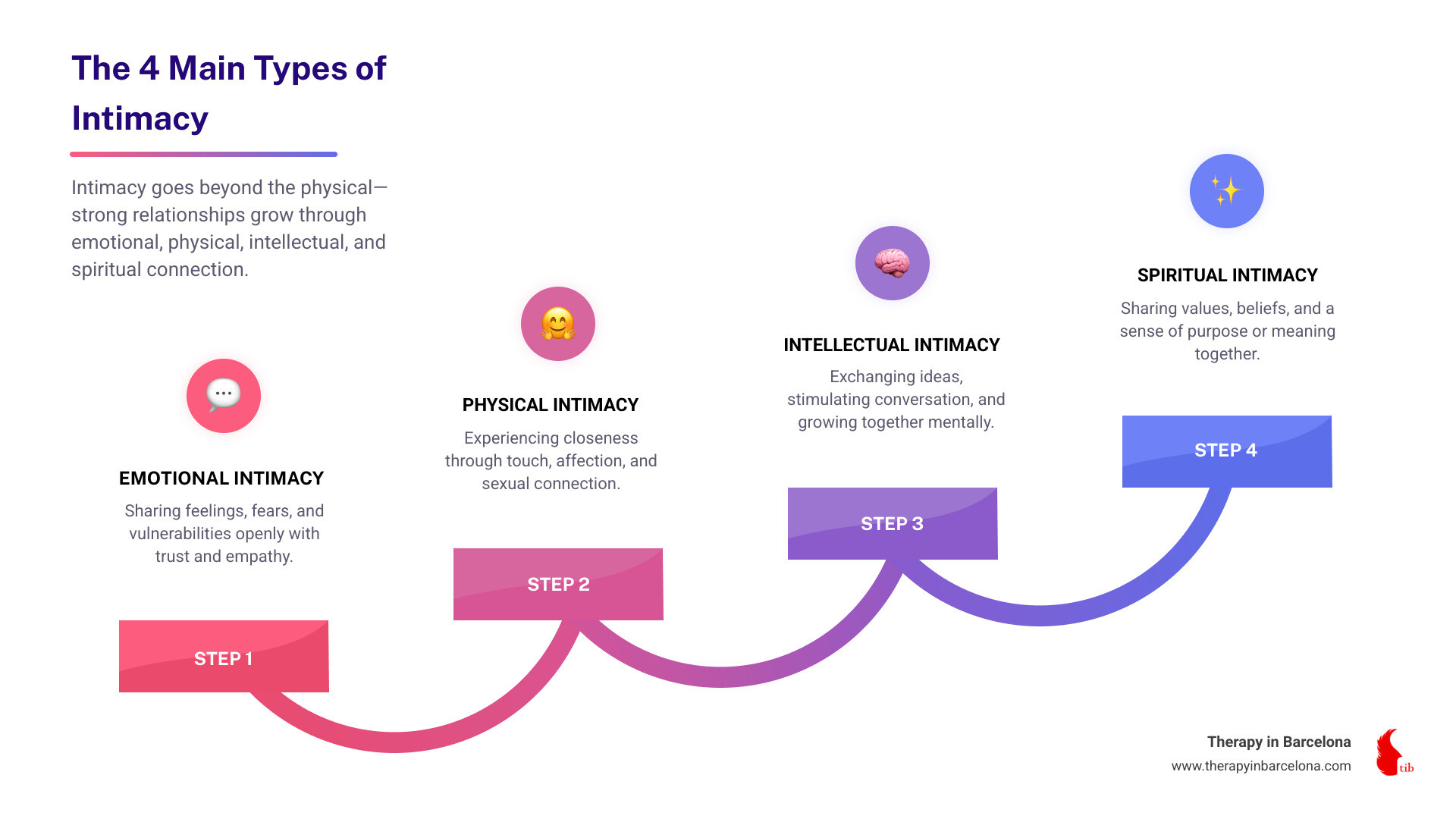
Intimacy is about more than just sex or physical closeness. True intimacy is a deep sense of trust, openness, and mutual understanding. Researchers identify four main types of intimacy:
- Emotional intimacy: Sharing vulnerable feelings, hopes, and fears.
- Physical intimacy: Affection, touch, and sexual closeness.
- Intellectual intimacy: Sharing thoughts, beliefs, and ideas.
- Spiritual intimacy: Connecting over shared values or meaning.
Intimacy issues can affect any of these areas, not just the bedroom. In relationships, struggles with intimacy often look like:
- Emotional distance or “walking on eggshells”
- Reluctance to be physically close
- Communication breakdowns
- Feeling misunderstood or “invisible”
- Fear of being rejected or abandoned
These challenges can be especially tough for expats and internationals, who may already be navigating cultural differences, homesickness, and the stress of adjusting to a new environment.
Common Signs You Might Be Struggling with Intimacy
How do you know if you’re facing intimacy issues? It’s not always obvious. Here are some clues:
- Difficulty sharing feelings, needs, or fears—even with close friends or partners
- Avoiding physical touch, sex, or even eye contact
- Fear of commitment, or “self-sabotaging” when relationships get serious
- Persistent negative self-talk (“I’m not lovable,” “They’ll leave me anyway”)
- Catastrophic thinking (“If I open up, I’ll be hurt”)
- Avoiding vulnerability by staying “busy” or using humour to deflect
Sometimes these patterns come from deep-seated fears. For example, fear of rejection and fear of abandonment are common drivers of intimacy struggles. Research also links issues like avoidant personality disorder to chronic difficulties forming close connections. Learn more about avoidant personality disorder.
“Fear of intimacy is often rooted in early experiences—sometimes as far back as childhood. It can show up as trust issues, anger, or even low self-worth.”
—Healthline: Fear of Intimacy
The Root Causes Behind Intimacy Challenges
So, where do intimacy issues come from? The answer is rarely simple. Research shows that the roots can include:
- Childhood trauma or neglect: Early experiences of not having needs met, or being punished for expressing emotion, can set up patterns of avoidance.
- Attachment issues: How safe or secure you felt with caregivers often shapes how you relate to partners as an adult.
- Past relationship pain: Betrayal, abandonment, or repeated heartbreak can make it hard to trust again.
- Cultural adjustment: Moving abroad can shake up your sense of identity, values, and how you connect with others.
- Body image concerns: Feeling ashamed or uncomfortable in your body can make physical closeness hard.
- Mental health factors: Anxiety, depression, or low self-esteem can all fuel intimacy struggles.
These factors often interact. For example, Emily—a fictional expat avatar—moved to Barcelona full of excitement but soon found herself withdrawing from her partner. She was struggling with homesickness, adjusting to a new language, and old fears of not being “enough” resurfaced. Her story mirrors the real-life struggles of many internationals, where cultural shifts and personal history collide.
How Therapy for Intimacy Issues Can Transform Your Relationships
Here’s the good news: therapy for intimacy issues is highly effective, and you don’t have to steer this journey alone. The patterns that keep you stuck—the walls you’ve built, the fears that hold you back—they can change.
When you work with a skilled therapist, something beautiful happens. You start to understand why intimacy feels scary or overwhelming. Maybe it’s because opening up in the past led to hurt, or perhaps you learned early on that your needs didn’t matter. Whatever the reason, therapy creates a safe space to explore these tender spots without judgement.
A therapist can help you heal emotional wounds that have been quietly shaping your relationships for years. They’ll guide you in challenging those unhelpful beliefs—like “I’m not worthy of love” or “If I let someone close, they’ll leave anyway”—and replacing them with healthier, more realistic thoughts.
But it’s not just about understanding the past. Therapy for intimacy issues is deeply practical. You’ll learn concrete skills for communication, building trust, and allowing yourself to be vulnerable in healthy ways. Whether you’re working on your relationship with yourself, a partner, or family members, these tools can transform how you connect with others.
Evidence-Based Therapeutic Approaches
At Therapy in Barcelona, our therapists use a variety of proven methods that have helped countless people rebuild their capacity for closeness. Cognitive Behavioural Therapy (CBT) is particularly powerful for intimacy struggles because it helps you identify and change the negative thought patterns that fuel fear of connection. Research shows CBT is one of the most effective approaches for relationship issues.
Acceptance and Commitment Therapy (ACT) takes a different but equally valuable approach. Instead of trying to eliminate uncomfortable feelings, ACT teaches you to accept them while committing to actions that align with your values—like building closer relationships despite the fear.
Mindfulness-based practices can be game-changers for intimacy issues. When you’re present in the moment rather than caught up in anxious thoughts about the future or painful memories from the past, you can actually experience connection as it happens.
For couples, sensate focus is a gentle, step-by-step method that helps partners rebuild both physical and emotional closeness at a pace that feels safe for everyone involved. It’s often used in sex therapy but addresses so much more than just physical intimacy.
Couples therapy itself provides a neutral, supportive space where you can practice new ways of communicating, learn to set healthy boundaries, and explore shared goals for your relationship. And for those specifically struggling with sexual intimacy, sex therapy addresses these concerns in a completely non-judgemental, professional environment.
The beauty of online therapy is that these evidence-based approaches work just as well through a screen as they do in person. Research confirms that online couples therapy can be as effective as in-person sessions, especially when using proven methods like CBT and ACT.
What makes Therapy in Barcelona particularly unique is our specialisation in culturally sensitive therapy for expats. We understand that intimacy challenges don’t exist in a vacuum—they’re often intertwined with language barriers, cultural differences, and the unique stressors of building a life abroad.
What to Expect in Intimacy Therapy Sessions
Starting therapy for intimacy issues can feel daunting, especially when you’re used to keeping your guard up. But here’s what actually happens, and why it’s less scary than you might think.
Everything begins with personalised matching. Therapy in Barcelona takes time to understand your specific situation, background, and what you’re hoping to achieve. We don’t just pair you with whoever’s available next—we match you with a therapist who truly gets your unique circumstances.
Your first sessions focus on creating a safe, confidential space where you can begin to lower your defences. There’s no pressure to share everything immediately. Your therapist will follow your lead, respecting your pace and never pushing you further than you’re ready to go.
Together, you’ll gently explore your history—not to dwell on the past, but to understand how earlier experiences might be influencing your current relationships. This isn’t about blame or dwelling on old wounds; it’s about gaining insight that leads to freedom.
Goal setting is crucial in intimacy therapy. What does healthy intimacy look like for you? What specific changes would make the biggest difference in your relationships? Your therapist will help you clarify these goals and create a realistic path towards achieving them.
The skill-building phase is where the real change happens. You’ll learn practical communication techniques, mindfulness exercises, and boundary-setting strategies that you can use immediately in your daily life.
Between sessions, you might be invited to try homework assignments—perhaps journalling about your feelings, practising mindfulness exercises, or trying new ways of connecting with your partner. These aren’t tests to pass or fail; they’re opportunities to practise new skills in a supportive environment.
Throughout the process, your therapist will help you monitor your progress, celebrating the wins (even small ones) and adjusting strategies as needed. Healing isn’t linear, and setbacks are normal parts of the journey.

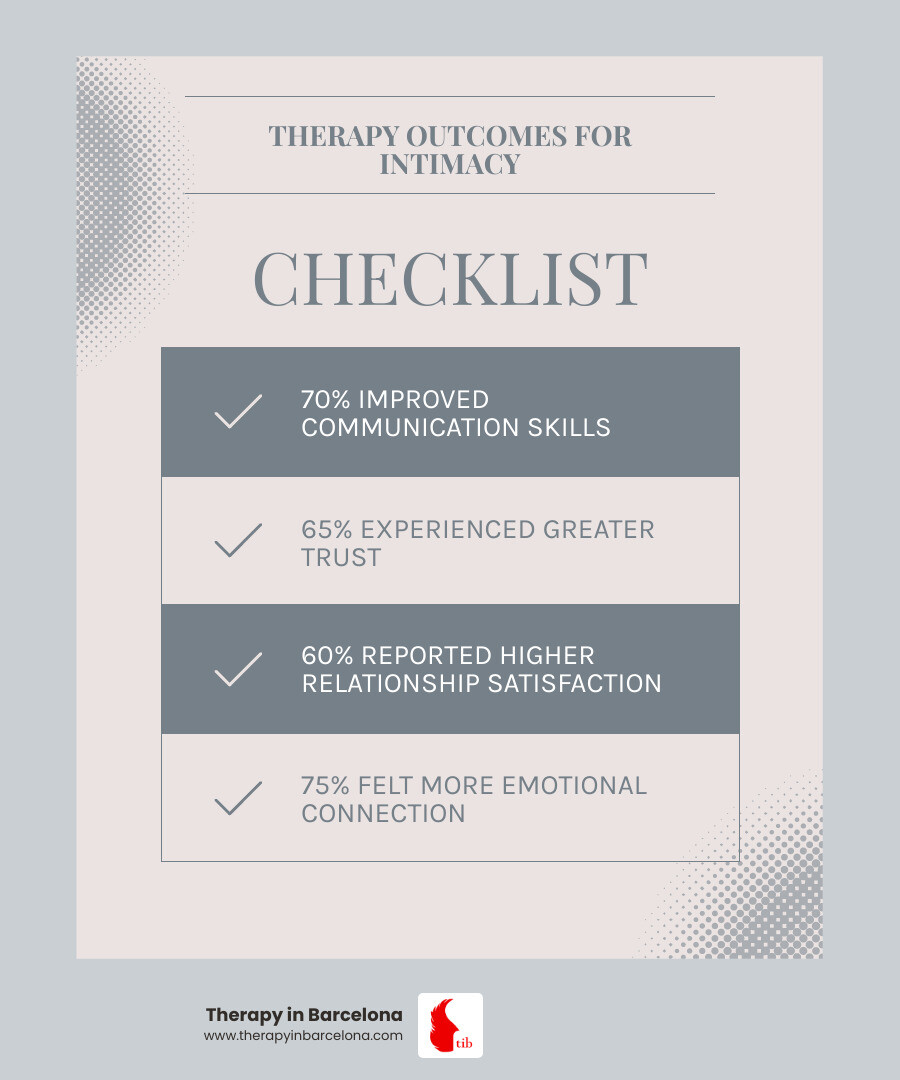
Most people notice changes gradually—perhaps feeling more confident in conversations, finding it easier to express their needs, or experiencing less anxiety about physical closeness. Many report significant improvements in their relationships within just a few months of starting therapy.
The journey isn’t always smooth, but it’s deeply worthwhile. As one client shared, “I never thought I’d be able to trust someone completely, but therapy helped me understand that vulnerability isn’t weakness—it’s actually courage.”
Practical Strategies for Building Intimacy Outside Therapy
Therapy for intimacy issues creates the foundation for change—but what happens between sessions often makes the biggest difference. Think of it like learning to drive: you need instruction, but you also need practice on the road.
The beautiful thing is that small, consistent actions can create profound shifts in how connected you feel. You don’t need grand gestures or perfect conversations. Instead, it’s about building intimacy one meaningful moment at a time.
Open communication might sound obvious, but it’s surprisingly tricky when you’re used to keeping things surface-level. Start small. Instead of diving into your deepest fears, try sharing something simple: “I felt proud when you complimented my cooking” or “I’ve been thinking about that conversation we had yesterday.” These “I feel…” statements create openness without overwhelming anyone.
Setting and respecting boundaries is equally important. This isn’t about building walls—it’s about creating safety. Maybe you agree that certain topics are off-limits when you’re both tired, or perhaps you establish phone-free zones during dinner. When both people know what feels safe, intimacy can actually flourish.
Emotional vulnerability is where the real magic happens, even though it feels terrifying. This might mean admitting you don’t have all the answers, sharing a worry, or simply saying “I’m scared” instead of pretending everything’s fine. Vulnerability isn’t weakness—it’s the birthplace of connection.
Quality time doesn’t require elaborate plans or expensive dates. It’s about presence. A weekly coffee ritual, an evening walk without phones, or even cooking together can become sacred spaces for connection. The key is consistency and genuine attention to each other.
Physical affection releases oxytocin, often called the “bonding hormone,” which literally helps us feel closer. This doesn’t mean jumping straight into sexual intimacy if that feels challenging. Small touches—holding hands, a hug that lasts a few seconds longer, sitting close while watching a film—can rebuild physical connection gradually.
Shared goals create a sense of partnership. This might be planning a holiday together, working towards a common dream, or even tackling a home project as a team. When you’re building something together, you’re reminded that you’re on the same side.

Expressing appreciation is perhaps the simplest yet most powerful tool. Notice what you value in your partner—and yourself—and say it out loud. “I appreciate how patient you were with me today” or “I’m proud of myself for speaking up about what I needed.” Gratitude creates a positive cycle that makes intimacy feel safer and more natural.
Self-Help Techniques That Complement Professional Support
Even if you’re not ready for therapy for intimacy issues yet, you can start building emotional resilience and connection skills right now. These techniques work beautifully alongside professional support, too.
Box breathing is a simple yet powerful tool for managing the anxiety that often comes with intimacy. When you feel overwhelmed or want to pull away, try this: inhale for four counts, hold for four, exhale for four, hold for four—and repeat. This calms your nervous system and helps you stay present instead of fleeing. Research shows box breathing can reduce stress and improve emotional regulation.
Mindfulness meditation teaches you to notice your thoughts and feelings without immediately reacting to them. When intimacy feels scary, you might notice thoughts like “They’re going to leave me” or “I’m not good enough.” Mindfulness helps you observe these thoughts without being controlled by them. Even five minutes a day can make a difference.
Gratitude practice shifts your focus from what’s wrong to what’s working. Each day, note three things you appreciate about your partner, yourself, or your life. This isn’t about toxic positivity—it’s about training your brain to notice connection and goodness alongside the challenges.
Self-reflection journalling creates space to understand your own patterns. Write about your fears, hopes, and what intimacy means to you. You might find that your definition of closeness is different from your partner’s, or that certain situations trigger old wounds. This self-awareness is incredibly valuable.
Partner exercises can help you practise new ways of connecting. Try “mirroring”—repeating your partner’s words back to them before responding. This slows down conversations and ensures you’re actually hearing each other instead of just waiting for your turn to speak.
Technology boundaries might seem unrelated to intimacy, but they’re crucial. Agree on device-free times or spaces—perhaps the bedroom or the first hour after work. When you’re constantly distracted by screens, genuine connection becomes nearly impossible.
The key with all these techniques is consistency rather than perfection. You don’t need to master them all at once. Pick one or two that resonate with you and practise them regularly. Small, steady changes create lasting change.
“Accepting uncertainty is a powerful relationship skill. When you can tolerate not knowing exactly how things will turn out, you become more open to closeness and growth.”
Overcoming Common Obstacles in Therapy for Intimacy Issues
It’s perfectly natural to hit a few bumps along the way when working on intimacy, especially if you’re carrying old habits or fears. Many people start therapy for intimacy issues hoping for a smooth ride, but the reality often looks more like a winding road with moments of progress and occasional setbacks.
Resistance to vulnerability is one of the most common problems. If you’ve spent years “armouring up” to protect yourself, lowering those defences can feel risky. Courage doesn’t mean never feeling afraid—it means showing up despite the fear. Taking small steps, at your own pace, is not only allowed but encouraged in therapy.
Sometimes there’s also a fear of judgement. You might worry about what your therapist or partner will think if you share your most personal thoughts. At Therapy in Barcelona, we know that trust is earned, not assumed. Our therapists—many of whom are internationals themselves—create a confidential environment where your feelings are respected and validated. You’re welcome exactly as you are.
Cultural barriers can add another layer of complexity. Different upbringings shape how we see closeness, affection, and even the definition of “intimacy.” If you’re in a cross-cultural relationship, or simply navigating new social norms, these differences can surface in unexpected ways. Our practice specialises in culturally sensitive support, helping you and your partner (or family) understand and respect each other’s backgrounds.
Language challenges are also a real concern—especially when trying to describe deep emotions in a second (or third!) language. Therapy in Barcelona offers sessions in English and several other languages, so you can express yourself in the way that feels most authentic. Sometimes just knowing your therapist “gets it” when you stumble over a word can be a huge relief.
It’s also easy to get caught up in progress expectations. Intimacy work isn’t a race, and real change tends to be gradual. Progress often comes in fits and starts—some weeks you feel open and hopeful, and other weeks old patterns sneak back in. These setbacks are not failures; they’re part of the learning process. Each time you notice yourself slipping into old habits, it’s a chance to pause, reflect, and gently course-correct with the tools you’re learning in therapy.
Above all, be patient with yourself. Therapy for intimacy issues is about creating a kinder, more open relationship—not only with others, but also with yourself. If you’re facing challenges, you’re not alone, and every step forward—no matter how small—counts towards lasting change.
Frequently Asked Questions about Therapy for Intimacy Issues
How long does therapy for intimacy issues typically take?
The honest answer? It depends on you, your history, and what you’re hoping to achieve. Therapy for intimacy issues isn’t a quick fix—it’s more like learning to trust yourself and others again, which takes time.
That said, many people start noticing shifts within the first few months. You might find yourself opening up more easily, feeling less anxious about closeness, or communicating more clearly with your partner. These early changes can be incredibly encouraging.
On average, clients see meaningful improvements in communication, trust, and connection within 12-20 sessions. Some people feel ready to wrap up after six months, while others benefit from ongoing support for a year or more. It’s not about being “broken” or “slow”—it’s about giving yourself the space to heal at your own pace.
Your timeline will depend on several factors: how long you’ve been struggling with intimacy, whether you’re dealing with past trauma, your current relationship situation, and how committed you are to practising new skills between sessions. The goal isn’t perfection—it’s progress.
Can online therapy be as effective as in-person sessions for intimacy problems?
Absolutely, and this might surprise you. Research consistently shows that online therapy can be just as effective as in-person sessions for most relationship and intimacy concerns, especially when evidence-based approaches like CBT and ACT are used. The scientific research backs this up.
For internationals and expats, online therapy often offers particular advantages. You can access your therapist from anywhere—whether you’re travelling for work, visiting family, or simply prefer the comfort of your own space. There’s something powerful about being in your familiar environment when you’re exploring vulnerable topics.
Many clients find that the slight “buffer” of a screen actually helps them open up more easily at first. You’re still making real eye contact and building genuine connection, but with a bit less intensity than face-to-face meetings.
At Therapy in Barcelona, we’ve seen excellent results with both formats. The key is finding what feels right for you and working with a therapist who understands the unique challenges of expat life, regardless of whether you’re meeting in our Barcelona office or connecting online.
What’s the difference between individual therapy and couples therapy for intimacy issues?
This is one of the most common questions we hear, and the answer depends on what’s happening in your specific situation.
Individual therapy is like having a private space to explore your own relationship patterns, fears, and history. You might find that your difficulty with intimacy stems from childhood experiences, cultural beliefs about relationships, or past hurts that you’ve never fully processed. It’s a chance to understand yourself better and develop personal tools for connection.
Couples therapy, on the other hand, focuses on the dynamic between you and your partner. You’ll work together to identify communication patterns, rebuild trust, and practise new ways of relating. It’s particularly helpful when both partners are committed to change and want to address shared challenges.
Sometimes, the most effective approach combines both. You might start with individual sessions to work through personal barriers, then transition to couples work once you feel more confident. Or you might alternate between individual and joint sessions, depending on what comes up.
At Therapy in Barcelona, we take time to understand your unique situation during our initial consultation. Whether you’re single and preparing for future relationships, or you’re part of a couple ready to work together, we’ll match you with the right therapist and approach for your needs. Our personalised matching process ensures you get the support that makes the most sense for your journey.
Conclusion
Healing intimacy issues isn’t just about “fixing” a relationship or ticking boxes—it’s an act of self-care and courage. It’s about growing as a person, open uping emotional freedom, and finding how to connect authentically with others and with yourself.
Whether you’re living in Barcelona, Madrid, Alicante, or calling any Spanish city home, you don’t have to face these challenges on your own. At Therapy in Barcelona, we understand the unique journey of internationals and expats—the joys, the setbacks, and the sometimes surprising loneliness that comes with starting over in a new country. Our team of English-speaking therapists, many of whom are expats themselves, offer culturally sensitive, non-judgemental support designed for the international community.
Perhaps you’ve tried other avenues—maybe the public health system, global online platforms, or even other local practices. While these can be helpful, Therapy in Barcelona stands apart because we take the time to match you with the right therapist for you, not just the next available. Your privacy is paramount. You’ll never find your data sold to third parties, and you’ll never feel like just another client in a queue.
Our therapists use a range of evidence-based approaches, including Cognitive Behavioural Therapy (CBT), Acceptance and Commitment Therapy (ACT), and more, all custom to the unique realities of expat life. You’ll have the freedom to set the pace and direction of your own healing journey. And when you’re ready, you can check our current fees here. Once you’re matched, you’ll receive clear information about your therapist’s fees and payment preferences. Individual sessions typically range from 80 to 95 Euros, and couples therapy from 95 to 120 Euros.
If you’re curious about how therapy for intimacy issues could help, or if you simply want to understand yourself and your relationships better, why not take the first step? Learn more about couples counselling at Therapy in Barcelona.
Remember: even if intimacy feels out of reach right now, change is possible. It takes courage to begin, but you don’t have to do it alone. At Therapy in Barcelona, we’re here to walk alongside you—one step, one conversation, one gentle breakthrough at a time.
If you’re an international or expat anywhere in Spain seeking therapy for intimacy issues, reach out for a confidential, supportive chat. Healing and deeper connection are within reach—no matter where your journey begins.