


What Drives Client Therapist Relationship Issues?

Client therapist relationship issues are more common than most people realise — and far less catastrophic than they feel in the moment.
Here is a quick overview of the most common issues and what you can do about them:
Common client therapist relationship issues and how to address them:
- Feeling misunderstood or dismissed — Raise it directly in your next session. A good therapist will welcome the feedback.
- Disagreement on goals or approach — Collaboratively renegotiate what you are working on and how.
- A sudden drop in trust or connection — This is called a therapeutic rupture. It is normal, and repairing it often leads to better outcomes than if it never happened.
- Cultural or communication mismatches — Look for a therapist with experience working with people from your background or community.
- Feeling stuck with no progress — Ask your therapist to review the therapy plan. If nothing shifts, it may be time to find a better fit.
- Urge to stop going without explanation — This is known as ghosting your therapist, and it tends to reinforce the very patterns therapy is trying to change.
- Boundary discomfort — Concerns about boundaries can and should be discussed openly in session.
There is a particular kind of silence that can settle into a therapy room. The session carries on, both people present, but something underneath has quietly pulled tight.
Maybe your therapist moved past something important a little too quickly. Maybe a comment landed wrong. Maybe you have been showing up, doing the work, and still feeling like something is off — but you have not quite found the words to say so.
If any of that sounds familiar, you are not alone. Research published in Relational complexity and conflict in psychotherapy consistently shows that significant strains in the therapeutic relationship — what therapists call ruptures — occur in a substantial number of therapy cases.
They are not a sign that therapy has failed, or that you have chosen the wrong path. They are, more often than not, a normal and even productive part of the process.
This matters especially for expats and internationals undertaking therapy in a second language, a new culture, or with a therapist who may not yet fully understand the unique aspects of life abroad.
Whether you are based in Barcelona, Valencia, Madrid, or working with a therapist online from anywhere in the world, the dynamics of the therapeutic relationship deserve your attention — not your silence.
This guide breaks down what drives client therapist relationship issues, what the research says about rupture and repair, and — most importantly — what you can actually do about it.

To understand why tension occurs, it helps to understand how the therapeutic alliance is built. Sociologists and psychologists point out that therapy is a highly unusual, hybrid relationship.
According to Alan Fiske’s Relational Models Theory, human relationships generally operate under four distinct frameworks: Communal Sharing (intimate, family-like care), Equality Matching (balanced, collaborative teamwork), Authority Ranking (expert guidance and hierarchy), and Market Pricing (financial transactions).
Therapy blends all four of these models simultaneously. A client pays a professional fee (Market Pricing) to access professional expertise (Authority Ranking), while working as an equal partner (Equality Matching) in a deeply personal, emotionally intimate space (Communal Sharing).
When these models clash, tension arises. For instance, a client expecting deep, unconditional emotional warmth might feel hurt when a therapist strictly enforces session time limits or payment terms.
Conversely, a client seeking direct advice might feel frustrated by a therapist who insists on collaborative, open-ended exploration.
These misaligned expectations are explored deeply in the paper on Relational complexity and conflict in psychotherapy.
When therapists make Relationship‐undermining statements by psychotherapists, it can breach trust and leave clients wondering what does the therapy process look like when it is actually working.
The Myth of the “Resistant” Client
For decades, when a client missed homework, avoided certain topics, or disagreed with a therapy plan, they were often labelled “resistant”. Modern psychology has moved away from this unhelpful framing.
As discussed in The Problem with Referring to Clients as “Resistant”, labelling a client as resistant is often an ego-preserving move for the therapist, shifting the blame away from a mismatch in pacing or approach.
In reality, hesitation is usually a healthy form of self-protection. If a client pulls back, it is not sabotage; it is a signal that they do not yet feel safe enough to explore a painful topic.
Safe therapy requires the therapist to respect these boundaries and adjust their pacing, rather than pushing through the client’s natural defences.
Language Entrainment and Conversational Chemistry
Have you ever felt an instant, unexplainable “click” with someone? In therapy, that connection is heavily influenced by language entrainment — the subtle way two people match each other’s speaking styles.
Linguistic research categorises this into two main types:
- Reciprocal Linguistic Style Matching (rLSM): Subconsciously matching function words (such as pronouns, prepositions, and conjunctions). This style matching is the foundation of the emotional bond.
- Reciprocal Linguistic Content Matching (rLCM): Aligning on topic-specific vocabulary (such as words related to thought patterns, goals, or specific concerns). This content matching helps therapist and client agree on the actual tasks of therapy.
When language entrainment is high, trust builds naturally. For expats receiving therapy in a second language, or working with a therapist who does not grasp their cultural idioms, the absence of this conversational chemistry can make the alliance feel thin.
This is why finding a professional who truly speaks your language — both literally and stylistically — is so important.
Rupture and Repair: Why Disconnection Can Lead to Better Outcomes

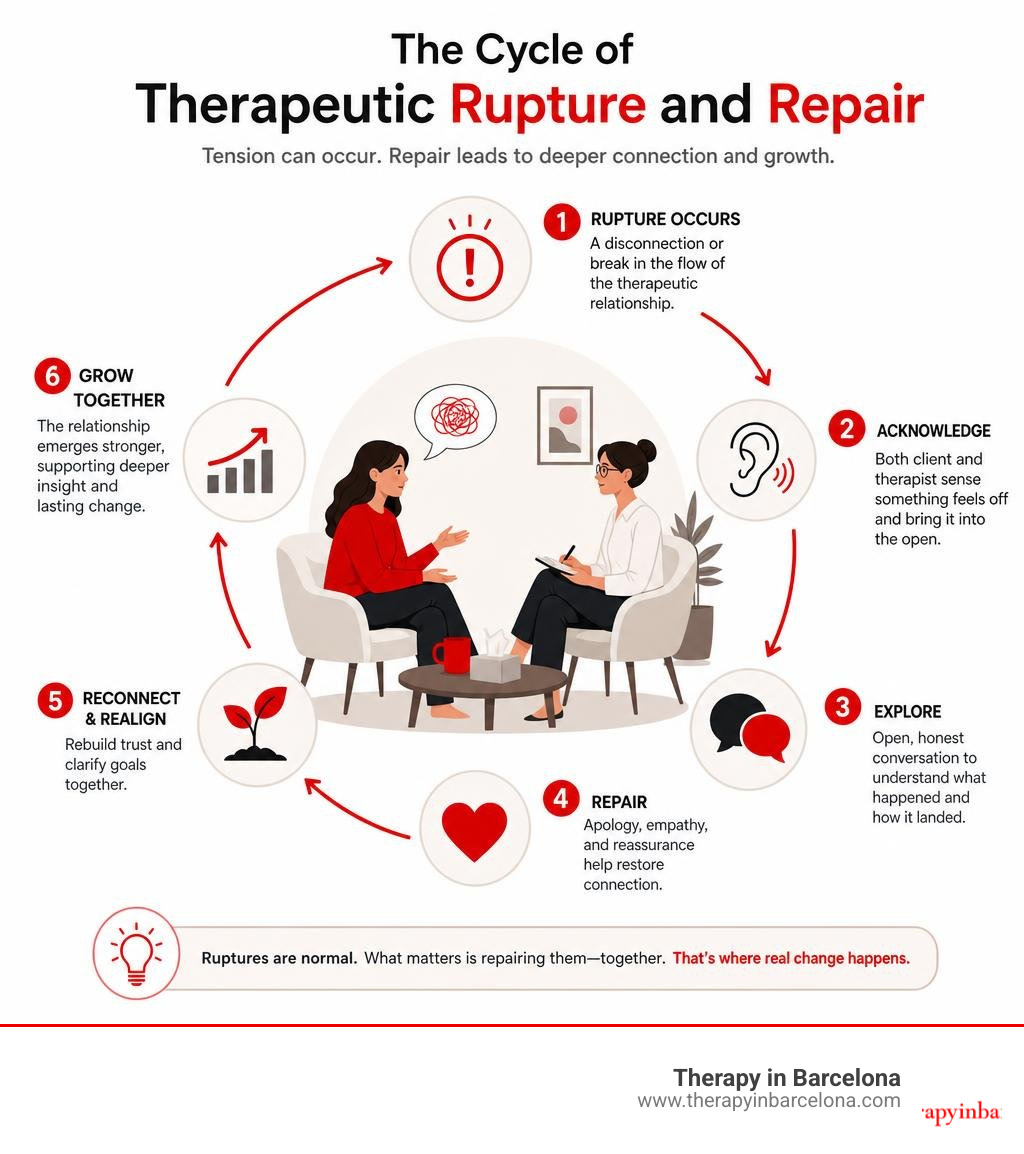
A therapeutic rupture is a drop in the quality of the working alliance. These ruptures generally fall into two categories:
- Confrontation Ruptures: The client expresses anger, dissatisfaction, or directly challenges the therapist.
- Withdrawal Ruptures: The client quietly pulls away, retreats into silence, gives short answers, or offers polite, superficial agreement to avoid conflict.
While ruptures feel uncomfortable, they are often the most valuable moments in the entire therapeutic journey. When a client experiences a rupture and successfully works through it with their therapist, they learn that conflict does not have to result in rejection or abandonment.
The repair is often where the real healing happens. Practising this in the safe space of therapy provides a healthy template for resolving conflicts in external relationships.
Expressing dissatisfaction is a powerful therapeutic tool. In fact, telling your therapist you are angry with them is not sabotaging the relationship — they are taking a courageous step toward making the therapeutic space genuine.
Reflecting on these milestones, as seen when a year in therapy a client and therapist reflect together, shows that navigating these hurdles is what truly deepens the therapeutic bond.
Ruptures in Individual vs. Couple and Family Therapy
In individual therapy, the therapist only has to manage a single relationship. In couple or family therapy, the dynamic is far more complex. The therapist must build a secure connection with multiple people at once, all of whom may have conflicting goals, histories, and levels of motivation.
A rupture in couples therapy often looks like one partner feeling that the therapist is taking sides. For example, if a couple seeking help in Valencia or Madrid is caught in a cycle of blame, the therapist must remain balanced.
If one partner feels misunderstood, they may withdraw, stalling the progress of the entire system. Navigating these multi-client dynamics requires high relational skill to ensure everyone in the room feels equally supported and heard.
Couples can find supportive spaces through specialised couples therapy in Madrid or by exploring collaborative approaches such as Solution-Focused Therapy.
The Hidden Impact of Ghosting Your Therapist
When therapy becomes uncomfortable or feels stagnant, a significant portion of clients drop out prematurely, as discussed in The Hidden Impact of Ghosting Your Therapist. This often takes the form of “ghosting” — cancelling appointments or simply disappearing without explanation.
While ghosting feels like an easy escape, the urge to run away is often driven by negative transference — projecting past expectations of anger, judgement, or abandonment onto the therapist.
Opting for a structured, healthy goodbye instead of disappearing allows clients to practice asserting their needs, process difficult emotions, and achieve true closure.
Navigating Boundaries, Transference, and Ethics in Therapy
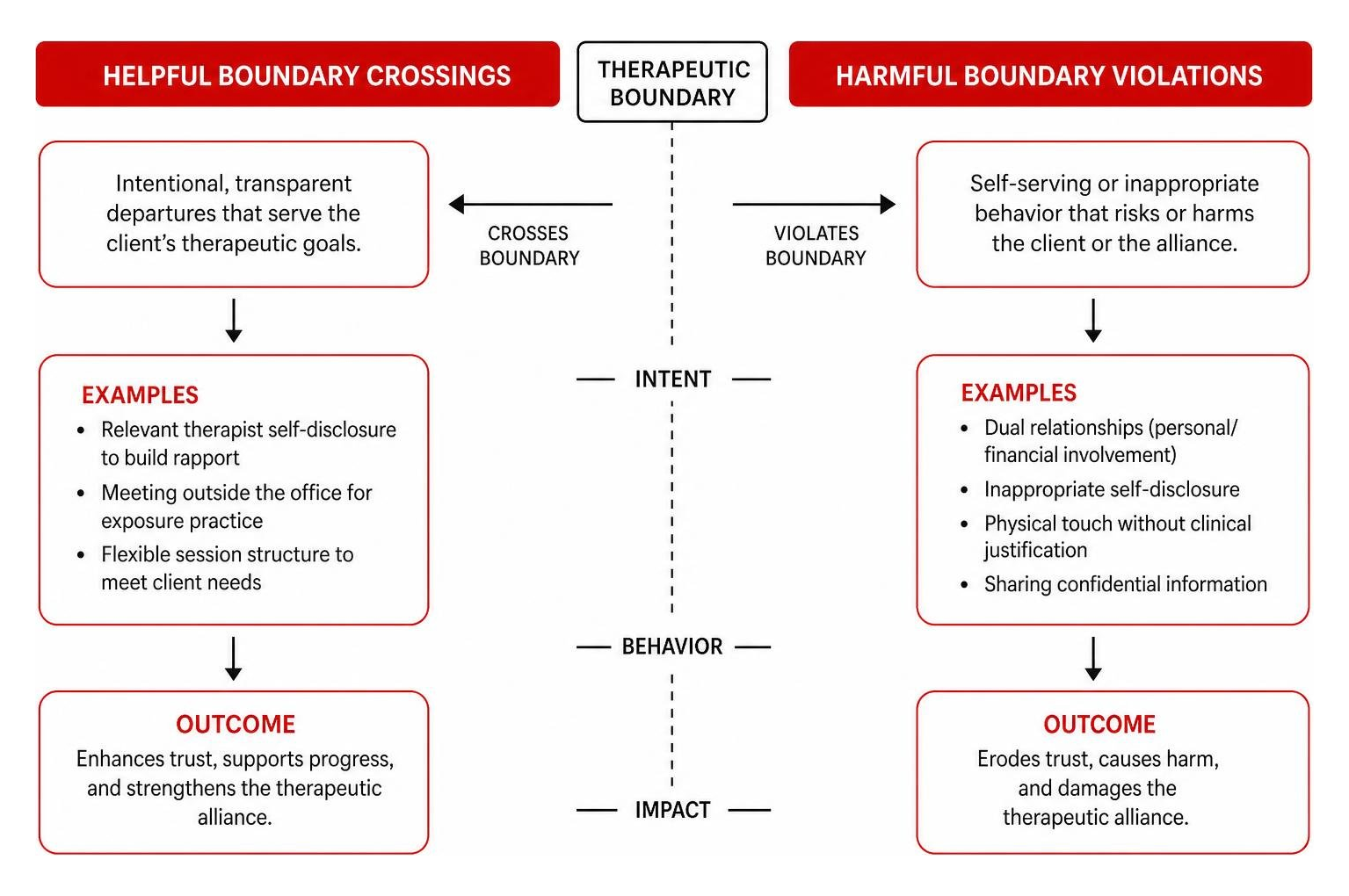
Clear boundaries create the emotional safety required for deep therapeutic work. However, there is an important distinction between a boundary crossing and a boundary violation:
- Boundary Crossings: Thoughtful departures from traditional therapy structures that support client goals, such as relevant self-disclosure or outdoor exposure therapy.
- Boundary Violations: Harmful, exploitative breaches that serve the therapist’s needs rather than the client’s. Examples include sexual relationships, financial exploitation, or entering business partnerships with clients.
In close-knit communities — such as the English-speaking expat community in Spain — dual relationships (where a therapist and client share another connection, such as living in the same neighbourhood or attending the same social events) are sometimes unavoidable.
When managed with clear communication and strict adherence to client-therapist relationship ethics, these interactions can be handled safely without compromising therapist and client boundaries.
Understanding setting healthy boundaries in therapy what you need to know helps clients remain active participants in their own care.
Managing Transference and Countertransference
Therapy often acts as a mirror for a client’s internal world. This brings up two common relational dynamics:
- Transference: When clients project feelings or unresolved issues from past relationships onto their therapist, resulting in admiration, anger, mistrust, or attraction.
- Countertransference: When a therapist projects their own unresolved emotional history onto the client.
Therapists must remain highly self-aware to manage countertransference, ensuring their personal feelings do not interfere with the client’s healing. This includes carefully managing self-disclosure.
Clients can learn more about how therapists navigate this by looking into uncovering the truth essential questions for therapeutic disclosure.
Understanding the “Boundary Hangover”
For individuals who grew up in environments where expressing needs was unsafe, setting a boundary can trigger what is known as a “boundary hangover.” This is a wave of intense anxiety, guilt, or dread that follows self-assertion, sometimes accompanied by physical symptoms like a racing heart or cold hands.
In therapy, a client might experience a boundary hangover after giving honest feedback to their therapist or asserting a preference. Clients who struggle with difficult childhood experiences or “good child” syndrome often use false compliance — agreeing with everything the therapist says — to keep the peace and avoid conflict.
Recognising these patterns is a key part of understanding consent in therapy and building genuine autonomy.
How to Proactively Address Client Therapist Relationship Issues
Rather than waiting for issues to build up, proactive monitoring is key to keeping therapy on track. Many modern practices use systematic feedback tools, such as the Outcome Rating Scale (ORS) and Session Rating Scale (SRS), to assess the therapeutic alliance at the end of every session.
Research published in Relational complexity and conflict in psychotherapy shows that clients who receive structured feedback are significantly more likely to experience positive progress compared to those receiving standard care. For clients, finding a professional who values this collaborative approach is essential.
Reading guides on finding the right therapist in barcelona is like finding the right key to a lock and choosing a therapist in barcelona why and how can help individuals navigate this selection process.
Spotting the Signs of Client Therapist Relationship Issues
It is important to notice the subtle signs that a therapeutic relationship is losing its strength. Key warning signs include:
- Withdrawal or Silence: Finding yourself holding back important details or rehearsing what to say to avoid disapproval.
- Polite Agreement: Nodding along with interpretations that do not actually resonate with your experience.
- Stagnation: Feeling like sessions have hit a plateau with no meaningful breakthroughs or behavioural changes.
Whether you are attending online therapy from Las Palmas de Gran Canaria or working with a psychologist, noticing these shifts early prevents premature dropout and keeps the therapy productive.
Empowering Clients to Resolve Client Therapist Relationship Issues
If you feel a disconnect, metacommunication — talking about how you are communicating in the room — is the most direct path to repair. Here are a few simple communication templates you can use to bring up difficult feelings with your therapist:
- “I wanted to go back to something you said last week. It felt a bit dismissive of my experience, and I’ve been feeling hesitant to open up since then.”
- “I feel like we are focusing a lot on my past, but right now I really need practical strategies to cope with my daily anxiety. Can we adjust our focus?”
- “When you suggested that boundary with my family, I felt rushed. I need us to slow down because my living situation makes direct confrontation very difficult.”
Whether you are working with a qualified counsellor or another professional therapist, a professional therapist will welcome these conversations with curiosity and warmth, rather than defensiveness.
Comparing Your Therapy Options: Finding the Right Fit
When dealing with relationship issues, it helps to understand how different service models handle client care, privacy, and therapist matching.
Public Healthcare System
- Pros: Fully funded or low-cost; integrated with local medical services.
- Cons: Long waiting lists; limited choice of therapist; high staff turnover; rarely available in English or other foreign languages.
- Best For: Individuals seeking local, long-term support who do not mind waiting or having less control over who they work with.
Large Online Platforms
- Pros: Highly convenient; easy to book; lower initial cost per session.
- Cons: Automated matching algorithms; high therapist turnover; variable quality control; potential privacy concerns regarding personal data.
- Best For: Individuals looking for quick, highly accessible support who are comfortable with a fully digital interface.
Local Private Practices (such as Therapy in Barcelona)
- Pros: Personalised therapist matching, vetted professionals, strict privacy, native-language support, and expertise in expat challenges.
- Cons: Private-pay service (though some therapists offer sliding scale fees based on financial need).
- Best For: Expats, international students, and families looking for culturally sensitive, high-quality, and reliable mental health support.
Frequently Asked Questions about Therapeutic Relationship Issues
What should I do if my therapist reacts defensively to my feedback?
If a therapist responds to your honest feedback with defensiveness, anger, or by shifting the blame onto you, this is a significant red flag.
While therapists are human and can make mistakes, they should be able to process feedback under professional supervision and respond with curiosity and accountability.
If the defensiveness continues, it is a clear sign of a therapeutic mismatch, and you have every right to terminate therapy and look for a new provider.
Is a mismatch in attachment styles between client and therapist a dealbreaker?
No, it is not a dealbreaker. In fact, mismatches are very common. For example, an anxious client seeking constant validation might feel triggered by a more objective, avoidant therapist.
Experienced therapists are trained to recognise these dynamics and temporarily adapt their relational style to help the client feel secure, before gently challenging those defensive patterns over time.
Can a strong therapeutic alliance be built over online therapy?
Yes. Extensive research shows that clients rate the quality of the therapeutic alliance and the presence of their therapist just as highly in online therapy as they do in-person.
While virtual sessions require different communication strategies, language entrainment and emotional safety remain highly effective across digital screens.
Finding the Right Path Forward
The relationship you share with your therapist is the single most important predictor of your healing — more powerful than any specific therapeutic technique or approach.
When client therapist relationship issues arise, they are not a sign of failure. Instead, they are a natural, predictable part of the therapeutic process that can catalyse deeper growth when addressed openly.
For expats and internationals living in Spain or abroad, finding a professional who understands the unique stresses of relocation, cultural adaptation, and language barriers is essential.
Founded by Leigh Matthews, an Australian Psychologist who has supported the international community in Barcelona since 2011, Therapy in Barcelona specialises in personalised therapist matching for expats.
Their dedicated team of multilingual, psychology-trained professionals offers tailored support for adults, couples, teens, and families.
If you are experiencing challenges in your therapy journey or are looking for a supportive, culturally sensitive space to begin, book your Free Discovery Call today to find a therapist who truly understands your path.
