


Why the Right Career Counselling Questions to Ask a Client Change Everything

The right career counselling questions to ask a client can turn a stuck session into real clarity. Whether someone is changing careers after redundancy or navigating a new job market in Barcelona, Madrid, or Valencia, good questions shape the path forward.
Here are the core categories of career counselling questions to use with clients:
- Strengths and skills – What are you naturally good at? What have others consistently told you you do well?
- Values and motivations – What does meaningful work look like to you? What would you be unwilling to compromise on?
- Short- and long-term goals – Where do you want to be in one year? In five?
- Work environment preferences – Do you thrive working independently or in a team? Remotely or in person?
- Obstacles and fears – What is holding you back right now? What would you do if you knew you could not fail?
- Education and upskilling needs – What skills or qualifications would make you feel more competitive?
- Networking and support systems – Who is already in your corner? Who do you need to meet?
- Application readiness – How confident do you feel about your CV, LinkedIn profile, and interview skills?
- Contingency planning – What is your Plan B if the primary path does not work out on your intended timeline?
- Accountability and milestones – What does progress look like, and how will you track it?
Good questions do more than collect facts. They create space. Open-ended prompts, especially “what” and “how” questions, help clients reflect, connect patterns, and notice insights they may have missed. Often, a client who says, “I don’t know what I want” already has clues. They just need the right structure to hear them.
This is especially true for internationally mobile professionals. A career move across countries can involve culture shock, language barriers, visa limits, and identity shifts. Career counselling here is not just about choosing a job. It is about helping the client build a life that fits.
This guide is designed to help counsellors and therapists facilitate exactly that kind of work. It covers the most effective questions to use across every stage of career exploration, from initial self-assessment through to action planning, and explains why each category of question matters.
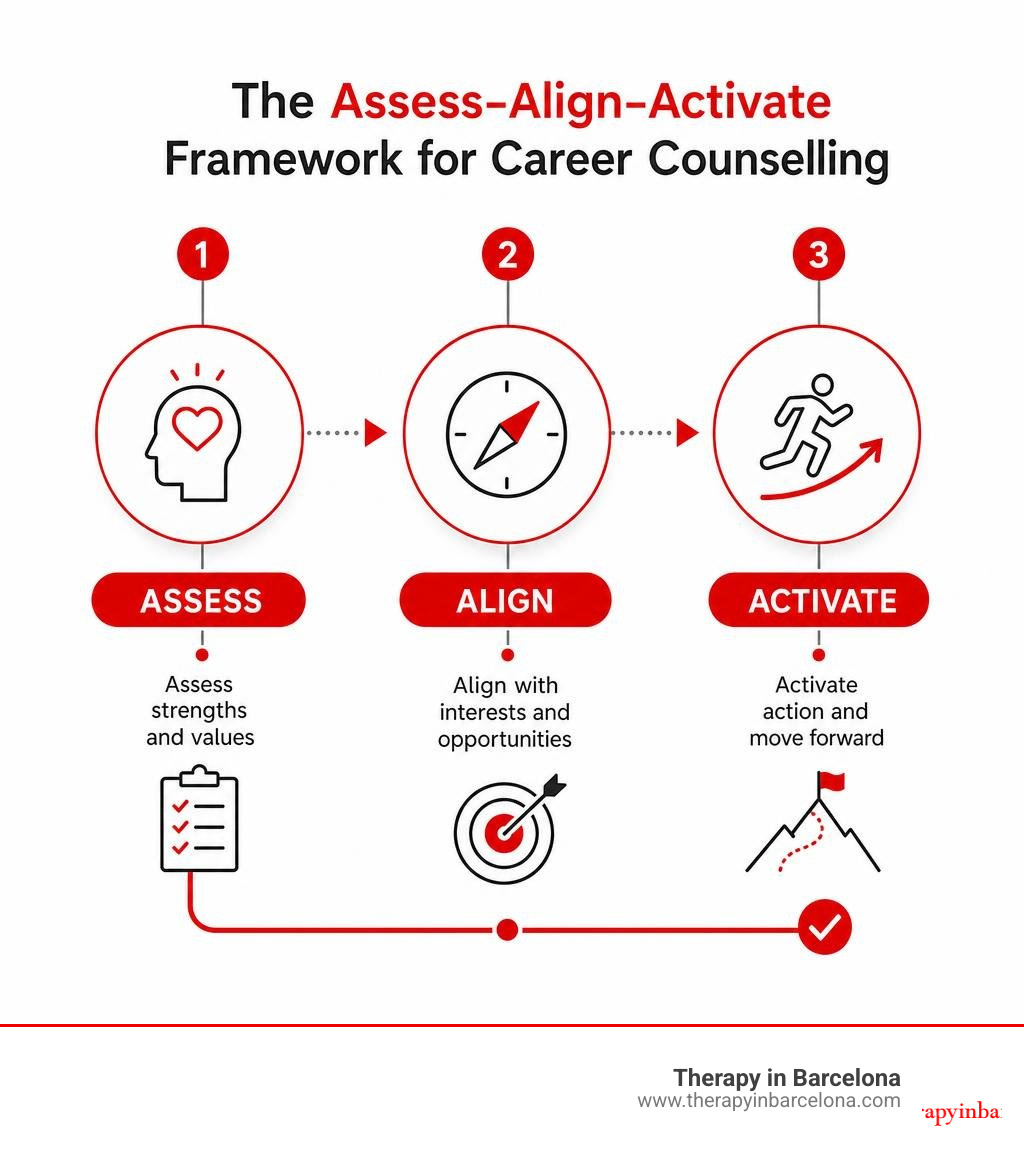
The Foundation: Assessing Strengths, Values, and Interests
Before a client can plan where they are going, they must understand where they are standing. Uncovering a client’s baseline requires looking backward to move forward. This diagnostic phase focuses on eliciting a comprehensive history of the client’s experiences, key achievements, and the underlying motivators that drive them.
Using structured, chronological questioning helps reveal long-term career patterns and transitions. Rather than letting a client list their work history like a dry CV, a skilled counsellor asks about the transitions themselves: Why did you leave that role? What were you looking for when you accepted the next one?
This retrospective approach is highly effective for eliciting client history and strengths. When clients are in the middle of a stressful career transition, they often lose sight of their own capabilities. Exploring their history helps rebuild their professional self-esteem. For many, career struggles are also deeply intertwined with their mental health, which is Why Career Change Therapy Might Be Your Missing Piece? because it addresses the emotional blocks that standard job coaching often ignores.

Career Counselling Questions to Ask a Client About Strengths and Skills
To help clients identify their transferable skills and hidden talents, a counsellor should look beyond formal job descriptions. Often, a client’s most valuable assets are skills they take completely for granted. A strengths-based perspective shifts the focus from “fixing weaknesses” to “maximising natural advantages.”
Here are targeted questions to uncover these patterns:
- “What activities or tasks make you feel most alive and energized when you do them?” This helps separate things a client can do from things they actually enjoy doing.
- “When you were around eight or ten years old, what did you choose to do in your free time?” Early play and hobbies often point to core, latent talents that have been buried under years of adult expectations.
- “What have colleagues, friends, or managers consistently praised you for throughout your life?” This highlights areas of lifelong excellence that the client might overlook as “too easy” or “not a real skill.”
- “How do you naturally help others in your everyday life, even when it is not part of your job description?” A natural inclination to organise, mediate, teach, or design is a strong indicator of transferable value.
- “Describe a past professional success that you are genuinely proud of. What specific role did you play in achieving it?” Exploring moments of pride helps the client articulate their personal contribution and see their skills in action.
- “What did you learn about your resilience and problem-solving abilities from your most challenging professional setback?” This reframes past failures as data points, helping the client extract lessons that can inform future decisions.
Focusing on these areas builds what psychologists call self-efficacy. By encouraging clients to engage in Strengths-Based Career Development, they begin to see how their unique skill set can be packaged and adapted for entirely new industries.
Uncovering Motivations, Values, and Work-Life Balance
A career that aligns with a client’s skills but violates their core values will eventually lead to burnout. To help clients find genuine workplace fulfilment, counsellors must ask questions that explore what truly drives them, how they view financial security, and what their ideal lifestyle looks like.
These questions help clarify those boundaries:
- “If salary and prestige were completely off the table, what would make a working day feel successful to you?”
- “What are your non-negotiable values? For example, how important are creativity, autonomy, security, or social impact to you?”
- “What does a healthy work-life balance look like in your ideal week? How many hours are you working, and when do you disconnect?”
- “How do your financial expectations interact with your career goals? What is your minimum baseline income, and what is your ideal target?”
- “If you could design your ideal daily schedule from scratch, what would it look like?”
For expat clients, career goals often connect directly to lifestyle goals. If they moved to Spain for more balance, guide them toward choices that support that vision, not undermine it. For more support, they can Navigate Your International Career with Expert Coaching.
Essential Career Counselling Questions to Ask a Client
Once the foundational self-assessment is complete, the focus shifts to alignment. This is where structured questioning helps clients bridge the gap between their current reality and their future ambitions.
Counsellors must help clients balance immediate practical needs (like paying rent in a new country) with their long-term professional vision. This requires asking Powerful Questions for Career Reflection that challenge assumptions and push past vague desires.

Mapping Out the Ideal Work Environment and Global Mobility
The physical and cultural environment in which a client works has a massive impact on their daily well-being. For global nomads and expat professionals, this environment is often highly fluid. Counsellors should ask specific questions about their preferences for remote work, international relocation, and cultural adaptation.
- “Do you thrive in a highly collaborative, social team environment, or do you prefer quiet, independent work?”
- “How do you feel about remote work versus hybrid or fully in-person roles? What structure keeps you most productive and connected?”
- “What specific challenges are you facing when trying to adapt your career to the local job market in Spain?”
- “Are you open to international relocation, or are you looking to build a local network in a specific hub like Madrid, Valencia, or Marbella?”
- “How does your current career path accommodate the legal, tax, and visa realities of living as an expat?”
Navigating these dynamics can be incredibly isolating. Expat professionals often find that traditional career coaching does not account for the emotional weight of living far from home. In these cases, it is highly beneficial to Unlock Your Expat Potential: The Best Life Coaches for Global Nomads who understand both the practical and psychological hurdles of international career development.
Career Counselling Questions to Ask a Client to Overcome Obstacles
Fear, self-doubt, and imposter syndrome are the most common reasons clients stall during a career transition. To help them move forward, a counsellor must ask gentle but direct questions that bring these hidden fears to light.
To understand how this works in practice, let us look at an example.
A Fictional Expat Career Pivot Example
This fictional composite reflects common expat career challenges, not a real client. Imagine a 34-year-old UK professional in Valencia who left a corporate project management career after relocating for a partner. Limited Spanish made local roles harder to access, and self-doubt crept in. Soon, they stopped applying for remote international jobs, even though their skills were transferable.
Ask: “If you were ten times bolder, what career step would you take today?”
This helps separate real skill gaps from fear. A client might see their project management experience could fit remote, English-speaking global companies. Then the work becomes practical: choose target firms, sharpen their positioning, practise applications, and build momentum.
To help clients confront their inner critics, use these diagnostic questions:
- “What is the primary fear or worry that comes up when you think about making a career change?”
- “How would you act differently if you were ten times bolder in your professional life?”
- “What does your inner critic tell you when you think about applying for your dream role? Is that voice speaking the absolute truth?”
- “What coping mechanisms do you use when professional uncertainty or rejection starts to feel overwhelming?”
- “If success were 100% guaranteed, what is the very first thing you would do?”
When self-doubt is deeply rooted in a client’s history, standard career advice is rarely enough. In these moments, finding a professional who can blend career development with deeper psychological support is essential. You can learn more about how to find this balance by reading Ready for Growth: How to Choose the Right Personal Development Coach.
Action Planning: Timelines, Upskilling, and Psychological Readiness
An inspiring career session is only as good as the action plan that follows it. Without concrete steps, clients often leave feeling motivated but ultimately remain stuck. Preparing targeted questions before a career session helps clients leave with a clear, documented 90-day action plan.
To turn reflection into momentum, counsellors should guide clients through a realistic timeline and a thorough skills-gap analysis.
- “What specific skills, certifications, or educational qualifications do you need to acquire to be competitive in your target field?”
- “Which of these learning paths offers the highest return on investment (ROI) for your immediate goals?”
- “What is a realistic timeline for you to complete this upskilling? Can we break this down into weekly milestones?”
Combining self-assessment with a structured skills-gap analysis helps clients complete targeted upskilling much more efficiently. To help clients structure this process, counsellors can encourage them to ask themselves the 12 Career Counseling Questions To Ask Your Career Counselor to keep their preparations highly practical.
Building Confidence for Networking and Interviews
For many clients, the thought of networking or selling themselves in an interview triggers intense anxiety. This is particularly true for expats who may have to network in a second language or adapt to a different professional culture in cities like Madrid or Barcelona.
Counsellors can use these questions to help clients prepare:
- “What is your current strategy for building professional relationships online and offline?”
- “How can you reframe networking as a collaborative exchange of value rather than a transactional ‘sales pitch’?”
- “What specific aspects of job interviews make you feel most anxious, and how can we practice managing that physical stress?”
- “How can you present your past achievements using clear, measurable metrics that speak directly to a hiring manager’s needs?”
Preparing specific feedback on application materials is highly effective. Clients who receive targeted, measurable feedback on their CVs and LinkedIn profiles during counselling sessions report significantly higher interview callback rates.
Creating Contingency Plans and Alternative Paths
A robust career strategy always includes a safety net. Helping clients build contingency plans actually increases their confidence, as it reduces the high-stakes pressure of a single “perfect” outcome.
- “If your primary career plan does not yield results within your target timeframe, what is your immediate Plan B?”
- “What are the early indicators or warning signs that your current job search strategy needs to be adjusted?”
- “Who are the mentors, peers, or professional communities you can lean on for support when things get tough?”
- “How will we hold you accountable to your goals, and what milestones will we use to measure your weekly progress?”
Structured career counselling that includes regular accountability check-ins greatly increases the likelihood of achieving career goals within a realistic timeframe. It keeps the client moving forward, even when the job market presents unexpected challenges.
Navigating Career Support: Choosing the Right Path
When looking for professional guidance, clients have several paths to choose from. It is important to understand how these options compare so clients can make an informed choice that fits their specific needs.
Public Employment Systems & Government Services
- Overview: Free, state-run job placement offices and basic vocational guidance.
- Limitations: These services are highly bureaucratic, rarely offer personalised attention, and almost never provide expat-specific psychological support or English-language services. They are designed for high-volume processing rather than nuanced career transitions.
Large Online Coaching Platforms
- Overview: High-volume, algorithm-driven websites that match clients with global coaches.
- Limitations: These platforms often lack bespoke matching, relying instead on automated systems. They raise potential privacy concerns regarding data sharing, and their coaches frequently lack a deep understanding of the local Spanish job markets and cultural nuances.
Local Private Practices
- Overview: Independent local therapists or career coaches.
- Limitations: While they offer good local knowledge, they may lack fluent English-speaking practitioners or specific expertise in the unique psychological challenges of international expat transitions.
Therapy in Barcelona’s Bespoke Approach
- Overview: Highly qualified, psychology-trained therapists offering bespoke therapist matching.
- Advantages: This is a private-pay service that offers deep expat-specific cultural sensitivity and support in the client’s native language. Our international team of psychology-trained therapists understand the expat experience firsthand. We maintain strict privacy with absolutely no data selling, and offer high-quality care both online worldwide and face-to-face in our central offices in Barcelona. For those with financial need, some of our therapists offer sliding scale fees to keep support accessible.
If you are looking for structured, goal-oriented support that respects both your professional ambitions and your emotional well-being, explore our dedicated Coaching services.
Frequently Asked Questions about Career Counselling
How do you identify a client’s transferable skills?
Identifying transferable skills involves looking at a client’s past achievements, volunteer work, hobbies, and daily habits. Instead of focusing on industry-specific technical tools, a counsellor helps the client zoom out to see core competencies—such as leadership, complex problem-solving, project coordination, or cross-cultural communication—that hold value in any sector.
What is the difference between career counselling and career coaching?
Career coaching is usually practical and goal-focused: CVs, interviews, job search plans. Career counselling also looks at the emotional side of change, including confidence, anxiety, identity, and self-doubt.
How can expats adapt their career goals when moving to Spain?
Start by researching local demand, checking how your qualifications transfer, and exploring English-speaking roles, international companies, or remote work. Good career support can help you adapt without losing your professional identity.
Moving Forward with Confidence
Asking the right career counselling questions is the most powerful tool a practitioner has to spark genuine change. By guiding clients through a structured exploration of their strengths, values, work environments, and potential obstacles, you help them build a practical, resilient roadmap for their future.
This empathetic approach guides Therapy in Barcelona. Founded by Leigh Matthews, an Australian Psychologist based in Barcelona since 2011, the practice supports internationals navigating life and career changes with culturally sensitive, high-quality care.
If you or your clients are navigating a messy professional transition, feeling stuck abroad, or trying to align your career with your life in Spain, you do not have to figure it out alone.
If you’d like support, book a Free Discovery Call today.
