


Why English-Speaking Therapy Barcelona is Your Gateway to Better Mental Health

English-speaking therapy Barcelona offers a lifeline for internationals navigating the complex emotional landscape of expat life. Whether you’re dealing with culture shock, homesickness, or relationship challenges amplified by living abroad, finding the right therapeutic support in your native language can make all the difference.
Quick Answer: Where to Find English-Speaking Therapy in Barcelona
- Therapy in Barcelona: Immigrant-founded group practice with 13 international therapists (since 2011)
- Individual practitioners: In 2025, British, Swedish, Swiss, American, Polish, Mexican, Colombian, South African and more international therapists
- Online options: Worldwide coverage for digital nomads and remote workers
- In-office options: In person sessions at our central Barcelona offices in Eixample
- Languages available: English plus 10+ other languages
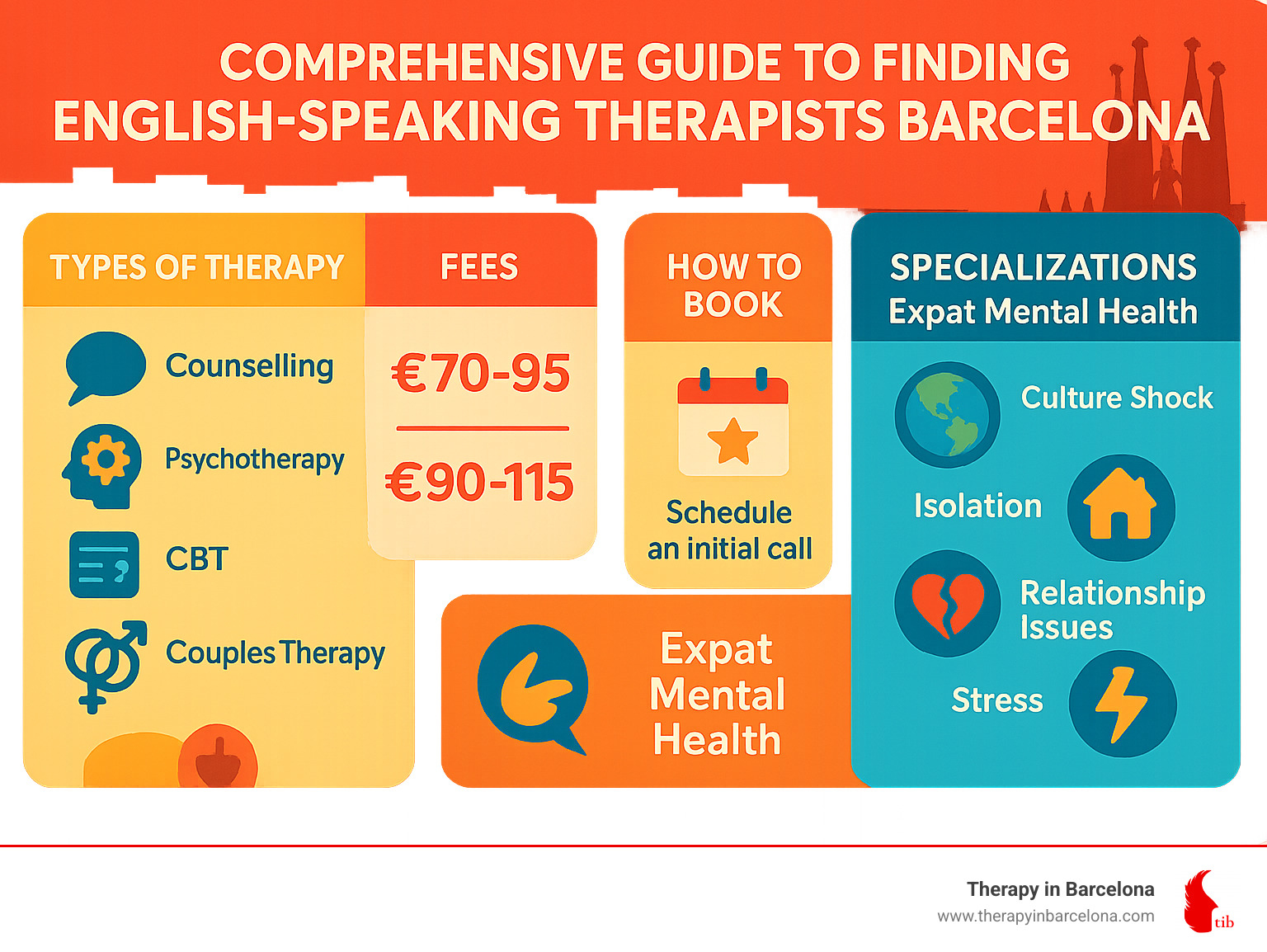
- Fees: €70-95 individual sessions, €90-115 couples sessions
- Free discovery calls: 15-20 minute consultations to find your perfect match
Life abroad can feel like an emotional rollercoaster. One day you’re loving the trip, the next you’re crying over a simple miscommunication at the local shop. Add work stress, relationship strain, or that persistent feeling of not quite belonging anywhere, and it’s no wonder so many expats find themselves seeking professional support.
The good news? Barcelona’s international community has created a robust network of English-speaking mental health professionals who truly get what you’re going through. These aren’t just therapists who happen to speak English – they’re often expats themselves who’ve walked in your shoes.
Since 2018 alone, Therapy in Barcelona’s team has supported over 4,000 internationals through life’s challenges. From digital nomads struggling with isolation to accompanying partners rebuilding their identity, these therapists understand that expat problems require culturally sensitive solutions.
Why Do Internationals Seek Support Abroad?
Moving to Barcelona as an expat feels exciting at first— the Mediterranean lifestyle, the vibrant culture, the promise of travel. But then reality hits. The emotional challenges of living abroad run far deeper than anyone warns you about, and English-speaking therapy Barcelona becomes not just helpful, but essential for many internationals. According to the World Health Organization, roughly one in eight people worldwide live with a mental-health concern, and major life changes such as international relocation can act as significant stressors.
Relocation stress sneaks up on you in unexpected ways. One day you’re confidently navigating your home city, the next you’re standing in a Spanish pharmacy unable to explain that you need paracetamol. The mental load of translating every interaction, decoding cultural norms, and rebuilding your entire support system from scratch is exhausting.
Then there’s the identity crisis that catches so many expats off guard. Who are you when stripped of your cultural context and familiar social roles? Many internationals describe feeling like they’re performing a version of themselves rather than being truly authentic.
The loneliness can be overwhelming, even in a city as social as Barcelona. There are expat meetups and language exchanges, but forming genuine, deep connections takes time. Meanwhile, maintaining relationships back home becomes increasingly difficult as time zones create barriers.
Relationship strain often intensifies when you’re living abroad together. Couples who moved to Barcelona find themselves leaning on each other for everything—emotional support, social connection, practical help with bureaucracy. This pressure can expose cracks in relationships that weren’t visible before.
Work-life balance becomes complicated when your office might be your primary source of social interaction. The boundaries between professional and personal life blur, especially for digital nomads working from Barcelona’s countless co-working spaces.
Anxiety and depression can emerge or worsen during major life transitions like international moves. The constant low-level stress of adaptation, combined with isolation and identity questions, creates the perfect storm for mental health challenges.
The Unique Expat Cocktail of Challenges
Digital nomads might struggle with constant adaptation and lack of routine. The freedom that initially felt liberating can become overwhelming without structure or consistent community connections.
Accompanying partners often experience the most dramatic identity shifts. They’ve given up careers, friend networks, and financial independence to support their partner’s Barcelona opportunity. The resulting resentment, loss of purpose, and dependency can trigger significant mental health challenges.
Third-culture kids face their own complex set of issues when living in Barcelona. They might feel at home everywhere and nowhere simultaneously. Questions like “Where are you from?” become existentially complicated.
Each group needs different therapeutic approaches because their challenges, while overlapping, have unique cultural and psychological dimensions that generic therapy simply can’t address effectively.
English-Speaking Therapy Barcelona: Services & Approaches
The landscape of English-speaking therapy Barcelona has transformed dramatically over the past decade. What began with scattered individual practitioners has blossomed into a comprehensive network of specialised services that truly understand the expat experience.
Individual therapy remains the cornerstone of support for internationals. These 50-minute sessions create space to explore everything from anxiety and depression to career transitions and cultural adjustment. There’s something profound about expressing your deepest emotions in your native language – those subtle feelings that simply don’t translate.
Couples therapy has seen remarkable growth, particularly among intercultural relationships navigating the unique pressures of life abroad. When partners come from different cultural backgrounds, English often becomes their therapeutic common ground.
Family therapy recognises that raising children abroad brings its own set of challenges. Parents worry about their children’s sense of identity, whether they’re losing their mother tongue, and how to help them answer that complicated question: “Where are you from?”
For younger expats, child and adolescent services address the unique adjustment challenges that international schools can’t always handle. Young people struggle with questions of belonging, friendship dynamics across cultures, and the constant code-switching between home and school environments.
Group therapy creates something magical – community amongst people who truly get it. There’s immense relief in finding you’re not the only one who feels overwhelmed by Spanish bureaucracy or gets homesick despite loving your new life.
The therapeutic approaches available rival those of any major international city. Cognitive Behavioural Therapy (CBT) helps untangle those spiralling thoughts that often accompany cultural adjustment – the “what if I never fit in here?” patterns that can consume expat minds.
Acceptance and Commitment Therapy (ACT) focuses on living according to your values, even when everything feels uncertain. For expats questioning their life choices, ACT provides clarity about what truly matters beyond geographical location.
Internal Family Systems (IFS) explores the different aspects of yourself – particularly relevant when you feel like a different person in different cultural contexts.
| Approach | Best For | Key Benefits |
|---|---|---|
| CBT | Anxiety, depression, negative thought patterns | Practical tools, quick results, evidence-based |
| ACT | Life transitions, value clarification, acceptance | Psychological flexibility, mindfulness-based |
| IFS | Identity issues, internal conflicts, self-compassion | Holistic self-understanding, trauma-informed |
More info about cognitive behavioural therapy
Specialised Care for Specific Concerns
Beyond general therapy services, Barcelona’s international community has access to highly specialised treatment for conditions that commonly surface during expat transitions.
Eating disorders can develop or worsen during major life transitions like moving abroad. The stress of cultural adaptation, changes in food culture, social isolation, and loss of familiar routines can trigger disordered eating patterns.
LGBTQ+ affirming therapy acknowledges that sexual and gender minorities face additional layers of complexity abroad. Some find Barcelona more accepting than their home countries, whilst others struggle with different cultural attitudes or isolation from their communities.
Grief and loss counselling addresses the multiple, often unrecognised losses inherent in expat life. You’re not just mourning people who’ve died – you’re processing the loss of your former life, relationships that have inevitably changed, and even versions of yourself that no longer fit your new reality.
ADHD support has gained recognition as the additional executive function demands of living in a foreign language can significantly exacerbate symptoms. Therapists help develop practical coping strategies for the unique challenges of neurodivergent expat life.
Postpartum support addresses the profound isolation that can accompany having children abroad. New parents steer unfamiliar medical systems, different parenting philosophies, language barriers with healthcare providers, and the absence of extended family support.
Benefits of Working with Expat Therapists
Barcelona’s unique advantage lies in its high concentration of therapists who are themselves expats. This shared experience creates therapeutic benefits that extend far beyond language proficiency.
Cultural empathy runs deeper when your therapist has personally steerd visa applications, homesickness, and identity questions. They understand the specific grief of missing family milestones and the exhaustion of constantly translating cultural context.
Multilingual insight means these therapists grasp how language affects emotional expression. They know that some feelings exist only in certain languages, that therapy in your mother tongue accesses different parts of your experience.
Global perspective allows expat therapists to contextualise your challenges within the broader human experience of adaptation and growth. They understand that what feels like personal failure might actually be completely normal cultural adjustment.
The shared journey creates a unique collaborative dynamic. Both you and your therapist are navigating life in Barcelona, creating a partnership rather than a hierarchical relationship.
How to Find & Match with Your Ideal Therapist
Finding the right therapist whilst you’re already struggling with expat challenges can feel overwhelming. The good news? Barcelona’s English-speaking therapy community has developed sophisticated matching systems that take the guesswork out of the process.
Most established practices begin with an intake questionnaire that goes beyond asking your name and phone number. They want to understand your cultural background, any previous therapy experience, your specific challenges, and which therapeutic approaches might resonate with you.
Discovery calls have become the gold standard in Barcelona’s therapy world. These 15-20 minute conversations give you a genuine feel for which therapist would be a great fit before you commit to full sessions. During these calls, you can ask about the therapists’ experience with expat issues, their therapeutic approach, and practical matters like scheduling flexibility and fees.
The best practices don’t just match you with whoever happens to be available next Tuesday. Personalised matching considers personality fit, cultural background, specific expertise, and therapeutic style preferences.
Therapist bios on practice websites have evolved into mini-portraits that help you gauge compatibility. Look for information about their own expat experience, specialisations, therapeutic training, and those personal touches that give you a sense of whether you’d feel comfortable opening up to them.
More info about matching process

Step-by-Step: From First Click to First Session
The journey from “I think I need therapy” to actually sitting in your first session has been streamlined to reduce barriers for stressed expats.
Initial contact usually happens through practice websites or personal referrals. Most offer straightforward online contact forms that ask thoughtful questions about your needs and preferences.
Intake coordination typically happens within 24-48 hours. An intake coordinator reviews your information and suggests potential matches based on your specific situation.
Discovery calls give you the chance to speak with an Intake Coordinator and find out more about the therapists and the service. These calls are free and help both parties assess whether there’s a good fit.
First session booking includes all the practical details like location, fees, and cancellation policies. Consent forms and other documentation will usually be sent to you to complete before your first meeting.
What to Expect in Session One
First therapy sessions follow fairly predictable patterns, but knowing what to expect can significantly reduce pre-session anxiety.
50-minute sessions are the standard format, though some therapists offer longer initial appointments. This timeframe provides enough space for meaningful conversation without feeling overwhelming.
Rapport building takes absolute priority over problem-solving in that first meeting. Your therapist will focus on helping you feel comfortable and understood rather than diving straight into solutions.
History taking covers your background, current challenges, and therapy goals in a conversational rather than interrogative way. Be prepared to discuss your reasons for moving to Barcelona, current stressors, and what you hope to achieve through therapy.
Collaborative goal setting ensures you and your therapist are working towards the same outcomes from the start. These goals might evolve significantly over time, but having initial direction helps focus those crucial early sessions.
Fees, Formats & Practicalities
Let’s talk about the practical side of English-speaking therapy Barcelona – because understanding what you’re investing in helps you make better decisions about your mental health journey.
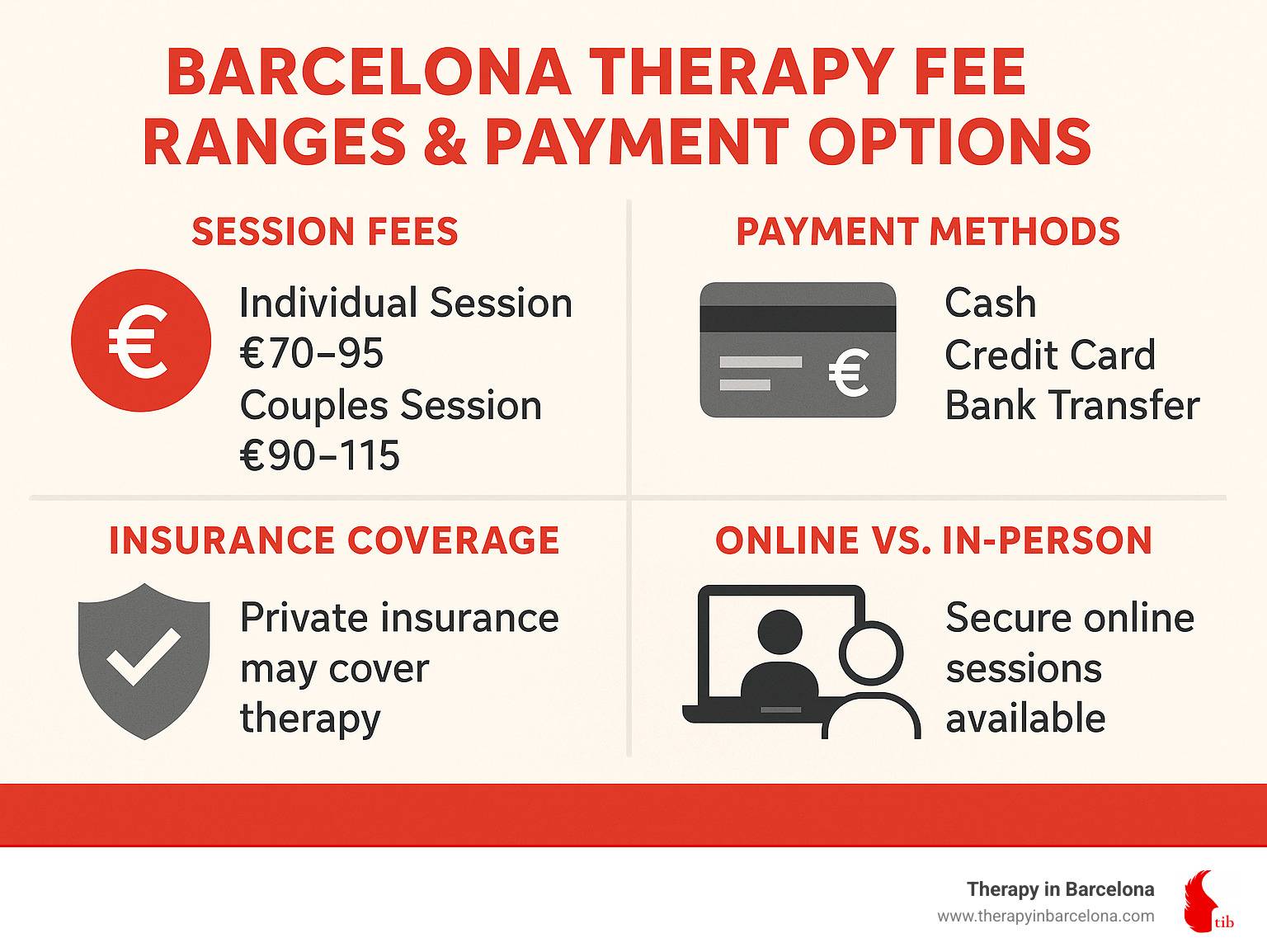
Therapy fees in Barcelona reflect the specialised nature of working with highly qualified, English-speaking, culturally aware therapists. Fees range from €70-95 for individual sessions and €90-115 for couples therapy. These prices might seem significant, but remember – you’re investing in a therapist who has invested 6+ years in their training in psychology, invests in ongoing professional development, understands mental health struggles and uniquely expat issues like visa stress, cultural adjustment, and the unique challenges of building a life far from home.
Payment flexibility varies by therapist. Some accept bank transfers, others work with Bizum, cash or PayPal. Prices include VAT since it is not a medical service that is being offered.
Insurance coverage can be tricky in Spain. Private health insurance sometimes covers psychological services, but coverage for English-speaking therapists varies significantly. Many internationals pay out-of-pocket and seek reimbursement from their home country’s insurance. Others prefer the privacy of private pay services.
Sliding scale options exist at some practices, particularly for students or accompanying partners without independent income. Financial stress shouldn’t prevent you from getting help – many therapists prefer to discuss payment difficulties privately.
The Eixample location offers practical advantages beyond just being central. The neighbourhood’s excellent public transport connections mean you can easily reach sessions from anywhere in Barcelona.
Online Therapy Options for the Modern Nomad
The digital revolution in therapy has been a game-changer for Barcelona’s international community. Online therapy isn’t just a pandemic adaptation – it’s become an essential service for the globally mobile lifestyle many expats accept.
Platform variety ensures you can find something that works with your tech comfort level. Zoom, doxy.me, and other encrypted services offer different features, but they all prioritise your privacy and security.
Time zone flexibility has opened up incredible possibilities. Digital nomads can maintain therapeutic relationships whilst travelling between Barcelona and Bali. Some therapists offer early morning or late evening sessions specifically for clients in different time zones.
Travel continuity means your therapy doesn’t pause when life gets complicated. Moving between cities, travelling for work, or dealing with family emergencies abroad no longer means interrupting your therapeutic progress.
The technical requirements are refreshingly simple. A stable internet connection and a private space where you won’t be interrupted are usually sufficient.
More info about online therapy

Multilingual & Inclusive Services
Barcelona’s incredible diversity has created something unique in the therapy world – truly multilingual practices that go far beyond just offering sessions in English.
Language options reflect the city’s international community. Beyond English, many therapists offer sessions in Spanish, Catalan, French, German, Swedish, Polish, Portuguese, and languages Afrikaans, Swiss German, and Austrian-German.
Intercultural couples often find that therapy in a shared second language creates unexpected equality. When neither partner is speaking their native tongue, it levels the playing field in ways that can be therapeutically powerful.
Cultural competency extends far beyond language into understanding different approaches to family, relationships, mental health, and personal expression.
Inclusive services mean that regardless of your sexual orientation, gender identity, cultural background, or relationship structure, you can find therapists who understand your experience.
Frequently Asked Questions about English-Speaking Therapy Barcelona
Why choose an English-speaking therapist instead of practising Spanish?
Even if you’ve mastered ordering coffee in Spanish or can steer Barcelona’s bureaucracy with confidence, therapy requires a completely different level of linguistic precision. When you’re exploring childhood memories, describing complex emotions, or working through relationship dynamics, you need access to the full depth of your emotional vocabulary.
English-speaking therapy Barcelona allows you to express those subtle distinctions between feeling “disappointed” versus “devastated,” or “anxious” versus “overwhelmed.” These nuances matter enormously in therapeutic work.
There’s also the cultural context that comes embedded in language. When you mention feeling like “the black sheep of the family” or describe someone as “passive-aggressive,” an English-speaking therapist immediately grasps both the literal meaning and cultural implications.
Many clients find that switching to their native language in therapy opens up emotional experiences they couldn’t access in Spanish. Childhood memories surface more vividly, family dynamics become clearer, and defence mechanisms that work perfectly in a second language suddenly become transparent.
Is English-speaking therapy Barcelona available online for people outside Catalonia?
Absolutely. One of the unexpected benefits of recent technological advances is that English-speaking therapy Barcelona is no longer limited by geography. Many Barcelona-based therapists now offer online sessions throughout Spain and internationally.
Therapy in Barcelona provides online services worldwide, with the exception of the USA and Canada due to licensing restrictions. This global reach has proven particularly valuable for digital nomads who move frequently, expats who’ve relocated from Barcelona to other cities, or internationals living in areas without English-speaking mental health services.
Online therapy has also opened doors for accompanying partners in smaller Spanish cities, international students in university towns, or expats in rural areas who previously had no access to culturally sensitive mental health support.
How long does a typical therapy journey last?
The honest answer is that therapy timelines vary as much as the people who seek it. Some internationals find that 8-12 sessions provide enough support to steer a specific challenge – perhaps adjusting to a new job, processing a relationship ending, or working through a particularly difficult bout of homesickness.
Others find that therapy becomes an ongoing resource rather than a time-limited intervention. They might engage intensively for several months, then return periodically during challenging periods.
Short-term focused work often suits people dealing with specific expat challenges like culture shock, work stress, or decision-making about staying versus returning home.
Longer-term therapy relationships typically develop when people want to explore deeper patterns – perhaps how their family background affects their relationships abroad, or why they keep recreating certain dynamics in new countries.
The average therapeutic relationship lasts somewhere between 6-18 months, but this statistic doesn’t capture the full picture. Many clients describe therapy as changeal work that happens in waves rather than linear progression.
Conclusion
Your journey to better mental health doesn’t have to wait until you’ve “figured out” expat life. In fact, seeking support whilst navigating the complexities of living abroad isn’t just wise—it’s one of the most proactive steps you can take for your wellbeing.
English-speaking therapy Barcelona has grown far beyond what anyone imagined when the first expat therapists recognised the gap in culturally sensitive mental health care. What started as individual practitioners responding to their own adjustment challenges has blossomed into a comprehensive support network that’s helped thousands of internationals find their footing in Barcelona and beyond.
The city’s therapeutic community understands something crucial: expat challenges aren’t just regular life problems with a language barrier thrown in. They’re unique, layered experiences that require specialised understanding. When your therapist nods knowingly as you describe the exhaustion of constant cultural translation, or the grief of missing yet another family milestone, you realise you’re not alone in this experience.
Whether you’re drawn to personalised matching processes, intrigued by intensive treatment options, or simply need someone who understands why you sometimes cry in Mercadona, Barcelona’s English-speaking therapeutic community has space for you. The combination of evidence-based approaches with genuine expat empathy creates something special—therapy that doesn’t just address symptoms but honours the complexity of your international journey.
The free discovery calls, thorough intake processes, and culturally sensitive matching mean you’re not just getting any available therapist. You’re connecting with someone who genuinely understands that homesickness can coexist with deep love for your new city, that success abroad can feel simultaneously thrilling and isolating, and that building a life in Barcelona requires both courage and support.
Your Barcelona story doesn’t have to include struggling alone. The city’s English-speaking therapy community is here, ready to walk alongside you as you steer this beautiful, challenging, transformative experience of life abroad. Sometimes the bravest thing you can do is reach out and say, “I could use some support with this.”
