


What You Actually Need to Know Before Moving to Marbella, Spain

Moving to Marbella, Spain is one of the most popular relocation choices for UK and US expats — and it’s easy to see why. Over 320 days of sunshine a year, 27 kilometres of coastline, world-class healthcare, and a thriving international community make it genuinely compelling. But a smooth move takes more than a one-way flight and a dream.
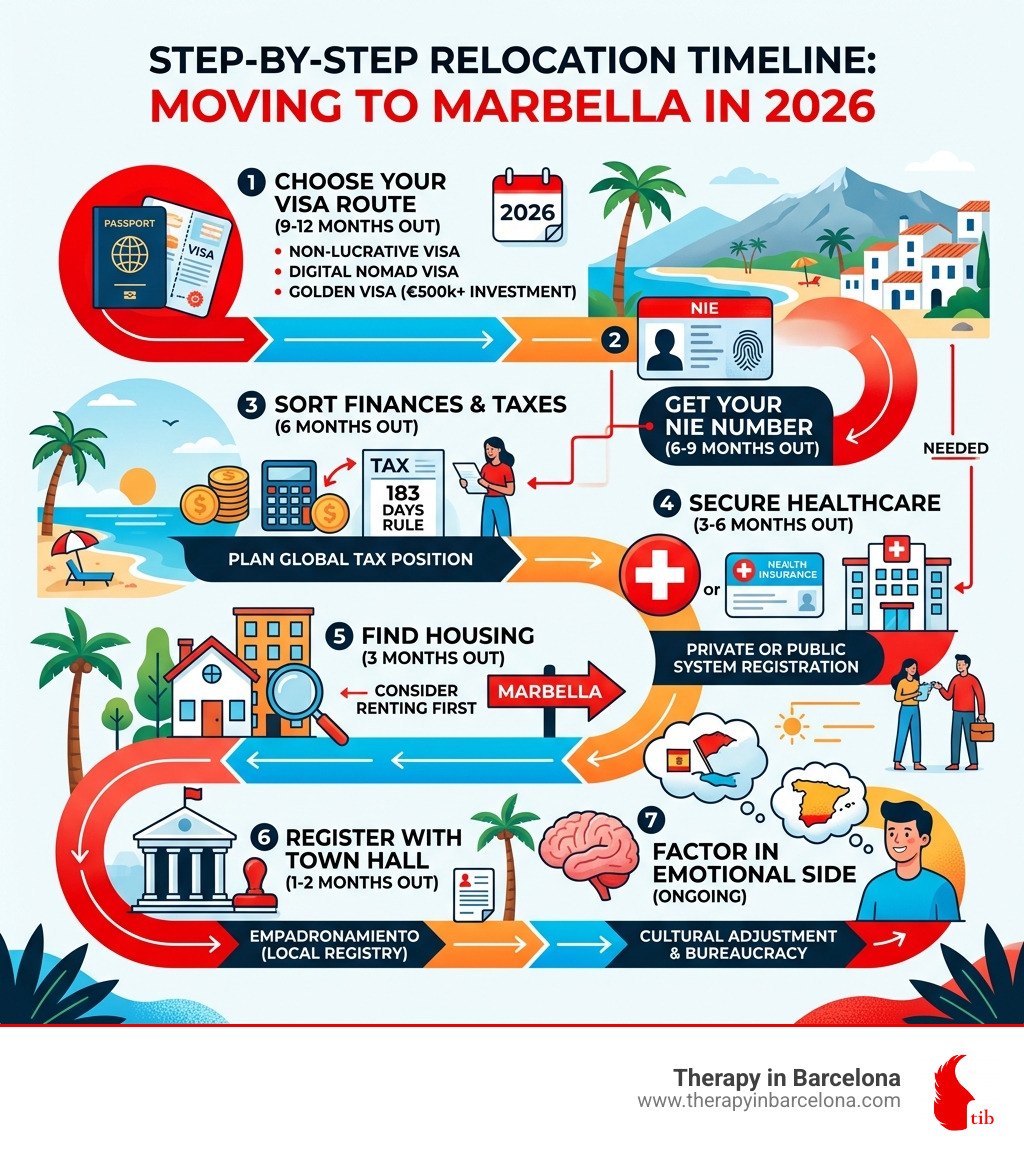
Here’s a quick overview of what the process involves:
- Choose your visa route — UK and US nationals need a visa before relocating. The most common options in 2026 are the Non-Lucrative Visa (for retirees or those with passive income), the Digital Nomad Visa (for remote workers), and the Golden Visa (for property investment of €500,000+).
- Get your NIE number — This is your Spanish identification number. You’ll need it for everything: opening a bank account, signing a lease, buying property.
- Register with the local town hall (empadronamiento) — This unlocks access to local services, school enrolment, and public healthcare.
- Sort your finances and tax position — If you spend more than 183 days a year in Spain, you become a tax resident and are taxed on your worldwide income. Early planning matters.
- Find housing — Most advisors recommend renting for 6–12 months before buying, to test different neighbourhoods before committing.
- Set up healthcare — Whether you use the public system or go private, you’ll need to register or take out insurance before your visa is approved.
- Factor in the emotional side — Cultural adjustment, bureaucracy fatigue, and the quieter winter months catch more people off guard than any paperwork does.
Marbella is genuinely easy to fall in love with on a sun-soaked visit. But living there year-round is a different experience — one that rewards people who plan carefully and go in with realistic expectations.
This guide covers everything: visas, property prices, neighbourhoods, schools, healthcare, tax, and the parts of relocation that rarely make it into the brochures — including the emotional toll of starting over somewhere new.
Why Marbella and the Red Tape of Residency
For many, moving to Marbella, Spain is about trading grey skies for a Mediterranean lifestyle. It is a place where you can hike the Sierra Blanca mountains in the morning and be at a beach club by the afternoon. Beyond the glitz of Puerto Banús, Marbella offers a structural depth that many other coastal towns lack: private hospitals, international legal firms, and a community that stays active all year.
However, the “Red Tape” is a reality of life in Spain. Since Brexit, UK citizens are treated as third-country nationals, similar to US citizens. This means you cannot simply pack a bag and move; you need a legal framework.
Planning your move requires a deliberate approach. It’s not just about finding a house; it’s about setting up your legal residency before committing to property. For a deeper look at the broader journey, you might find this Moving to Marbella: a complete guide for expats helpful. If you are coming from the States, check out Your American Dream In Spain A Relocation Roadmap for a strategic perspective.
Visa Options for UK and US Nationals in 2026
By April 2026, the visa landscape has settled into several clear paths for those moving to Marbella in Spain:
- The Digital Nomad Visa (DNV): This has become a favourite for remote workers. You must work for a non-Spanish company and meet specific income thresholds. It allows you to live in Spain while paying a reduced tax rate for the first few years.
- The Non-Lucrative Visa (NLV): Ideal for retirees. You cannot work in Spain on this visa, and you must prove you have sufficient passive income or savings to support yourself.
- The Golden Visa: If you invest €500,000 or more in Spanish real estate (without a mortgage on the first €500k), this visa offers a path to residency with significant flexibility.
Regardless of the visa, you will need an NIE (Número de Identificación de Extranjero). This is your tax ID and the key to almost every transaction in Spain. Once you arrive, you’ll exchange your visa for a TIE (Tarjeta de Identidad de Extranjero), which is your actual residency card.
For more details on these routes, see How To Move To Spain From The Uk Visas Residency And More or Moving To Spain From The Us Your Step By Step Guide.
Tax Implications and the Beckham Law
Tax is where many expats get caught out. Spain operates on the 183-day rule: if you spend more than half the year here, you are a fiscal resident. This means the Spanish government expects a slice of your worldwide income.
Key things to watch:
- Form 720: If you own more than €50,000 in assets outside Spain, you must declare them.
- Wealth Tax: Andalusia has historically been more tax-friendly than other regions, but you should still check the current 2026 thresholds for high-net-worth individuals.
- The Beckham Law: This special tax regime allows foreign workers (like those on a Digital Nomad Visa) to be taxed at a flat rate of 24% on Spanish income for up to six years, rather than the progressive rates that can climb much higher.
The Financial Reality of Moving to Marbella Spain
Marbella is a premium market. While it is significantly more affordable than London (about 43% cheaper) or New York, it is one of the most expensive places in Spain.

When moving to Marbella in Spain, you need to decide whether to rent or buy. Most experts suggest renting for the first year. This allows you to see if you actually like the “winter hibernation” period and which micro-market suits your personality.
If you decide to buy, the sticker price isn’t the final price. In Andalusia, the Transfer Tax (ITP) for resale properties is 7%. When you add notary fees, land registry fees, and legal costs, you should budget for 9–11% on top of the purchase price.
If you need a mortgage as a non-resident, be prepared to put down a 30–40% deposit. For a comprehensive look at the financial steps, read Spain Awaits A Comprehensive Guide To Your Move.
Micro-markets and Property Prices when Moving to Marbella Spain
Marbella is not one single market; it is a collection of neighbourhoods with vastly different price points:
- The Golden Mile: The peak of luxury. Prices range from €6,000 to over €10,000 per square metre. Beachside properties can easily exceed €15,000 per sqm.
- Sierra Blanca & Cascada de Camoján: Gated, secure, and prestigious. Expect €6,000 – €10,000 per sqm.
- Nueva Andalucía (The Golf Valley): Popular with families and golfers. Prices sit between €4,500 and €7,000 per sqm.
- East Marbella (Elviria, Los Monteros): Offers great beaches and a more relaxed feel. Prices are €4,000 – €6,000 per sqm.
- Estepona (The New Golden Mile): A fast-growing alternative that offers modern developments for €3,500 – €5,500 per sqm.
Daily Expenses for Families and Couples
What does it actually cost to live here in 2026?
- Rent: A mid-range 2-3 bedroom apartment in a good area like San Pedro or Elviria will cost €1,800–€3,500 per month. Premium villas in Nueva Andalucía can reach €8,000+.
- Groceries: A couple can expect to spend €500–€800 per month.
- Utilities: Electricity (especially with air-conditioning in summer), water, and high-speed internet usually total €150–€300 per month.
- School Fees: International schools range from €8,000 to €16,000 per child, per year.
- Leisure: An individual golf membership can cost between €1,500 and €4,500 annually.
Settling In: From Logistics to Emotional Well-being
Once the boxes are unpacked, the real work of “settling” begins. This involves navigating the healthcare system and finding the right schools for your children.
Healthcare and Education Systems
Marbella has some of the best infrastructure in Andalusia.
- Healthcare: The Costa del Sol Hospital is highly regarded, but many expats opt for private insurance (costing roughly €150–€300 per month) to ensure faster access to English-speaking specialists at hospitals like Quirónsalud or HC Marbella.
- Education: Families are spoilt for choice with institutions like Swans International School and Aloha College. Most follow the British Curriculum or the International Baccalaureate (IB).
For a logistical deep dive, check Your Ultimate Moving To Spain Checklist Dont Miss A Step.
Navigating the Expat Emotional Journey
Relocating is more than a change of zip code; it is a major life transition. Many people experience a “honeymoon phase” where everything is wonderful, followed by a period of “disappointment” or loneliness when the reality of being far from family sets in.
In Marbella, this often hits in the winter. While the sun still shines, the town is much quieter, and the bustling social life of August can feel like a distant memory. This is why “settling your character”—working on your own self-confidence and internal stability—is just as important as finding a house.
Bureaucracy fatigue is also a real thing. The “mañana” culture can be charming on holiday but infuriating when you are trying to get your internet connected or your residency card issued.
If you’re feeling the weight of the move, you aren’t alone. Read more on The Importance Of Mental Health During Relocation and Expat Mental Health Staying Sane Abroad.
Comparing Support Systems: Public vs. Private Care
When it comes to mental health support, expats in Marbella have two main routes. It is important to understand the differences so you can choose what fits your needs.
Public Healthcare and Therapy The Spanish public system (Seguridad Social) is world-class for physical emergencies, but mental health care can be a challenge for internationals.
- The Process: You must see your GP (médico de cabecera) first. They decide if you need a referral.
- The Reality: Waiting lists for non-urgent psychological support can be several months long.
- Language Barrier: Most public system therapists will speak Spanish. If you aren’t fluent, expressing complex emotions in a second language can hinder your progress.
- Continuity: You may not always see the same professional, making it hard to build a deep therapeutic relationship.
Private-Pay Services and Platforms Many expats choose private-pay therapy to bypass these hurdles. Services like ours at Therapy in Barcelona offer a different experience:
- Bespoke Matching: We don’t just give you the next person on a list. We use an intake process to match you with a therapist who understands your specific background.
- Expat-Specific Sensitivity: Our therapists are expats themselves. They understand “culture shock,” “identity loss,” and the specific stress of moving**** countries.
- Privacy and Quality: We offer a higher tier of care with strict privacy (no data selling) and evidence-based approaches like CBT, ACT, and IFS.
- Language: Therapy is available in English and several other languages (German, French, Afrikaans, etc.), ensuring you are truly understood.
For a broader look at how this works in Spain, see A Beginner’s Guide to Living in Marbella, Spain – A Way Abroad.
Frequently Asked Questions about Moving to Marbella Spain
Is Marbella expensive to live in compared to the UK or US?
While Marbella is one of Spain’s most expensive cities, it still offers a high quality of life for less than London or major California hubs. For example, living here is roughly 43% cheaper than London. Your money goes further in terms of housing quality, dining out, and fresh local produce.
Do I need a car to live in Marbella?
In short, yes. While the town centre is walkable and there is a bus system (a monthly pass is about €38), the best parts of Marbella—the golf courses, the international schools, and the mountain trails—require a car. If you are a resident, you will eventually need to exchange your UK or US driving license for a Spanish one.
What is the biggest mistake expats make when moving?
The two biggest mistakes are skipping legal “due diligence” on property and underestimating the emotional impact of the move. In Spain, debts (like unpaid taxes or community fees) follow the property, not the person. If you buy a house with debt, you inherit that debt. Emotionally, many people wait until they are in a crisis to seek support. Building a network and a routine early on is vital.
Conclusion
Moving to Marbella, Spain is a bold, exciting step that can lead to an incredible life under the sun. But the secret to a successful relocation isn’t just about finding the right villa on the Golden Mile; it’s about preparing for the logistical and emotional journey ahead.
Whether you are a retiree looking for a slower pace, a digital nomad seeking a base in Málaga or Marbella, or a family wanting a multicultural upbringing for your children, remember to be patient with the process.
At Therapy in Barcelona, we’ve been supporting the international community in Spain since 2011. Our founder, Leigh Matthews—an Australian Psychologist and expat who moved to Spain in 2011—recognised that foreigners need a “compassionate sanctuary” where they are understood without language barriers.
We offer personalised therapist matching to ensure you get the support you need, whether you are in Marbella, Valencia, or Madrid. If the stress of the move is feeling like too much, or if you just want a safe space to navigate your new life, we are here to help.
If you’d like support, book a Free Discovery Call today. You can also explore our A Practical Guide to Moving to Spain for more tips on making your move a success.
