


The Best Mental Counseling Options in 2026: A Guide for Internationals

Mental counseling is a professional, talk-based support service that helps people work through difficult emotions, life transitions, relationship problems, and mental health challenges — with the guidance of a trained therapist or counsellor.
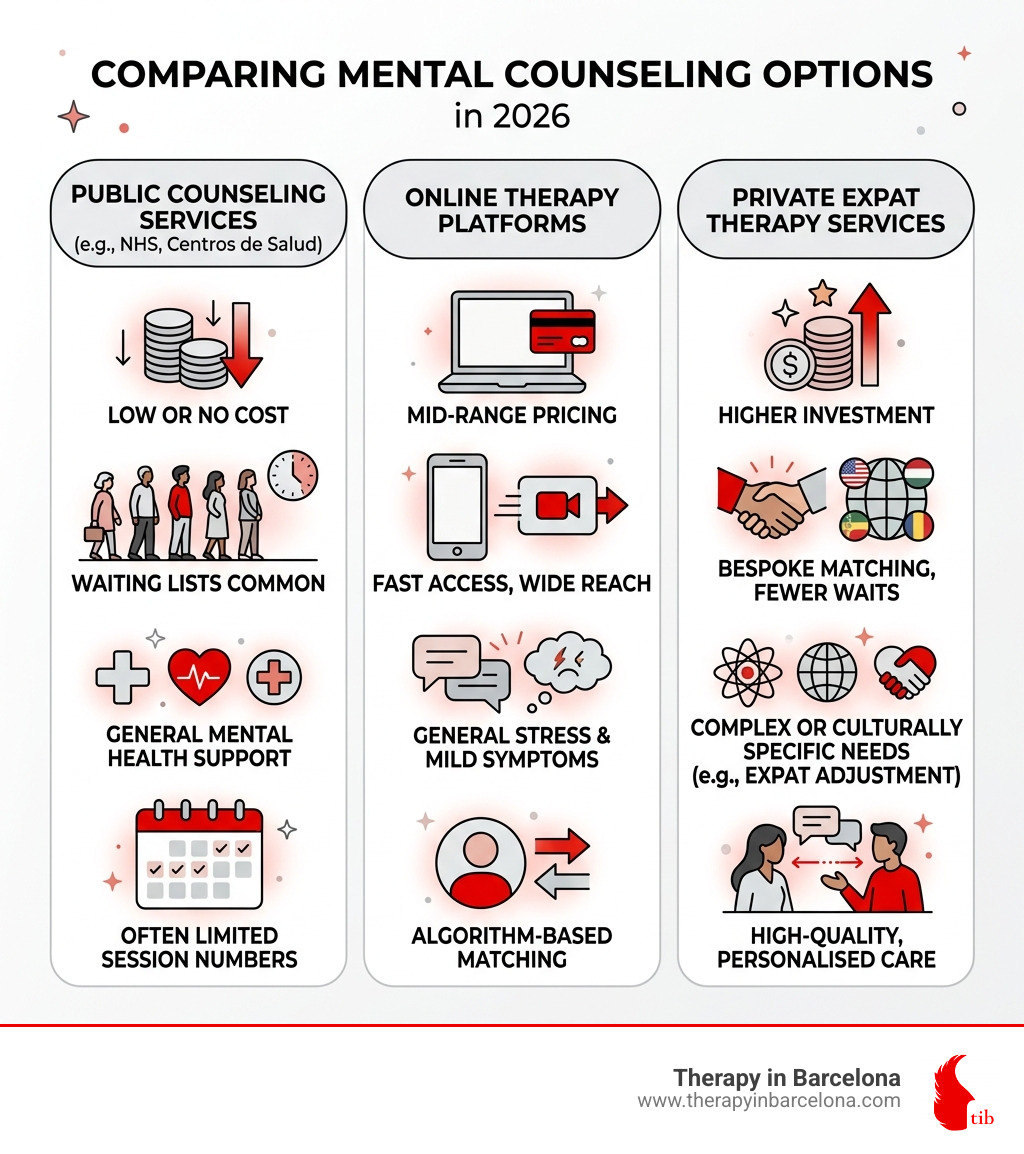
If you’re trying to evaluate your options quickly, here’s a snapshot of the main types of mental counseling available in 2026:
- Public health services (e.g., NHS in the UK, Centros de Salud in Spain) — Free or low cost, but often involve waiting lists and limited session numbers.
- Large online therapy platforms — Fast access, mid-range pricing, algorithm-based matching, best for general stress or mild symptoms.
- Specialised private practices — Higher quality, bespoke matching, best for complex or culturally specific needs such as expat adjustment, relationship issues, or trauma.
- Crisis and helpline services — Free, 24/7, for urgent mental health needs (call or text 988 in the US; dial 112 for emergencies in Europe).
There is a moment many people recognise. You have moved to a new city — perhaps Barcelona, Valencia, or Málaga — and life looks good on paper. The weather is beautiful. The food is extraordinary. But something feels off. You feel more anxious than usual, more disconnected, or simply unable to shake a low mood that follows you from flat to café to office.
You are not alone in that feeling, and it does not mean something is seriously wrong. It means you are human.
Mental counseling exists precisely for moments like this. It is not only for people in crisis. It is for anyone who wants to understand themselves better, manage the pressures of daily life, or work through something that feels too heavy to carry alone.
In 2026, the options for accessing that support have never been broader. You can see someone in person, connect via video from your living room, or use a platform that offers therapists in over 60 languages. But more choice also means more decisions — and it can be hard to know where to start, especially if you are new to therapy or navigating it in a second language.
This guide helps you find the right support for your journey. We’ll look honestly at what is available, who each option suits best, and how to find a therapist who is genuinely right for you.
Understanding Mental Counseling and How It Works
At its heart, mental counseling is a collaborative partnership. It is a professional relationship where you and a trained expert work together to improve your mental well-being. While people often use the terms “counseling” and “psychotherapy” interchangeably, they both fall under the umbrella of “talk therapy.”
According to the National Institute of Mental Health (NIMH), these treatments help people identify and change troubling emotions, thoughts, and behaviours.
Unlike psychiatry, which often focuses on the medical side of mental health—like diagnosing disorders and managing medication—counselling usually follows a “wellness model.” This means the focus is on your overall personal growth, emotional regulation, and finding practical solutions to life’s hurdles.
Think of it as a gym for your brain. You don’t wait until you can’t walk to start exercising; similarly, you don’t need a clinical diagnosis like major depression to benefit from a counsellor’s perspective. Whether you are dealing with work stress in Madrid or feeling isolated after moving to Alicante, counseling provides a non-judgmental space to unpack your experiences.
What Happens During a Mental Counseling Session?
If you’ve never been to therapy, the unknown can feel a bit daunting. In a typical session, which usually lasts between 50 and 60 minutes, you lead the conversation while the therapist listens and guides.
In the beginning, it’s all about the “introductory conversation.” Your therapist will ask questions to understand your history, your current environment, and what brought you through the door. From there, you’ll work together to build a therapeutic alliance—a term for a relationship based on trust and shared goals.
Whether you are seeking individual therapy to handle anxiety or looking for couples counselling to fix communication loops, the process involves setting goals and learning new strategies to meet them. It is a safe environment where you can say the things you might not feel comfortable saying to friends or family.
Preparing for Your First Mental Counseling Visit
Preparation is the best antidote to first-session jitters. You don’t need to have a perfect “speech” ready, but a little reflection goes a long way.
- Reflect on your “Why”: What is the main thing bothering you right now? Is it a specific event, a general feeling of “stuckness,” or a relationship issue?
- Write it down: Many clients find it helpful to bring a notebook with a few bullet points or questions.
- Check the tech: If you are opting for online therapy, log in 15 minutes early. Ensure your internet is stable and you are in a private space where you won’t be interrupted.
- Complete the paperwork: Most practices use intake forms to get a head start on your history. Filling these out thoughtfully helps your therapist understand your needs from the very first moment.
For a deeper dive, check out our guide on preparing for your first session, specifically written for the international community.
Exploring Mental Counseling Options Available in 2026
The “best” option isn’t the most expensive one; it’s the one that matches your specific needs, budget, and location. Here is how the landscape looks in 2026.
Public Health Services: The NHS and Community Clinics
In the UK, the NHS provides free counselling through talking therapy services. You can often self-refer without seeing a GP. However, the reality of public health is that resources are stretched. You may face long waiting lists, and the number of sessions is typically capped—often between 8 and 16.
In Spain, the public system (Centros de Salud) offers mental health support, but for the English-speaking community, there is a significant hurdle: language. While the care is professional, finding a therapist in the public sector who is fluent in English and understands the nuances of expat life can be difficult.
Large-Scale Virtual Platforms: General Online Therapy Providers
Large-scale virtual platforms and directories have made therapy more accessible than ever. These services are great for convenience, often offering 24/7 access and a wide directory of therapists.
- Pros: They are usually more affordable than private clinics and offer a quick start. Some even offer support in over 60 languages.
- Cons: Matching is often done by algorithms. While efficient, it can feel a bit “corporate.” These platforms are excellent for general life stress but may lack the specialised cultural sensitivity required for complex relocation issues.
Specialised Expat Support: Therapy in Barcelona
Therapy in Barcelona offers a different approach. Founded in 2011 by Leigh Matthews—an Australian Psychologist, expat in Barcelona since 2011—the practice was built to provide experienced support for the international community.
We aren’t just a directory; we are a group practice of psychology-trained therapists who are expats themselves. We understand that moving to Sevilla or starting a business in Valencia isn’t just a logistical change—it’s an emotional one. We specialise in expat therapy, addressing everything from cultural shock and isolation to the specific stresses of bicultural relationships.

Choosing the Right Approach for Your Needs
Not all mental counseling uses the same “tools.” Depending on what you’re facing, different modalities might be more effective.
- Cognitive Behavioural Therapy (CBT): This is the gold standard for anxiety and depression. It focuses on identifying negative thought loops and replacing them with more balanced ones.
- Acceptance and Commitment Therapy (ACT): Instead of fighting difficult feelings, ACT teaches you to accept them and take action based on your values. It’s great for life transitions.
- Internal Family Systems (IFS): This approach looks at the different “parts” of your personality (like the part that’s a perfectionist or the part that’s scared). It’s deeply effective for healing past trauma.
- The Gottman Method: If you’re seeking couples counselling, this research-based approach helps couples build friendship and manage conflict effectively.
- Sex Therapy: For those navigating intimacy issues, sex therapy provides a professional, safe space to discuss concerns that are often hard to talk about.
For more detail on these styles, read our comprehensive guide to psychotherapy.
Comparing Your Options: Public vs. Online Platforms vs. Private Practices
To help you decide, we’ve broken down the main differences between the three most common paths to care.
Public Systems (NHS / Spanish Public Health)
- Cost: Free or very low cost.
- Speed: Slow. Expect waiting lists that can last months.
- Choice: Very low. You are typically assigned whoever is available.
- Best for: Residents on a tight budget dealing with common conditions like mild depression.
Large Online Platforms
- Cost: Mid-range. Often uses a subscription or “pay-as-you-go” model.
- Speed: Fast. You can often book a session within 48 hours.
- Choice: Moderate. You can browse profiles, but matching is often automated.
- Best for: People with busy schedules dealing with general stress or those who prefer a purely digital experience.
Specialised Private Practices (Therapy in Barcelona)
- Cost: Higher private-pay rates. However, your insurance providers may cover these costs, check with them beeforehand. We also offer sliding scale fees for those in financial need.
- Speed: Fast. We prioritise getting you into a room (virtual or physical) quickly.
- Choice: High. We use bespoke, human-led matching. We don’t just give you the next person on the list; we match you based on your personality, your specific expat struggle, and the therapist’s expertise.
- Best for: Expats, international students, and digital nomads who need a therapist who “gets” the life-abroad experience.
When to Seek Professional Help and Crisis Resources
How do you know if it’s “time”? You don’t need to wait for a breakdown. If you find yourself thinking, “I just don’t feel like myself,” that is reason enough. Common signs include:
- Feeling overwhelmed by the move to a new city like Madrid or Sevilla.
- Struggling to connect with others in your new home.
- Persistent feelings of sadness, irritability, or “burnout.”
- Relationship friction that you can’t seem to resolve on your own.
Immediate Crisis Resources
If you or someone you know is in immediate danger or experiencing a mental health crisis, please use these resources. Therapy in Barcelona is not a crisis service.
- Europe: Dial 112 for emergency services.
- USA: Call or text 988 for the Suicide & Crisis Lifeline.
Frequently Asked Questions about Mental Counseling
How long does counseling typically last?
There is no one-size-fits-all answer. Some people find relief in 8 to 16 sessions (a common length for NHS or short-term CBT). Others choose long-term therapy that lasts a year or more to work through deep-seated patterns or trauma. You and your therapist will decide on a timeframe that feels right for your goals.
Is it covered by insurance?
If you have private international health insurance, your plan may cover outpatient psychological care. As we are a private-pay service, you pay upfront and can use our documentation to claim reimbursement. It’s best to check your cover with your insurer beforehand.
What if I don’t “click” with my therapist?
This is actually very important. Research shows that the “therapeutic alliance“—how well you get along with your therapist—is the biggest predictor of success. At Therapy in Barcelona, we take our personalised matching very seriously. But if after a few sessions you don’t feel it’s a good fit, we encourage you to tell us. We can help you transition to a different therapist who might be a better match.
Can I see someone in person?
Yes! While we offer online therapy worldwide (including the USA and Canada), we have a beautiful office in the heart of Barcelona’s Eixample district. We also support clients across Spain, from those living the beach life in Marbella to those in the bustling streets of Zaragoza.
Your Next Step
Life as an expat is a brave adventure, but it can also be “messy.” Whether you are struggling with a bicultural marriage, feeling the weight of professional pressure in a new country, or simply feeling lost, mental counseling is a powerful way to find your footing again.
You don’t have to navigate these challenges alone. From the structured support of the public system to the specialised, culturally sensitive care we offer at Therapy in Barcelona, there is a path forward that fits your life. Your brain—and your future self—will thank you for taking the first step.
Ready to start? We offer a Free Discovery Call to help find the perfect therapist for your needs.
