


Why Long-Distance Relationships Need Intentional Connection Work
Maintaining a bond across miles requires intentional work. Couples therapy exercises long distance can help you strengthen your connection with practical, evidence-based techniques. Here are some effective approaches:
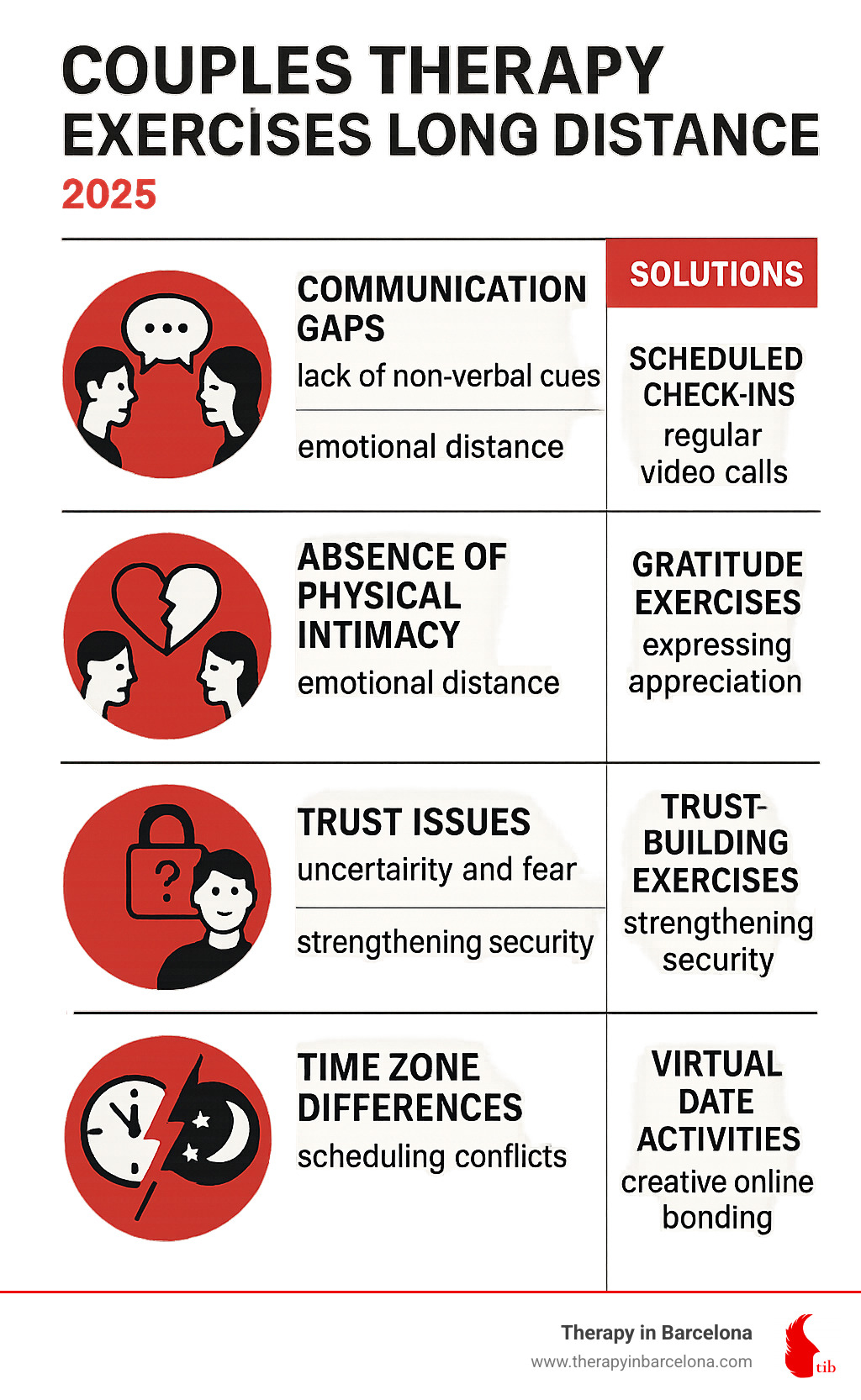
- Scheduled check-ins: Daily or weekly video calls for structured emotional sharing.
- Gratitude exercises: Regular appreciation to reinforce positive feelings.
- Active listening: Mirroring and validation exercises adapted for video calls.
- Virtual date activities: Shared online experiences like cooking together.
- Conflict resolution strategies: Time-out techniques for disagreements.
- Trust-building exercises: Future planning and transparency practices.
- Digital sharing rituals: Photos and voice notes to maintain closeness.
Long-distance relationships face unique challenges. Physical absence and communication barriers can create misunderstandings that escalate quickly. Yet, many couples succeed by using intentional, structured approaches to connection—exactly what couples therapy exercises provide.
These techniques, often adapted from established methods like the Gottman Method and Emotionally Focused Therapy, address the specific vulnerabilities of LDRs. Whether you’re temporarily apart or building a relationship across continents, these exercises can help you maintain intimacy, resolve conflicts, and plan for a shared future.
The Unique Problems of Long-Distance Relationships
When you’re building a relationship across miles, every challenge feels magnified. The usual relationship problems become steeper, and new obstacles emerge.
The absence of physical intimacy is often the hardest part. Spontaneous hugs and simple touches disappear, leaving partners feeling emotionally adrift and lonely in a way video calls can’t always fix.
Communication barriers create their own complications. Technology helps, but it also creates walls. A text can read as cold, emojis get misinterpreted, and a pause on a video call can cause anxiety. These digital misinterpretations can spiral into arguments.
Time zone differences add another layer of complexity. Your big news at 2 PM might be your partner’s 3 AM wake-up call. These mismatched rhythms can leave both partners feeling disconnected from each other’s daily lives.
Trust issues can intensify with distance. Uncertainty can breed anxiety, especially if one partner feels insecure and needs regular reassurance.
Social isolation may also creep in. You might miss having someone to share small daily experiences with, and friends may stop inviting you to couples’ events.
Consider Sofia, a marketing professional from Seville, and Marcus, a teacher in Valencia. While they are a fictional couple, their story reflects the real challenges many international couples face. When Marcus moved, they found their communication breaking down. His supportive texts seemed to irritate Sofia, and he couldn’t understand why. They needed practical strategies to manage the distance and the cultural nuances in their communication. Couples therapy exercises long distance became their lifeline. Sofia and Marcus are composites based on common expat themes; they are not real clients.
These challenges require intentional effort. Understanding them is the first step towards addressing them effectively. For couples dealing with cultural differences, exploring strategies for intercultural relationships can provide additional support: How to Conquer These Intercultural Relationship Challenges.
Communication Exercises to Bridge the Miles
When you’re separated by distance, communication is your relationship’s lifeline. It’s not about talking more, but communicating better. Traditional couples therapy techniques can be adapted for the digital age to create deeper connections.

The foundation of effective couples therapy exercises long distance starts with scheduled check-ins. Consistency creates safety and makes connection a priority. During these check-ins, try guided emotional check-ins with questions like, “What made you feel proud today?” or “What’s weighing on your mind?” to encourage deeper sharing.
Using “I” statements is a powerful tool. Instead of “You never call when you say you will,” try “I feel anxious when our planned calls don’t happen because it makes me worry.” Research shows this approach reduces defensiveness and keeps conversations productive.
Active listening is crucial when you can’t read full body language. Put away distractions and paraphrase what you heard: “It sounds like you’re feeling overwhelmed. Did I get that right?” Mirroring takes this further: one partner speaks while the other listens, then reflects back what they heard before responding. It ensures you’re truly hearing each other.
For couples navigating both distance and cultural differences, these skills are vital. You can explore more strategies here: From Misunderstandings to Meaningful Conversations: A Guide to Couples Communication Therapy.
The “Daily Temperature Check” for LDRs
Created by family therapist Virginia Satir, this exercise is like checking your relationship’s vital signs. Adapt it for video calls by setting aside 10-15 minutes to cover five areas:
- Appreciations: Share something specific you appreciated about your partner.
- New Information: Share something meaningful from your day.
- Puzzles: Discuss things you’re curious or confused about in the relationship.
- Complaints with a request: Frame complaints productively. Instead of blaming, make a request for change.
- Hopes and wishes: Share what you’re looking forward to, keeping you focused on your shared future.
Mastering Empathetic Communication from Afar
Empathy is your superpower when you can’t physically connect. It’s about understanding the feelings behind the words. Treat video calls as important conversations: put away distractions, look at the camera, and tune in to your partner’s tone and facial expressions. Validation is key—you don’t have to agree, but acknowledging their feelings (“That sounds really frustrating”) makes them feel heard. If you notice your partner seems quiet, ask gentle questions. This creates a safe space where you both feel understood and valued.
Building Intimacy and Trust with Couples Therapy Exercises for Long Distance
Emotional intimacy and trust are the lifelines of a long-distance relationship. Without daily physical reassurance, couples need intentional strategies to nurture these connections. Couples therapy exercises long distance can help you build an even deeper bond.

Gratitude exercises are remarkably powerful. Make it a daily habit to express specific appreciation. Instead of a generic “I love you,” try, “Thank you for asking about my presentation—it meant a lot.” This practice is consistently linked to higher relationship satisfaction.
Gottman’s Love Maps help you deepen your knowledge of each other’s inner worlds. Ask questions about your partner’s current hopes, fears, and dreams. This helps you feel connected to their emotional landscape. Learn more here: Gottman’s Love Maps Exercise.
Shared goal setting gives your partnership purpose. Working towards common objectives—like planning a visit or discussing career moves—makes the distance feel more manageable.
Virtual date nights create shared experiences. Cook the same meal over video, watch a film while texting, or take an online class together. The key is to generate new memories.
Digital sharing of daily life maintains closeness. Send photos of your coffee, voice notes on your walk, or short videos of things that made you think of your partner.
Starting a book or film club for two provides fresh conversation topics beyond “How was your day?” and can lead to fascinating discussions. For more ideas, check out: Love in Action: Activities to Do as a Couple.
Creating Your Shared Future
Planning for the future transforms abstract hopes into concrete plans.
- Create a relationship bucket list: Brainstorm activities, travel, and experiences you want to share.
- Make a future dreams collage: Use images and words to represent your shared vision, discussing why each element resonates.
- Hold goal alignment sessions: Discuss how your individual and joint aspirations fit together.
- Plan visits in detail: Discussing what you’ll do builds anticipation and makes the future feel more tangible.
Virtual Activities to Strengthen Your Bond
Get creative with shared experiences to foster genuine connection.
- Virtual cooking sessions: Pick a recipe and cook simultaneously on a video call.
- Movie marathons: Use browser extensions that sync your viewing for a shared experience.
- Online gaming: Play together for teamwork and playful banter.
- Shared playlists: Create playlists on streaming services to convey emotions and share music.
- Virtual tours: Explore museums or cities you dream of visiting together.
Managing Conflict When You’re Miles Apart
Conflict feels more intense when managed through a screen. Without the comfort of a hug or the ability to read body language, disagreements can feel harder to resolve.

The ‘Time-Out’ strategy is essential. Agree beforehand that either partner can call for a pause when a conversation gets heated. This isn’t about giving the silent treatment; it’s about recognising when emotions are too high for a productive talk. During the break, focus on calming down before returning to the conversation, usually within 20 minutes to a few hours.
Once you’ve cooled down, use structured problem-solving. Start with “I” statements (“I felt unheard when…”) and give each person space to speak without interruption. Validate what you’ve heard before seeking solutions.
Identifying triggers is especially important for couples therapy exercises long distance, as cultural differences can amplify misunderstandings. Understanding these patterns helps prevent future blow-ups. This is particularly relevant for international couples. Learn more about recognising these patterns here: Identifying Stress Languages: Couples Therapy Tips for International Couples.
Repair attempts—small gestures like a joke or an “I love you”—can de-escalate tension. Having a clear plan for managing disagreements builds confidence that your relationship can weather any storm.
When to Seek Professional Support for Your LDR
Sometimes, even the best couples therapy exercises long distance aren’t enough. When conflicts keep cycling or you feel stuck, professional guidance can offer a breakthrough. A therapist provides an outside perspective, spotting patterns and triggers you might miss in a safe, neutral space.
Online therapy has made support more accessible for long-distance couples. You can join sessions from your respective locations, making geography less of a barrier. Many find this format flexible and less intimidating than in-person sessions.
So when should you consider reaching out? If you’re having the same arguments on repeat, if trust feels fragile, or if major life changes are straining the relationship, professional guidance can help.
You have options. Public health services in Barcelona, Madrid, Valencia or Málaga can be affordable, though waitlists and language fit can be tricky. Large online platforms are convenient, but matching can be generic and policies vary. Local private practices offer choice, but quality and cultural sensitivity differ.
At Therapy in Barcelona, we’re a group practice of highly qualified, psychology-trained therapists. We work with adults, couples, teens and families. We offer online therapy worldwide (including the USA and Canada) and face-to-face sessions in our Barcelona office. Since 2011, our team has supported internationals across Spain and beyond. Our founder, Leigh Matthews, an Australian Psychologist in Barcelona since 2011, built the practice to serve the unique needs of expats.
Here’s how we work:
- Personalised therapist matching rather than algorithmic assignment.
- Multilingual care: we work in English, and some therapists also speak German, French, Spanish, Afrikaans, Portuguese, Swedish, Austrian-German and Swiss-German.
- Collaborative care and high-quality, private-pay service with a focus on continuity.
- Strict privacy and confidentiality. We don’t sell your data.
If you’d like a thoughtful, culturally sensitive approach to your long-distance relationship, we can help you find the right therapist for your situation.
Frequently Asked Questions about Couples Therapy Exercises Long Distance
How can we build physical intimacy from a distance?
Physical intimacy starts with emotional intimacy. The deeper your emotional connection, the more physically connected you’ll feel.
- Use sensual communication: Engage in descriptive conversations about desire and touch. Verbal affection can create powerful feelings of closeness.
- Create shared sensory experiences: Light the same scented candle during video calls or listen to the same playlist to create a shared atmosphere.
- Plan future touch: Talk in detail about what you’ll do when you next meet. This builds anticipation and reinforces your physical connection.
- Adapt therapeutic techniques: You can even adapt exercises like Sensate Focus by describing mindful self-touch to your partner on a call, increasing body awareness and shared sensuality.
What technology is best for these exercises?
The right tools make a difference, but you don’t need anything fancy.
- Video conferencing (Zoom, FaceTime) is essential for seeing expressions and reducing misinterpretations.
- Couple-specific apps offer a private space for sharing updates, while others let you send doodles to your partner’s screen.
- Collaborative planning tools like TripIt and shared digital calendars are crucial for coordinating visits and virtual dates.
- Voice notes and digital sharing make your partner feel included in your daily life in a spontaneous way.
How often should we do these exercises?
Consistency matters more than intensity. A sustainable routine is better than ambitious plans that fall apart.
- Aim for one dedicated weekly check-in using a structured format like the “Daily Temperature Check.”
- Practise daily gratitude. A quick text or mention during a call reinforces positive feelings.
- Be realistic about your schedules. Find a rhythm that works for both of you and stick to it.
- Don’t forget spontaneity. Surprise gestures like a random voice note keep the relationship exciting.
Your Next Step to a Stronger Connection
Long-distance relationships ask for intention. With simple routines—like a weekly 15-minute temperature check and a daily gratitude message—you can keep the bond steady and strong.
If you want support, we offer culturally sensitive therapy for internationals in Spain—whether you’re in Barcelona, Madrid or Valencia—and online worldwide, including the USA and Canada. We also see clients face to face in our Barcelona office and can match you with a therapist who speaks your language.
If you’d like support, book a Free Discovery Call. We’ll help you choose one or two exercises to start this week and find a therapist who fits your needs.
