


Visas and Legal Routes for Immigrating to Spain from US

Moving beyond the 90-day Schengen tourist limit requires securing an official long-stay national visa (Type D) before establishing residency. Spain processes these visas through its consular network across the United States, usually managed via BLS International service centres. Processing times generally range from four to twelve weeks once an application is submitted, though gathering the required supporting evidence takes several months beforehand.
Selecting the right legal path depends entirely on your source of income and professional plans. To understand the primary pathways, review this detailed breakdown of moving to Spain from the USA: visa routes, costs and timeline.
2026 Visa Options for US Citizens
Non-Lucrative Visa (NLV)
- Primary Purpose: Retirees, individuals living off passive income, or those with substantial personal savings.
- 2026 Income Threshold: 400% of Spain’s IPREM (approximately €2,400 per month or €28,800 annually for the main applicant, plus €7,200 annually per dependent).
- Work Permissions: Strictly prohibited from engaging in any local Spanish employment or remote teleworking.
- Initial Validity: 1 year, renewable for successive 2-year periods.
Digital Nomad Visa (DNV)
- Primary Purpose: Remote employees and self-employed contractors working for non-Spanish entities.
- 2026 Income Threshold: 200% of the Spanish Minimum Interprofessional Wage (SMI) (approximately €2,849 per month or €34,188 annually for a solo applicant).
- Work Permissions: Permitted to work remotely for foreign employers; up to 20% of income can come from domestic Spanish clients.
- Initial Validity: 1 year if granted via a US consulate, or 3 years if applied for directly while legally present in Spain.
Employee Work Visa (Cuenta Ajena)
- Primary Purpose: Professionals hired directly by a registered Spanish business entity.
- 2026 Income Threshold: Governed by employment contract (must meet industry-standard salary levels).
- Work Permissions: Fully authorised to work for the sponsoring employer within Spain.
- Initial Validity: 1 year, tied directly to the sponsoring employer.
Self-Employed Work Visa (Cuenta Propia / Autónomo)
- Primary Purpose: Entrepreneurs, freelancers targeting the Spanish market, and small business founders.
- 2026 Income Threshold: Sufficient capital investment to fund the proposed business plan plus personal maintenance funds.
- Work Permissions: Authorised to carry out independent commercial activity within Spain.
- Initial Validity: 1 year, renewable based on business viability.
Student Visa
- Primary Purpose: Individuals enrolled in accredited full-time educational programmes or language academies.
- 2026 Income Threshold: 100% of IPREM (€600 per month) plus tuition fees paid in advance.
- Work Permissions: Authorised to work part-time up to 30 hours per week, provided working hours do not conflict with studies.
- Initial Validity: Duration of the study programme (typically up to 1 year renewable).
Non-Lucrative Visa Requirements When Immigrating to Spain from US
The Non-Lucrative Visa remains the standard option for retirees and self-funded movers. Spain calculates financial eligibility using the Public Multiple Effects Income Indicator (IPREM). For 2026, the principal applicant must prove guaranteed passive funds of at least 400% of the IPREM, which equals approximately €28,800 per year ($31,000–$34,000 depending on exchange rates). Each additional family member requires an extra 100% of the IPREM (roughly €7,200 annually).
Acceptable proof includes certified pension statements, annuity distributions, investment dividends, and substantial liquid bank balances. Spanish consulates strictly interpret the non-lucrative clause: applicants are barred from carrying out any economic activity, including remote consulting or operating a home business based in the United States.
Digital Nomad Visa for Remote American Workers
Introduced under the Spanish Startup Act, the Digital Nomad Visa accommodates remote professionals. Applicants must demonstrate an ongoing working relationship with non-Spanish companies for at least three months prior to applying, and the employing company must have been operational for at least one year.
Financially, applicants must earn at least 200% of the Spanish minimum wage (SMI). In 2026, this sets the baseline threshold at €2,849 per month (€34,188 per year). Bringing a spouse or first dependent adds €916 per month, with €305 per month required for each subsequent family member. Teleworkers must provide a formal employer declaration confirming remote work authorisation, company registration certificates, and documentation of professional qualifications or three years of relevant industry experience.
Investor, Work, and Student Visas: The Post-Golden Visa Reality
Spain officially repealed the real estate investment route for its Golden Visa programme on 3 April 2025. US citizens can no longer secure residency solely by purchasing €500,000 in residential property. High-net-worth movers must now consider alternative avenues, such as the Entrepreneur Visa—which requires an innovative business project approved by ENISA—or standard investment routes involving public debt or Spanish corporate equity.
Corporate employment sponsorship remains challenging due to the national labour market testing requirement, which prioritises Spanish and EU citizens for open roles unless a position appears on the national shortage list or qualifies under the Highly Qualified Professional (HQP) scheme. For younger adults or career changers, student visas remain accessible, offering legal pathways to study while permitting up to 30 hours per week of side employment.
Step-by-Step Logistics: From FBI Background Checks to the First 90 Days
Managing Spanish consular procedures requires careful attention to sequence. The most frequent cause of administrative delay is document expiration: police checks and medical clearances carry strict 90-day validity windows from their date of issue to consular filing.
To review regional document requirements, consult this guide to moving to Spain from the USA in 2026.
Essential Document Checklist for US Consulates
- Valid US passport with at least two blank pages and one year of remaining validity.
- National visa application form and official consular photograph.
- FBI Identity History Summary Check covering the entire United States.
- State-level police certificates for any US states lived in during the past two years (or five years, depending on consulate jurisdiction).
- Apostille of The Hague issued by the US Department of State (for federal records) or state authorities.
- Sworn Spanish translations (traducción jurada) completed by a translator certified by the Spanish Ministry of Foreign Affairs.
- Medical certificate signed by an MD or DO confirming the applicant does not carry diseases subject to quarantine under the International Health Regulations.
- Qualifying private health insurance policy issued by a Spanish-regulated insurer with no deductibles or copayments (sin copagos).
- Certified financial documentation (bank statements, IRS tax transcripts, pension letters) translated into Spanish.
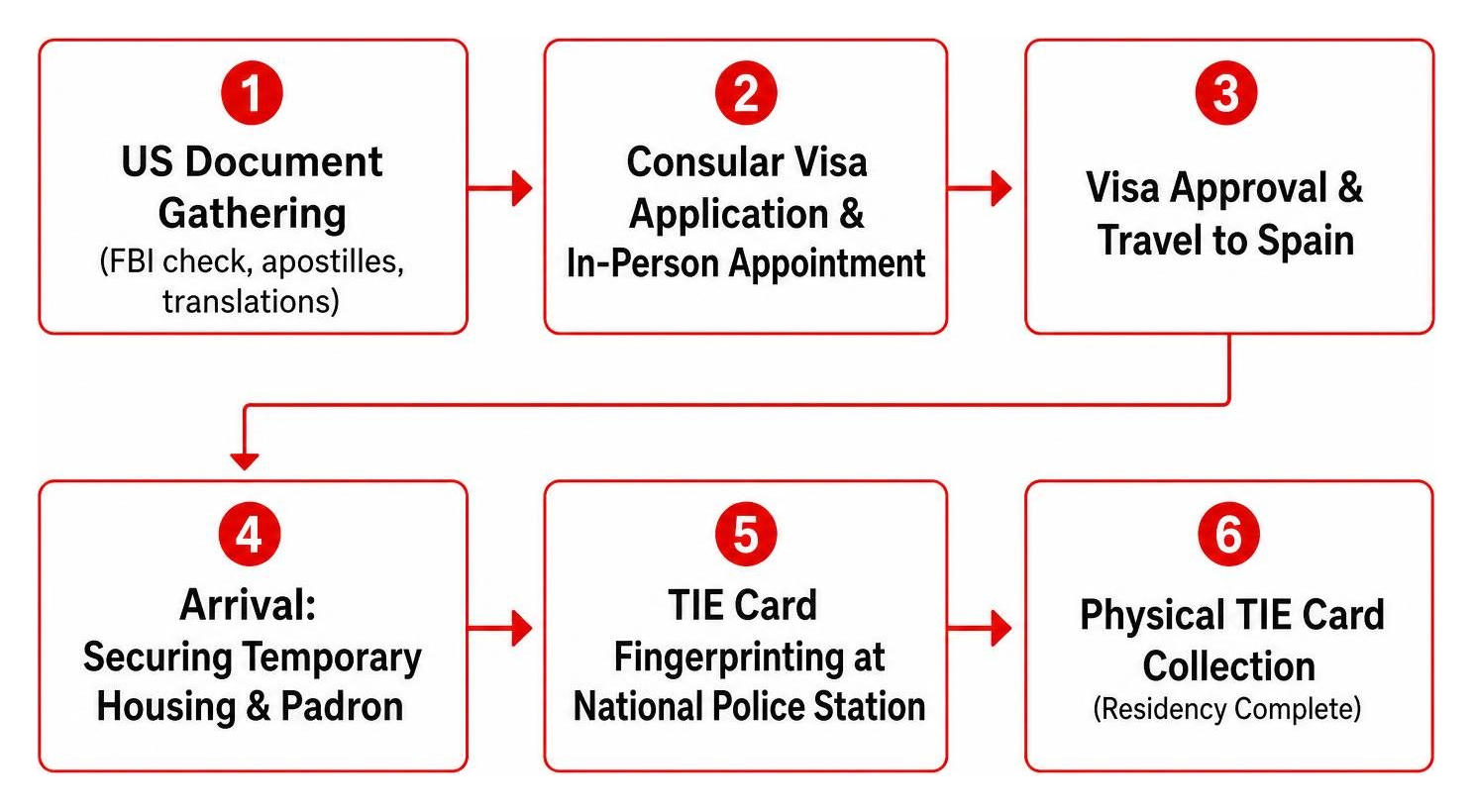
Document Preparation: Apostilles, Sworn Translations, and Medical Clearances
The primary administrative roadblock in the United States is the FBI background check and federal apostille. Requesting digital fingerprinting through FBI-approved channelers produces electronic results in 3 to 5 business days. However, obtaining the federal apostille from the US Department of State in Washington, D.C., can take 6 to 10 weeks unless coordinated through specialised expediting services.
All English-language records—including medical clearances, marriage licences, and criminal histories—must receive an official sworn translation (traducción jurada). Non-sworn translations or standard commercial notary stamps will lead to rejection at the consular window.
The Administrative Sequence: NIE, Empadronamiento, and TIE
Upon landing in Spain, newcomers often encounter an interconnected administrative sequence: renting long-term housing requires a Foreigner Identity Number (Número de Identidad de Extranjero or NIE), municipal registration (empadronamiento) requires a formal lease, and securing the physical residency card (Tarjeta de Identidad de Extranjero or TIE) requires both your NIE and local registration certificate.
To manage this smoothly:
- Book temporary bridge housing for your first 30 to 60 days.
- If your initial entry visa does not list an NIE, obtain one through the local immigration office (Extranjería).
- Sign a standard 12-month residential rental contract (arrendamiento de vivienda).
- Register your residence at the local municipal town hall (Ayuntamiento) to obtain your volante de empadronamiento.
- Schedule an appointment (cita previa) with the National Police for fingerprinting (toma de huellas) within 30 days of arrival.
- Return 30 to 45 days later to pick up your physical TIE plastic card.
Relocating Pets to Spain from the United States
Relocating domestic dogs and cats from the US to Spain requires precise veterinary timing under non-commercial pet movement regulations. Pets must have an ISO 11784/11785-compliant 15-digit microchip implanted prior to receiving an updated rabies vaccination. The primary rabies vaccine must be administered at least 21 days before entry into the European Union.
Within 10 days of travel, an accredited USDA veterinarian must issue an official bilingual EU Non-Commercial Health Certificate, which must be endorsed digitally via the USDA Veterinary Services Process Streamlining (VEHCS) system or physically stamped at a regional USDA office. Entry must occur through designated Spanish Border Inspection Posts (BIP), such as Madrid-Barajas or Barcelona-El Prat.
Cost of Living, Banking, and Spanish vs. US Taxes
Financial planning across two different economic frameworks involves balancing currency rates, cost-of-living differences, and overlapping tax obligations.
Managing Taxes and Finances While Immigrating to Spain from US
US citizens remain subject to citizen-based taxation, requiring annual federal Form 1040 filings regardless of where they live. Additionally, expats with foreign financial assets exceeding $10,000 at any point during the calendar year must file a Report of Foreign Bank and Financial Accounts (FBAR/FinCEN Form 114), alongside potential FATCA (Form 8938) filings.
Living in Spain for more than 183 days during a single calendar year establishes Spanish tax residency, making you liable for progressive Spanish personal income tax (IRPF), which ranges from 19% to 47% depending on income and Autonomous Community. Double taxation is generally prevented via the US-Spain Double Taxation Treaty through two primary IRS mechanisms:
- Foreign Tax Credit (FTC – Form 1116): Allows you to offset US tax liabilities dollar-for-dollar against higher taxes paid in Spain, which is often the most beneficial approach.
- Foreign Earned Income Exclusion (FEIE – Form 2555): Excludes qualifying active earned income up to the annual limit, though it cannot be applied to passive pension or retirement funds.
Qualifying inbound employees and digital nomads may also consider applying for the Special Expatriate Tax Regime—widely known as the Beckham Law. If approved within the strict six-month window of registration, individuals are taxed at a flat 24% rate on Spanish-sourced income up to €600,000 for up to six years, while non-Spanish investment income remains exempt from local wealth and inheritance reporting.
Comparative Cost of Living and Setting Up Spanish Banking
Living in Spain generally costs 30% to 50% less than living in comparable metropolitan areas across the United States. Outside the urban centres of Madrid and Barcelona, monthly rental rates can drop by 50% to 70% compared to major US cities. A single individual can live comfortably on €1,400 to €1,800 per month in secondary hubs, while a family of four typically spends between €2,800 and €3,800, inclusive of housing.
Opening a traditional bank account involves complying with the Foreign Account Tax Compliance Act (FATCA). Traditional Spanish banks (such as CaixaBank, BBVA, and Santander) ask US citizens to sign Form W-9. While setting up local accounts, international movers frequently use digital fintech accounts (such as Wise or Revolut) to receive funds and transfer money at real mid-market exchange rates without incurring inflated currency markups.
Healthcare, Housing, and Settling Into Spanish Daily Life

Settling into everyday Spanish life involves securing private health cover, understanding local housing laws, and choosing a base that matches your lifestyle and family needs. If you are preparing your arrival checklist, review a practical guide to moving to Spain for foundational insights.
Accessing Healthcare: Private Policies, Convenio Especial, and SNS
US Medicare does not provide medical coverage abroad. For initial visa approval, Spanish consulates require an expat-specific private health insurance policy with comprehensive coverage and zero copayments or deductibles (sin copagos). Major providers include Sanitas, Adeslas, and DKV, with annual premiums generally ranging from €800 to €2,000 per person—considerably lower than comparable private insurance premiums in the US.
Once legal residency is established, public healthcare (Sistema Nacional de Salud or SNS) can be accessed through employment contributions or Social Security registration. After one full year of continuous municipal registration on the padrón, individuals without access to public health coverage can opt into the Convenio Especial—a public buy-in programme providing comprehensive state healthcare for a fixed monthly contribution (roughly €60 per month for individuals under 65, and €157 for those over 65).
Choosing Your City: Madrid, Barcelona, Valencia, and the South
Spain’s distinct regions offer varying lifestyles, costs, and expat infrastructures:
- Madrid: The economic and cultural hub, offering excellent transit, broad English-speaking professional opportunities, and active international networks, accompanied by higher rental competition.
- Barcelona: A coastal Mediterranean capital combining international schools, strong startup activity, and architectural character, balanced by local rental market regulations and a bilingual Catalan environment.
- Valencia: A balanced coastal alternative that is 20% to 30% more affordable than Madrid or Barcelona, offering beaches, green spaces, and a growing community of remote workers.
- Málaga & Costa del Sol (including Marbella): Warm southern climates, modern airport connectivity, and a well-established English-speaking international infrastructure.
- Sevilla & Zaragoza: Authentic cultural immersion, lower living expenses, and traditional daily rhythms, requiring higher Spanish language proficiency for routine interactions.
- Alicante & Gran Canaria: Relaxed paces of life, mild winters, and popular options for retirees and remote professionals seeking coastal settings.
Managing Culture Shock, Relocation Stress, and Emotional Adjustment
Relocating across the Atlantic is a major life transition that often brings emotional adjustments. The early excitement can give way to administrative fatigue, linguistic frustration, and the practical challenges of rebuilding social routines from scratch.
Consider the fictional composite example of Mark and Sarah (representing common expat challenges, not real clients), who relocated from Denver to Valencia on a Digital Nomad Visa. During their first three months, the ongoing effort to secure municipal appointments, language barriers at the bank, and the loss of their established social circle created unexpected friction, relationship strain, and persistent self-doubt. These feelings are a normal response to significant cultural adaptation rather than personal failure.

Culture shock typically progresses through recognisable stages:
- The Honeymoon Phase: High excitement, curiosity, and romanticising new surroundings.
- The Frustration Phase: Irritation with bureaucratic processes, siesta closures, language barriers, and isolation.
- The Adjustment Phase: Practical problem-solving, developing cultural competence, and building local connections.
- The Integration Phase: Feeling settled, balanced, and at ease in everyday routines.

When adjusting to life abroad, having access to culturally informed mental health support makes a meaningful difference. While Spain’s public health system provides mental health support through GP referrals, public waiting lists are long and sessions are conducted entirely in Spanish or regional languages. Large online platforms often connect users with practitioners who lack first-hand knowledge of Spanish administrative systems and local cultural nuances, while local practices may not offer sessions in English.
Therapy in Barcelona offers an established, culturally sensitive alternative. Founded in 2011 by Australian Psychologist Leigh Matthews, who has lived in Barcelona since 2011 and is experienced in supporting internationals, the practice specialises in supporting English-speaking expats, accompanying partners, remote workers, and Third Culture Kids. Psychology-trained therapists offer services as therapists in Spain for adults, couples, teens, and families. The primary language is English, with some therapists offering sessions in German, French, Spanish, Afrikaans, Portuguese, Austrian-German, and Swiss-German. Practitioners draw on evidence-based approaches—including Cognitive Behavioural Therapy (CBT), Acceptance and Commitment Therapy (ACT), and Systemic Family Therapy—to help clients address relocation stress, identity shifts, persistent worry, and relationship changes. The practice provides bespoke therapist matching, expat-specific cultural sensitivity, strict privacy with no data selling, and high-quality private-pay care.
Clients can access face-to-face sessions at their central Eixample office in Barcelona or arrange secure online therapy across Spain and worldwide, including the USA and Canada. For those with specific financial constraints, some therapists offer sliding-scale fees upon inquiry.
Note: If you or someone you know is experiencing a mental health emergency within Spain, please call the National Crisis Hotline at 024 or Emergency Services at 112 for immediate support.
Frequently Asked Questions About Immigrating to Spain
Is the Spain Golden Visa still available for Americans in 2026?
No. The Spanish government officially terminated the real estate investment route on 3 April 2025 to ease domestic housing pressures. US citizens seeking residency based on financial independence or business activities now use the Non-Lucrative Visa, the Digital Nomad Visa, or the Startup Entrepreneur Visa scheme.
Do US citizens have to pay taxes in both the US and Spain?
All US passport holders must file an annual tax return with the IRS. However, paying taxes twice on the same income is largely prevented by the US-Spain Tax Treaty. By using the Foreign Tax Credit (FTC) or the Foreign Earned Income Exclusion (FEIE), most expats can offset their US liability against taxes paid in Spain.
How much money do you need in the bank to move to Spain from the US?
For visa approval, Non-Lucrative applicants must show at least €28,800 in passive funds or liquid reserves for an individual, while Digital Nomad applicants must earn at least €2,849 monthly. Beyond official visa minimums, a practical moving budget ranges between $10,000 and $25,000 to cover visa processing, apostilles, sworn translations, flights, transitional housing, security deposits, and initial setup costs.
Practical Next Steps for Your Spanish Move
Moving to Spain from the US involves meeting clear legal criteria, completing municipal procedures, and adapting to a new rhythm of life. While gathering apostilled files and waiting for residency appointments takes patience, structured preparation makes the transition manageable. After five years of continuous legal residence, you can obtain Spanish permanent residency (residencia de larga duración), with citizenship eligibility following after ten years of legal residence.
Settling abroad is not just an administrative journey—it is an emotional process that takes time, patience, and realistic expectations. Giving yourself room to adjust, learn the language, and build a supportive community makes the experience far more rewarding.
Therapy in Barcelona is a trusted psychology practice established in Spain since 2011, providing culturally attuned mental health support for adults, couples, teens, and families. If you’d like support, book your Free Discovery Call to connect with an English-speaking therapist who understands the expat experience, available face-to-face in Barcelona and via online therapy worldwide.
