


What is Narrative Couples Therapy? A New Chapter for Your Relationship

Narrative couples therapy treats relationship challenges as stories that can be rewritten, rather than problems that define you. This postmodern therapy method, developed by Michael White and David Epston, helps partners step outside their conflict-heavy narratives to find new possibilities for connection.
Here’s what makes narrative couples therapy unique:
- The problem is the problem, not the person: Issues like jealousy or withdrawal become external challenges you face together.
- Your relationship has multiple stories: Therapy focuses on preferred stories rather than problem-saturated ones.
- You are the experts on your own lives: The therapist acts as a curious co-author, not an advice-giver.
- Change happens through conversation: By talking about your experiences differently, you create new relationship realities.
- Cultural influences are explored: This is particularly valuable for intercultural couples and expats navigating different cultural expectations.
Take Carlos and Sophie, fictional composites representing common expat experiences. Carlos, a Catalan architect, and Sophie, a British writer in Barcelona, felt trapped in a story of cultural misunderstanding. While traditional therapy might focus on their communication skills, narrative therapy helped them externalise “The Cultural Clash” as something affecting their relationship, rather than seeing each other as the problem.
For expats and international couples in cities like Barcelona, Valencia, or Madrid, this approach offers particular value. When you’re navigating new cultural contexts while building a relationship, narrative therapy helps you write a shared story that honours both your backgrounds and your future together.
This approach is fundamentally optimistic. Every relationship contains multiple stories—some difficult, others hopeful. Narrative therapy helps you identify and strengthen the stories you want to live by.
Understanding the Core Idea
Narrative couples therapy views your life and relationship as a collection of stories shaped by your experiences, culture, and the meanings you give to events. Like a book with many chapters, your relationship story isn’t fixed; it’s always being written.
A core principle is that “the problem isn’t the person.” Instead of seeing your partner (or yourself) as flawed, you learn to see the problem as a separate entity that has influenced your relationship. This shift reduces the blame and shame that often paralyse couples.
The founders, Australian social worker Michael White and New Zealander family therapist David Epston, believed that people are not their problems. They argued that problems often arise from dominant cultural narratives and societal pressures. By working with a narrative therapist, couples can challenge these limiting stories and co-author new, preferred narratives that reflect their strengths, values, and hopes.
Why Your Story Matters, Especially for Expats
Your personal life narratives, rooted in your upbringing and cultural background, profoundly shape your relationship dynamics. For example, a partner from a culture where financial security is paramount might have a different “money story” than someone from a more affluent background. These differing stories can lead to conflict if not understood.
For internationals living in Spain—in cities like Valencia, Madrid, or Barcelona—the challenges are amplified. You might be an expat couple adapting to a new country, or an intercultural couple blending different backgrounds. Both scenarios introduce unique cultural narratives. Issues like cultural adjustment, isolation, or homesickness can easily become dominant, problem-saturated stories.
Narrative couples therapy provides a framework to explore these influences respectfully. It helps couples understand how their individual cultural narratives interact and how societal expectations might be affecting their relationship. This process allows them to create a shared identity and a joint narrative that accepts their diverse backgrounds while building a cohesive future.
How Narrative Therapy Rewrites Your Relationship Story
In narrative couples therapy, the focus shifts from what’s broken to what’s possible. Instead of assigning blame, the process becomes a collaborative journey of finding and uncovering the strengths and resources that already exist within your relationship.
This changes the dynamic entirely. Rather than getting stuck in cycles of blame, couples learn to work together against their shared challenges. The focus moves from “what’s wrong with us?” to “how is this problem affecting our relationship, and how can we tackle it together?”
Therapists help you identify “unique outcomes”—those moments when the problem didn’t win. Perhaps it was an evening you talked through a disagreement without it escalating, or how you supported each other during a stressful week. These exceptions to your problem story become the building blocks for a new, more hopeful narrative.
For expats adjusting to life in Spain, this approach offers particular comfort. Whether you’re dealing with relocation stress in Valencia or feeling isolated as an international couple in Madrid, narrative couples therapy helps you see these challenges as external pressures, not fundamental flaws in your partnership. You can learn more about how we support couples through our couples counselling services.
The Core Process of Narrative Couples Therapy
Narrative couples therapy is a conversational process of co-authoring a new story for your relationship. It typically involves these stages:
- Telling your story: You share the deeper narratives you each carry about love and partnership. Your therapist listens for themes, cultural influences, and family patterns shaping your current struggles.
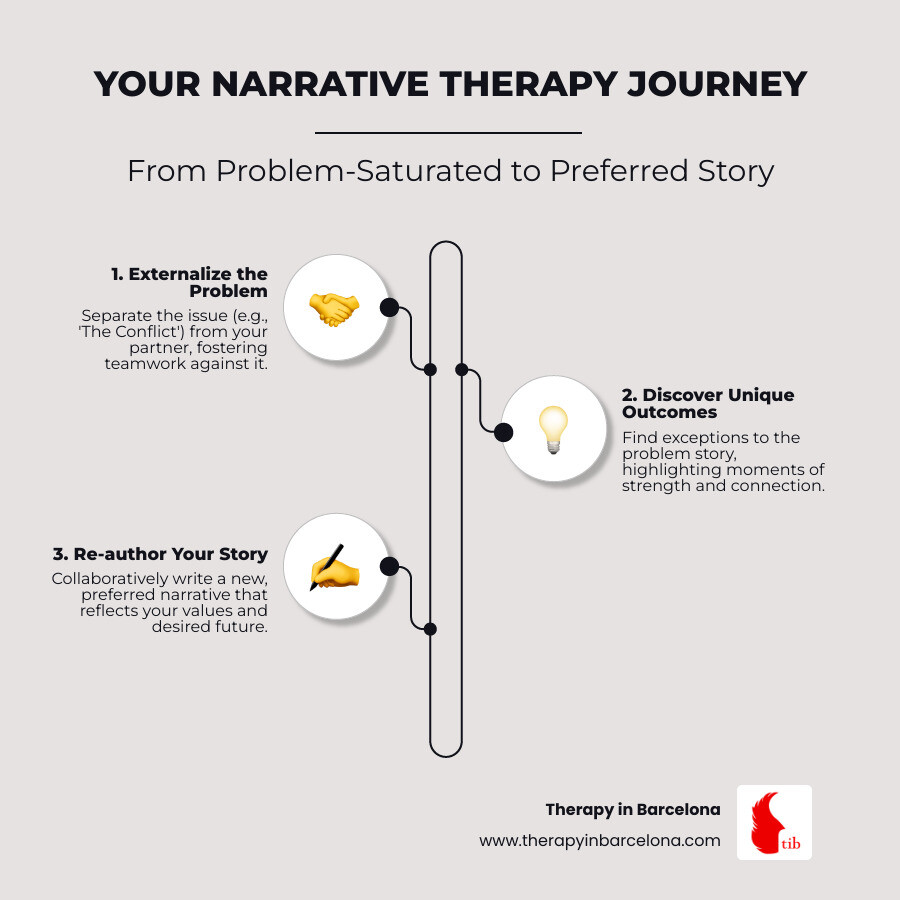
- Deconstructing the problem: This involves understanding how certain issues gained so much power. For instance, you might explore how cultural ideas about gender roles are influencing your ability to connect. This often reveals that relationship problems are responses to external pressures, not personal failures.
- Identifying unique outcomes: Your therapist helps you find evidence of your relationship’s strengths by asking questions like, “Tell me about a time you felt really understood by your partner,” or “When did you last solve a problem together successfully?” These moments prove your relationship holds more than just problems.
- Re-authoring a new narrative: Together, you craft a preferred story for your relationship, built on your shared values, strengths, and hopes. This isn’t wishful thinking; it’s grounded in the real evidence of your unique outcomes.
- Strengthening the new story: You find ways to make your preferred narrative more lasting in daily life. This might mean creating new rituals, sharing your progress with trusted friends, or celebrating moments when you’re living your new story.
The Role of the Therapist
In narrative couples therapy, you are the experts on your relationship. The therapist acts as a curious co-author and respectful partner, asking thoughtful questions to help you see possibilities you might have missed, without imposing their own solutions.
This collaborative approach creates a safe, non-judgemental space where both partners feel heard. For international couples navigating cultural differences or feeling isolated, a therapist who understands the expat experience is invaluable.
At Therapy in Barcelona, our psychology-trained professionals bring this understanding to their work. As many of us are expats, we know how cultural transitions affect relationships. We help you explore how living abroad influences your partnership. Our team of therapists offers diverse specialisations and cultural backgrounds, ensuring you can find someone who gets your experience.
The therapist’s role is to help you externalise problems and find the strengths already in your relationship, facilitating conversations you might struggle to have on your own.
Core Techniques Used in Narrative Couples Therapy

Narrative couples therapy uses practical tools to help partners communicate better, reduce blame, and work together. The techniques may feel unusual at first, as they involve talking about problems as if they are separate entities, but this shift in language can create real change.
Externalising the Problem: You vs. The Issue
A core technique is treating the problem as something separate from you and your partner. Instead of saying, “You’re always jealous,” you might explore, “How is The Jealousy affecting our relationship today?” When you externalise a problem, you stop seeing your partner as the enemy. The Withdrawal becomes something that happens to your relationship, not something your partner does to you. The Misunderstanding becomes a pattern you can both interrupt.
Consider Maria and James, fictional composites representing common expat experiences. Maria, from Madrid, and James, from Canada, argued constantly about social plans. Narrative therapy helped them externalise The Social Pressure as an influence on their relationship. This allowed them to discuss its effects and work together to reduce its power.
Common externalised problems include The Blame Game, The Critic, The Worry, and The Isolation. This approach reduces shame—you are not a jealous person; you are someone whose relationship is being influenced by jealousy. This creates space for compassion and collaboration.
Deconstructing and Finding Unique Outcomes
Once the problem is externalised, the next step is to understand where it came from. This is about curiosity, not blame. How did The Perfectionism gain so much power? What cultural messages feed The Conflict Cycle? For expats in Valencia or Madrid, this can reveal cultural layers, such as how The Homesickness or The Cultural Clash shows up around family or finances.
Just as important is focusing on when problems don’t appear. These moments, or “unique outcomes,” highlight your relationship’s strengths. A therapist might ask, “Tell me about a time The Withdrawal tried to take over, but you stayed connected instead.” These questions reveal skills and resources you may have forgotten, showing your relationship’s natural wisdom.
Re-authoring Conversations and Therapeutic Letters
The final stage involves consciously writing a new story for your relationship through “re-authoring conversations.” These discussions help you articulate the relationship you want, based on your values and hopes. Your therapist might ask, “If The Criticism weren’t in charge, what conversations would you be having?” or “What would your relationship look like if it were guided by your shared values of trust and respect?”
This process helps you become the authors of your preferred narrative. Sometimes, it includes therapeutic letters. Your therapist might write a letter summarising your progress and strengths. Couples might also write letters to each other, committing to their new story, or even “goodbye letters” to old problems. These re-authoring principles are also powerful in individual therapy. If you’re interested in exploring your personal narratives, you can learn more about our individual therapy services.
By changing how you talk about your relationship, you create new possibilities for how you experience it.
Is This Approach Right for You and Your Partner?

Narrative couples therapy offers a different path from traditional relationship counselling. Understanding if it fits your situation can help you move forward with confidence.
Who Can Benefit Most?
This approach is particularly effective for:
- Couples feeling stuck in the same arguments. By externalising “The Recurring Fight,” you can step outside the pattern and find new solutions.
- High-conflict relationships. Narrative therapy helps you redirect energy from fighting each other to fighting the problem together.
- Couples dealing with external pressures. Moving to a new city like Málaga or Alicante, or navigating career changes, are life problems that affect your relationship. This therapy helps you tackle them as a team.
- Intercultural couples. It provides a way to explore how different cultural stories influence your relationship without making either person wrong, weaving your backgrounds into a new, shared narrative.
- Anyone wanting to move past blame. If you are tired of finger-pointing, this approach offers a compassionate alternative that addresses problems without creating villains.
The Goals and Outcomes of Narrative Couples Therapy
Narrative therapy doesn’t aim to “fix” you, because you’re not broken. Instead, it helps you rewrite your relationship story in a way that works for you. Key outcomes include:
- Improved communication: When you’re no longer on the defensive, conversations become explorations rather than accusations.
- Deeper understanding and empathy: Recognising how external forces have shaped your relationship fosters compassion.
- A stronger, more resilient partnership: Facing problems together as a team creates powerful bonds.
- A shared vision for the future: Re-authoring conversations help you define the relationship you want, guided by clear intentions.
- Renewed intimacy and connection: As blame dissolves and stories of strength emerge, emotional walls come down.
The ultimate goal is agency. Narrative couples therapy helps you recognise that your love story isn’t fixed. You are the authors, and you can choose how the next chapter unfolds. That sense of possibility is often what shifts things.
Frequently Asked Questions about Narrative Therapy for Couples
How is narrative therapy different from other couples therapies?
While approaches like Cognitive Behavioural Therapy (CBT) or the Gottman Method focus on changing behaviours and communication patterns, narrative couples therapy looks at the stories couples tell about their relationship challenges. Instead of labelling a relationship as “dysfunctional,” it treats problems as external influences that have taken over the relationship’s story. This is liberating, as it means neither you nor your partner is seen as broken.
Unlike more structured approaches, narrative therapy positions you as the expert on your own life. The therapist is a curious companion who asks thoughtful questions rather than prescribing solutions. The process flows organically through conversation and can complement other methods, such as using story-focused insights alongside techniques from sex therapy to rewrite narratives around intimacy.
How long does narrative couples therapy usually take?
The duration of therapy depends on your specific needs and goals. Narrative couples therapy focuses on progress rather than a fixed timeline. Some couples see meaningful change in 6-12 sessions, especially if dealing with a specific, well-defined issue. Others with more complex histories may choose longer-term work to explore and rewrite several aspects of their relationship story.
You and your therapist decide together when your preferred narrative feels strong enough to sustain itself. For expat couples, the timeline might also depend on how many stories need attention, including those related to cultural adjustment and identity.
Can we do narrative couples therapy online?
Yes, it is highly effective online. Since narrative couples therapy is centred on conversation and storytelling, it translates seamlessly to virtual sessions. You don’t miss out on any core components of the therapy.
Online sessions offer flexibility, which is particularly valuable for expats. Whether you have busy schedules in Barcelona, are living in different locations temporarily, or reside elsewhere in Spain—from Valencia to Madrid or Zaragoza—you can access specialised support without geographical limits.
Therapy in Barcelona offers online therapy to expats worldwide, including the USA and Canada. This allows you to work with therapists who understand both the narrative approach and the unique challenges of expat life, wherever you are.
Your Next Chapter Starts Here

If you feel stuck in old patterns or want to strengthen your connection, narrative couples therapy offers a hopeful path forward. It helps you see that your relationship isn’t broken—it’s just caught in a story that no longer serves you. Real change is possible when you can see the patterns from a different angle.
At Therapy in Barcelona, we understand the challenges of navigating relationships while living abroad. Our team of psychology-trained therapists are expats themselves. We offer services in English, German, French, Spanish, Afrikaans, Portuguese, Swedish, Austrian-German, and Swiss-German.
Since 2011, we have supported internationals across Spain. Whether you’re in Barcelona, Valencia, or Madrid, we understand the complexities you face. Our personalised therapist matching ensures you’re paired with someone who gets your situation and can guide you in rewriting your relationship story.
Our fees for couples therapy in 2026 typically range from €90 to €115, with some sliding scale places available. You can find more details on our fees page.
We offer both face-to-face sessions in our Barcelona office and online sessions worldwide, including the USA and Canada, making culturally sensitive support accessible wherever you are.
Taking the first step can be hard, but you don’t have to do it alone. We invite you to start with a Free Discovery Call—a no-pressure conversation to help us understand your needs and find the right therapist for you.
Your story isn’t finished. The best chapters may be yet to come.
Book your Free Discovery Call with Therapy in Barcelona today.
