


Why Narrative Therapy Works So Well for Adjustment Disorder

Narrative therapy for adjustment disorder helps you rewrite the story of your life transition from victim to hero. Instead of seeing yourself as broken or struggling, you learn to separate your identity from your problems and find the strength you’ve always had.
Quick Answer: How Narrative Therapy Helps Adjustment Disorder
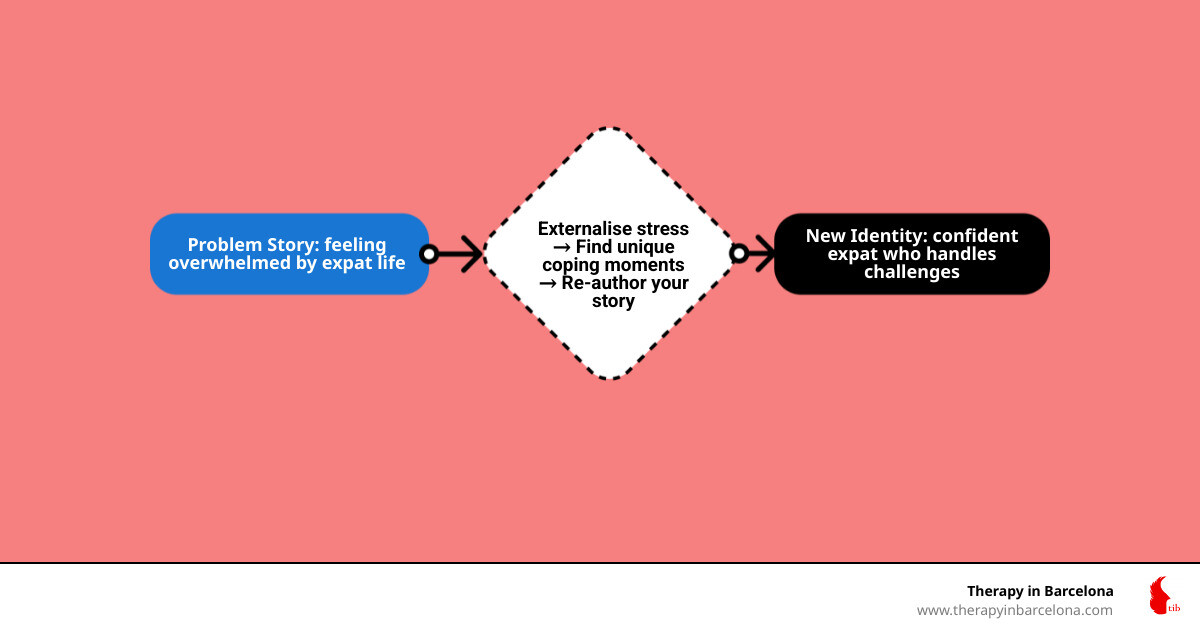
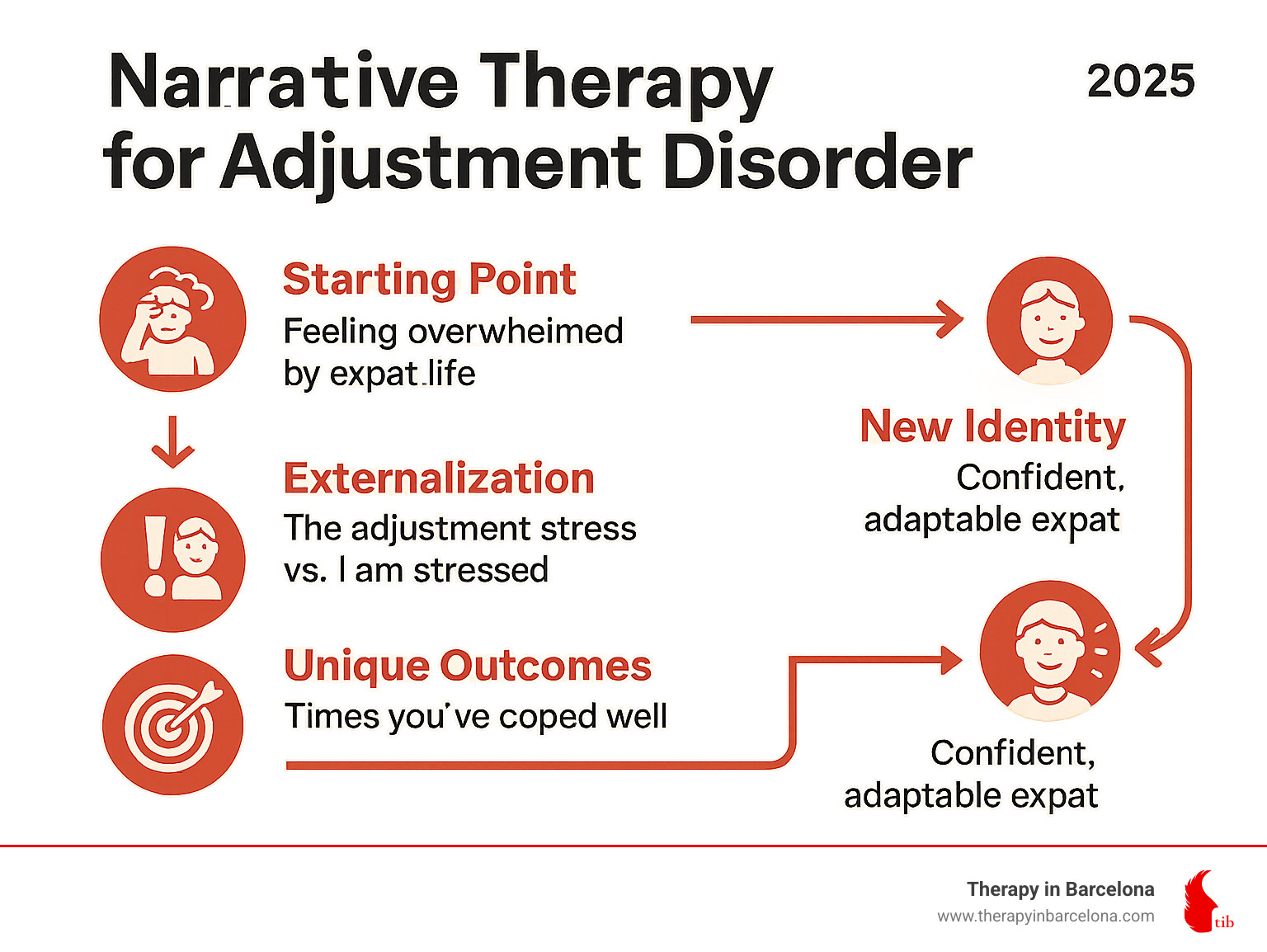
- Externalises the problem: Your adjustment struggles become “the stress” rather than “I’m stressed”
- Finds hidden strengths: Identifies moments when you’ve already coped well with change
- Rewrites your story: Transforms your narrative from “I can’t handle this move” to “I’m learning to thrive abroad”
- Builds agency: Puts you back in control of your life story instead of feeling powerless
- Typically takes 8-12 sessions to see meaningful change
Living abroad can feel like you’re constantly rewriting your identity. One day you’re confident and capable back home, the next you’re struggling to order coffee in Spanish or feeling completely lost in a new culture.
Narrative therapy can help ease the emotional weight of adjustment disorder by helping you separate yourself from the problem and see your strengths more clearly. Rather than centering on what is “wrong,” it focuses on the skills, values, and experiences that can help you move forward.
The beauty of this approach lies in its core belief: the problem is the problem, not you. When you’re struggling with adjustment disorder, you’re not broken—you’re simply dealing with a challenging life transition that needs a new story.
What Exactly Is Adjustment Disorder?
When you’re struggling to settle into life in Barcelona, you might wonder if what you’re experiencing is just normal “moving stress” or something more significant. Adjustment disorder isn’t simply feeling a bit overwhelmed by your new Spanish life—it’s a recognised mental health condition that affects up to 10% of the general population.
According to the DSM-5, adjustment disorder happens when emotional or behavioural symptoms develop in response to a clear stressor within a few months and cause more distress than would usually be expected. For someone who has moved to Barcelona, that might mean feeling unusually overwhelmed by everyday tasks or stuck in ongoing sadness that feels bigger than normal homesickness.
The crucial difference between adjustment disorder and major depression lies in the clear connection to a specific life event—like your big move to Spain—rather than symptoms that seem to arise from nowhere.
| Adjustment Disorder | Major Depression |
|---|---|
| Symptoms linked to specific life change | Symptoms may appear without clear trigger |
| Develops within 6 months of stressor | Timeline varies |
| Often improves as you adapt | May persist without treatment |
| Focused on adjustment challenges | Affects multiple life areas |
Common Signs You Might Recognise
Many expats brush off their struggles as simply “part of the expat experience,” but these symptoms deserve proper attention and support. You might notice persistent sadness or feeling down about your new life, even when things are going relatively well. Excessive worry about your future in Barcelona can consume your thoughts, whilst feeling overwhelmed by daily tasks that never bothered you before becomes frustratingly common.
Sleep issues often creep in—either lying awake worrying about your decisions or feeling exhausted despite getting enough rest. You might find yourself avoiding social activities or work responsibilities, struggling with decision-making in ways that feel completely unlike your usual self.
Physical symptoms like persistent fatigue, headaches, or digestive issues often accompany the emotional struggles, creating a cycle where you feel unwell but can’t pinpoint exactly why.
Why Expats Are Especially Vulnerable
Living abroad creates what researchers call a “perfect storm” for adjustment difficulties. You’re not just changing your postcode—you’re rebuilding your entire support system, navigating unfamiliar cultural expectations, and often managing daily life in a second language.
Leigh Matthews, the Australian psychologist who founded Therapy in Barcelona after her own challenging transition to Spanish life, explains: “When I moved to Barcelona in 2011, I experienced how isolating it can be to steer pregnancy, marriage, and cultural adaptation simultaneously. The lack of English-speaking mental health support made me realise how vulnerable expats really are during these major life transitions.”
Research consistently shows that adjustment disorders are particularly common among people experiencing relocation to a new country combined with language barriers in daily communication. The loss of familiar social and professional networks can leave you feeling untethered, whilst cultural differences in work and social expectations create constant low-level stress.
What makes expats uniquely vulnerable is that you’re often dealing with multiple major life changes simultaneously—new job, new culture, new language, new social circles—all whilst being physically separated from your usual support systems. This combination can overwhelm even the most resilient individuals, making professional support not just helpful, but essential for thriving in your new Spanish trip.
Narrative Therapy 101: Turning Your Story Into a Strength
Imagine if your struggles were not your identity, but problems you could step back from and understand more clearly. That is the heart of narrative therapy, an approach developed in the 1980s by Michael White and David Epston.
Unlike traditional therapy approaches that might ask “What’s wrong with you?”, narrative therapy poses a completely different question: “What’s the story you’ve been telling yourself, and how can we help you write a better one?”
This postmodern approach sees you as the author of your own life, fully capable of rewriting problematic narratives into empowering ones. It’s particularly powerful for expats because it acknowledges that your identity isn’t fixed—it’s something you actively create and can reshape as you steer life abroad.
The approach rests on several core principles that make it especially suited for international life. Respect means you’re viewed as the expert on your own experience—not your therapist, not your family back home, but you. Non-blaming approaches separate problems from your identity, so you’re not “the expat who can’t cope” but rather someone dealing with adjustment challenges.
Cultural sensitivity recognises that your story is shaped by your unique background and current circumstances. When you’re living between cultures, this becomes especially important. Finally, the collaborative nature means you and your therapist work together as co-authors of your new narrative.
Core Techniques That Re-shape Your Narrative
Externalisation is the cornerstone technique that can feel almost magical when you first experience it. Instead of saying “I’m depressed about my move to Barcelona,” you learn to say “Depression is affecting my adjustment to Barcelona.” This subtle shift creates emotional distance and makes the problem feel more manageable—suddenly, you’re not the problem, you’re someone dealing with a problem.
Deconstruction involves breaking down your problem-saturated story into smaller, more manageable pieces. Rather than the overwhelming narrative of “I’m terrible at adapting,” you might explore “What specific situations feel most challenging?” Perhaps it’s navigating Spanish bureaucracy, or feeling left out of colleague conversations, or missing familiar foods. When you break it down, each piece becomes something you can actually address.
Re-authoring helps you identify and develop alternative storylines. You start finding moments when you’ve successfully handled change—maybe you figured out the metro system, had a meaningful conversation with a neighbour, or successfully steerd a challenging work situation. These moments become evidence for a different story about your capabilities.
Unique outcomes are those precious times when the problem didn’t dominate your experience. Perhaps you had a wonderful afternoon exploring a new neighbourhood, or you felt completely at ease during a video call with friends back home. These moments, however small, become building blocks for your preferred narrative.
Therapeutic letters create a tangible record of your journey from struggle to strength. Your therapist might write letters documenting your progress, insights, and the alternative story that’s emerging. These letters become powerful reminders of how far you’ve come.
How Narrative Therapy Builds Hope and Agency
One of the most profound aspects of narrative therapy for adjustment disorder is how it restores your sense of agency. When you’re struggling with adjustment challenges, it’s easy to feel like life is happening to you rather than feeling in control of your story.
Reclaiming your identity becomes possible when you separate yourself from the problem. You’re not “the expat who can’t cope”—you’re someone learning to thrive in a new environment. This shift alone can be transformative, especially when you’re already questioning so much about who you are in this new culture.
Building self-efficacy happens as you start noticing your own strengths, past wins, and ability to adapt. Times when you handled change, solved problems, or got through uncertainty become proof that you are more capable than your stress may suggest. In narrative therapy, those moments help you build confidence, trust yourself more, and feel better equipped to handle this transition.
Values clarification emerges as you explore what matters most to you. Living abroad often forces you to question your priorities and values. Narrative therapy helps you identify which values are truly yours versus those you’ve inherited from family or culture, guiding decision-making in your new life.
The beauty of this approach is that it doesn’t pathologise your struggles. Instead, it honours the complexity of your experience while empowering you to author a story that reflects your strength, resilience, and capacity for growth.
Narrative Therapy for Adjustment Disorder: Step-by-Step Roadmap

Think of narrative therapy as drafting a short book about your relocation. Most expats need around 8–12 weekly sessions to move from the first draft (“I can’t cope”) to the final chapter (“I’m learning to thrive”).
Session Flow at a Glance
- Initial consultation – a short call or intake form so we can match you with the right therapist.
- Sessions 1–2: Telling the story – space to describe what feels hardest about life in Spain.
- Sessions 3–4: Externalising – shifting from “I’m the problem” to “adjustment stress is visiting me”.
- Sessions 5–6: Spotting unique outcomes – collecting examples of when you already coped (mastering the metro, making a new friend, finishing paperwork…).
- Sessions 7–10: Re-authoring – strengthening the preferred story and setting realistic goals.
- Last sessions: Consolidation – reviewing progress, creating a maintenance plan, and receiving a therapeutic letter you can revisit when wobblier days appear.
For details on how this looks specifically for internationals, see our expat therapy services.
Techniques in Action
- Name the problem – “The Critic”, “Mr Homesick”, or whatever fits.
- Re-authoring timelines – visual maps of growth since arrival.
- Narrative letters – concise summaries of wins and insights.
A clinical trial showed narrative groups cut depression scores from 29.69 to 12.23 in ten sessions (see the research). Progress is tracked through:
- How your story about expat life shifts.
- Goal attainment (e.g., speaking Spanish at work, expanding social circles).
- Overall life quality – do mornings feel lighter? Are you exploring the city again?
Does It Really Work? Research & Real-Life Proof
Large reviews confirm narrative approaches create moderate-to-large drops in depression and anxiety. One meta-analysis found effect sizes of –0.51 (depression) and –0.65 (anxiety).
Key findings relevant to expat adjustment:
- Better mood and sleep after 8–10 sessions.
- Increased sense of agency – participants reported “remembering who I am beneath the stress”.
- Gains hold at follow-up, unlike quick wins that fade once medication is stopped.
Consider a common expat experience: arriving in Barcelona and quickly feeling like you’re “failing at expat life.” With focused therapy over several sessions, that story can shift toward confidence, connection, and practical next steps, like joining a Catalan class. Read more in the scientific literature.
How It Compares to CBT or Medication
| Narrative Therapy | CBT | Medication |
|---|---|---|
| Non-pathologising: you’re not the diagnosis | Skill-focused | Symptom-focused |
| Emphasises cultural context | Also effective; sometimes less culture-specific | Helpful for severe symptoms |
| Lasting change without side-effects | Can be combined | May cause side-effects |
Many clients mix methods: CBT tools for panic, short-term medication for sleep, and narrative work for the big picture.
Limitations to Keep in Mind
- Requires some comfort with metaphor; therapists adapt if you prefer concrete tasks.
- Needs commitment over several weeks.
- Quality depends on practitioner training – always choose someone experienced with internationals (all our therapists are expats too).
Crafting Your Personal Treatment Plan

At Therapy in Barcelona, you and your therapist co-author a roadmap rather than follow a rigid manual.
- Clarify the current story – what messages are you telling yourself?
- Define the preferred narrative – how would life look if you saw yourself as adaptable and courageous?
- Pick techniques that fit – timelines, letter-writing, or brief check-ins.
- Set session rhythm – usually weekly at first; spacing out once momentum builds.
When Will I Notice Change?
Small shifts (hope, perspective) often appear within 2–3 sessions. Most expats feel solid progress after 8–12 sessions and sometimes book occasional boosters during later transitions (new job, house move, visa renewal).
Who Benefits Most?
- International students juggling coursework and culture.
- Accompanying partners recalibrating identity.
- Digital nomads craving a coherent story amid constant movement.
- Families helping children settle into new schools.
Our personalised matching ensures you meet someone who “gets” your context from day one.
Frequently Asked Questions about Narrative Therapy for Adjustment Disorder
How quickly will I feel better?
Many clients notice a lighter mood or clearer perspective within a couple of sessions. Sustainable narrative change usually unfolds over 8–12 weeks.
Can I combine it with CBT or medication?
Yes. Narrative therapy plays well with practical CBT tools and, when needed, short-term medication. Your therapist can coordinate with other providers.
Is online therapy as effective?
For storytelling-based work, online sessions are equally effective. They’re ideal if you’re travelling, based elsewhere in Spain, or juggling a tight schedule. We offer both online and in-office options so you can switch when life demands flexibility.
Conclusion
Your story as an expat doesn’t have to be one of constant struggle. Narrative therapy for adjustment disorder offers you something different—a chance to step back from the overwhelming narrative of “I can’t cope with this move” and find the strength that’s been there all along.
Think about it: you’ve already done something incredibly brave by moving to a new country. You’ve steerd airports, paperwork, and probably ordered your first coffee in Spanish (even if it took three attempts). These aren’t small accomplishments—they’re chapters in a story of courage and adaptability.
The journey from feeling lost in Barcelona’s winding streets to seeing yourself as someone who thrives on international trip isn’t always smooth. Some days you’ll feel like you’re back at square one, questioning every decision that brought you here. But here’s what narrative therapy teaches us: those difficult moments aren’t evidence that you’re failing. They’re simply part of a larger story that’s still being written.
When you externalise your adjustment struggles—seeing them as “the stress” rather than “who you are”—something remarkable happens. You stop being the victim of your circumstances and become the author of your own experience. The anxiety about speaking Spanish becomes a temporary visitor, not a permanent resident. The homesickness transforms from an identity into an emotion that will pass.
What makes narrative therapy particularly powerful for expats is how it honours your cultural background while helping you adapt to your new environment. You’re not asked to abandon who you were back home—instead, you’re invited to find who you’re becoming abroad. That’s a story worth telling.
At Therapy in Barcelona, we’ve witnessed countless internationals rewrite their adjustment stories. Our team of psychology-trained therapists understands this journey intimately because we’ve lived it ourselves. We know what it feels like to question whether you made the right choice, to feel invisible in a crowd of locals, to wonder if you’ll ever truly belong.
Founded by Leigh Matthews, an Australian psychologist who moved to Barcelona in 2011, our practice was born from the recognition that expats need more than just therapy—they need therapists who understand the unique challenges of building a life in a foreign country.
Your narrative doesn’t end with confusion and homesickness. It continues with resilience, growth, and perhaps even gratitude for the challenges that helped you find strengths you never knew you had. The person who arrived in Barcelona feeling overwhelmed is the same person who will eventually help other newcomers find their way. That’s not just adaptation—that’s change.
Whether you’re struggling with the daily reality of expat life or simply want to make sense of this major life transition, narrative therapy can help you rewrite your story from one of survival to one of thriving. Because at the end of the day, you’re not just living abroad—you’re creating a life that’s uniquely yours.
Ready to start writing your next chapter? Contact us to and find how narrative therapy can help you transform your adjustment journey into a story of strength, growth, and belonging.
