


Why Family Conflict Cultural Sensitive Therapy Matters

Culturally sensitive family therapy helps families manage disagreements that stem from different cultural values and communication styles. It’s a therapeutic approach that recognises how culture shapes family roles and conflict, adapting to your family’s specific background rather than using a one-size-fits-all model.
This type of therapy addresses:
- Clashes between traditional values and new cultural environments.
- Communication breakdowns rooted in different cultural norms.
- Intergenerational conflicts, especially in expat or immigrant families.
- Stress from family members adapting to a new culture at different paces.
Therapists practice cultural humility, creating space for all perspectives and focusing on finding common ground. Many expat families face challenges as cultural differences shape family dynamics, making it valuable to work with a therapist who understands these complexities.
Cultural differences exist within families, especially when one generation grows up in a different country. In cities like Barcelona, Valencia, or Madrid, where international families build new lives, these tensions can feel overwhelming.
A meta-analysis of 65 studies confirmed that culturally-adapted treatments are more effective than traditional approaches for clients of colour. The key is finding a therapist who actively integrates your culture into the therapeutic process.
The Cultural Fabric of Family Conflict
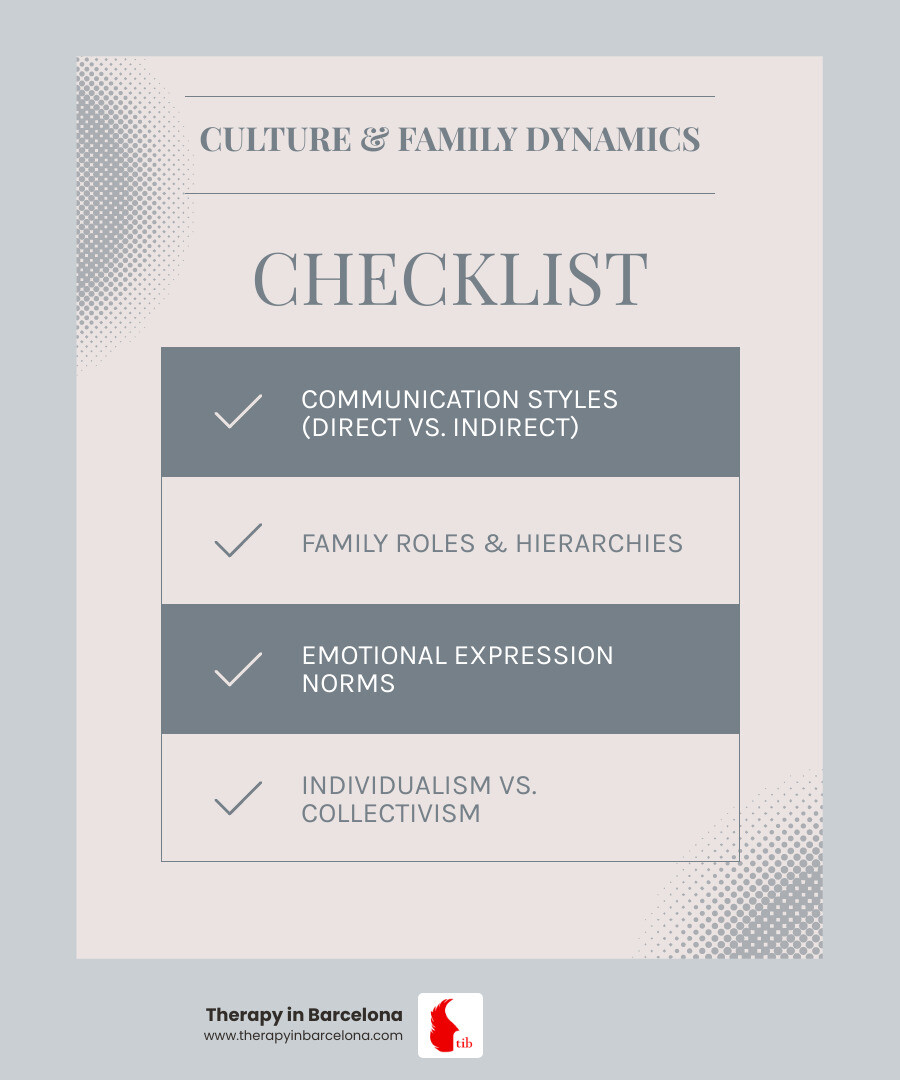
Culture shapes family roles, communication, and emotional expression. When different cultural backgrounds come together, these differences can create misunderstandings and conflict, making cultural awareness an important part of family therapy.
In expat families living in cities like Barcelona, Valencia, or Madrid, these differences can be particularly sharp. Children might quickly adopt the individualistic values of their new home, while parents try to maintain collectivist traditions. These “acculturation gaps” can lead to friction as family members operate from different value systems.
How Cultural Background Influences Family Communication
Our cultural background dictates how we communicate, especially within the family.
- Direct vs. Indirect Communication: Some cultures value saying exactly what you mean, while others prefer hints and non-verbal cues. A direct request from a teenager might seem disrespectful in a culture that values indirectness.
- High-Context vs. Low-Context Cultures: High-context cultures rely on shared understanding and implicit messages. Low-context cultures, common in many Western societies, favour explicit language. Misunderstandings arise when one person assumes shared context and another expects everything to be spelled out.
- Non-Verbal Cues: Gestures, eye contact, and personal space carry different meanings across cultures. What is respectful in one culture might seem aggressive in another.
- Respect for Elders and “Saving Face”: Many cultures emphasise respecting elders and avoiding public confrontation to “save face.” This can lead to unspoken resentments if disagreements are not handled sensitively.

Individualism vs. Collectivism: A Core Tension
One of the most fundamental cultural differences is the spectrum between individualism and collectivism.
- Individualism: These cultures focus on personal achievement, independence, and self-reliance. Personal goals often take precedence over group needs.
- Collectivism: These cultures emphasise group harmony, interdependence, and loyalty to the family. Family obligations and the group’s reputation are paramount.
This tension is common in expat families. A teenager in Barcelona might accept individualistic values like personal choice, while their parents from a collectivist background expect them to prioritise family duties. This can cause conflict over careers, relationships, and daily routines.
Research shows that clients from collectivist cultures may prefer a more directive therapist, while those from individualistic cultures often want a more collaborative relationship. A culturally sensitive therapist understands this and adapts their approach to build rapport and avoid misunderstandings.
Core Principles of Culturally Sensitive Therapy
Culturally sensitive therapy integrates an understanding of diverse backgrounds into treatment, respecting the unique identity of each family member. Its core principles include:
- Cultural Humility: A therapist’s commitment to self-reflection and lifelong learning, approaching different cultures with openness and respect.
- Therapist Self-Awareness: Examining one’s own cultural background and biases to understand how they might influence therapy.
- Respecting Diverse Values: Honouring a family’s beliefs and traditions, acknowledging there is no single “right” way to live.
- Collaborative Goal-Setting: Co-creating goals with the family that align with their cultural values.
- Flexibility: Adapting therapeutic methods and communication styles to fit the family’s context.
The American Psychological Association (APA) provides guidelines on culturally sensitive care, stressing that effective support must be rooted in cultural understanding.
How Therapists Adapt Their Approach for Diverse Families
A therapist must adapt their approach to each family’s specific cultural context. Here’s how:
- Adapting Communication: Adjusting their level of directness and formality to align with the family’s norms, sometimes taking a more directive role and other times a more collaborative one.
- Integrating Cultural Beliefs: Incorporating a family’s spiritual or cultural practices into therapy where appropriate.
- Modifying Therapy Models: Adapting evidence-based therapies like Cognitive Behavioural Therapy (CBT) to be culturally respectful. For instance, exploring the function of a belief within a cultural framework rather than challenging it directly.
- Understanding Family Structures: Recognising and respecting different family hierarchies and the roles of extended family, who can be crucial in many cultures.
- Involving Community Leaders: In some cultures, collaborating with elders or community leaders can reinforce treatment goals.
Building Trust and Rapport Across Cultures
Building trust is the foundation of effective therapy, especially across cultures. A therapist’s ability to connect genuinely is essential. Key elements include:
- Active Listening and Curiosity: Listening for cultural context and showing sincere curiosity about a family’s background and values.
- Acknowledging Power Dynamics: Being aware of societal power imbalances and addressing them openly to foster a more trusting environment.
- Using Inclusive Language: Employing respectful, non-judgemental language to create a safe space.
- Therapist Credibility: A therapist’s cultural competence and humility are crucial for building credibility and a strong therapeutic alliance, which studies show is vital for positive outcomes.
- Creating a Safe Space: Validating a family’s experiences, including any discrimination, helps them feel understood and more willing to engage in therapy.
Challenges and Benefits in Culturally Sensitive Family Therapy
While culturally sensitive family therapy offers a path to healing, families can face certain problems. However, the benefits of a custom approach often lead to more profound and lasting change.

Common Challenges for Families
Families from diverse cultural backgrounds may encounter specific problems when seeking therapy:
- Mental Health Stigma: In many cultures, seeking therapy is seen as a sign of weakness or shame. Research shows this stigma is a major barrier, with some preferring traditional healers.
- Language Barriers: Even with multilingual services, nuances can be lost in translation, affecting communication.
- Mistrust of Western Models: Some families may view Western therapy as incompatible with their values or as an imposition of foreign ideas.
- Logistical Issues: The cost of private therapy, transport, and scheduling can be significant barriers, though online therapy helps with access.
- Fear of Judgement: Families may worry a therapist won’t understand or will judge their cultural traditions, preventing open communication.
The Benefits of a Culturally-Informed Approach
Despite the challenges, the rewards of this approach are substantial:
- Stronger Therapeutic Alliance: A therapist’s respect for a family’s culture builds trust, a key predictor of positive outcomes.
- Increased Engagement: When family members feel understood within their cultural context, they are more likely to participate actively.
- More Effective Solutions: A meta-analysis of 65 studies found that culturally-adapted treatments are more effective. Solutions that align with a family’s values are more likely to be sustained.
- Validation of Cultural Identity: Therapy becomes a space where cultural identity is seen as a source of strength, reducing internal conflict.
- Reduced Isolation: Addressing identity-related stress helps lessen the isolation often felt by families from non-dominant cultures.
- Improved Family Harmony: By learning to manage cultural differences, families can communicate more effectively and find common ground.
Practical Strategies and Models That Work
Effective culturally sensitive family therapy uses specific strategies to integrate cultural understanding into the therapeutic process.
A Deeper Look at Multisystemic Therapy (MST)
Multisystemic Therapy (MST) is an evidence-based model for young people with serious behavioural challenges. It takes a holistic view, understanding that a young person is influenced by their entire environment: family, school, and community.
Therapists work directly in the family’s home and community, empowering parents with skills to address problems in their natural environment. MST is highly adaptable, respecting a family’s unique values and structures. Therapists receive extensive training to manage cultural differences and engage caregivers as active partners, which is crucial for long-term change.
Case Study: The Silva Family in Barcelona
In multicultural families, children and parents may adapt to a new culture at different speeds, leading to conflict over values, family roles, friendships, or expectations. Therapy helps families understand these differences and strengthen communication.
A culturally sensitive therapist helps family members explore differing cultural expectations without taking sides. By validating each person’s perspective and finding practical compromises, therapy strengthens communication, builds mutual understanding, and helps families find common ground.
Questions to Ask a Potential Family Therapist:
Finding the right therapist is key. Here are some questions to ask:
- How do you incorporate cultural understanding into your practice?
- What is your experience with families from our cultural background(s)?
- How do you handle cultural differences in communication and family roles?
- How do you address issues of acculturation and identity?
- Can you give an example of how you’ve adapted your approach for a family?
- What is your training in multicultural therapy?
- Do you offer therapy in other languages?
Overcoming Barriers to Accessing Therapy
Accessing culturally sensitive therapy can be challenging, but there are ways to overcome problems:
- Find a Therapist: You can access therapy through the Spanish public health system, online platforms, or specialist private practices. While public services and large platforms offer convenience, specialist practices like Therapy in Barcelona provide personalised therapist matching, strong privacy, and culturally sensitive care.
- Use Online Therapy: Online therapy removes geographical barriers, which is especially helpful for expat families in Spain, whether in Barcelona, Madrid, Malaga, Valencia, or Gran Canaria.
- Assess the Fit: Use initial consultations to see if a therapist is right for you. Therapy in Barcelona offers a Free Discovery Call for this purpose, allowing you to ask questions and discuss your concerns before committing.
- Address Stigma and Access: Culturally sensitive therapists work to normalise seeking support. Models like MST also counter access issues by delivering services directly in the home, and online therapy makes support available regardless of location.
Finding the Right Support for Your Family
Recognising your family needs support is the first step. It’s important to know your options to make an informed choice.
Comparing Your Therapy Options
When seeking culturally sensitive family therapy in Spain, you have a few paths:
- Public Health System: This option is often low-cost or free but may have long waiting lists and less specialised training in cultural sensitivity for expats.
- Large Online Platforms: These offer convenience but can feel impersonal, with variable quality, less rigorous therapist matching, and potential data privacy concerns.
- Specialist Private Practices: Specialist private practices like Therapy in Barcelona offer personalised, culturally aware care for the international community. With bespoke therapist matching, strict privacy, and therapists who understand the expat experience, they provide specialised support tailored to your needs.
Founded by Australian psychologist Leigh Matthews, Therapy in Barcelona offers culturally sensitive therapy for adults, couples, teens, and families, with online sessions worldwide and in-person therapy in Barcelona.
Cultural differences can enrich family life but also create conflict. Culturally sensitive family therapy provides a safe space where every family member’s perspective is respected and understood.
This specialised therapy helps families resolve conflicts, celebrate their unique identities, and strengthen their bonds by getting to the cultural roots of an issue. It fosters deeper understanding, harmony, and lasting resilience.
If your family is working through these issues and you’d like support, book a Free Discovery Call to start your journey with Therapy in Barcelona.
Our international team of psychology-trained therapists, who are expats themselves, offer in-person sessions in Barcelona and online therapy worldwide, including in the USA and Canada. We are here to provide the culturally sensitive care your family deserves.
