


Why Young Adulthood Feels Like Such a Complex Transition

Therapy for young adults addresses one of life’s most challenging transitions: the shift from adolescence to full independence. If you’re feeling overwhelmed by career decisions, relationship changes, or simply figuring out who you are, you’re not alone.
Quick guide to therapy for young adults:
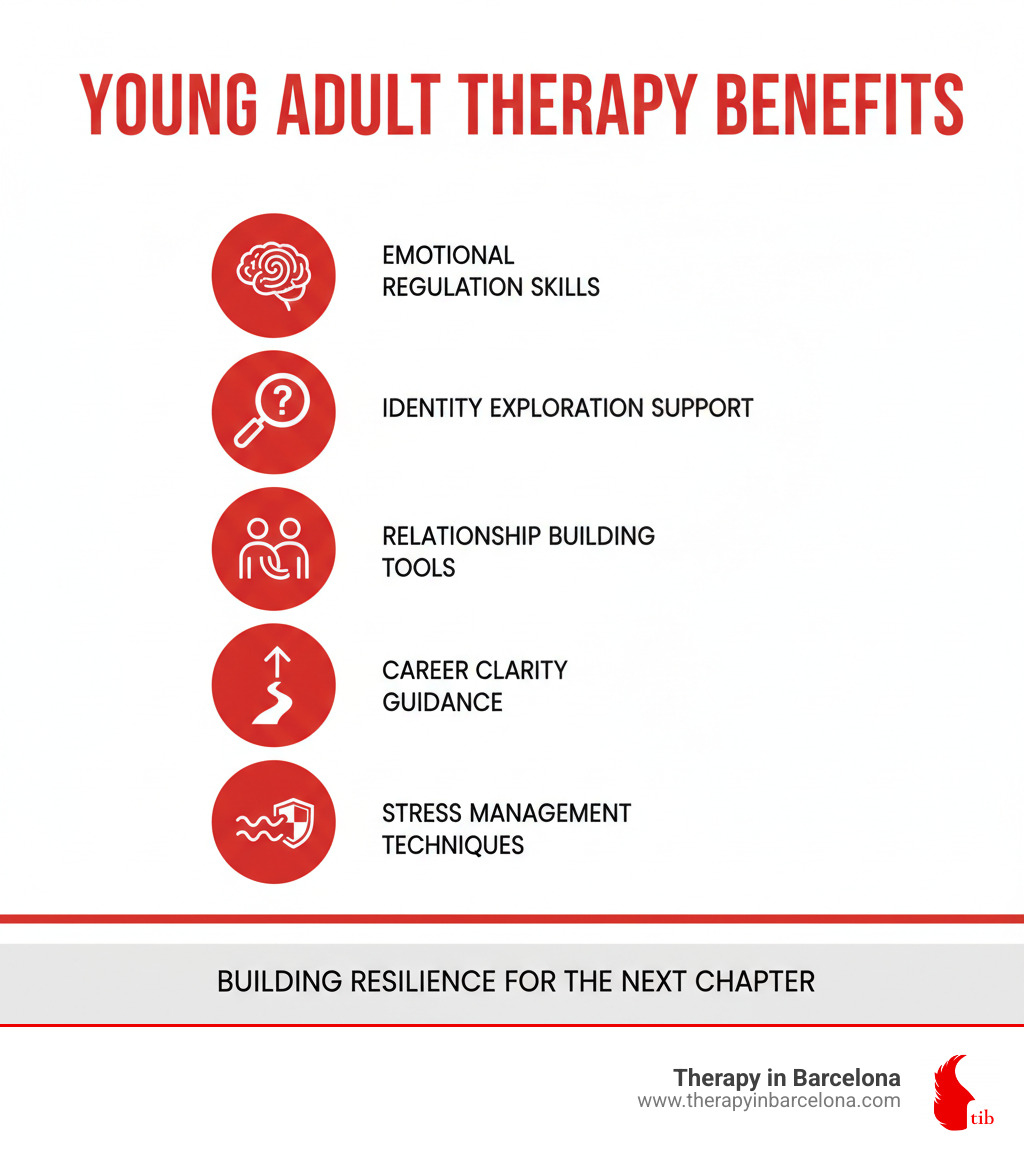
- What it helps with: Identity exploration, career anxiety, relationship skills, emotional regulation, and life transitions.
- Common approaches: CBT for managing anxious feelings, ACT for values-based living, and mindfulness for stress.
- What to expect: A safe space to explore your thoughts, practical coping tools, and support for personal growth.
- How to find help: Look for therapists experienced with young adult challenges and consider cultural fit if you’re an expat.
- Cost: This is typically a private-pay service, though some therapists offer sliding-scale fees.
Young adulthood brings unique pressures, from sorting out your career and relationships to facing an uncertain economic future. With added global challenges like climate anxiety and social media comparison, it’s no wonder this stage can feel overwhelming.
Research shows that more young adults struggle with their mental health than other age groups, yet they are often the least likely to seek support. This gap matters because the coping skills you build now can set the foundation for decades to come.
For expats living in cities like Barcelona, Valencia, or Madrid, these challenges intensify. You’re not just figuring out adulthood; you’re doing it in a new culture, possibly in a different language, and often without your usual support network. The isolation can feel profound.
Whether you’re questioning your career path, struggling with loneliness, or simply want to understand yourself better, therapy offers practical tools and genuine support. It’s not about having something “wrong” with you—it’s about building resilience for whatever comes next.
Why This Chapter of Life Can Feel So Overwhelming
Your twenties and early thirties can feel overwhelming. This period, from ages 18 to 30, is one of life’s most demanding transitions, and you’re not alone in feeling this way.
The science backs this up. Your brain’s executive functions—the tools for emotional self-regulation and complex decision-making—don’t fully mature until your mid-twenties. You’re essentially handling intense emotional landscapes while your brain is still developing the equipment to manage them. It’s like trying to drive through a storm with windscreen wipers that haven’t been installed yet.
Beyond this, external pressures are relentless. You might be facing academic stress, the daunting pursuit of financial independence in a tough economy, and a shifting social world where friendships fade and loneliness creeps in. Imposter syndrome—that feeling you’re not qualified for the life you’re building—and global concerns like climate anxiety add to the weight.
Therapy for young adults recognises these aren’t individual failings but universal challenges of this life stage. You’re not broken for struggling; you’re human.

The Pressure to Have It All Figured Out
Society sends a clear message: by your early twenties, you should have your life mapped out. Career milestones and relationship expectations loom large, with pressure to choose the “right” path on a predetermined timeline. Social media amplifies this by showing everyone else’s curated highlight reel, making your reality feel inadequate. This comparison culture creates a constant fear of failure, making every decision feel monumental. The truth is, most successful people changed direction multiple times, but you rarely see those messy middle chapters on Instagram.
The Unique Stressors for Young Adult Expats
If you’re a young adult living abroad—whether in Barcelona, Madrid, Málaga, or anywhere else—these challenges intensify. You’re not just figuring out who you are; you’re doing it while adapting to a new culture, often in a different language and without your usual support system.
Language barriers can be isolating when you can’t express complex emotions, and homesickness can hit unexpectedly. Building a new support system from scratch takes energy you might not have, especially across cultural differences.
At Therapy in Barcelona, we understand these layered challenges. Our psychology-trained therapists are expats themselves, so they’ve lived through the disorientation of building a life in a new country. This shared experience creates a foundation of understanding that goes beyond professional training—we genuinely know what it feels like to feel lonely in a room full of people speaking your second language.
How Therapy for Young Adults Provides Essential Support
The challenges of young adulthood don’t have to be faced alone. Therapy for young adults offers a dedicated space to process these intense experiences, develop crucial coping skills, and build resilience. It’s about personal growth, self-discovery, and enhancing your mental wellbeing. When life feels like an uphill climb, therapy can equip you with the tools to steer the terrain more confidently.
One study of 239 university students found that those better able to regulate their emotions reported higher levels of well-being. This highlights the profound impact that developing emotional skills can have on your daily life. Therapy provides a structured environment to cultivate these skills, whether through our individual therapy services or other approaches.
Developing Self-Awareness and Emotional Regulation
Emotional regulation is the ability to manage difficult emotions thoughtfully, rather than letting them control your actions. In therapy, you learn to identify your emotional triggers, helping you respond with less reactivity. This isn’t about suppressing feelings—it’s about understanding them and choosing how to react.
This goes hand-in-hand with self-awareness: the capacity to observe yourself without judgement. You might learn mindfulness techniques to stay present with your thoughts and feelings without getting swept away. Crucially, therapy also fosters self-compassion. Research, including a major review of multiple studies, shows self-compassion is directly associated with better mental health, helping to reduce feelings of anxiety and low mood and the likelihood of substance use. It teaches you to treat yourself with kindness, a powerful antidote to the harsh self-criticism many young adults experience.
Building Healthier Relationships and Boundaries
Young adulthood is a prime time for redefining relationships. Therapy can be instrumental in improving communication skills, helping you articulate your needs effectively. It also provides a space to explore your attachment patterns—how you connect with others—and how they might be influencing your current relationships.
Learning to handle conflict constructively and set healthy boundaries are vital skills. Whether with peers, partners, or family, clearly communicating your limits is essential for mutual respect. For many young adults, especially those living abroad, these conversations can be challenging. Therapy offers strategies to approach them with confidence.
If you’re looking to strengthen your romantic relationship, our couples counselling in Barcelona can provide additional support.
The role of therapy for young adults in career and identity
Young adulthood is a time of identity exploration. Who are you? What do you believe in? Therapy provides a safe space to dig into these questions. It helps you clarify your values, which then act as a compass for decisions about your career and life.
Career development is a source of intense anxiety for many. Therapy can help you manage these feelings, explore potential paths, and set meaningful goals. It also addresses imposter syndrome, helping you recognise your strengths instead of constantly doubting yourself. By fostering self-acceptance, therapy empowers you to pursue a path that genuinely aligns with who you are.
What to Expect When You Start Your Therapy Journey
Starting therapy for young adults can feel unfamiliar, but knowing what to expect can ease any initial nerves. Your journey begins before the first session, with a conversation about what brought you here and what you hope to change.
Most practices, including ours, begin with a Free Discovery Call or an intake form. This initial step is crucial for matching you with a therapist who fits your personality and goals, ensuring a personalised approach from the start.
During your first session, you’ll begin building the “therapeutic relationship.” This is about creating a space where you can be honest without fear of judgement. Your therapist will likely ask about your background and current challenges. It’s a collaboration from day one—you are an active participant in your own growth.
Confidentiality is the backbone of this process. What you share stays between you and your therapist, with very limited exceptions (like immediate risk of harm), which your therapist will explain clearly.
You’ll also decide between online therapy and in-person sessions. Online offers flexibility, while in-person can feel more connected. Neither is better; it’s about what works for you.
Different therapeutic approaches are available. Cognitive Behavioural Therapy (CBT) helps shift unhelpful thinking patterns. Acceptance and Commitment Therapy (ACT) focuses on accepting difficult feelings while committing to value-driven actions. Psychodynamic therapy explores how past experiences influence your present.
Our therapists are trained in diverse approaches like CBT, ACT, Psychodynamic Therapy, and Internal Family Systems (IFS). This variety ensures your therapy is personalised, not a one-size-fits-all solution.

What to expect from therapy for young adults
Therapy should feel like a sanctuary—a place to speak freely without being judged. Your therapist is a skilled listener who helps you find your own insights, not someone who tells you what to do. You’ll work together to set meaningful goals and learn practical tools that extend far beyond your sessions. This personalised support means the strategies you develop are custom to your life, not generic advice from a book.
How to Prepare for Your First Session
Preparing for your first session is simple. Thinking about what you hope to achieve can be helpful, even if your goal is as broad as “feeling less overwhelmed.” Being open and honest is crucial, but trust builds over time, so start with what feels manageable. Don’t hesitate to ask questions about the therapist’s approach or the process. Therapy is a process, not a quick fix. Progress isn’t always linear, and that’s okay.
If you’re a young person ready to take this step, our adolescent intake form or adult intake form (if you are above 18 years old) can help you get started. The form helps us understand your situation so we can match you with the right therapist.
Finding the Right Therapist for You
The relationship with your therapist is the most important factor in successful therapy for young adults. It’s not just about credentials; it’s about finding someone you feel safe with, who truly gets you and your struggles.
Think about what matters to you. Are you an expat in Barcelona or Valencia? Do you need someone who understands the pressures of being a young adult today—the career anxiety, identity questions, or relationship confusion? Finding a therapist with experience in your particular challenges makes all the difference.
Therapy for young adults is typically a private-pay service. This is an investment in your future self, and the skills you gain will serve you for decades. Some therapists offer sliding-scale fees for financial hardship, so it’s always worth asking.

Comparing Your Options: Public Health vs. Private Practice
When seeking support, you have a few options.
Public health systems offer low-cost services but often have long waiting lists, limited choice of therapists, and rushed sessions. For expats, language barriers can add another layer of stress.
Large online therapy platforms offer convenience but can have data privacy issues and an overwhelming, impersonal matching process. It can be hard to find a genuine fit when you feel like just another number.
Private practices like Therapy in Barcelona offer a different experience. We focus on personalised care, taking time to understand your needs to find the right therapist. We maintain strict client privacy and never sell data. This approach is especially valuable for specialised support. We’re a group practice of highly qualified, psychology-trained therapists who work with adults, couples, teens and families, and we collaborate to ensure high-quality care. We’ve been trusted in Spain since 2011.
The Importance of a Culturally-Sensitive Approach for Expats
For young adults living abroad—whether in Madrid, Málaga, or Alicante—a therapist who understands your experience is essential. When your therapist has walked a similar path, they get the subtle challenges: handling bureaucracy in a foreign language, missing home, or feeling caught between cultures.
At Therapy in Barcelona, our team is made up of expat therapists who have lived these experiences. This shared experience creates a foundation of understanding that goes beyond professional training. We offer sessions in English, and some of our therapists also speak German, French, Spanish, Afrikaans, Portuguese, Swedish, Austrian-German and Swiss-German, so you can express yourself in the language that feels most natural.
This cultural sensitivity extends beyond language. We understand the dynamics of intercultural relationships and the identity questions that arise when living between cultures. This nuanced understanding improves the therapeutic relationship and helps you move toward healing and growth.
Frequently Asked Questions About Therapy for Young Adults
How long does therapy for young adults usually take?
The duration of therapy is unique to each person. Some find short-term therapy (8-12 sessions) is enough for specific challenges, like exam anxiety, while others benefit from longer-term support for deeper work. The length depends on your goals and is a collaborative decision you’ll make with your therapist. Therapy is a process of building emotional resilience, not a quick fix.
Is what I talk about in therapy confidential?
Yes, confidentiality is fundamental. What you share is protected by legal and ethical obligations, creating a safe space for you to be open without fear of exposure. There are rare exceptions, such as immediate risk of serious harm to yourself or others, or cases involving child abuse. Your therapist will explain these boundaries clearly in your first session so you know exactly where you stand.
Can therapy help even if I don’t have a diagnosed mental health condition?
Absolutely. You don’t need a diagnosis to benefit from therapy. Many young adults come for personal growth, stress management, or self-exploration. Think of it as preventive care for your mental health. Therapy for young adults often focuses on building resilience before challenges become overwhelming by teaching skills for managing stress, setting boundaries, or gaining clarity on your goals. It’s about proactively investing in your well-being, not waiting for a crisis. Many of our clients at Therapy in Barcelona come to us to make the most of this transformative period in their lives.
Taking the Next Step on Your Journey
Young adulthood is a time of immense potential and significant challenge. The uncertainty, pressure, and constant questioning are all part of a complex but transformative process.
Therapy for young adults isn’t just about fixing problems; it’s about investing in your future self. It’s about building a strong foundation for the decades ahead, equipping yourself with the emotional tools and self-awareness to handle life’s twists and turns with resilience and confidence.
Seeking support now is powerful. As your brain is still developing its executive functions, the skills you learn can become deeply integrated. You’re not just surviving this period—you’re actively shaping the adult you want to be.
At Therapy in Barcelona, we understand this journey because we’ve lived it. Our expat-focused team of psychology-trained therapists brings both professional expertise and personal experience to every session. We know what it’s like to build a life in a new place, whether in Barcelona, Valencia, Madrid, or Málaga.
What sets us apart is our commitment to personalised matching. We don’t just pair you with the next available therapist. We take time to understand your specific needs, cultural background, and goals to connect you with someone who truly gets your experience. This matters enormously, whether you’re a digital nomad in Marbella or an international student in Zaragoza.

We offer both online therapy sessions available worldwide (including the USA and Canada) and in-person sessions at our welcoming office in Barcelona. This flexibility means you can access support in a way that works for you.
The journey ahead is yours, but you don’t have to walk it alone. If you’d like support, book a Free Discovery Call. It’s a simple conversation, not a commitment, to explore how therapy for young adults can support you.
