


When ‘Living the Dream’ Feels Anything But: Online Digital Nomad Mental Health Explained

Digital nomad mental health is a growing concern that rarely makes it into Instagram captions. If you are wondering whether what you are feeling is normal—or what you can do about it—here is a quick answer:
The most common mental health challenges digital nomads face — and what helps:
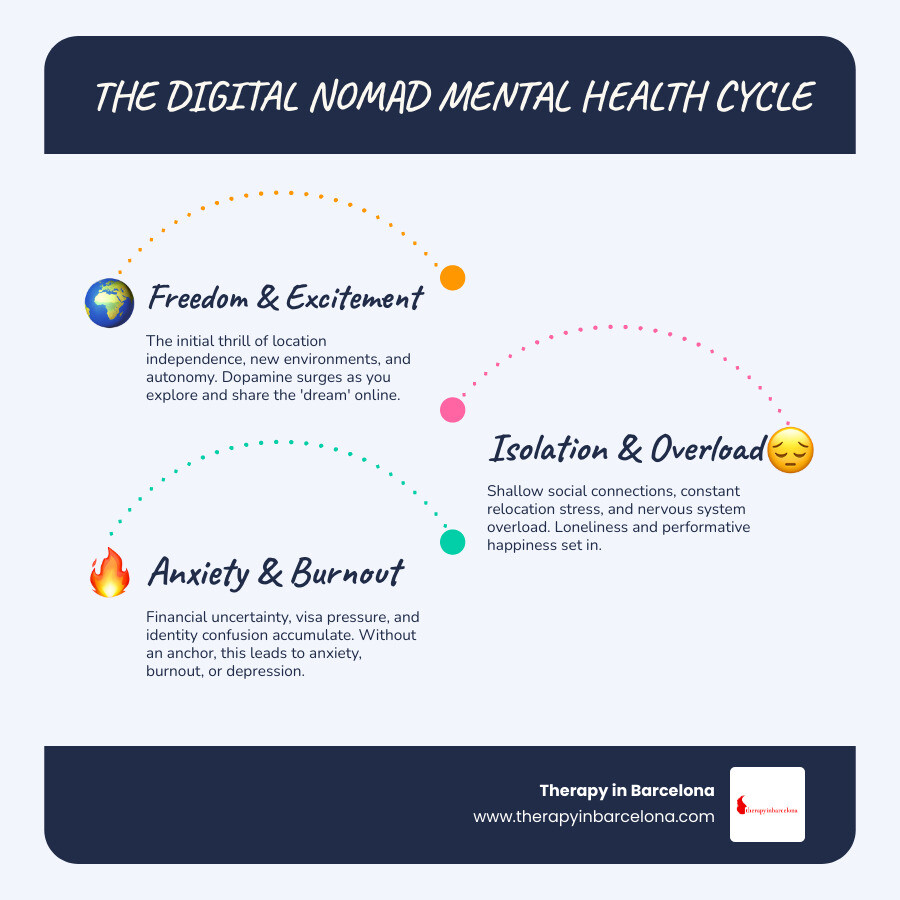
- Loneliness and isolation — not from lack of people, but from lack of continuity. Online therapy with a consistent therapist can provide a stable relational anchor.
- Feelings of anxiety and burnout — driven by financial uncertainty, visa stress, and the pressure to keep moving. Evidence-based approaches like CBT and ACT help build coping strategies.
- Identity confusion — losing a sense of self when your social circle resets every few months. Narrative and Gestalt therapy can help you rebuild a coherent sense of who you are.
- Nervous system overload — constant new environments keep your body in a low-grade state of alert. Somatic and nervous system-aware therapy addresses this directly.
- Performative happiness — the pressure to appear thriving online while struggling offline. A private, confidential therapeutic space gives you room to be honest.
The most practical solution: Find a specialist online therapist with real expat or nomad experience before the struggles escalate. Look for someone who offers time-zone flexibility, continuity of care across borders, and genuine cultural sensitivity.
Take a fictional composite example that reflects common expat challenges. Originally from the UK, this digital nomad has spent two years working remotely while moving between Valencia, Lisbon, and the Canary Islands.
Social media shows rooftop co-working spaces, golden-hour beaches, and freedom. The reality is loneliness, a lack of deep connection, and a growing sense of emotional flatness that is easy to dismiss as tiredness.
It is not tiredness.
With 35 million digital nomads worldwide — a number projected to reach one billion by 2035 — the mental health pressures of location-independent life are becoming impossible to ignore. The lifestyle is real, the freedom is real, and the psychological cost is equally real.
Persistent worry and stress affect many adults at some point in their lives, and the specific pressures of nomadic life — rootlessness, shallow connections, constant administrative pressure — create fertile ground for these struggles to take hold.
This guide cuts through the romanticised version of nomad life to look honestly at what is actually happening underneath, and what genuinely helps.
The Freedom Paradox: Why the Dream Lifestyle Can Feel Heavy
The digital nomad lifestyle is built on the promise of absolute autonomy. You choose your hours, your climate, and your view. But this absolute lack of constraints often gives rise to the “freedom paradox.”
When you can go anywhere, deciding where to go next starts to feel like a high-stakes gamble. The absence of a fixed routine or structure can lead to choice paralysis and a deep sense of restlessness, rather than the liberation you expected.
Living in “borrowed environments” — hotel rooms, short-term Airbnbs, and co-living spaces — can subtly erode your mental well-being. When nothing in your physical space belongs to you, it is easy to lose a sense of agency.
This lack of control over your immediate surroundings can trigger procrastination, helplessness, and a feeling of being a permanent guest in your own life.
Compounding this is the continuous background noise of administrative stress. Securing a reliable internet connection, dealing with foreign authorities, registering for local taxes, and managing visa requirements — such as navigating Spain’s Digital Nomad Visa — act as persistent, low-grade stressors.
This ongoing administrative load disrupts your emotional balance, turning what should be a relaxing evening into a cycle of worry.
When these external pressures build up, they often trigger a deeper sense of guilt. You look around at a stunning beach in Málaga or a vibrant street in Sevilla and think, “I am in paradise, why am I not happy?”
This mismatch between your beautiful physical surroundings and your internal emotional state often leads to secondary guilt. You end up shaming yourself for struggling, which only deepens the emotional weight. Understanding that these feelings are a natural response to a highly unstable lifestyle is the first step toward reclaiming your well-being.
For a deeper look at these dynamics, read our guide on Wanderlust Wellness: Navigating Digital Nomad Mental Health.
The Psychological Toll of Constant Relocation
The human nervous system is wired to seek safety in the familiar. When you are constantly changing locations, your brain has to work overtime to process new sights, sounds, cultural norms, and languages.
This constant adaptation keeps your nervous system in a low-grade, chronic state of alert. Over time, this leads to nervous system overload, manifesting as physical fatigue, mental fog, and unexplainable irritability.
This chronic rootlessness makes it difficult to establish a psychological baseline. Without a physical “home” to return to, your body remains primed for stress. When you combine this with culture shock fatigue — the mental exhaustion of constantly trying to decode local customs, buy groceries in a foreign language, and navigate unfamiliar transport systems — burnout is often close behind.
This is a common reality for those staying in highly popular hubs. While the scenery is beautiful, the internal pressure of living without a stable physical container can quickly catch up with you. To understand how this plays out in popular destinations, explore what it is really like to look Beyond the Beaches: What It’s Really Like to Be a Digital Nomad in Gran Canaria.
Loneliness vs. Relational Continuity
For digital nomads, loneliness is often not about quantity, but continuity. You may meet many people, but meaningful connection comes from relationships with people who know your history and see you grow over time.
Without this continuity, you experience shallow connections. You find yourself repeating the same introductory conversations over and over again: Where are you from? What do you do? How long are you staying?
This repetitive social pattern can lead to identity diffusion. When no one around you shares your past or understands your context, you may begin to feel invisible, as if your identity is dissolving.
In some cases, this profound lack of grounding can leave you feeling completely detached from your surroundings. You might feel as though you are watching your life from behind a sheet of glass, or that the vibrant streets around you are flat and artificial.
It is easy to mistake this deep sense of disconnection for mere travel fatigue or jet lag, which often delays people from seeking the support they need.
Therapy offers a crucial space to address these feelings before they turn into a deeper, more persistent low mood. You can explore 12 Compelling Reasons Internationals and Digital Nomads Should Consider Therapy to see how professional support can help you rebuild your relational roots.
Navigating Your Options: Online Digital Nomad Mental Health Support
When you realise you need support, finding the right avenue while moving across borders can feel overwhelming. Traditional, location-dependent therapy is rarely practical for highly mobile individuals. Fortunately, online therapy has evolved to bridge this gap, offering a consistent space that travels with you.

To understand how to build this support system, read our guide on Digital Nomad Counseling for the Location-Independent Soul and learn how Online Mental Health Therapy: Your Couch is the New Therapist’s Office can simplify your search.
Comparing Public Systems, Large Platforms, and Private Practices
To find the right support, it is helpful to look at how different mental health avenues compare.
Public Healthcare Systems:
- The Reality: Most local public healthcare systems are designed for permanent residents. They often involve long waiting lists, complex administrative requirements, and a lack of English-speaking clinicians.
- The Limitation: Even if you can access care in a hub like Barcelona or Valencia, local public systems cannot support you when you cross international borders, meaning you lose your therapist the moment you move on.
Large Subscription-Based Platforms:
- The Reality: These highly advertised platforms offer quick sign-ups and low initial costs.
The Limitation: High-volume platforms can lead to therapist burnout, frequent turnover, and repeated loss of trust. Some also raise concerns about data privacy.
Specialised Private-Pay Practices:
- The Reality: Practices like Therapy in Barcelona focus specifically on expats, internationals, and digital nomads.
- The Advantage: We personally match you with qualified, psychology-trained expat therapists, ensuring strict privacy and no data selling. Our private-pay model provides personalised, consistent care wherever you are.
Why Specialised Online Digital Nomad Mental Health Care Works
The primary benefit of specialised online therapy is continuity of care. Instead of starting over with a new therapist in every country, you maintain a single therapeutic relationship. This consistent bond acts as a psychological anchor, providing a safe space where you do not have to constantly re-explain your lifestyle or background.
Specialised providers also offer time zone flexibility. They understand that your schedule might change as you move from Spain to Southeast Asia or Latin America, and they use scheduling systems that automatically adjust to your current location.
Most importantly, specialised therapists bring cultural sensitivity to their practice. A therapist who has personally lived the expat or nomad journey understands the unique emotional waves of relocation, culture shock, and the subtle grief of leaving places behind. They will not dismiss your struggles as “first-world problems” or suggest that you simply “go home.”
Instead, they validate your experiences and help you build practical resilience. To learn more about this approach, read Roam Free, Heal Freely: A Digital Nomad’s Guide to Remote Therapy.
Practical Strategies and Therapeutic Approaches for Life on the Move
Maintaining your mental health while travelling requires active, intentional effort. You cannot rely on your external environment to provide stability; instead, you must build a “portable secure base” within yourself.
One of the most effective ways to do this is through physical micro-habits. When your accommodation changes every few weeks, keeping small routines identical can restore a sense of agency.
This might mean setting up your laptop and work materials in the exact same way at every desk, unpacking your bags in a specific order, or starting your morning with the same five-minute stretching routine.
These small, predictable actions send signals of safety to your nervous system, helping to counteract the lack of control in your external surroundings. To explore how these practices support your well-being, read about the Benefits of Online Therapy for Internationals Living in Spain.
Evidence-Based Frameworks for Emotional Grounding
Different therapeutic modalities offer unique tools to help you manage the emotional demands of nomadic life:
- Cognitive Behavioural Therapy (CBT): CBT helps manage the worry and stress of constant change by reframing anxious thoughts and focusing on practical problem-solving.
- Acceptance and Commitment Therapy (ACT): ACT helps you accept difficult emotions during transitions and clarify your values, so you can make travel choices based on growth rather than avoidance.
- Gestalt Therapy: Gestalt therapy focuses on the present moment and how you relate to your current environment. It helps you slow down, notice how your body is responding to stress, and manage the balance between connecting with new people and withdrawing to recharge.
- Narrative Therapy: Moving between different cultures can leave you feeling fragmented. Narrative therapy helps you weave your various cultural transitions, challenges, and triumphs into a single, coherent personal story, reinforcing your sense of identity.
Overcoming the Logistics of Online Digital Nomad Mental Health Sessions
While online therapy is highly convenient, it does require some practical planning to ensure your sessions are safe and effective:
- Internet Stability Backup Plans: Test your connection before each session and have a backup plan, such as a hotspot, private room, or switching to audio or phone if needed.
- Secure Video Platforms: Ensure your therapist uses secure, encrypted, and GDPR-compliant video platforms to protect your confidentiality. Avoid using public, unencrypted Wi-Fi networks for your sessions without a secure VPN.
- Time Zone Scheduling: Use scheduling tools that automatically convert session times to your current local time zone to avoid missed appointments.
- Jurisdictional Licensing Rules: Professional licensing laws vary by region. Reputable therapists are transparent about where they are licensed to practise and will help you navigate these rules to ensure your care is fully legal and ethical.
Frequently Asked Questions about Digital Nomad Mental Health
Is online therapy as effective as meeting in person?
Yes, extensive research shows that virtual therapy is just as effective as traditional face-to-face sessions for managing persistent worry, low mood, and life transitions.
The key to successful therapy is the therapeutic alliance — the trust and connection you build with your therapist. High-definition video allows your therapist to observe micro-expressions, posture, and breathing, ensuring a deep and authentic connection regardless of distance.
How do I maintain privacy for sessions while staying in shared spaces?
If you are staying in a hostel, co-living space, or shared Airbnb, finding a quiet, private space can be challenging. Many nomads solve this by booking a private meeting room at a local co-working space for an hour, which typically costs around €10 to €15.
Alternatively, you can schedule your sessions during quiet hours when your roommates are out, use a parked car in a quiet location, or use high-quality headphones and sit in a quiet outdoor space for an audio-only session.
What should I look for in a location-independent therapist?
Look for a licensed, psychology-trained therapist with expat or digital nomad experience. Ensure they use secure video platforms, offer transparent pricing, and practise evidence-based therapies like CBT, ACT, or Gestalt.
Finding Your Anchor with Therapy in Barcelona
If you are ready to build a stable psychological foundation that travels with you, Therapy in Barcelona is here to help. Founded in 2011 by Australian psychologist and expat Leigh Matthews, our practice provides English-speaking mental health support for internationals navigating cultural adjustment, relationships, and life transitions abroad.
Today, Therapy in Barcelona has grown into a trusted group practice of highly qualified, psychology-trained therapists from diverse cultural backgrounds. We speak English, and members of our team also offer support in German, French, Spanish, Portuguese, Afrikaans, Austrian-German, and Swiss-German.
We do not believe in automated, one-size-fits-all algorithms. Instead, we take the time to personally match you with the therapist who best fits your specific needs, personality, and goals.
We offer face-to-face sessions at our warm, professional offices in the heart of Barcelona’s Eixample district, as well as secure online therapy to expats and digital nomads worldwide.
We operate on a private-pay basis to guarantee the highest standards of professional care, strict data privacy, and complete confidentiality. For those experiencing financial constraints, some of our therapists offer sliding scale fees based on availability.
You do not have to navigate the solo travel blues alone. If you would like support, book a Free Discovery Call today to take the first step toward finding your emotional anchor, wherever your journey takes you.
