


Why Online Mental Health Therapy is Changing Mental Healthcare
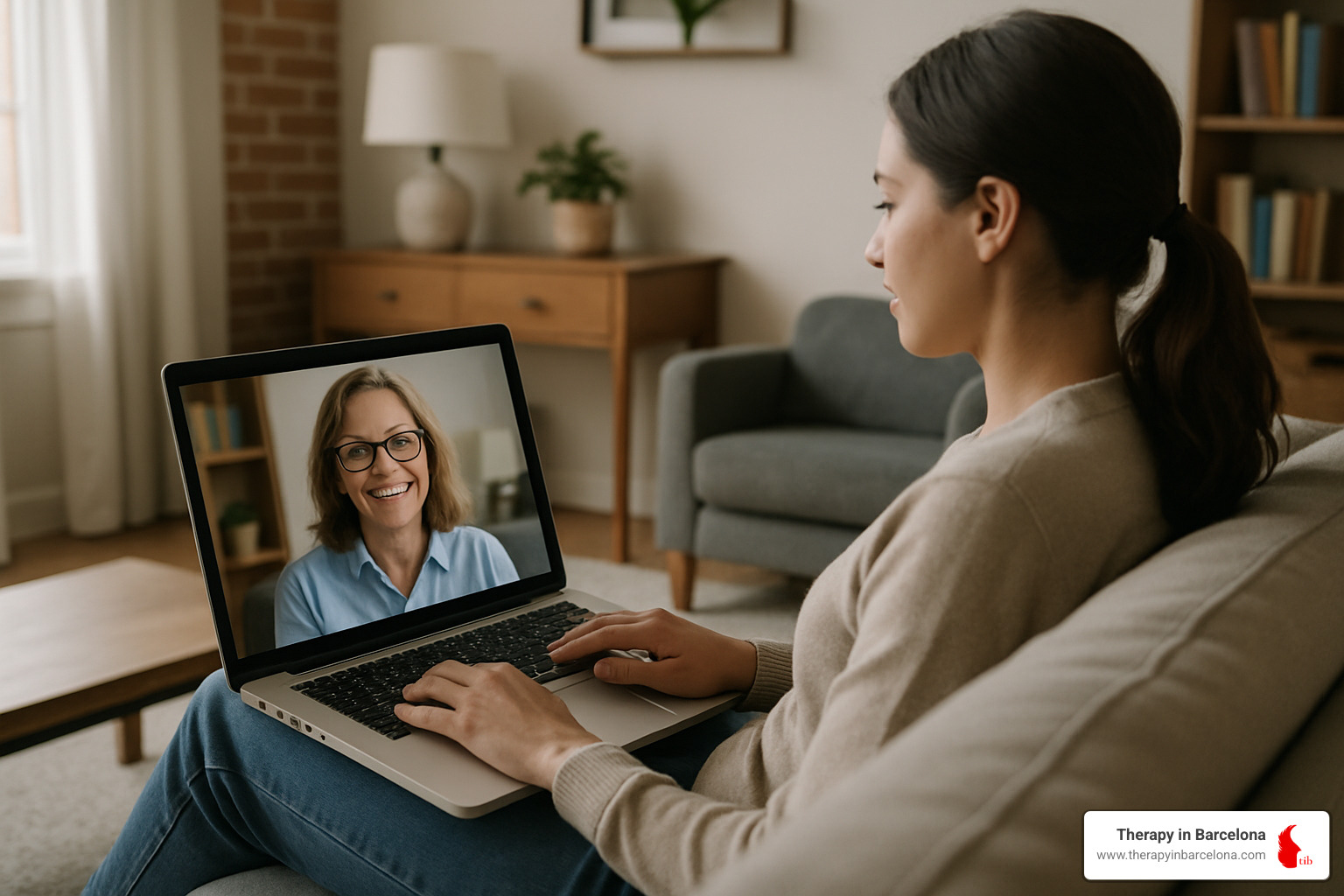
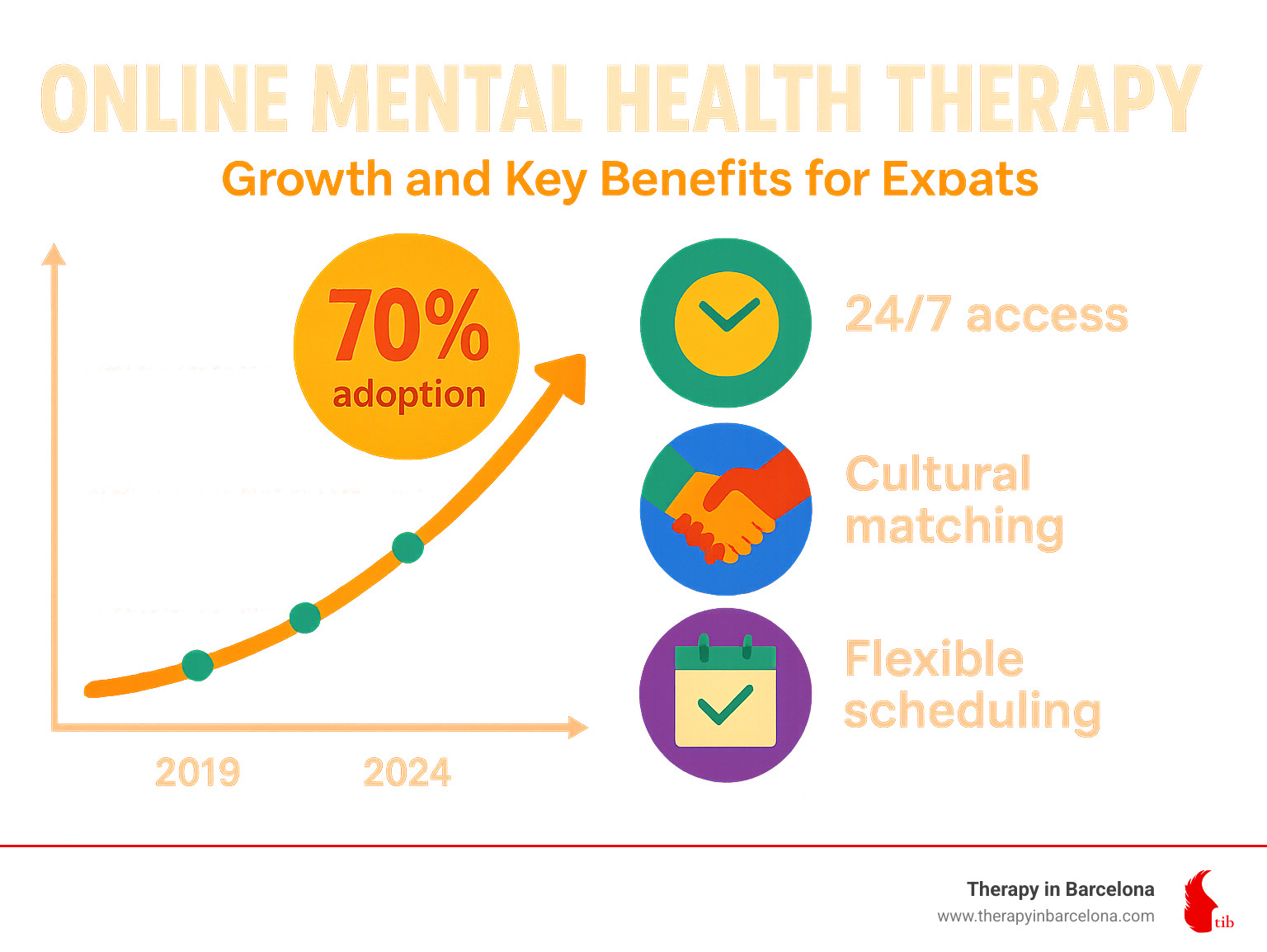
Online mental health therapy has revolutionised how we access mental health support, especially for expats and internationals living far from home. Here’s what you need to know:
What it is:
- Therapy sessions conducted via secure video calls, messaging, or phone
- Access to licensed therapists from your own device
- Same evidence-based treatments as in-person therapy
Key benefits:
- No travel time or geographical barriers
- Flexible scheduling across time zones
- Often more affordable than traditional therapy
- Cultural and language matching with international therapists
- Privacy and comfort of your own space
Perfect for:
- Expats struggling with cultural adjustment
- Busy professionals with demanding schedules
- Those in areas with limited mental health resources
- Anyone preferring the convenience of home-based sessions
The pandemic accelerated online therapy adoption worldwide, with platforms reporting 70% of users seeing improvement in anxiety or depression symptoms within three months. For internationals like Emily (a composite representation of our typical clients), a 34-year-old British expat in Barcelona, online therapy offers something invaluable: access to English-speaking therapists who understand the unique challenges of living abroad.
Whether you’re dealing with homesickness, relationship stress, work anxiety, or simply feeling lost in a new country, online therapy removes the traditional barriers that often prevent expats from seeking help.
The shift represents more than just convenience. It’s about making mental healthcare truly accessible for our increasingly mobile, international world.
What Is Online Mental Health Therapy?
Think of online mental health therapy as having your regular therapy session, but instead of sitting in a therapist’s office, you’re in your own comfortable space—whether that’s your Barcelona flat, a quiet corner in Madrid, or even a café in Valencia. It’s the same professional psychological support you’d receive face-to-face, just delivered through your screen.
The heart of online therapy remains unchanged: you’re still working with qualified therapists using proven approaches like Cognitive Behavioural Therapy (CBT), Acceptance and Commitment Therapy (ACT), or psychodynamic therapy. What’s different is the delivery method—and for many expats, that difference is life-changing.
Modern online therapy platforms use encrypted, secure platforms that meet strict privacy standards like HIPAA in the US and GDPR here in Europe. Many platforms also offer messaging between sessions, which can be incredibly helpful when you’re processing something difficult.
For internationals living abroad, this digital approach solves what can feel like an impossible puzzle: finding culturally sensitive mental health care in your native language. Research consistently shows that therapy in your mother tongue is often more effective—emotional nuances translate more naturally when you’re not also translating your feelings.
How Online Mental Health Therapy Works
Starting online mental health therapy typically begins with a comprehensive intake questionnaire exploring your background, current challenges, cultural context, and therapeutic goals. At Therapy in Barcelona, this detailed matching process is crucial because we don’t simply assign you to the next available therapist. Instead, we match you with someone whose expertise and therapeutic style align with your specific needs.
Once matched, you’ll receive secure login credentials for the therapy platform. Most services include a brief technology check to ensure smooth video sessions. Your therapist will walk you through everything during your first session, including privacy settings and emergency procedures.
The actual sessions mirror traditional therapy in every meaningful way. You’ll discuss concerns, work through challenges, develop coping strategies, and build insights. The main difference? You’re doing this from an environment where you feel most comfortable.
Online Mental Health Therapy for Expats & Internationals
Living as an international comes with unique mental health challenges that traditional therapy often overlooks. Online mental health therapy addresses these head-on, recognising that cultural adjustment, identity shifts, language barriers, and isolation create specific therapeutic needs.
Consider third-culture kids—individuals who’ve spent significant time in cultures different from their parents’ homeland. They often grapple with profound questions of belonging that require culturally informed therapeutic support. Online platforms can connect them with therapists who share similar multicultural backgrounds.
Digital nomads face their own challenges. Constantly moving between countries whilst maintaining work and relationships requires exceptional emotional resilience. Online therapy provides the consistency they need—the same therapist, regardless of location.
At Therapy in Barcelona, we understand these complexities intimately. Our team of psychology-trained therapists are expats themselves, bringing both professional expertise and lived experience to their work with internationals navigating life abroad.
Benefits vs. In-Person Therapy
The shift to online mental health therapy represents more than just a technological upgrade—it’s opening doors that traditional therapy simply couldn’t. Research consistently demonstrates that online therapy delivers outcomes equivalent to face-to-face sessions for most mental health conditions, particularly anxiety and depression that commonly affect expats.
For internationals living abroad, these benefits extend far beyond convenience, though that’s certainly transformative. Consider Sarah, a Canadian marketing manager in Valencia, who found herself cancelling therapy appointments due to work travel. With online sessions, she maintained consistent support regardless of whether she was in her Valencia flat or presenting to clients in Madrid.
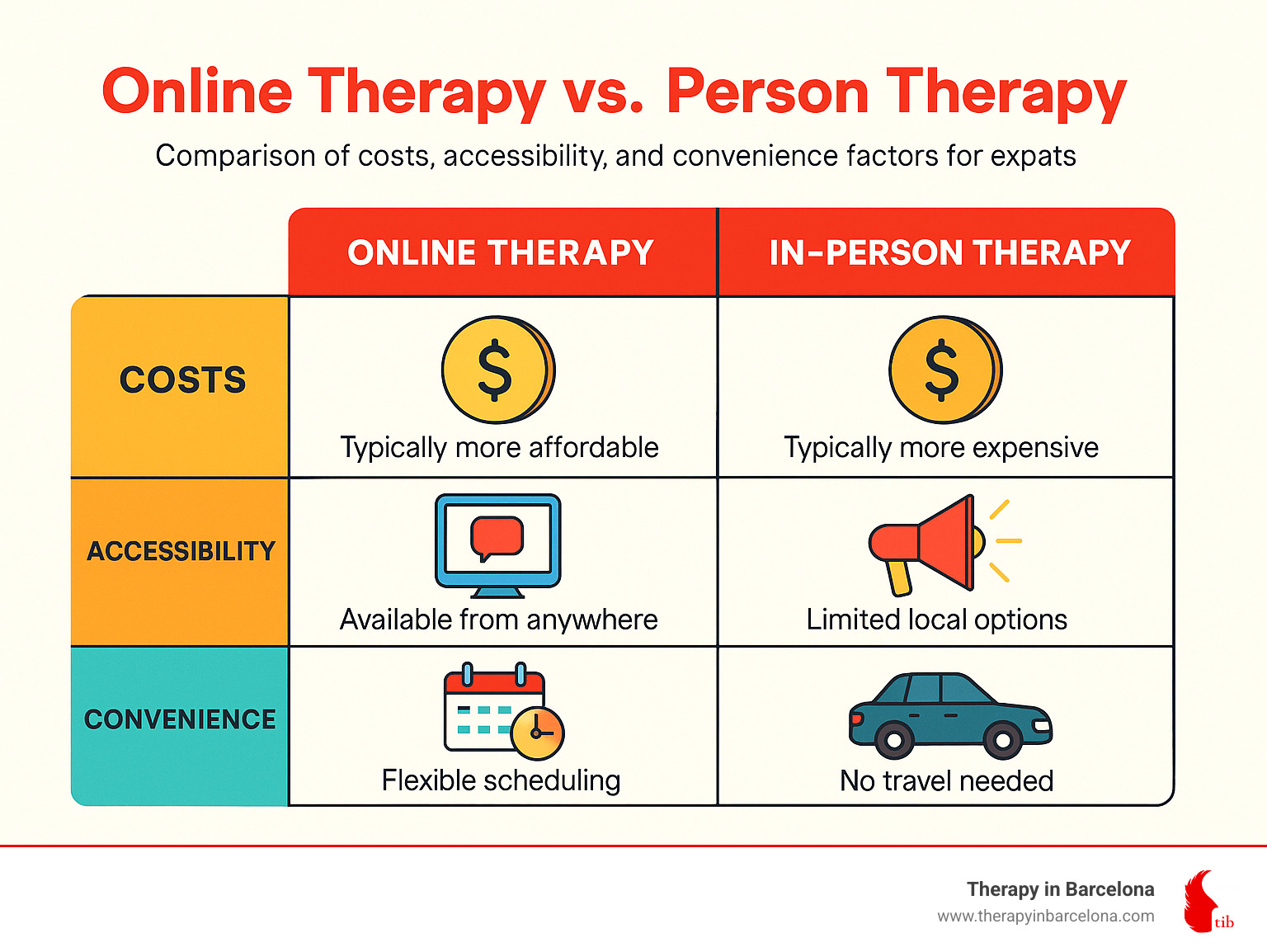
The cost-effectiveness alone makes therapy accessible to many who previously couldn’t afford it, but be aware that these low-cost, big-box platforms are creating untenable work conditions and unfair pay for therapists. Some online platforms typically charge 20-30% less than traditional sessions, which translates to a 20-30% reduction in fees for therapists. Not great.
At Therapy in Barcelona, our fees reflect the quality of our therapists’ work, the depth of their training, their commitment to investing in ongoing professional development and self-care, and the years of experience they bring. Our sessions range from 85-95 euros, often less than what you’d pay for therapy elsewhere, plus you’re saving on transport costs and time off work.
Key Advantages You’ll Feel Fast
The elimination of commute stress transforms therapy from another obligation into genuine self-care time. No more rushing through Barcelona traffic or cramming into packed metros before sessions. You arrive at therapy already in your comfortable space, ready to focus entirely on your wellbeing.
Time zone flexibility becomes a game-changer for expats maintaining connections with home-country therapists or finding specialists who understand their cultural background.
Perhaps most significantly, online mental health therapy reduces the stigma barrier that prevents many expats from seeking help. In tight-knit international communities, privacy concerns about being seen entering a therapist’s office can delay crucial support. Online therapy offers complete discretion—your mental health journey remains entirely private.
Situations Where Face-to-Face May Still Win
Honesty matters here: online mental health therapy isn’t universally superior. Certain situations genuinely benefit from in-person connection and immediate physical presence.
Severe mental health crises requiring immediate intervention, active suicidal thoughts, or situations involving potential harm need face-to-face emergency support. Online platforms can’t replace the immediate safety net of in-person care during acute emergencies.
Some therapeutic approaches translate more naturally to physical spaces. Specific trauma therapies, group dynamics, or techniques incorporating movement and body awareness often work more effectively when therapist and client share the same room. The subtle non-verbal communications and full presence can improve these specific therapeutic approaches.
Technology barriers can also create obstacles rather than solutions. If you’re uncomfortable with digital platforms, struggle with unreliable internet, or find video calls draining rather than connecting, the technology itself might add stress rather than support to your therapeutic journey.
The key lies in honest self-assessment: what do you need most right now? The convenience and accessibility of online therapy, or the physical presence and immediacy of traditional sessions? Many expats find that online therapy perfectly suits their lifestyle and adjustment challenges, while others prefer the ritual and separation that comes with visiting a therapist’s office.
Effectiveness & Scientific Evidence
The science behind online mental health therapy is remarkably encouraging, particularly for expats who’ve wondered if digital sessions could truly match face-to-face therapy. Research consistently shows that online therapy isn’t just a convenient alternative—it’s often as effective as traditional in-person sessions.
A comprehensive study published in the Journal of Telemedicine and e-Health found that online mental health therapy is “as effective, if not more effective, than face-to-face therapy” for many conditions. This finding has been particularly meaningful for internationals, where cultural sensitivity and language comfort play crucial roles in therapeutic success. However, if you are in Barcelona, then you have no problem finding great in-office therapists who are culturally sensitive and speak your language – that’s where Therapy in Barcelona come in!
Cognitive Behavioural Therapy (CBT) shows especially strong outcomes when delivered online. Multiple meta-analyses demonstrate that internet-based CBT produces similar results to in-person CBT for anxiety disorders, depression, and PTSD. The structured nature of CBT translates beautifully to digital formats.
Perhaps most importantly, the therapeutic alliance—that crucial bond between therapist and client—develops just as strongly through video calls as it does in person. Research suggests that the factors that matter most—therapist warmth, empathy, and genuine understanding—translate effectively through digital platforms.
What the Numbers Say About Online Mental Health Therapy
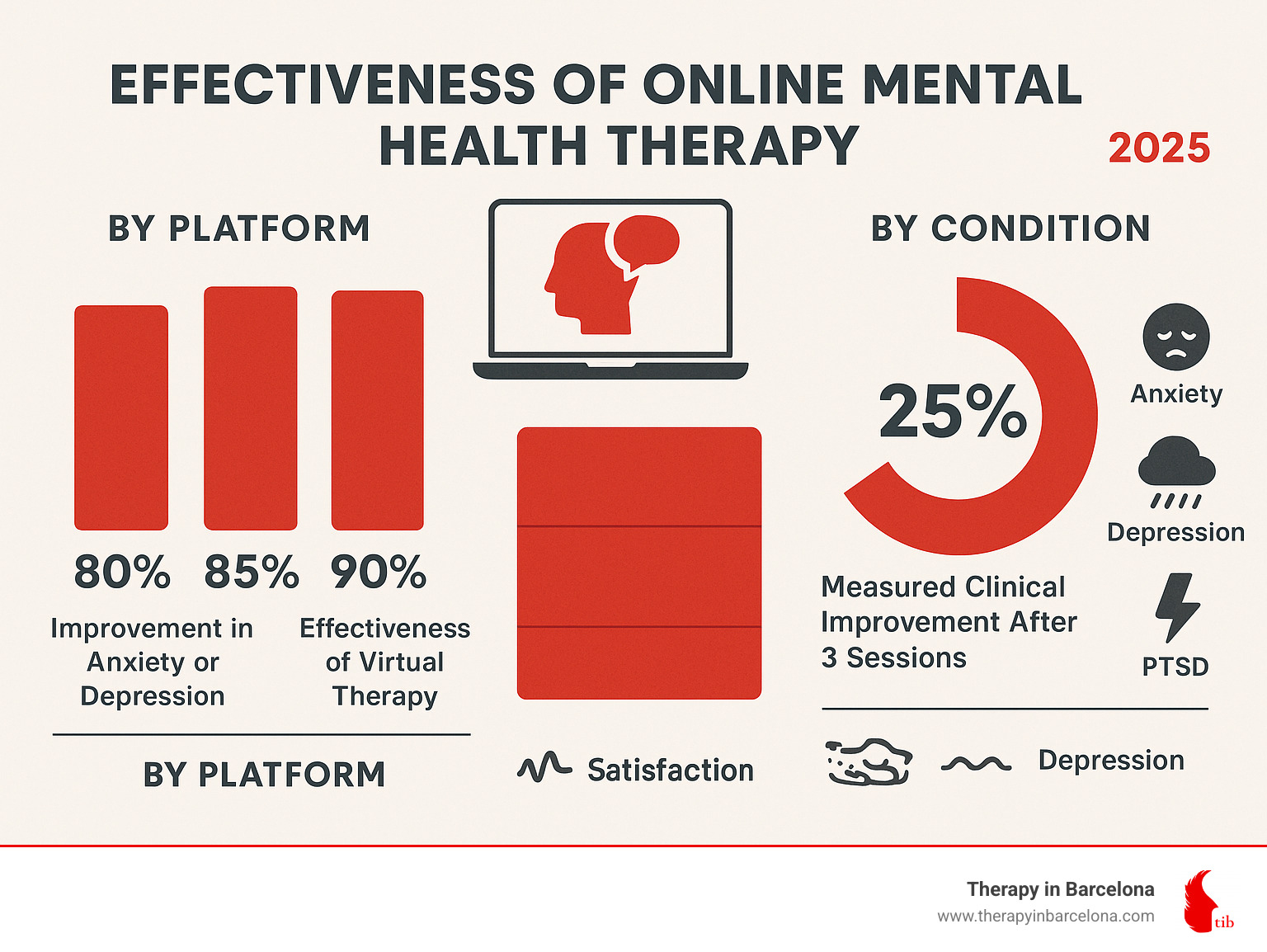
The real-world statistics paint a compelling picture of online mental health therapy‘s effectiveness:
70% of Talkspace users experienced meaningful improvement in anxiety or depression symptoms within just three months. For busy expats juggling new jobs and cultural adjustment, this rapid improvement timeline can be life-changing.
84% of Inkblot clients found virtual therapy as effective as their previous in-person sessions. This statistic is particularly relevant for internationals who may have experienced traditional therapy in their home countries.
88% of MindGuide clients reported high satisfaction with their online therapeutic support, citing convenience and cultural matching as key factors.
Perhaps most encouraging, 25% of clients showed measurable clinical improvement after just three sessions. For expats in crisis—whether dealing with homesickness, relationship stress, or career uncertainty—knowing that relief can come quickly removes a significant barrier to seeking help.
Busting Myths: Is Online Mental Health Therapy “Real” Therapy?
Some people still question whether online mental health therapy constitutes genuine therapeutic work. This scepticism is understandable—we’ve been conditioned to think of therapy as something that happens in a specific room with tissues on the table.
The reality is far more encouraging. Licensed therapists providing online services maintain the same qualifications, training, and ethical obligations as those working in traditional office settings. They’ve simply adapted their expertise to meet clients where they are.
The therapeutic techniques remain identical regardless of delivery method. Whether conducted via video call or face-to-face, CBT still involves identifying thought patterns and developing practical coping strategies. The medium changes, but the therapeutic content remains constant.
Regulatory bodies increasingly recognise online mental health therapy as equivalent to traditional practice. Most licensing boards now explicitly permit online services, provided therapists meet specific training and technology requirements.
For internationals, online therapy often provides something that traditional therapy cannot: access to therapists who truly understand the expat experience. When your therapist has also steerd visa applications, cultural misunderstandings, and the complex emotions of living between two worlds, the therapeutic relationship often deepens more quickly.
Choosing the Right Online Therapist or Platform
Finding the right online mental health therapy provider isn’t like picking a restaurant from Google reviews. The therapeutic relationship is deeply personal, and what works brilliantly for your flatmate might not suit you at all. Think of it as finding the right travel companion for a significant journey—you want someone who understands your destination and speaks your language, both literally and figuratively.
The matching process begins with honest self-reflection. Are you struggling with homesickness and cultural adjustment, or are anxiety and work stress keeping you awake at night? Do you need someone who understands the unique challenges of raising third-culture kids in Barcelona, or are you navigating the complexities of an intercultural relationship?
Language considerations matter more than many people initially realise. You might order your morning café con leche in perfect Spanish, but when exploring childhood memories or processing difficult emotions, you’ll likely want the nuanced expression that only your native tongue allows. This is particularly important for expats who’ve spent years adapting to communicate in a second language—therapy is one space where you shouldn’t have to translate your feelings.
Steps to Find Your Perfect Online Mental Health Therapy Match
Start with a comprehensive assessment. The best platforms use detailed questionnaires that go beyond basic demographics. They’ll ask about your cultural background, previous therapy experiences, specific challenges, and even your communication preferences. This might feel lengthy, but it’s the foundation of a good match. At Therapy in Barcelona, we’ve found that clients who invest time in thorough intake processes have significantly better therapeutic outcomes from the start.
Review therapist profiles with intention. Look beyond credentials to find someone whose specialisations align with your needs. If you’re a digital nomad struggling with constant transitions, seek a therapist experienced with location-independent professionals. For relationship challenges, find someone trained in couples work who understands intercultural dynamics.
Schedule that initial consultation. Many platforms offer brief findy calls to assess fit. Use this time wisely—evaluate not just their expertise, but how they communicate. Do they ask thoughtful questions? Do they seem genuinely curious about your experience? Can you imagine feeling comfortable sharing vulnerable moments with this person?
Trust your instincts about rapport. The therapeutic alliance—that sense of connection and trust between you and your therapist—is crucial for success. You should feel heard, understood, and gently challenged. If something feels off after a few sessions, don’t hesitate to request a different therapist. Good platforms make switching simple and stigma-free.
Privacy, Insurance & Cost Considerations
Privacy and security should be absolutely non-negotiable when choosing online mental health therapy. Look for platforms using end-to-end encryption, GDPR compliance in Europe, and secure data storage practices. Reputable services will clearly explain their privacy policies without hiding behind legal jargon. If you can’t easily understand how your data is protected, keep looking.
Insurance coverage for online therapy has improved dramatically since the pandemic, though it varies significantly by country and provider. Many European insurers now cover virtual sessions under the same terms as in-person therapy. However, coverage details differ considerably, so check with your insurer about copays, deductibles, and approved providers before committing to a platform.
Cost structures range widely across platforms. Some use subscription models (typically €60-100 per week), whilst others charge per session (usually €70-115 for individual sessions). Consider your budget and desired therapy frequency when evaluating options. Many platforms offer sliding scale fees or financial assistance programmes for those facing financial hardship.
For those paying out-of-pocket, many therapists provide receipts for insurance reimbursement or Health Savings Account claims. This can significantly reduce your effective therapy costs, making professional support more accessible than initially expected. Don’t let cost concerns prevent you from exploring your options—many paths to affordable, quality care exist if you know where to look.
Preparing for Your First Virtual Session

Taking that first step into online mental health therapy can feel both exciting and nerve-wracking. The beauty of virtual sessions is that you’re creating your own therapeutic space—somewhere you feel safe, comfortable, and truly yourself.
Creating your sanctuary matters more than you might think. Choose a spot where you won’t be interrupted—perhaps your bedroom corner with soft lighting, or that quiet nook in your living room. Many expats find their therapy space becomes a special retreat where they can be completely honest about the challenges of living abroad.
Technical preparation is surprisingly straightforward. Test your internet connection, check that your camera shows your face clearly, and ensure your microphone picks up your voice without echo. Good lighting helps your therapist read your facial expressions. Consider using headphones—they improve audio quality and give you extra privacy.
Emotional readiness involves thinking about what brought you to this moment. Perhaps you’re struggling with homesickness, feeling overwhelmed by work stress, or finding relationships more challenging than expected. Having a rough idea of what you’d like to explore can help you make the most of that first session.
What to Expect in Session One of Online Mental Health Therapy
Your first online mental health therapy session will likely feel like meeting a supportive guide who happens to be professionally trained to help you steer life’s complexities. Most therapists begin with a quick technology check, making sure you can hear each other clearly.
Building trust starts immediately. Your therapist will explain how online therapy works, discuss confidentiality, and talk through emergency procedures. Since they’re not physically present, you’ll likely discuss local crisis resources and provide emergency contact information.
The real conversation begins when your therapist starts exploring your background and current challenges. They’ll want to understand what brought you to therapy and what your life looks like right now. For expats, this often means discussing cultural adjustment, language barriers, feeling caught between two worlds, or missing family support systems.
Goal-setting happens naturally as you talk. Maybe you want to feel less anxious about work presentations, improve your relationship with your partner, or simply feel more settled in your new country. These conversations help shape your therapeutic journey.
Quick Access & Switching Therapists Made Simple
One of the most liberating aspects of online mental health therapy platforms is how easily you can change therapists if the fit isn’t quite right. Unlike traditional therapy, where finding a new provider might mean weeks on waiting lists, most online platforms can match you with a different therapist within 24-48 hours.
Making the switch typically requires just a brief explanation. Perhaps you’d prefer someone with a different therapeutic style, need a therapist who better understands your cultural background, or simply feel the personal chemistry isn’t clicking. These are all perfectly valid reasons.
The process stays simple. Most platforms make switching straightforward—often just requiring you to complete a short form. You might realise you need someone who specialises more specifically in expat challenges, or perhaps you’d prefer a therapist from your home country.
Don’t hesitate to advocate for yourself. The therapeutic relationship is the foundation of successful therapy, and settling for a mediocre connection does you no favours. At Therapy in Barcelona, the matching process is designed to get it right from the start.
The beauty of online platforms is that this flexibility removes one of the biggest barriers to getting help—the fear of being stuck with the wrong therapist.
Frequently Asked Questions about Online Mental Health Therapy
Can an online therapist see me if I’m in a different country?
Cross-border online mental health therapy can feel like navigating a maze of regulations, but it’s absolutely possible with the right approach. The main challenge lies in licensing requirements—therapists typically need active licenses in both their location and yours, which naturally limits your options but doesn’t eliminate them.
Many platforms have found creative solutions within these regulatory frameworks. Some employ therapists licensed in multiple jurisdictions, whilst others specialise in specific international corridors. For instance, if you’re a British expat living in Spain, you might find services that specifically cater to this demographic.
Time zones can actually work in your favour. Imagine you’re living in Barcelona but prefer evening sessions—you could connect with a UK-based therapist during their afternoon hours, creating a perfect scheduling match. When you’re processing deep emotions, having that cultural understanding and native language fluency can be transformative.
Is online therapy covered by insurance in Spain or Canada?
Insurance coverage for online mental health therapy has transformed dramatically since the pandemic, with many insurers now treating virtual sessions on par with traditional therapy. However, the details vary significantly depending on your location and specific plan.
In Spain, coverage depends heavily on your insurance provider and whether your chosen therapist is recognised within their network. Many private health insurance plans now include telemedicine benefits, but the specifics can differ between providers.
Canadian coverage varies by province and insurance type. Employee benefits plans increasingly include online therapy options, and some provincial health systems have expanded their digital mental health offerings.
Even if direct coverage isn’t available, many people successfully claim reimbursement through health spending accounts or tax deductions for medical expenses. Always check with your insurance provider about coverage details before starting therapy.
Can online therapists prescribe medication or provide medical notes?
Most online mental health therapy focuses on psychological support rather than medical interventions, which means your therapist likely cannot prescribe medication. This limitation exists because prescribing medications typically requires specific medical training beyond standard therapeutic qualifications.
However, some platforms now offer integrated services that combine therapy with psychiatric care, connecting you with medical doctors who can prescribe and monitor psychiatric medications alongside your therapeutic work.
For medical notes and documentation, the situation is more flexible but varies by therapist and jurisdiction. Many online therapists can provide employment letters, therapy attendance confirmations, or general mental health documentation. However, acceptance of these documents by employers or government agencies might vary.
If you need specific documentation, discuss this with your therapist early in the process. They can explain exactly what types of documentation they’re qualified to provide and help you understand any limitations.
Conclusion
Online mental health therapy has transformed the landscape of mental healthcare, offering unprecedented access to support for expats and internationals navigating life far from home. The evidence speaks for itself: this isn’t just a convenient alternative to traditional therapy—it’s often an equally effective solution that addresses the unique challenges of our globally mobile world.
For many internationals, the choice between online and in-person therapy isn’t really a choice at all. When you’re living in Barcelona but struggling with homesickness, or working as a digital nomad whilst managing anxiety, finding a therapist who truly understands your experience can feel impossible. Online mental health therapy bridges that gap, connecting you with professionals who speak your language—both literally and culturally.
The numbers don’t lie. When 70% of users see improvement within three months, and 88% report satisfaction with their online therapeutic experience, we’re looking at a genuine breakthrough in mental healthcare accessibility. These aren’t just statistics—they represent real people finding relief, developing coping strategies, and building more fulfilling lives.
As Leigh Matthews, founder of Therapy in Barcelona and an Australian psychologist who has lived in Barcelona since 2011, often reflects, “The therapeutic relationship transcends physical space. What truly matters is the connection, understanding, and expertise your therapist brings to your unique situation as an international navigating life abroad.”
Perhaps most importantly, seeking support—whether online or in-person—represents courage, not weakness. The decision to prioritise your mental health whilst juggling the complexities of expat life shows remarkable self-awareness and strength.
If you’re considering online mental health therapy, start by honestly assessing what type of support would work best for your lifestyle, cultural needs, and therapeutic goals. Do you need someone who understands third-culture kid experiences? Are you looking for flexibility to accommodate demanding work schedules across time zones? Would you prefer the consistency of the same therapist regardless of where your travels take you?
Your mental health journey is uniquely yours, and the right therapeutic support can make all the difference. Whether you choose the convenience of online sessions or the traditional approach of face-to-face meetings, the most crucial step is simply taking that first one.
Ready to explore your options? Consider what matters most to you in a therapeutic relationship, and remember that finding the right fit might take a bit of exploration—and that’s perfectly normal.
For more information about therapy options specifically designed for internationals, including both online and in-person services, visit Therapy in Barcelona’s expat therapy services.
