


Online Therapy for Expats in Spain: Support That Travels With You

Online therapy for expats Spain offers a confidential way to speak with a qualified therapist from home, work, or wherever you are living in the country. It can be especially useful when you want support in English or another familiar language, live outside a major city, travel often, or simply prefer not to commute to an appointment.
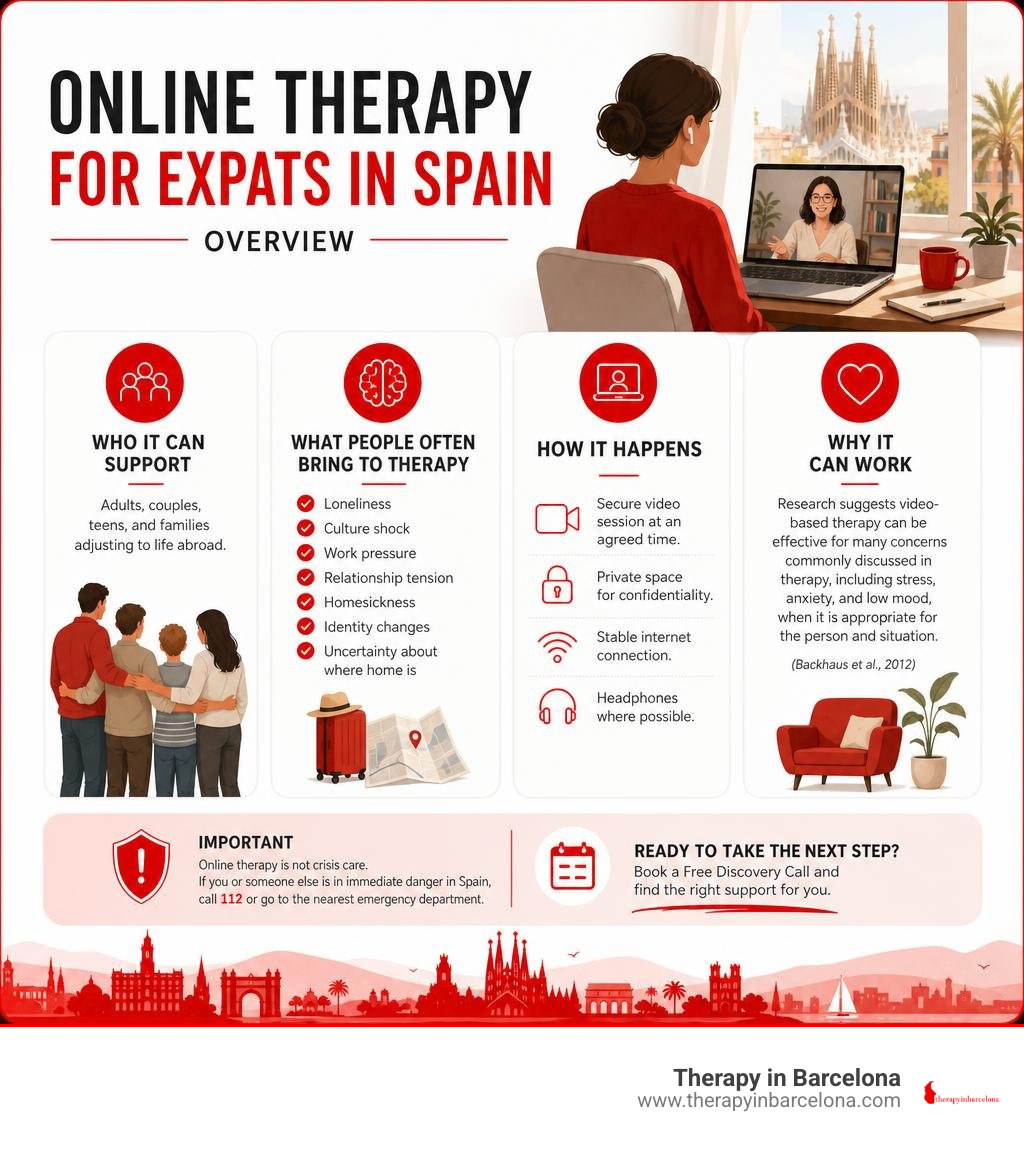
- Who it can support: adults, couples, teens, and families adjusting to life abroad.
- What people often bring to therapy: loneliness, culture shock, work pressure, relationship tension, homesickness, identity changes, and uncertainty about where home is.
- How it happens: usually through a secure video session at an agreed time, with a private space, stable internet connection, and headphones where possible.
- Why it can work: research suggests video-based therapy can be effective for many concerns commonly discussed in therapy, including stress, anxiety, and low mood, when it is appropriate for the person and situation.
Moving to Spain can be exciting and still feel unsettling. Everyday tasks may be manageable in Spanish or Catalan while grief, frustration, humour, and more personal feelings are harder to express. For many internationals, the practical move happens quickly, but feeling settled takes longer.
Therapy in Barcelona is a trusted group practice in Spain, established in 2011. We offer psychology-trained, multilingual care in English, German, French, Spanish, Afrikaans, Portuguese, Austrian-German, and Swiss-German. Our team works online with clients worldwide, including in the USA and Canada, and offers face-to-face sessions from our Barcelona office, with careful personalised matching for adults, couples, teens, and families.
Online therapy is not crisis care. If you or someone else is in immediate danger in Spain, call 112 or go to the nearest emergency department. If you’d like support, book a Free Discovery Call.
Why Online Therapy for Expats in Spain Is Essential for Moving Abroad
Relocating to Spain brings a unique blend of adventure and emotional adjustments. While unpacking boxes happens in a matter of days, emotional integration usually takes much longer. Internationals often find that the excitement of sunshine, tapas, and scenic coastal views wears off after a few months, leaving behind unexpected psychological hurdles. You can explore more about these dynamics in our guide on Connect From Anywhere: Your Guide to Online Therapy in Spain.
Living abroad forces individuals to reconstruct their daily routines, social networks, and professional identities from scratch. Without local support systems, even minor setbacks like navigating Spanish bureaucracy or setting up utilities can trigger high levels of stress. Many internationals experience an unsettling identity split where their life looks enviable on social media, yet inside they feel unrooted and isolated.
Location independence is another reason remote care has become standard for internationals. Remote workers, digital nomads, and corporate expats frequently relocate between Spanish cities like Barcelona, Madrid, Valencia, Málaga, Alicante, Sevilla, Marbella, Gran Canaria, and Zaragoza. Online therapy for expats Spain ensures that your therapeutic relationship remains continuous, even when your physical address changes.
Common Challenges Faced by Internationals and Digital Nomads
Moving across borders alters far more than your address; it reshapes how you see yourself and relate to others. Internationals in Spain regularly encounter predictable psychological stages, beginning with initial excitement and progressing into culture shock, frustration, and eventual integration. To understand how remote sessions help navigate these transitions, see What Are the Benefits of Online Therapy for Internationals Living in Spain?.
To illustrate these common challenges, consider the story of Elena, a 34-year-old marketing strategist who relocated from Northern Europe to Valencia. (Please note that Elena is a fictional composite character created to illustrate expat struggles, not a real client). On paper, Elena was living her ideal life in Spain. However, after six months, the inability to express subtle emotions in Spanish, combined with the loss of her close friendship network back home, left her feeling deeply lonely and disconnected.
The psychological themes Elena faced represent core issues that internationals bring to therapy:
- Culture Shock and Relocation Fatigue: Navigating new social norms, slow administrative procedures, and daily language strain can drain your emotional energy over time.
- Isolation and Superficial Friendships: Making genuine, deep connections abroad takes time. Expats often feel surrounded by friendly acquaintances at social meetups while lacking true emotional support.
- Trailing Spouse Dynamics: When one partner moves for career reasons, the accompanying partner often suffers a sudden loss of career identity, personal independence, and daily purpose.
- Relationship Strain: Relocation acts as a pressure cooker for couples. Existing communication gaps can widen when both partners rely entirely on each other for social fulfilment.
- Professional Identity Disruption: Translating career credentials or adapting to a different work culture in Spain can lead to self-doubt and career burnout.
Is Remote Support Effective in Online Therapy for Expats in Spain?
A common question among internationals considering virtual care is whether a screen can deliver the same emotional depth as an in-office appointment. Extensive peer-reviewed research confirms that remote therapy yields clinical outcomes equivalent to traditional face-to-face sessions for a wide range of concerns, including anxiety, stress, low mood, and relationship difficulties.
Evidence-based therapeutic frameworks adapt seamlessly to virtual formats. Practitioners working with internationals often integrate established methodologies to provide structured, practical tools:
- Cognitive Behavioural Therapy (CBT): Focuses on identifying unhelpful thought patterns surrounding relocation, performance anxiety, and social distress, replacing them with balanced coping strategies.
- Acceptance and Commitment Therapy (ACT): Helps individuals accept difficult feelings associated with culture shock while committing to actions aligned with their personal values.
- Internal Family Systems (IFS): Explores the internal “parts” of a person—such as the protective part that wants to perform confidence and the vulnerable part that misses home.
- Psychodynamic and Existential Approaches: Examines deeper shifts in personal identity, belonging, and meaning that emerge when living outside one’s country of origin.
For a broader look at how structured support can assist your transition, read our detailed article on Psychotherapy for Expats.
How Online Therapy Works: Platforms, Scheduling, and Privacy

Starting virtual therapy in Spain is a straightforward process designed around your schedule and privacy needs. Whether you reside in a bustling neighborhood in Madrid or a quiet town in Gran Canaria, remote sessions eliminate the time and stress of commuting across the city. For tips on setting up your space, see Online Therapy Madrid: Mental Health Support From Your Couch.
Sessions are scheduled according to Central European Time (CET), making it easy to fit appointments around work commitments, travel, or family routines. Most video platforms operate directly through secure web links, requiring no complex software downloads.
Confidentiality and data protection are vital considerations when selecting a telehealth service. Standard commercial platforms sometimes collect user data for marketing purposes. In contrast, professional private practices strictly adhere to strict privacy laws, including the European Union General Data Protection Regulation (GDPR). Video sessions are fully encrypted, and personal therapeutic notes remain confidential.
Technical Setup and Creating a Safe Environment
To make the most of your virtual sessions, establishing a comfortable, private physical space is essential. You can discover more helpful tips in our resource on 5 Reasons to Choose Online Therapy.
Preparing your environment takes only a few simple steps:
- Check Your Connection: Ensure you have a stable high-speed Wi-Fi connection or ethernet cable to avoid video lag or audio dropouts.
- Use Headphones: Wearing wired or wireless headphones improves sound clarity and prevents anyone outside your room from hearing your therapist.
- Ensure Privacy: Choose a quiet room where you will not be interrupted. Closing doors, using white noise machines, or letting housemates know you are busy helps create a safe zone.
- Optimise Lighting and Comfort: Sit in a comfortable chair with soft lighting in front of you so your therapist can see your subtle facial expressions.
- Practice Grounding: Keep a glass of water, a journal, or a comforting object nearby to help you stay present before and after your session.
What to Look for When Choosing Online Therapy for Expats in Spain
Selecting the right mental health professional is the single most important factor in achieving positive therapy outcomes. When searching for online therapy for expats Spain, look beyond basic qualifications to ensure your practitioner understands cross-cultural living.
Key factors to evaluate include:
- Psychology-Trained Credentials: Verify that the practitioner holds recognized university degrees in psychology or psychotherapy from their country of training, ensuring rigorous ethical standards.
- Lived Expat Experience: Therapists who have lived abroad themselves bring immediate empathy. They understand culture shock, administrative exhaustion, and international family dynamics without requiring long explanations.
- Language Nuance: Being able to speak in your native or primary language allows you to express deep emotions, humor, and subtle nuances that get lost when translating into a second language.
- Personalized Matching: Avoid platforms that automatically assign you to the next available practitioner. A thoughtful matching process evaluates your specific personality, goals, and cultural background to pair you with the right professional.
Navigating Mental Healthcare in Spain: Public vs. Private Options
Navigating mental health care in a foreign country can feel complicated, especially when trying to understand the differences between Spain’s public healthcare system (Seguridad Social) and private mental health services.
In Spain’s public healthcare system, accessing psychological support requires an initial appointment with a primary care doctor (médico de cabecera). The GP acts as a gatekeeper and decides whether to write a referral to a specialist. While public care is fully covered by social security, waitlists for non-emergency mental healthcare often range from several weeks to many months. Furthermore, public sector sessions are typically brief, scheduled weeks apart, and rarely guaranteed to be conducted in English or by the same practitioner each time.
Private care provides immediate accessibility, weekly session consistency, freedom to choose your practitioner, and direct access to native English-speaking professionals. To assist your decision, we respectfully acknowledge all options—including public clinicians, large directory platforms such as It’s Complicated Directory, Expat Therapy 4U, TherapyTribe, Healing with Heather, and regional medical providers like OmniaSalus—so you can find what best matches your timeline and budget. Specialized private practices like ours focus on key differentiators: strict privacy with no data selling, bespoke therapist matching, and culturally sensitive support delivered in your native language.
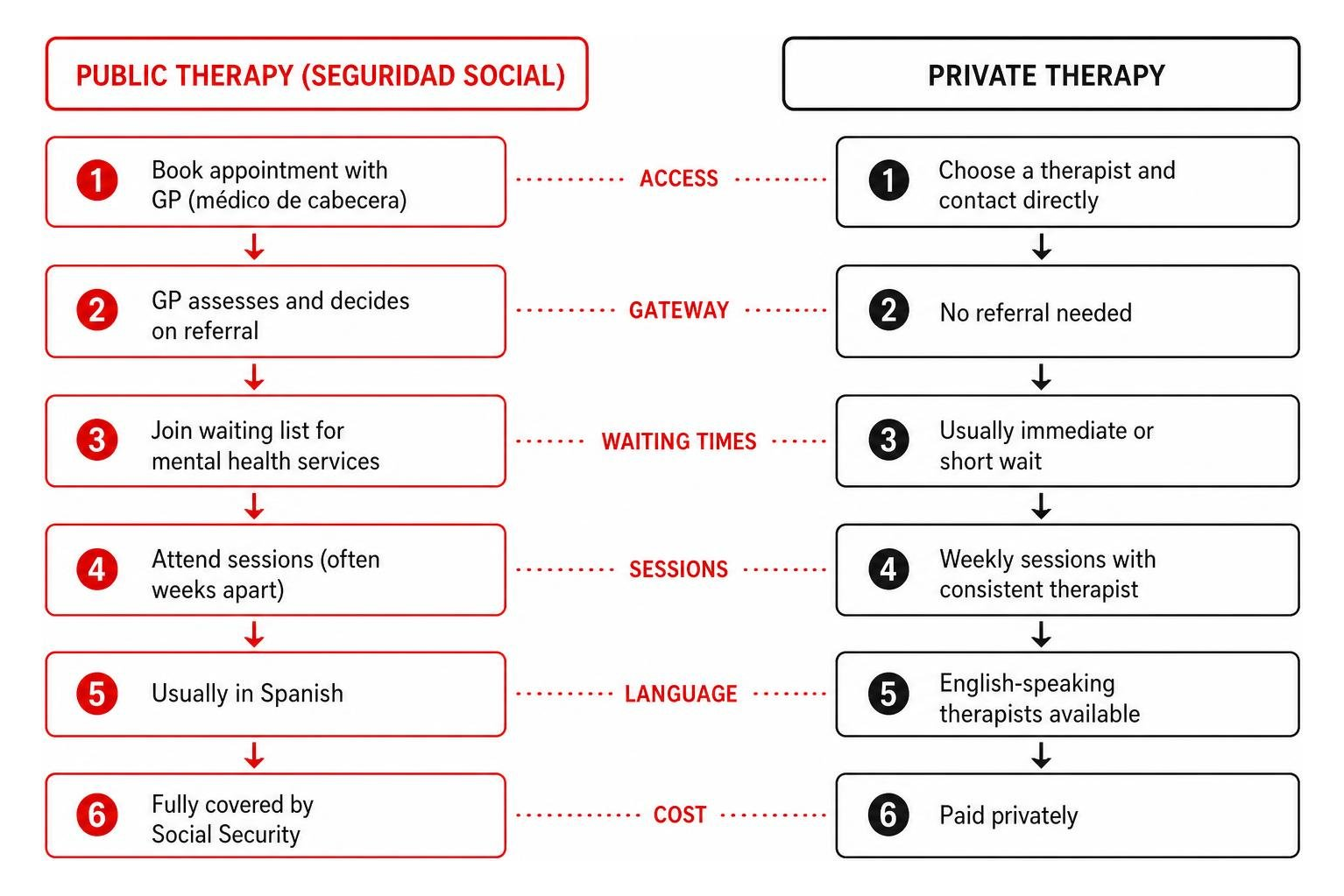
Comparison of Public and Private Therapy Options in Spain
Spanish Public Healthcare (Seguridad Social)
- Access Pathway: Requires a referral from an assigned general practitioner (médico de cabecera).
- Waiting Times: Long waiting periods, often ranging from several weeks to many months.
- Language Availability: Primarily Spanish or regional co-official languages (e.g., Catalan); native English is rarely available.
- Session Continuity: Sessions are infrequent (often monthly or less) with limited time per appointment.
- Therapist Choice: Assigned automatically based on local clinic availability without individual choice.
Private Online Expat Therapy
- Access Pathway: Direct booking online via intake form or discovery call without needing a GP referral.
- Waiting Times: Immediate or short waiting times, typically booking within a few days.
- Language Availability: Multilingual care in English, German, French, Spanish, Afrikaans, Portuguese, and more.
- Session Continuity: Consistent weekly or bi-weekly 50-minute sessions with the same matched practitioner.
- Therapist Choice: Bespoke matching based on individual goals, personality fit, and shared cultural background.
Understanding Costs, Session Fees, and Insurance Coverage
Understanding private therapy fees in Spain helps you plan your healthcare budget effectively. To learn more about standard therapeutic options across the country, visit Counselling Spain.
Private therapy in Spain operates on a private-pay basis. Standard session rates across the private market typically range between €50 and €100+ per session, depending on the therapist’s qualifications, location, and specialisation. For high-quality, specialized expat therapy practices, standard 50-minute individual sessions generally cost between €80 and €95.
Key considerations regarding fees and insurance coverage:
- Private Pay Model: Private therapy services are paid directly out-of-pocket per session or in monthly blocks.
- Insurance Reimbursement: Some private international health insurance policies or corporate coverage plans allow policyholders to claim back a percentage of private therapy costs. It is advisable to check your policy terms directly with your insurer.
- Sliding Scale Options: Some private therapists and practices offer sliding scale fees for clients experiencing genuine financial hardship. Prospective clients are encouraged to inquire about sliding scale availability during their initial contact.
Finding Multilingual and English-Speaking Support Across Spain
For internationals living outside major metropolitan areas, finding high-quality face-to-face therapy in English can be a challenge. While English-speaking practitioners are concentrated in major hubs like Barcelona and Madrid, internationals residing in regions like Málaga, Alicante, Sevilla, Marbella, Gran Canaria, or Zaragoza often face strict local language barriers.
Language carries emotional depth. When processing vulnerable personal experiences, trauma, or identity loss, translating your thoughts into a second language creates emotional friction. Working with a fluent English-speaking therapist allows you to speak freely in your inner language, ensuring that emotional nuances, metaphors, and cultural references are understood effortlessly.
Virtual care solves geographic barriers entirely. Online therapy for expats Spain connects internationals in any region across Spain to vetted, psychology-trained therapists who specialize in expatriate adjustment.
Frequently Asked Questions About Expat Mental Health in Spain
How can expats access emergency crisis support in Spain?
Outpatient online therapy services are designed for non-emergency emotional support and personal development; they do not provide crisis intervention. If you or someone you know is experiencing a mental health emergency, severe self-harm urges, or immediate physical danger in Spain, please use the following public crisis resources immediately:
- National Emergency Call Centre: Call 112 (available 24/7 with English-speaking operators across Spain).
- Mental Health Crisis Line (Línea de Atención a la Conducta Suicida): Call 024 (free, confidential national helpline in Spain).
- Emergency Medical Care: Visit the nearest hospital emergency room (Urgencias) at your local public hospital.
What languages are available for online therapy in Spain?
English is the primary language for expat therapy services in Spain, but multilingual options are widely available. Practices specializing in international mental healthcare frequently offer therapeutic support in multiple languages, including English, German, French, Spanish, Afrikaans, Portuguese, Austrian-German, and Swiss-German. Being able to switch fluidly between languages during a session helps clients communicate complex emotions comfortably. You can view practitioner profiles on international therapist directories to explore international provider options.
Can expats switch between online and in-person therapy sessions?
Many practices offer hybrid care models that allow clients to transition between virtual and face-to-face appointments. For instance, an expat living in Barcelona might attend face-to-face sessions at a local clinic when in town, but seamlessly switch to online video sessions when traveling for work or visiting family back home. This flexibility protects the continuity of care and keeps your therapeutic momentum going wherever life takes you.
Finding Your Safe Space Abroad

Living abroad in Spain is a transformative journey filled with growth, beauty, and unique challenges. You do not have to navigate identity shifts, culture shock, or feelings of isolation on your own. Connecting with a professional who understands both evidence-based psychology and the lived reality of international life can provide the clarity and comfort you need to thrive.
Therapy in Barcelona is a trusted group practice in Spain established in 2011. Founded by Leigh Matthews, an Australian Psychologist who has lived in Barcelona since 2011, our practice was born out of her experience with the psychological adjustments of moving abroad. Leigh has over 20 years of clinical experience supporting international clients, accompanying spouses, Third Culture Kids, digital nomads, and expat professionals.
Our team offers psychology-trained multilingual care across our services in English, German, French, Spanish, Afrikaans, Portuguese, Austrian-German, and Swiss-German. We provide careful personalized matching for individual therapy, couples counselling, adolescent therapy, family therapy, and sex therapy. We work online therapy with clients worldwide, including in the USA and Canada, as well as face-to-face from our central office in Barcelona. You can learn more about our team and transparent private-pay fees on our website.
What small step can you take today to make your life in Spain feel more like home? If you’d like support, book a Free Discovery Call.
