


Demystifying Performance Anxiety Sex: What It Is and Why It Happens

Performance anxiety sex is one of the most common — and least talked about — challenges affecting adults in relationships today. You might be deeply attracted to your partner, genuinely wanting to connect, and yet your body simply won’t cooperate. Your mind races. You start watching yourself from the outside. And the more you try to make it work, the worse it gets.
This experience has a name, and it is far more widespread than most people realise. Research suggests that up to 25% of men and 16% of women are affected by worry and stress around sex at some point in their lives, as detailed in clinical studies on sexual performance anxiety.
Most men will experience temporary difficulties with erections or performance at least once — often tied to stress, exhaustion, or relational tension rather than anything physically wrong.
For expats and internationals living in Barcelona, Valencia, Madrid, or elsewhere in Spain, the pressures of relocation, cultural adjustment, and life in a new country can quietly intensify these challenges. When you are already running on stress, your intimate life is often the first thing to suffer.
Here is a quick overview of what stress around sex is and how it can be addressed:
What it is: A stress response where worry and tension interfere with physical arousal, desire, or how your body responds — not a permanent condition or character flaw.
Common signs:
- Difficulty getting or maintaining an erection
- Trouble with lubrication or arousal
- Inability to orgasm, or orgasming too quickly
- Mentally “watching” yourself during sex rather than being present
- Avoiding intimacy altogether due to fear of failure
What causes it:
- Stress, fatigue, or major life transitions (including relocation)
- Body image concerns or unrealistic expectations from media
- Past disappointing sexual experiences
- Relationship tension or communication difficulties
- Underlying patterns of persistent worry and stress
What helps:
- Breathing techniques to calm the nervous system before and during intimacy
- Shifting the goal from “performance” to shared pleasure and connection
- Open, honest communication with your partner
- Evidence-based therapy such as CBT, sex therapy, or mindfulness-based approaches
This article walks through all of these areas in plain, practical terms — so you can understand what is happening, why it happens, and what you can actually do about it.
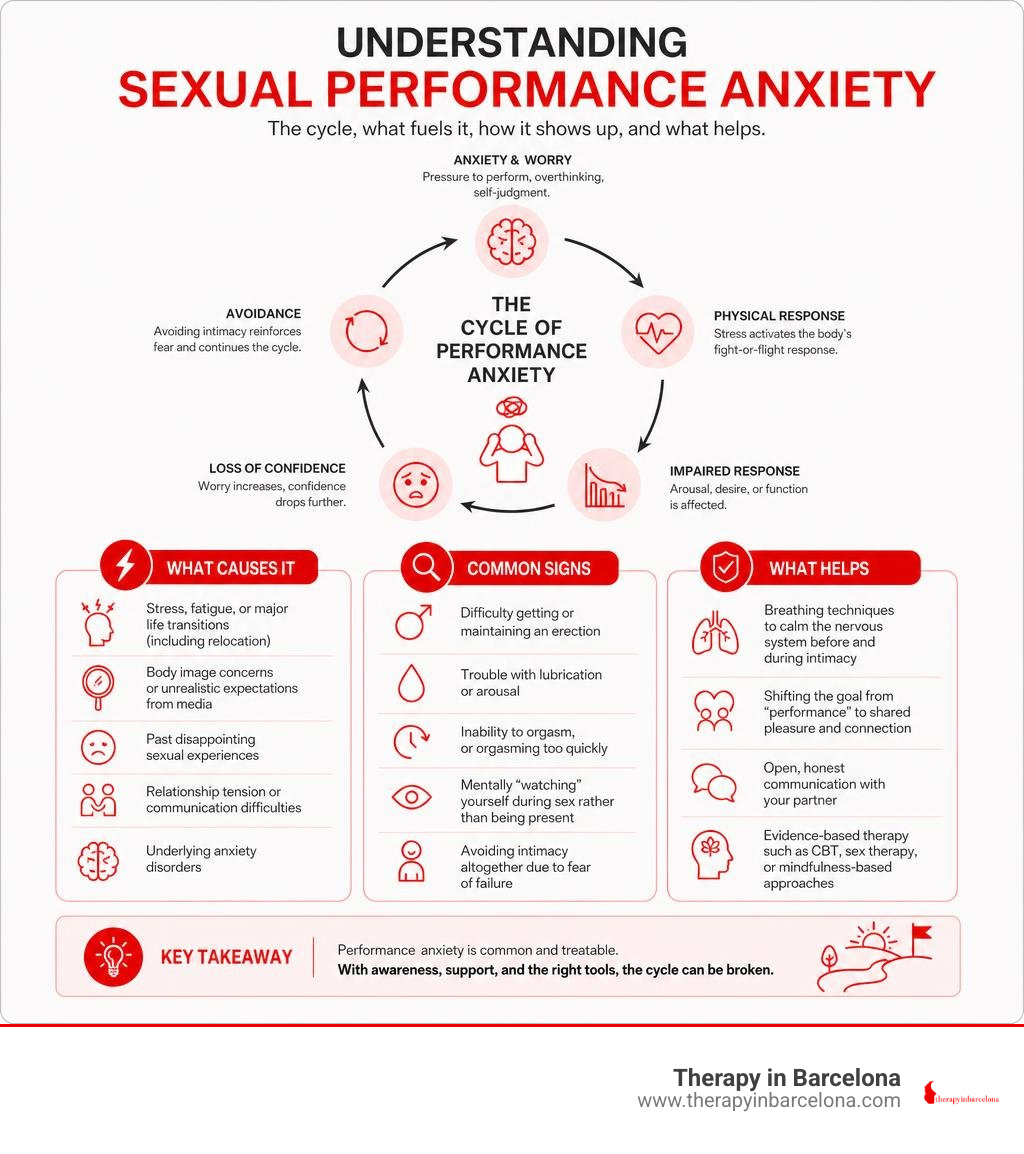
At its core, performance anxiety sex refers to the intense worry, fear, or self-consciousness that interferes with your ability to enjoy or engage in sexual activity.
Unlike generalised worry, which might linger as a vague sense of unease throughout your day, stress around sexual performance is situational. It is a psychological block that directly interrupts the body’s natural, reflexive sexual response.
This pressure often affects high-achievers who are used to managing outcomes and excelling in their professional lives. When these individuals enter the bedroom, they frequently treat intimacy like a task to be completed or a test to be graded.
This “performance mindset” shifts sex from an experiential, pleasure-based activity to a high-pressure chore. For a deeper look into how this mindset functions, you can read more in Sexual Performance Anxiety: Going for the A+ Grade in Bed | Psychology Today.
For expats, the stress of building a new life in Spain can compound this issue. Relocating to cities like Madrid, Málaga, or Alicante involves dealing with language barriers, administrative hurdles, and professional pressures. This chronic stress leaves the nervous system highly sensitised.
Consider a fictional composite example of a 32-year-old software engineer who relocated from Chicago to Madrid. The stress of adapting to a new workplace, feeling isolated, and dating in a foreign language led to performance anxiety. After losing an erection during a date, they became so anxious that they began avoiding dating altogether.
When you are already operating under high relocation pressure, your capacity to relax and feel vulnerable is significantly reduced.
The Vicious Cycle of Performance Stress and the Fight-or-Flight Response
To understand why the body shuts down during moments of intimacy, we have to look at the nervous system. Sexual arousal requires the parasympathetic nervous system to be dominant. This is our “rest and digest” state, where blood vessels dilate, muscles relax, and the body feels safe enough to focus on pleasure.
Worry and stress, however, trigger the sympathetic nervous system — our “fight-or-flight” survival mode. When your brain perceives a threat (even if that threat is simply the fear of losing an erection or failing to satisfy a partner), it releases stress hormones like adrenaline.
Adrenaline immediately shunts blood flow away from non-essential extremities, including the genitals, and directs it to major muscle groups so you can run or fight. In men, this makes achieving or maintaining an erection physically difficult. In women, it restricts natural lubrication and muscle relaxation.
This biological response feeds into a phenomenon known as “spectatoring.” Instead of being fully present in your body and feeling the physical sensations of touch, you mentally step outside yourself. You become an audience member, critically monitoring your own performance:
- Is this taking too long?
- Am I hard enough?
- Do I look attractive in this light?
- What if I fail again?
This self-monitoring keeps the sympathetic nervous system active, ensuring that arousal remains physically impossible. This is the classic “snowball effect” of performance anxiety: one difficult encounter leads to anticipatory worry before the next, which virtually guarantees another difficult encounter.
You can learn more about how to break this physiological loop in How To Overcome Sexual Performance Anxiety.
Practical Strategies to Overcome Performance Anxiety in the Moment
Breaking the cycle of performance anxiety sex requires retraining your nervous system to feel safe during intimacy. Here are several practical, evidence-based tools you can use in the bedroom.
Paced Breathing and Grounding
The fastest way to quiet the fight-or-flight response is through your breath. When you feel anxiety spike, try the 4-7-8 breathing technique:
- Inhale quietly through your nose for 4 seconds.
- Hold your breath for 7 seconds.
- Exhale completely through your mouth, making a whoosh sound, for 8 seconds.
Alternatively, try a simple paced breathing ratio: inhale for 4 seconds, hold for 4 seconds, and exhale for 6 seconds. Repeating this cycle for just two to three minutes actively triggers the parasympathetic nervous system, lowering your heart rate and allowing blood vessels to dilate.
Sensate Focus Exercises
Developed by pioneering sexologists, Sensate Focus is a structured touch therapy designed to eliminate performance pressure. It involves a temporary, absolute ban on penetration and orgasm.
You and your partner take turns giving and receiving non-demand touch. For 15 minutes, one partner focuses solely on exploring the sensory feelings of the other’s skin (warmth, texture, softness) using their hands, avoiding the genitals and breasts.
The receiving partner simply focuses on the physical sensations of being touched, without any expectation to perform, respond, or get aroused. By removing the “end goal” of sex, your mind can slowly step out of its spectator role and return to the body.
Walk Through the “So What?” Scenario
Anxiety thrives on unspoken catastrophes. Before intimacy, try walking through the worst-case scenario with curiosity rather than fear. Ask yourself: So what if I lose my erection? So what if I don’t climax tonight?
When you accept that a less-than-perfect sexual encounter is not a relationship-ending event, the pressure vanishes. This shift in perspective is discussed in detail in Performance Anxiety: Understandable, Unnecessary, Changeable | Psychology Today.
How Partners Can Support Each Other and Shift the Focus to Pleasure
When one partner experiences sexual anxiety, both partners feel the impact. Silence is the greatest enemy here; without open communication, partners often assume the worst. A partner might conclude, They don’t find me attractive anymore, or They are having an affair, when the reality is simply a quiet battle with performance stress.
Remove Immediate Pressure
If your partner loses their erection or struggle to get aroused, stay calm. Avoid dramatic reactions, heavy sighs, or asking performance-related questions like “What’s wrong?” Instead, maintain eye contact, offer a reassuring smile, and continue physical contact. You might say, “Let’s just cuddle for a bit,” or “I love touching you, there’s no rush.”
Redefine What “Sex” Means
Many couples fall into the trap of thinking that real sex must involve penetration and end in mutual orgasms. This narrow definition creates immense pressure. Shift the focus to alternative forms of pleasure. Manual stimulation, oral sex, using toys, or giving a sensual massage are all deeply satisfying ways to connect without needing an erection or perfect lubrication.
Have the Conversation Outside the Bedroom
Never try to resolve sexual anxiety in the heat of the moment or immediately after a disappointing experience. Instead, bring it up during a neutral, relaxed time — perhaps while walking through a park in Valencia or having coffee in Seville.
Keep the conversation non-judgmental, focusing on how you can work as a team to make intimacy feel safe and fun again. To read further on how relational dynamics interact with sexual anxiety, review the Scientific research on anxiety and intimacy difficulties.
Choosing the Right Support: Therapy in Barcelona vs. Other Options
If self-help strategies aren’t enough, professional support can help you untangle the deeper roots of performance stress. When seeking help in Spain, it is useful to understand how different services compare.
Public Health System (CatSalut / Seguridad Social)
The public system provides free healthcare, but mental health resources are often stretched. Waiting lists for specialists like psychologists can be months long, and you are unlikely to find a dedicated sex therapist who speaks fluent English or understands the unique pressures of expat life.
Large Online Therapy Platforms
These corporate services offer convenience and lower costs, but they often rely on automated algorithms to match you with a therapist. They have faced criticism regarding data privacy, and the high turnover of practitioners can make it difficult to build a consistent, trusting therapeutic alliance.
Local Spanish Clinics
While Spain has excellent local psychologists, dealing with complex sexual concerns in a second language can be incredibly difficult. True vulnerability requires being able to express yourself in your native tongue, without worrying about translation errors.
Therapy in Barcelona
Established in 2011 by Leigh Matthews — an Australian Psychologist, supervisor, and expat who has lived in Barcelona for over 14 years — Therapy in Barcelona offers a highly personalised, private-pay alternative.
We do not believe in one-size-fits-all solutions. Unlike large online platforms, we guarantee strict privacy with absolutely no data selling. We provide bespoke therapist matching, carefully pairing you with a practitioner based on your unique situation, and offer culturally sensitive support in your native language.
Our team consists of qualified, psychology-trained international therapists who understand the expat experience first-hand. We take the time to carefully match you with the right therapist based on your specific needs, rather than simply assigning you to the next available slot.
Our practitioners offer specialised support in More info about sex therapy and More info about understanding sex therapy and support, blending evidence-based practices like CBT, ACT, and somatic therapies.
While we are a private-pay service, some of our therapists offer sliding scale fees for those with financial need; you are welcome to inquire about this during your initial contact. We offer in-person sessions at our central offices in Barcelona and online therapy to expats worldwide.
Frequently Asked Questions about Performance Anxiety Sex
Why does performance anxiety sex happen even when I am highly attracted to my partner?
Attraction and anxiety are managed by different parts of the brain. You can be incredibly attracted to your partner, but if your mind is filled with negative self-talk or fear of failure, your brain registers “danger.” This cognitive interference overrides your body’s natural reflexes. It is not a sign of lost attraction; it is simply a sign that your nervous system is overwhelmed.
How does performance anxiety sex differ between men and women?
While the underlying worry is identical, societal expectations shape how it manifests:
- For men: Socialisation often links masculinity with instant, on-demand erections. This creates intense erectile pressure and fear of premature ejaculation, turning sex into a test of physical performance.
- For women: Socialisation often focuses on body image and responsiveness. Women may experience “spectatoring” about how their body looks, leading to difficulty with lubrication, pain during intercourse, or struggling to reach orgasm (the orgasm gap).
When should I see a doctor for sexual performance issues?
It is always wise to consult a physician to rule out underlying medical issues. Erection difficulties can sometimes be an early warning sign of heart or circulation issues or changes in hormone levels (such as low testosterone).
Medical Red Flags:
- You struggle to get an erection during masturbation or when waking up in the morning (which suggests a physical rather than psychological cause).
- Your symptoms started suddenly after beginning a new medication (like SSRI antidepressants or blood pressure drugs).
- You experience physical pain during intimacy.
If you have ruled out physical causes and want to address the psychological roots of your anxiety, you can read More info about finding the right therapist for erection difficulties.
Reclaiming Your Intimate Life
Experiencing performance anxiety sex can feel incredibly isolating, especially when you are dealing with the hurdles of living abroad. But you do not have to carry this weight alone. By understanding the mind-body connection, practising grounding techniques, and shifting your focus from performance to presence, you can rebuild a fulfilling, relaxed intimate life.
If you are ready to step out of your head and back into connection, we are here to help.

Book your Free Discovery Call today to find a therapist who understands your journey and can support you in reclaiming your confidence.
