


When Life Abroad Feels Like a Canvas You Can’t Paint

Expressive arts therapy for adjustment disorder combines creative expression with psychological support to help people steer life’s overwhelming transitions. This approach uses multiple art forms—painting, movement, music, drama, and writing—to process emotions when words alone feel insufficient.
Quick Overview: Expressive Arts Therapy for Adjustment Disorder
- What it is: A multimodal therapy combining visual arts, movement, music, and storytelling
- Who it helps: Expats, international students, teens, and anyone struggling with major life changes
- How it works: Creative expression bypasses verbal barriers to process emotions and build coping skills
- Evidence: Studies show significant reductions in anxiety, depression, and stress scores
- Sessions: Typically 8-12 weekly sessions, available in-person or online
Moving to Barcelona was supposed to be Emily’s fresh start. Instead, the 34-year-old marketing professional from Manchester found herself staring at blank walls in her new flat, feeling more lost than liberated. The language barriers, cultural differences, and isolation had triggered what psychologists call adjustment disorder—a stress response that affects up to 12% of people facing major life transitions.
While Emily represents a composite of the typical challenges faced by expats, her story mirrors countless internationals who find that exciting life changes can still be emotionally overwhelming. When traditional talk therapy feels too clinical or language barriers make expression difficult, expressive arts therapy offers a different path forward.
Leigh Matthews, the Australian psychologist who founded Therapy in Barcelona in 2011, explains: “Living abroad amplifies every emotion. The creative process gives our international clients a universal language to explore their feelings, whether they’re processing homesickness, identity shifts, or the simple exhaustion of adapting to a new culture.”
Research backs this approach. A recent study of a 17-year-old with adjustment disorder showed dramatic improvements after just eight art therapy sessions—depression scores dropped from severe to moderate, anxiety fell from very severe to severe, and stress levels decreased from moderate to mild.
Adjustment Disorder: When Life Changes Overwhelm
Adjustment disorder is more than just feeling stressed about change—it’s a recognised mental health condition that emerges when life’s transitions become too overwhelming to manage. Unlike depression or anxiety that can appear without clear triggers, adjustment disorder has a direct link to specific life events. For many expats, that trigger is the complex web of challenges that come with building a new life abroad.
The statistics tell a compelling story. Whilst adjustment disorder affects approximately 12% of the general population, certain groups face dramatically higher risks. Cancer patients show a 19.4% prevalence rate, and expats find themselves in similarly vulnerable territory due to the multiple stressors of cultural adaptation happening all at once.
When adjustment disorder takes hold, it creates a cascade of symptoms that can feel bewildering. Persistent sadness might settle in like an uninvited guest, whilst anxiety starts interfering with daily activities that once felt routine. Irritability can flare up unexpectedly, making simple interactions feel charged with tension.
The cognitive symptoms are equally challenging. Difficulty concentrating makes work tasks feel impossible, whilst sleep disturbances leave you exhausted but wired. Many people find themselves withdrawing socially just when they need connection most. The physical symptoms—headaches, stomach issues, unexplained fatigue—often appear first, signalling that emotional overwhelm is manifesting in the body.
Why Expats Are Especially Vulnerable
Living abroad creates a unique cocktail of stressors that can trigger adjustment disorder. The excitement of trip often masks the underlying challenges of cultural adaptation, creating an emotional rollercoaster that’s hard to predict.
Visa applications and bureaucratic hassles create chronic, low-level stress that never quite goes away. Every form, every appointment, every interaction with officialdom becomes a reminder that you’re navigating systems designed for locals. Language barriers transform simple tasks into complex puzzles—ordering coffee, making a doctor’s appointment, or understanding your electricity bill suddenly require enormous mental energy.
Professional identities often shift dramatically when qualifications don’t transfer seamlessly or workplace cultures operate by entirely different rules. Social networks disappear overnight, leaving expats isolated precisely when they need support most.
Leigh Matthews, who experienced this transition herself when moving from Australia to Barcelona, reflects: “I was a successful psychologist in Brisbane, but suddenly I couldn’t even order coffee without feeling anxious. The identity shift was profound—I went from being competent to feeling like a confused tourist in my own life.”
Common Warning Signs to Watch For
Adjustment disorder often creeps in gradually, making it easy to dismiss early signs as normal settling-in challenges. Sleep patterns frequently shift first—either insomnia from racing thoughts about tomorrow’s challenges or oversleeping to escape the overwhelming reality of adaptation.
Concentration becomes elusive, making work or studies feel impossible even when the tasks themselves haven’t changed. Social withdrawal becomes the default response, even when opportunities for connection exist. The energy required to steer new social norms whilst processing your own emotional responses can feel exhausting.
Physical symptoms often serve as early warning signals. Headaches, digestive issues, or unexplained fatigue might indicate emotional overwhelm before psychological symptoms become obvious. Many expats dismiss these as temporary “settling in” challenges, but they often signal deeper adjustment struggles that deserve attention.
What Sets Expressive Arts Therapy Apart from Other Creative Approaches
When most people think of art therapy, they picture someone sitting quietly with a paintbrush, working through emotions on canvas. Expressive arts therapy for adjustment disorder takes this concept and expands it into something far more dynamic and fluid.
The key difference lies in its multimodal approach. Rather than focusing on one creative medium, expressive arts therapy invites you to move freely between painting, music, movement, drama, and writing—sometimes all within a single session. This flexibility mirrors how our emotions naturally flow and change, especially during the turbulent adjustment periods that expats face.
This approach is grounded in intermodal theory, which suggests that switching between different art forms actually deepens therapeutic insight. You might begin by painting your homesickness as a grey cloud, then find yourself moving your body to express the weight of that emotion, before finally writing about what emerged.
The philosophy accepts poiesis—an ancient Greek concept meaning “to bring something new into being.” This isn’t just about expressing what you already feel; it’s about creating new possibilities for how you see and cope with your situation.

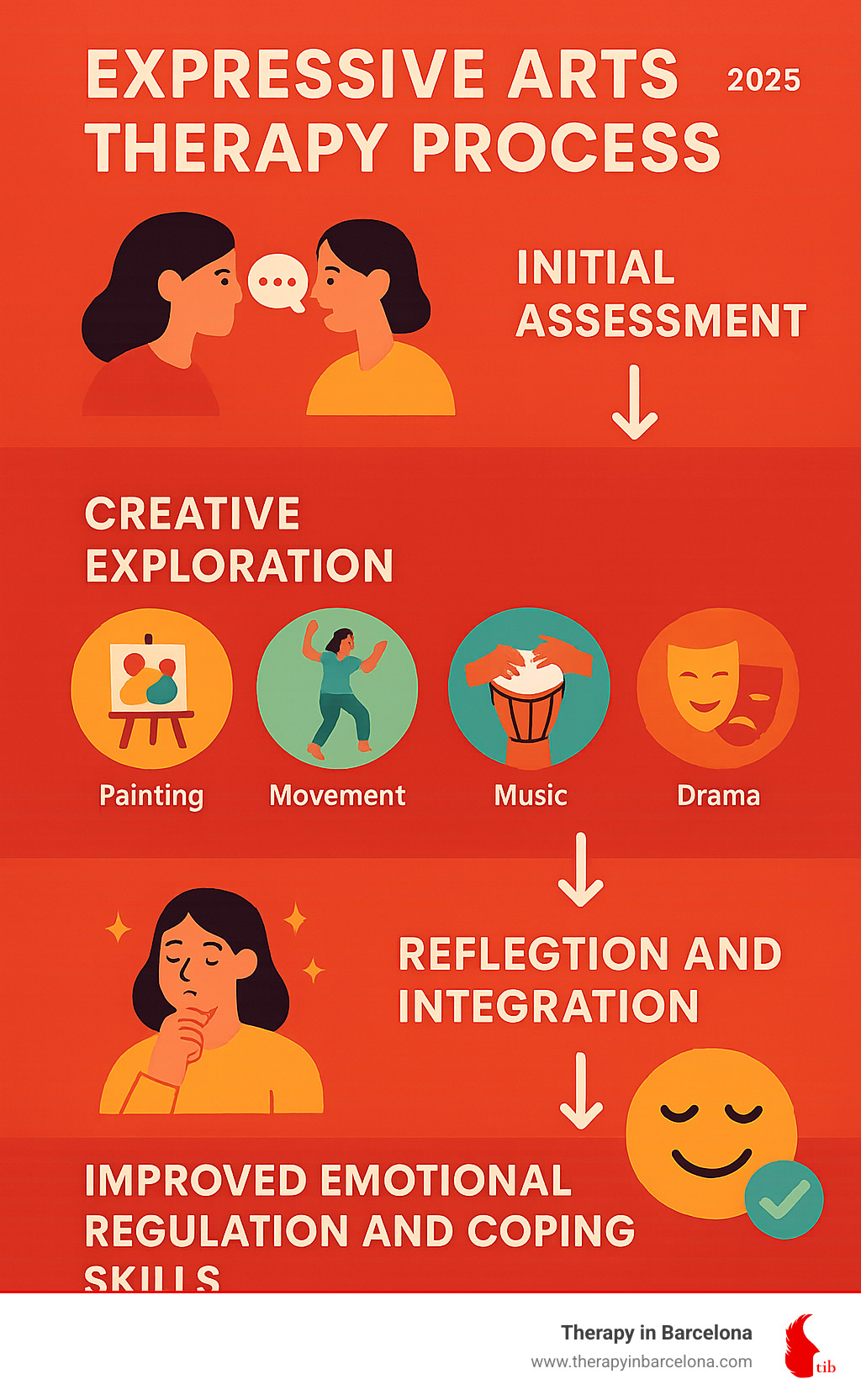
Core Modalities You Might Explore
Visual arts often serve as the foundation for many sessions, offering tangible ways to externalise complex internal experiences. Painting, drawing, collage, and sculpture give form to feelings that might otherwise remain trapped inside.
Movement and dance engage your body’s inherent wisdom about emotional states. Living abroad often creates physical tension—the rigid posture of trying to fit in, the collapsed stance of feeling defeated by another bureaucratic hurdle. Movement allows this stored stress to be expressed and released in ways that words alone cannot achieve.
Music and sound provide rhythm and resonance for emotional expression. Drumming can safely release anger about visa complications. Singing might reconnect you with your cultural identity.
Drama and storytelling help you explore different perspectives on your expat experience. Role-playing allows experimentation with new aspects of your identity. Storytelling helps create coherent narratives from what often feels like chaotic life changes.
The Science Behind Creative Flow
Neuroplasticity research reveals that creative activities literally rewire your brain. When you engage in art-making, multiple brain regions activate simultaneously, strengthening neural pathways associated with emotional regulation, problem-solving, and stress management.
Your limbic system—the brain’s emotional processing centre—responds particularly strongly to creative expression. When you paint your anxiety or dance your frustration, the amygdala (your fear centre) begins to calm whilst the hippocampus (memory centre) helps integrate the experience more constructively.
Research on neuro-aesthetics shows that even observing art can boost serotonin levels and increase cerebral blood flow. Creating art amplifies these benefits exponentially, inducing flow states that promote cognitive restoration and emotional healing.
How Expressive Arts Therapy for Adjustment Disorder Heals and Empowers

When Sarah first walked into her expressive arts therapy for adjustment disorder session, she couldn’t have imagined that mixing paint colours would help her make sense of her messy emotions about moving to Barcelona. Yet that’s exactly what happened—and it’s what happens for countless expats who find the transformative power of creative healing.
Sensory grounding forms the foundation of this therapeutic approach. When you’re feeling displaced and disconnected from your new environment, simply touching clay or feeling paintbrush bristles against paper can anchor you back to the present moment.
The magic often happens through narrative reframing. Instead of telling yourself “I’m completely failing at this new life,” you might paint your struggles as a stormy sea—and then find you can add a lighthouse to guide you safely to shore. The creative process naturally shifts your story from victim to navigator.
Symbolic distance creates emotional safety that direct conversation sometimes can’t provide. Talking about homesickness might feel too raw, but painting it as a grey cloud drifting across a canvas? That becomes manageable.
Benefits of Expressive Arts Therapy for Adjustment Disorder
The evidence for expressive arts therapy for adjustment disorder is compelling. The single-case study mentioned earlier showed remarkable improvements after just eight sessions: depression scores dropped from 26 (severe) to 20 (moderate), anxiety fell from 23 (very severe) to 19 (severe), and stress decreased from 19 (moderate) to 17 (mild).
Quick symptom relief often surprises clients. When you’re stuck in negative thought patterns, creative expression provides alternative pathways to emotional release. You might not be able to think your way out of anxiety, but you can paint your way through it.
Self-awareness increases as internal experiences become visible through creative work. Many clients report genuine surprise at what emerges in their artwork—colours they didn’t expect to choose, movements that feel foreign yet familiar.
Coping skills develop organically through the creative process. Learning to tolerate uncertainty whilst waiting for paint to dry mirrors learning to tolerate uncertainty in life transitions.
Populations Who Thrive with Expressive Arts Therapy
Adolescents respond particularly well to creative approaches. Art can address complex medical and psychological challenges simultaneously. Teenagers often struggle with verbal expression, making creative outlets especially valuable during the vulnerable process of cultural adaptation.
International students face unique adjustment pressures—academic stress layered with cultural adaptation, financial concerns, and social isolation. Creative expression provides outlets for homesickness and identity confusion whilst building resilience for ongoing challenges.
Inside a Session: Techniques, Tools & Take-Home Practices

Walking into an expressive arts therapy for adjustment disorder session might feel daunting at first. Sarah, a 28-year-old teacher from Ireland, remembers her initial nervousness: “I kept thinking I couldn’t draw to save my life. How was this supposed to help with my homesickness?” Yet within minutes of her first session, she found herself completely absorbed in the creative process.
Each session begins with grounding exercises that help clients reconnect with their bodies and the present moment. You might hold textured stones whilst taking deep breaths, or engage in gentle stretching to release the physical tension that often accompanies adjustment stress.
Mask-making offers one of the most powerful techniques for identity exploration. Living abroad often feels like wearing different masks—the confident professional mask at work, the lost tourist mask on the street, the homesick child mask in private moments. Creating literal masks allows you to explore these different aspects of your identity safely.
The gentle repetition of mandala colouring provides structure when life feels chaotic. The circular patterns contain overwhelming emotions whilst the rhythmic colouring motion soothes an overactive nervous system.
Movement mirroring helps rebuild connection with your body. Many expats carry cultural tension physically—rigid shoulders from trying to fit in, or a collapsed posture from feeling defeated. Your therapist might mirror your natural movements, then gradually introduce new gestures that release stored stress.
Case Example: 17-Year-Old Expat with SLE & TB
A remarkable case study demonstrates how expressive arts therapy for adjustment disorder can work even in the most challenging circumstances. A 17-year-old female patient facing multiple overwhelming stressors—systemic lupus erythematosus, pulmonary tuberculosis, and cultural adjustment as a recent immigrant—showed extraordinary improvement through creative expression.
Her initial psychological assessment revealed severe distress. Depression scores reached 26 (severe range), anxiety climbed to 23 (very severe), and stress levels hit 19 (moderate). The combination of serious illness and cultural displacement had created a perfect storm of psychological overwhelm requiring immediate intervention.
Waterfall painting became a turning point in her treatment. The flowing water imagery helped her visualise releasing pent-up emotions whilst the blue and white colours induced feelings of calm and peace.
The results spoke volumes about the effectiveness of creative intervention. Post-treatment scores showed remarkable improvement: depression dropped to 20 (moderate), anxiety fell to 19 (severe), and stress decreased to 17 (mild).
Evidence Base & Integrative Care

The research supporting expressive arts therapy for adjustment disorder continues to grow stronger each year. Meta-analyses examining creative therapies consistently demonstrate significant improvements in anxiety and depression symptoms across diverse populations.
Cancer patients have provided some of the most compelling evidence for expressive arts approaches. Multiple RCT studies show that when art therapy supplements standard medical care, patients experience significant reductions in depression, anxiety, and fatigue. These findings translate beautifully to adjustment disorder, where similar symptom clusters create comparable distress.
The Depression Anxiety Stress Scale (DASS-21) has become a gold standard for measuring therapeutic progress in creative therapies. Across multiple studies and populations, researchers consistently document clinically significant improvements within 8-12 sessions.
Systematic reviews of art therapy applications reveal effectiveness across an impressive range of mental health conditions. From childhood trauma to adult depression, from medical anxiety to cultural adjustment struggles, creative approaches demonstrate remarkable versatility.
Expressive Arts + Talk Therapy: Better Together
Emotion labelling becomes remarkably easier when clients can point to visual representations of their feelings. Instead of struggling to find words for complex emotions, they can describe the swirling colours of confusion, the jagged edges of anger, or the heavy greyness of homesickness.
Cognitive reappraisal—a core CBT technique—becomes far more concrete through artistic metaphors. A client might paint their negative thoughts as storm clouds, then create sunshine breaking through. This visual representation transforms abstract cognitive concepts into memorable, accessible experiences.
The shared language that develops between therapist and client through creative work becomes invaluable for ongoing therapy. Referring back to specific artworks or creative metaphors provides shorthand for complex emotional states and therapeutic insights.
Frequently Asked Questions about Expressive Arts Therapy for Adjustment Disorder
Do I need artistic talent to benefit?
This concern tops nearly every initial consultation. Expressive arts therapy for adjustment disorder operates on a fundamental principle that might surprise you: artistic skill has absolutely no bearing on therapeutic success.
The magic happens in the process, not the product. When someone creates their first painting in therapy, they’re not aiming for gallery walls—they’re externalising emotions that have been trapped inside. Those wobbly lines might represent anxiety more powerfully than any masterpiece ever could.
Leigh Matthews, the Australian psychologist who founded Therapy in Barcelona in 2011 after experiencing her own adjustment challenges as an expat, often reassures new clients: “I’ve seen stick figures convey more healing than detailed portraits. The therapeutic value lies in what you’re expressing, not how it looks to others.”
Research consistently supports this approach. Studies tracking therapeutic outcomes show zero correlation between artistic ability and mental health improvements.
How quickly might I notice changes in mood or stress?
Many people experience immediate shifts during their very first session. There’s something profoundly releasing about giving physical form to internal struggles—watching anxiety take shape in clay or seeing homesickness emerge in watercolours.
Measurable improvements typically emerge within 4-6 sessions. The case study we discussed earlier demonstrated significant DASS-21 score improvements after eight sessions, but many clients report mood changes much sooner.
However, sustainable change requires patience and consistency. Early sessions often provide emotional release and hope, whilst ongoing work builds lasting coping strategies.
Can sessions be done online if I travel often?
Absolutely. Expressive arts therapy for adjustment disorder adapts remarkably well to digital formats, making it perfect for digital nomads, frequent travellers, and expats who move between cities.
Online sessions offer surprising versatility. Clients can create digital art on tablets, photograph physical artwork for sharing, engage in movement exercises within their camera frame, or participate in guided visualisation exercises.
Therapy in Barcelona offers online sessions worldwide (except USA and Canada), recognising that international lifestyles demand therapeutic flexibility. Digital nomads working from Lisbon one month and Prague the next can maintain consistent support regardless of location.
Conclusion
Living abroad can feel like standing before a blank canvas, overwhelmed by the endless possibilities and paralysed by not knowing where to begin. Expressive arts therapy for adjustment disorder transforms that intimidating white space into a welcoming playground for healing and self-findy.
The beauty of this approach lies in its accessibility—you don’t need to be the next Picasso or have any artistic background whatsoever. The magic happens in the process of creation itself, not in producing gallery-worthy masterpieces. When words feel inadequate to capture the complexity of homesickness, cultural confusion, or identity shifts, colours, movement, and sounds become your voice.
Research consistently demonstrates the power of creative expression for adjustment challenges. Those significant drops in depression, anxiety, and stress scores we’ve discussed aren’t just numbers on a page—they represent real people refinding their resilience, rebuilding their confidence, and creating new narratives about their expat journey.
Leigh Matthews, the Australian psychologist who founded Therapy in Barcelona in 2011 after experiencing her own adjustment struggles as an expat, understood this need intimately. Her vision was simple yet profound: create a space where expats could process their experiences with therapists who truly understood the unique challenges of building a life in a foreign country.
Today, that vision has grown into a collaborative team of expat therapists who bring both professional expertise and personal understanding to their work. The personalised matching process ensures you’re paired with someone who gets your specific cultural background, adjustment challenges, and therapeutic preferences.
The flexibility of expressive arts therapy for adjustment disorder means your healing journey can adapt to your lifestyle. Digital nomads can engage in online sessions from anywhere in the world. Busy professionals can explore creative techniques during lunch breaks. Families can use art-making as a way to process their collective adjustment experience.
Your expat story doesn’t have to be one of struggle and survival. With the right creative tools and supportive guidance, it can become a masterpiece of resilience, growth, and authentic self-expression. The canvas of your new life is waiting—and you already have everything you need to create something beautiful.
Ready to pick up that brush and start painting your path forward? Therapy in Barcelona’s expressive arts services offer both in-person sessions at their Eixample location and online support for expats worldwide. Current fees range from €80-95 for individual sessions, with each therapist setting their own rates based on their experience and specialisation.
