


When Words Keep Failing You: A Guide to Communication for Couples Worksheets

Communication for couples worksheets are structured, printable (or digital) tools designed to help partners practise healthier conversation habits — and you can access many of them for free right now.
Here are some of the most effective types to look for:
- Feedback Wheel worksheet – guides you through separating what you observed from what you interpreted, then expressing feelings and making requests (adapted from Terry Real’s work)
- ‘I’ Statement worksheet – helps you replace blame with ownership, e.g. “I feel upset when plans change without warning”
- Active listening exercise – structured turns of uninterrupted speaking and reflective listening
- Weekly check-in template – a set of guided questions to keep connection consistent
- Appreciation exercise – a simple prompt to name five things you value about your partner
- Fair fighting rules reference sheet – a reminder of agreed boundaries during conflict
Most of us were never taught how to argue well, or how to really listen. That gap shows up quickly when two people are under pressure — and for couples navigating a move abroad, the pressure is rarely in short supply.
Relocation strips away familiar routines, support networks, and often a sense of individual identity. What’s left is two people who depend on each other more than ever, often without the tools to handle it.
Many couples experience these challenges after relocating. Whether navigating cultural differences or unequal adjustment to life abroad, stress often shows up in communication. Small misunderstandings grow, old patterns resurface, and silence can begin to feel easier than talking.
The good news is that communication is a learnable skill. Worksheets won’t solve everything on their own, but they give couples a concrete place to start — a shared structure that makes difficult conversations feel less like a minefield and more like a joint project.
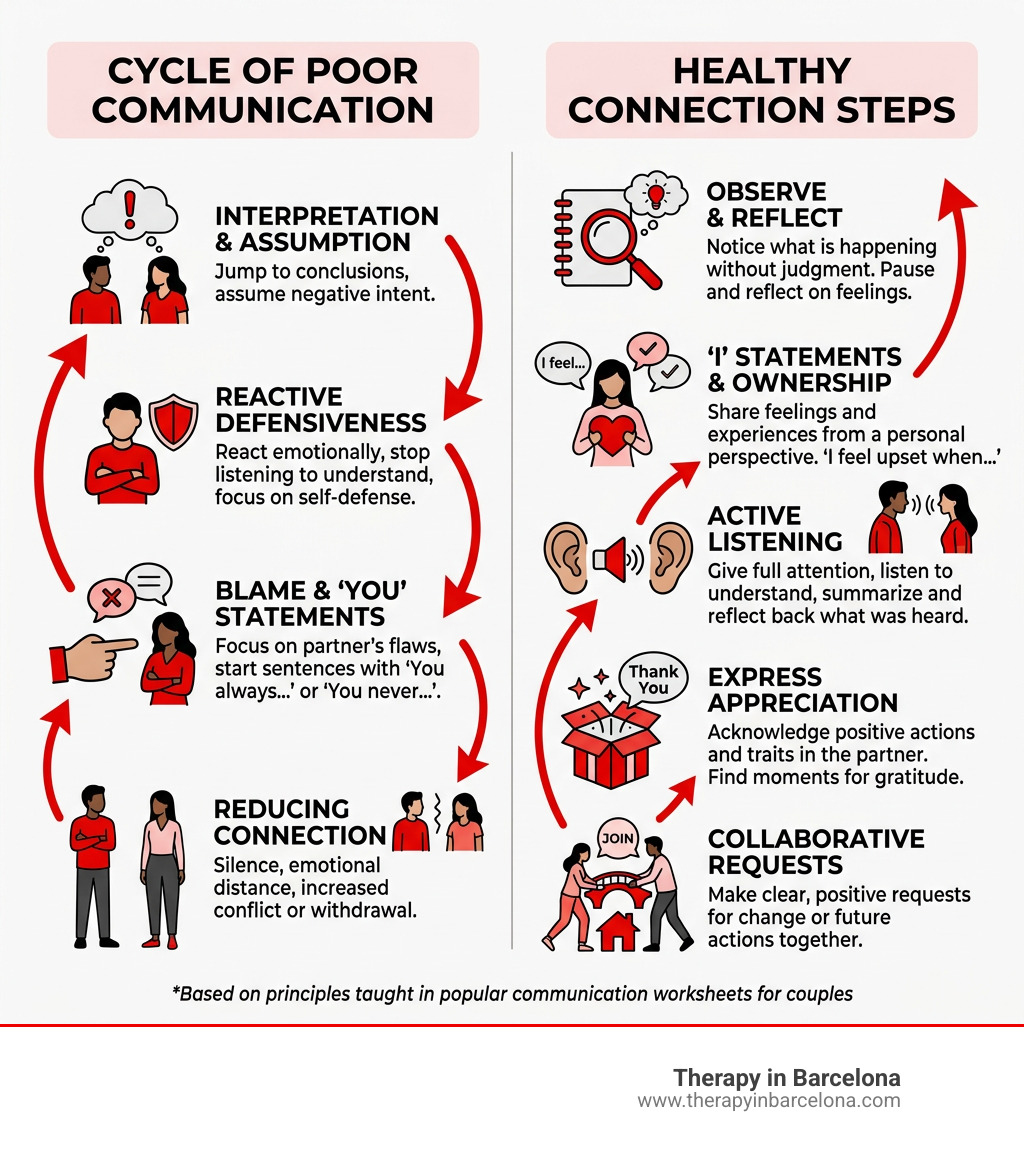
Poor communication can gradually erode a relationship, while learning healthier ways to communicate can strengthen connection and understanding.
This guide walks you through the best free and evidence-based communication worksheets for couples, how to use them, and when working with a therapist might make all the difference.
Why Use Communication for Couples Worksheets?
When emotions run high, our brains often flip into “fight or flight” mode. In this state, we stop listening to understand and start listening to defend. This is where communication for couples worksheets act as a vital external circuit breaker. They provide a roadmap when you’re feeling lost in a fog of resentment or confusion.
The core skills of healthy communication—listening, validation, and constructive feedback—can be hard to use in the middle of conflict. Worksheets help slow conversations down, shifting the focus from blame to understanding.
Research highlights the stakes of these skills. A study by Jafari et al. (2021) found that effective communication skills training significantly impacts the status of marital burnout. By using structured exercises, couples can break negative cycles before they lead to deep-seated detachment.
These tools also build accountability; when a request is written down clearly, it moves from a vague complaint to a collaborative goal.
The Best Communication for Couples Worksheets for Lasting Change
If you are looking for a place to start, few tools are as transformative as the Feedback Wheel, adapted from the work of renowned marriage expert Terry Real. This exercise is designed to help you elevate your communication game by stripping away the “mind-reading” that often poisons relationship dialogue.
The Feedback Wheel follows a specific four-step sequence for the speaker:
- Observation: State exactly what you saw or heard (e.g., “Yesterday, when you came home, you didn’t say hello”).
- Interpretation: Share the “story” your mind created (e.g., “What I made up about that is that you are unhappy with me”).
- Feeling: Name the core emotion (e.g., “I felt rejected and sad”).
- Request: Ask for a specific, positive action (e.g., “I would like a five-minute check-in when we both get home”).
The listener’s role is equally structured: they must paraphrase what they heard, acknowledge the partner’s perspective (without necessarily agreeing), and offer what they can realistically give. This prevents the “ping-pong” of accusations and ensures both partners feel heard.
Research published in the Personality & Social Psychology Bulletin suggests that these types of within-couple associations between communication and satisfaction are crucial for long-term happiness.
Mastering ‘I’ Statements with Communication for Couples Worksheets
Assertive communication is the cornerstone of a healthy relationship, but it’s a skill that requires constant practice. Most of us default to “You” statements (“You always ignore me,” “You never help”), which immediately trigger defensiveness in our partners.
Using couple communication worksheets focused on ‘I’ statements helps you take ownership of your emotions. Instead of attacking the other person’s character, you are describing your internal experience. This reduces the need for the other person to build a wall of self-protection.
Examples of ‘I’ Statements:
- “I feel overwhelmed when the kitchen is cluttered, and I would appreciate help with the clearing up tonight.”
- “I feel lonely when we spend our evenings on separate devices; can we set aside 30 minutes to talk?”
- “I feel anxious when I don’t know the plan for the weekend; could we sit down on Friday to look at our schedule?”
By focusing on the issue rather than the person, you move toward solution-oriented dialogue. You can learn more about developing assertive communication skills here.
Implementing Communication for Couples Worksheets in Your Routine
One-off exercises are great, but relationship maintenance is about habits. To move from misunderstandings to meaningful conversations, consider incorporating these structured check-ins:
- The Weekly CEO Meeting: Schedule a non-negotiable 30-minute block each week. Use a worksheet to track logistics (finances, chores) so they don’t bleed into your romantic time, but also ask: “How can I make you feel more loved this week?”
- Uninterrupted Listening: Set a timer for 3 to 5 minutes. One partner speaks while the other listens without speaking, using only non-verbal cues. Then swap.
- The Miracle Question: Ask each other: “If a miracle happened tonight and our relationship was perfect tomorrow, what is the first small thing you would notice?” This helps identify shared goals and desires.
- Five Things Go!: A quick exercise where you each list five things you appreciated about the other person that day.
These rituals ensure that distraction-free time becomes a pillar of your partnership, preventing the “roommate syndrome” that often plagues busy couples.
Navigating the Expat Relationship Experience
For the international community, communication isn’t just about “who does the laundry.” It’s often entangled with cultural adjustment, language barriers, and the profound isolation of living in a new city.
Whether you are navigating expat life in Valencia or the bustling international community in Madrid, the “intercultural compass” is a necessary tool.
Expat couples often face unique stressors:
- Relocation Stress: One partner may have moved for the other’s career, leading to an imbalance of power or resentment.
- Cultural Differences: Navigating different “stress languages” or family obligations in a foreign context.
- Third Culture Kids: Parenting children who are growing up between cultures adds another layer of complexity to family communication.
In these cases, worksheets help translate not just words, but cultural expectations. They provide a neutral ground where “how we do things in my country” can be explored without judgment.
Choosing the Right Support: Worksheets vs. Professional Therapy
While couple communication worksheets are excellent self-help tools, they have limits. If you find yourselves stuck in the same circular arguments despite using worksheets, or if there has been a significant breach of trust, professional support may be necessary.
In Spain, couples have several options for support, and it is important to understand the differences:
Public Health Systems Spain’s public system is affordable and accessible, but it often involves long waiting lists, limited choice of therapist, and less specialised support for the unique challenges of expat life.
Large Online Platforms Apps and large therapy platforms offer convenience and quick matching, but therapist continuity can vary, and some people have concerns about data privacy and confidentiality.
Therapy in Barcelona As a private-pay practice, Therapy in Barcelona provides personalised, culturally sensitive care. Since 2011, we’ve specialised in matching internationals with psychology-trained therapists who understand the expat experience, while maintaining a strong commitment to privacy and confidentiality.
Comparison of Support Options
Public Health Systems
- Pros: Accessible; low or no cost.
- Cons: Long waiting lists; no choice of therapist; rarely available in English or other expat languages; may lack cultural nuance.
Large Online Platforms
- Pros: Immediate start; usually lower cost than private clinics.
- Cons: Variable therapist quality; automated matching can feel impersonal; data privacy risks; high therapist turnover.
- Pros: Bespoke matching based on your specific needs; all therapists are psychology-trained expats; established local expertise since 2011; sessions available in-person in Barcelona or online worldwide.
- Cons: Private-pay service (though sliding scale fees are available for those in financial need).
Frequently Asked Questions about Relationship Worksheets
Can worksheets replace professional couples therapy?
Worksheets are fantastic for maintenance and “upskilling,” but they aren’t a replacement for therapy when there is deep-seated trauma, ongoing infidelity, or high-conflict cycles that feel unsafe. Think of worksheets as “relationship vitamins” and therapy as “specialist medicine.”
How often should we use communication exercises?
Consistency is better than intensity. A five-minute daily check-in or a weekly 30-minute “CEO meeting” is more effective than a four-hour marathon session once every six months.
What if my partner is reluctant to use worksheets?
It’s common for one partner to be more “pro-therapy” than the other. Instead of forcing a long worksheet, try suggesting a small, playful exercise like “Five Things Go!” or ask if they’d be open to a Free Discovery Call with an Intake Coordinator to see how it feels.
Conclusion
At Therapy in Barcelona, we know that life abroad can be messy. Our founder, Leigh Matthews, started this practice because she couldn’t find the culturally sensitive, English-speaking support she needed when she first moved to Spain. Today, our team of psychology-trained expat professionals provides that sanctuary for others.
Whether you are in Barcelona, Málaga, or Alicante, or connecting with us online from anywhere in the world, we are here to help you navigate the complexities of international life.
If you’re ready to move beyond the worksheets and start a deeper conversation, we invite you to book a Free Discovery Call. We will take the time to match you with the right therapist for your unique journey, ensuring you have the tools to build a stronger, more connected relationship.
