


Why Finding the Right Couples Counselor Matters

Couples counselling near me is a search many people make when their relationship hits a rough patch or when they simply want to strengthen their bond. If you’re looking for support, here’s what you need to know:
- Start with online directories like Psychology Today or specialised platforms that list qualified therapists in your area
- Check therapist qualifications – look for psychology-trained professionals with specific couples therapy training (Gottman Method, EFT, or Imago)
- Book a Free Discovery Call to assess comfort level and cultural fit, especially important for expats
- Consider virtual therapy for flexibility and access to specialists beyond your immediate location
- Expect an initial intake session where you’ll share your story, set goals, and establish a safe space
- Know your options – private practices offer personalised matching, while public systems and large platforms provide broader access
Many couples recognise the value of professional support for their relationship. Whether you’re navigating cultural differences as an international couple in Barcelona, dealing with communication challenges after a move to Valencia or Madrid, or simply feeling more like roommates than partners, finding the right therapist can feel overwhelming.
This guide will walk you through how to find qualified couples counselling in your area. You’ll learn about different therapeutic approaches, what to look for in a therapist, and what to expect from your first session. We’ll also address practical questions about cost, effectiveness, and what happens if your partner is hesitant about therapy.
The connection between you and your therapist is crucial for positive outcomes. For expats and internationals living in Spain, finding someone who understands both relationship dynamics and the unique challenges of life abroad makes a real difference.
That’s why we’ll also acknowledge alternatives – from public system clinicians to large online platforms to local private practices – and explain how specialised group practices like ours support internationals so you can make an informed choice.
Why Consider Couples Counseling? Signs and Benefits
Relationships, like anything living, require care and attention to thrive. Sometimes, despite our best efforts, we encounter challenges that feel too big to tackle alone. This is where couples counseling can offer a lifeline, providing a safe and structured environment to address issues and foster growth.
Many couples seek therapy when they notice persistent signs of distress. These might include:
- Constant arguments or escalating conflicts: When disagreements become cycles of anger and resentment, making it difficult to find resolution or even understand where things went wrong.
- Emotional disconnection: Feeling like you’re drifting apart, or perhaps more like roommates than partners, leading to an unfulfilled marriage or relationship.
- Infidelity or betrayal: A breach of trust that leaves a relationship broken and damaged, requiring careful navigation to heal or decide a path forward.
- Navigating major life transitions: Major life changes—such as moving abroad, becoming parents, job loss, or health challenges—can put a relationship under strain. For expats, cultural adjustment and homesickness can make things even harder.
- Parenting disagreements: Differing styles or expectations regarding children can become a significant source of conflict.
- Issues with intimacy or sex: A change in or lack of intimacy, or other sexual issues, can often signal deeper underlying problems.
- Feeling controlled or unappreciated: When one partner feels their love and devotion have turned into painful experiences, or that their partner has become demanding.
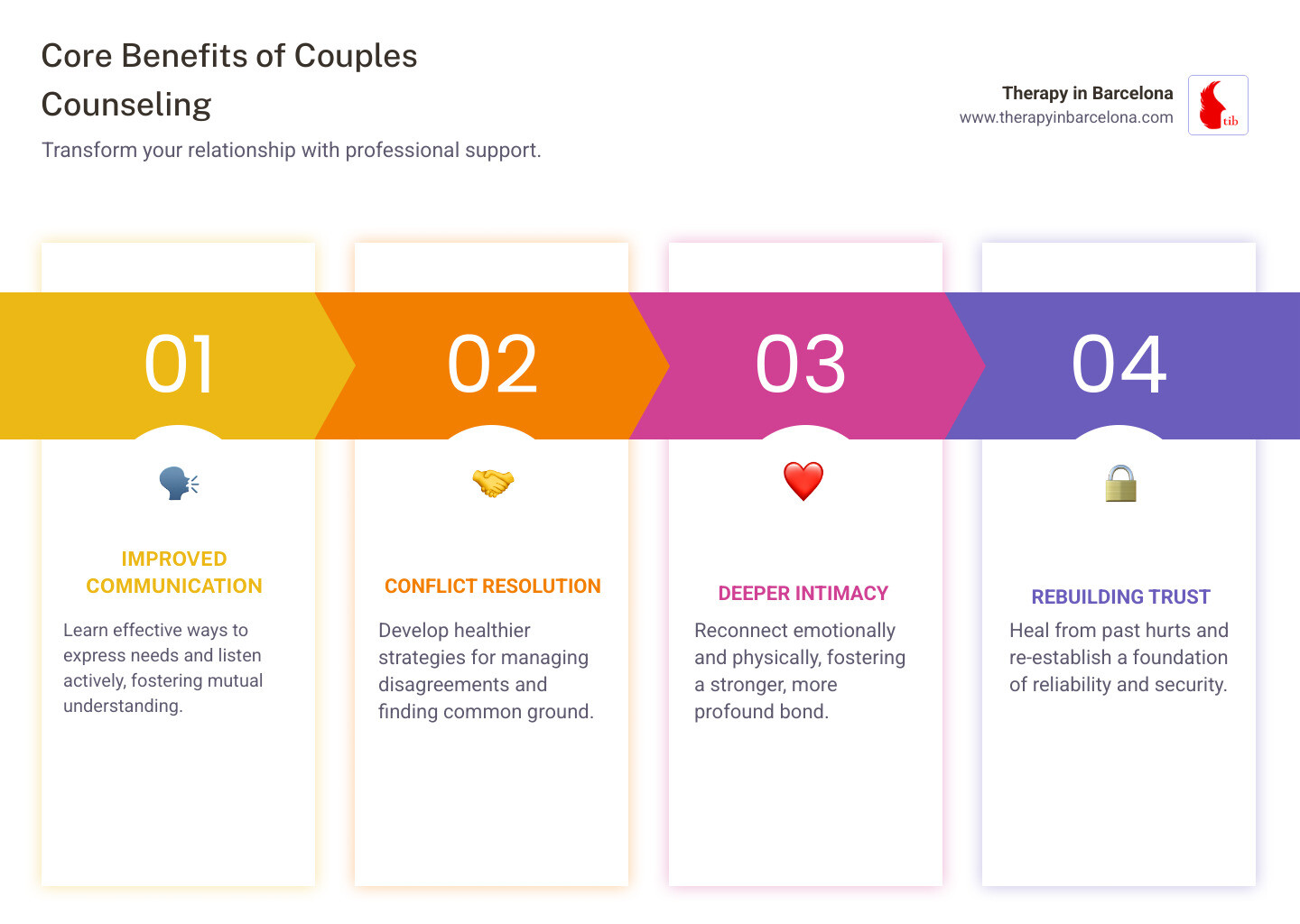
Couples counseling isn’t just for relationships in crisis, however. It’s also a powerful tool for proactive relationship care and improvement. Many couples find immense benefits, including:
- Improved communication skills: Learning to express needs clearly, listen actively, and truly understand each other’s perspectives. This can help break negative communication patterns and foster more positive interactions.
- Effective conflict resolution: Developing healthier strategies to steer disagreements, allowing couples to discuss difficult topics without spiralling into arguments.
- Increased empathy and understanding: Gaining insight into your partner’s inner world, attachment histories, and emotional triggers, which can lead to greater compassion.
- Rebuilding trust: For relationships impacted by betrayal, therapy provides a pathway to address the hurt, take accountability, and work towards reconciliation.
- Deepening intimacy and connection: Re-igniting passion, fostering a sense of security, and creating a relationship marked by understanding and empathy.
- Personal growth: Individual partners can also gain self-awareness and develop healthier coping mechanisms that benefit the relationship as a whole.
Couples therapy can help partners strengthen communication, rebuild trust, and navigate challenges together. With the right support, many couples gain practical tools to improve their relationship, resolve conflict more effectively, and reconnect with each other.

Understanding the Different Types of Couples Therapy
Choosing to seek help is a significant step, and therapy is not one-size-fits-all. Different therapeutic approaches resonate with different couples and address various needs. Finding the right approach for you is about aligning with a method that feels comfortable and effective.
The Gottman Method
One of the most widely recognised and extensively researched approaches is the Gottman Method. Developed by Dr John Gottman, this method is based on decades of research into what makes relationships work versus what causes them to deteriorate.
The Gottman Method uses the “Sound Relationship House Theory”, which is made up of nine components essential for healthy relationships. These components guide couples through exercises designed to improve their friendship, manage conflict constructively, and create shared meaning in their lives.
A Gottman-trained couples therapist will help you build skills to foster respect, love, trust, and affection. You can learn more about this approach directly from The Gottman Institute.
For those seeking this type of evidence-based support, Therapy in Barcelona offers couples counselling that can integrate such effective modalities.
Our psychology-trained therapists provide their services as therapists in Spain and bring experience working with internationals. You can find more information about our specific offerings on our website: More info about our couples counseling services.
Emotionally Focused Therapy (EFT)
Another widely used approach for couples is Emotionally Focused Therapy (EFT). Pioneered by Dr Sue Johnson, EFT is based on the idea that our relationship dynamics, both positive and negative, are driven by the way we feel and express our emotions, particularly those related to attachment.
EFT helps couples understand the emotional patterns that keep them stuck. By exploring deeper feelings and needs, partners can build a stronger emotional bond and create healthier ways of relating to each other.
Other Evidence-Based Approaches
Beyond Gottman and EFT, several other evidence-based modalities can be helpful in couples counselling. These include:
- Imago Relationship Therapy: Focuses on how unconscious childhood patterns influence adult relationships and helps partners understand each other’s “imago” or ideal partner image.
- Systemic Therapy: Looks at relationship problems within the context of the larger family system, exploring how family patterns and dynamics influence the couple.
- Somatic Approaches: Integrate body-centred techniques to help couples become more aware of physical sensations and emotional responses, often used to support trauma work or deeply ingrained patterns.
- Cognitive Behavioural Therapy (CBT): CBT principles can be adapted for couples to identify and change unhelpful thought patterns and behaviours that impact the relationship.
- Acceptance and Commitment Therapy (ACT): Helps couples clarify their values and commit to actions that align with those values, while learning to make space for difficult thoughts and feelings.
A skilled therapist will usually blend techniques rather than rigidly sticking to one model.
At Therapy in Barcelona, our team of psychology-trained therapists draw on approaches such as CBT, ACT, Systemic Therapy, Somatic approaches and Third Wave therapies, always adapting them to the needs of internationals living in places like Barcelona, Málaga, Valencia or Alicante.
This personalised matching and integrated approach is a cornerstone of effective therapy.
Your Practical Guide to Finding Couples Counselling Near Me
The search for couples counselling near me can feel overwhelming, but a simple, step-by-step approach can make it much easier.
Step 1: Where to Look for a Therapist
When you begin your search, you’ll encounter a few main avenues for finding a couples therapist:
- Online directories: Directories like Psychology Today and therapist matching services let you filter by location, speciality, therapeutic approach, and language to find the right couples therapist.
- Local community health centres and public system clinicians: Public health services in Spain may offer psychological support, although couples therapy can involve longer waits and fewer language options. For some couples, it’s a useful low-cost starting point.
- Large global therapy platforms: Some online platforms offer access to therapists worldwide, often at lower prices. However, they may place less emphasis on cultural fit or the unique needs of expat couples.
- Local private practices: Many cities with international communities – from Barcelona and Madrid to Málaga, Alicante or Sevilla – have independent therapists or small practices offering couples work. Quality and specialisation vary, so it’s worth asking about training and experience.
- Specialised group practices: Specialist practices, such as Therapy in Barcelona, offer personalised therapist matching, culturally informed care, and experienced psychologists who support individuals, couples, teens and families.
The key is to cast a wide net initially, then narrow down your options based on what feels right for you and your partner.
Step 2: How to Choose a Qualified Therapist
Finding a therapist with the right credentials and experience is essential. Not all counsellors have expertise in working with couples, so look for specific qualifications:
- Checking qualifications: Look for a qualified therapist with specific training and experience in couples therapy, and don’t hesitate to ask about their background and approach.
- Asking about specific couples therapy training: Therapists trained in approaches like the Gottman Method, EFT, or Imago Therapy have specialised tools to help couples strengthen their relationship.
- Assessing cultural and language fit: For expats, choose a therapist who understands the challenges of living abroad and offers therapy in your preferred language.
- Reading reviews and testimonials: While not the sole factor, client feedback can offer insights into a therapist’s style and approach.
- Considering a group practice: Group practices offer the benefit of shared expertise and collaborative care, helping ensure high-quality support.
You can learn more about the diverse qualifications and experiences of our team at Therapy in Barcelona here: More info about our team of therapists.
Step 3: The Initial Consultation
Once you have a few potential therapists in mind, the next step is to schedule an initial consultation, often as a short call.
This first contact is your opportunity to:
- Ask key questions: Ask about their approach to couples therapy, their experience with issues similar to yours, their fees, and how they handle confidentiality.
- Gauge your comfort level: The connection and therapeutic alliance with your therapist is one of the most important factors for a good outcome. Notice how you feel talking to them. Do they seem empathetic, clear, and non-judgemental?
- Ensure you feel heard and understood: This initial interaction should give you a sense that the therapist can grasp your situation and that both you and your partner feel respected.
At Therapy in Barcelona, clients can begin with a Free Discovery Call or by filling out an intake form. This first step helps us understand your needs and carefully match you with a psychology-trained therapist with the right experience and language skills.

The Convenience of Virtual Couples Counseling
Online couples counselling has become a practical and effective option for many internationals.
The benefits of online therapy include:
- Accessibility from anywhere: Whether you’re living in Barcelona, Valencia, Sevilla, Málaga, Alicante or further afield, virtual sessions remove geographical barriers, allowing you to access specialised therapists regardless of your physical location.
- Fitting sessions into busy schedules: Online therapy offers greater flexibility, making it easier to schedule appointments around work, family commitments, or different time zones, without travel time.
- A good option for couples in different locations: If you and your partner are in a long-distance relationship, or temporarily in different cities like Madrid and Gran Canaria, virtual therapy allows you to attend sessions together.
- Overcoming geographical barriers to find the right specialist: Sometimes, the best therapist for your specific needs isn’t located nearby. Virtual counselling opens up the possibility of working with highly specialised professionals who might otherwise be inaccessible.
At Therapy in Barcelona, we work online with clients worldwide, including the USA and Canada, and offer face-to-face sessions in our Barcelona office. All of our therapists are psychology-trained and provide their services as therapists in Spain, with a focus on the international community.
What to Expect: Your Couples Therapy Journey
Starting couples therapy is a journey, and knowing what to expect can help ease any worries you might have. It’s a collaborative process designed to help you and your partner deal with challenges and build a stronger, more satisfying relationship.
What happens in the first couples counselling session?
The initial session is the foundation of the work.
- Sharing your story and relationship history: You’ll be invited to talk about what brings you to therapy, your relationship history, and the specific challenges you’re facing.
- Collaboratively setting goals: The therapist will work with you to identify what you hope to achieve from therapy. These goals might evolve, but having a starting point helps guide the process.
- Establishing a safe, non-judgemental space: A good therapist will ensure both partners feel comfortable and heard. They create an environment where you can express feelings and thoughts without fear of blame.
- The therapist as a neutral facilitator: The therapist’s role is not to take sides. Instead, they act as a neutral guide, moderating conversations, asking questions, and helping you both communicate more effectively and understand each other’s perspectives.
How long does couples therapy typically last?
The duration of couples therapy is highly individual and depends on several factors:
- Your specific goals: If you have a very specific issue to address, therapy might be shorter-term, perhaps 8–12 sessions.
- The nature and depth of the issue: Long-standing conflicts or repeated patterns usually take more time.
- Each partner’s engagement: The more willing both partners are to participate in each session and apply what they learn between sessions, the more efficiently progress can be made.
Some couples find meaningful shifts in a few months, while others value ongoing support for a year or more. Your therapist will usually offer an initial sense of what might be helpful after the first few sessions.
How effective is couples therapy in improving relationships?
Couples therapy can help improve communication, strengthen connection, and give partners practical tools to navigate challenges together. Approaches such as the Gottman Method and Emotionally Focused Therapy (EFT) are designed to support lasting relationship change.
Outcomes depend heavily on both partners’ commitment. When both people are willing to be honest, try new ways of relating, and reflect on their patterns, therapy can help rebuild trust, improve intimacy, and create a more grounded sense of partnership.
At Therapy in Barcelona, our aim is to support internationals and their partners in building sustainable, respectful relationships, whether they are living in Barcelona, Valencia, Málaga, Madrid or beyond.
You can explore the range of therapeutic services we offer here: More info about our therapy services.
Frequently Asked Questions about Couples Counseling
When considering couples counselling, a few common questions often arise. Answering these can help you feel more prepared and confident in taking the next step.
Is couples counseling covered by insurance?
In Spain, private therapy services are typically self-funded. This means you would pay for sessions directly.
If you have international health insurance, it’s best to check with your provider. Some international plans offer coverage for mental health services, and couples therapy may be included if it relates to one or both partners’ mental wellbeing.
Policies vary widely, so a direct enquiry to your insurance company is the best course of action.
Some therapists and practices offer sliding scale fees for those with financial need. It’s always appropriate to ask about this possibility during your initial consultation if cost is a concern.
For more details on fees and how our services are structured, you can visit our dedicated page: More info about our fees.
What if my partner is unwilling to go to couples counselling?
Sometimes one partner is ready for therapy, while the other is hesitant.
Generally, couples counselling is most effective when both partners are willing to participate, as the focus is the relationship itself. Without both partners present, it is harder to work on shared patterns.
However, you still have options:
- Consider individual therapy: One partner can start individual therapy to work on their own responses, communication skills, and boundaries. Positive changes in one person can often shift the relationship dynamic and sometimes encourage the other partner to join later.
- Explore the resistance with curiosity: Try to understand why your partner is unwilling. Is it fear of blame, scepticism about therapy, or discomfort with emotions? Calm conversations that normalise therapy as a form of support, not judgement, can sometimes reduce resistance.
At Therapy in Barcelona, we support individuals navigating relationship challenges, even if their partner is not yet ready to join. You can learn more about how individual therapy can support your wellbeing and your relationships here: More info about individual therapy.
Can therapy help even if we’re not in a crisis?
Yes. Couples therapy is not only for crisis situations.
Here are some scenarios where therapy can be very helpful even without a crisis:
- Premarital counselling: For couples planning to marry in cities like Zaragoza or Marbella, premarital counselling offers space to discuss expectations, values, money, parenting, and conflict styles before making a long-term commitment.
- Navigating life transitions: Proactively seeking support when moving to a new country like Spain, relocating to Barcelona or Valencia for work, starting a family, or blending families can help prevent future conflicts and strengthen your bond.
- Enhancing an already good relationship: Even strong relationships can benefit from a check-in. Therapy can help you deepen your connection, improve intimacy, and learn new ways to support each other.
Seeking support early often means shorter, more focused work and can help you build habits that protect your relationship over time.
Taking the First Step Towards a Healthier Relationship
Finding the right support for your relationship is a sign of care, not weakness. It shows you value your connection and want it to grow.
For expats and internationals living in Spain – whether in Barcelona, Madrid, Valencia, Málaga, Alicante or smaller hubs like Sevilla or Zaragoza – having a therapist who understands the realities of life abroad can make the process feel safer and more relevant.
At Therapy in Barcelona, we offer:
- Personalised matching: We carefully match you with a psychology-trained therapist based on your needs, background, and language.
- Psychology-trained expat therapists: Our psychology-trained therapists have extensive experience supporting expats, international professionals, and multicultural families.
- Culturally and linguistically sensitive care: We work in English, and some of our therapists also speak German, French, Spanish, Afrikaans, Portuguese, Austrian-German and Swiss-German.
- Flexible access: We offer online sessions worldwide, including the USA and Canada, and face-to-face sessions in our Barcelona office.
- Collaborative group practice: Established in Spain since 2011, our collaborative team supports adults, couples, teens, and families with high-quality, psychology-led care.
If you’d like support, book a Free Discovery Call. It’s a simple way to ask questions, share what you’re looking for, and explore whether our team is a good fit for you and your partner.
