


When Studying Abroad Feels Nothing Like You Imagined

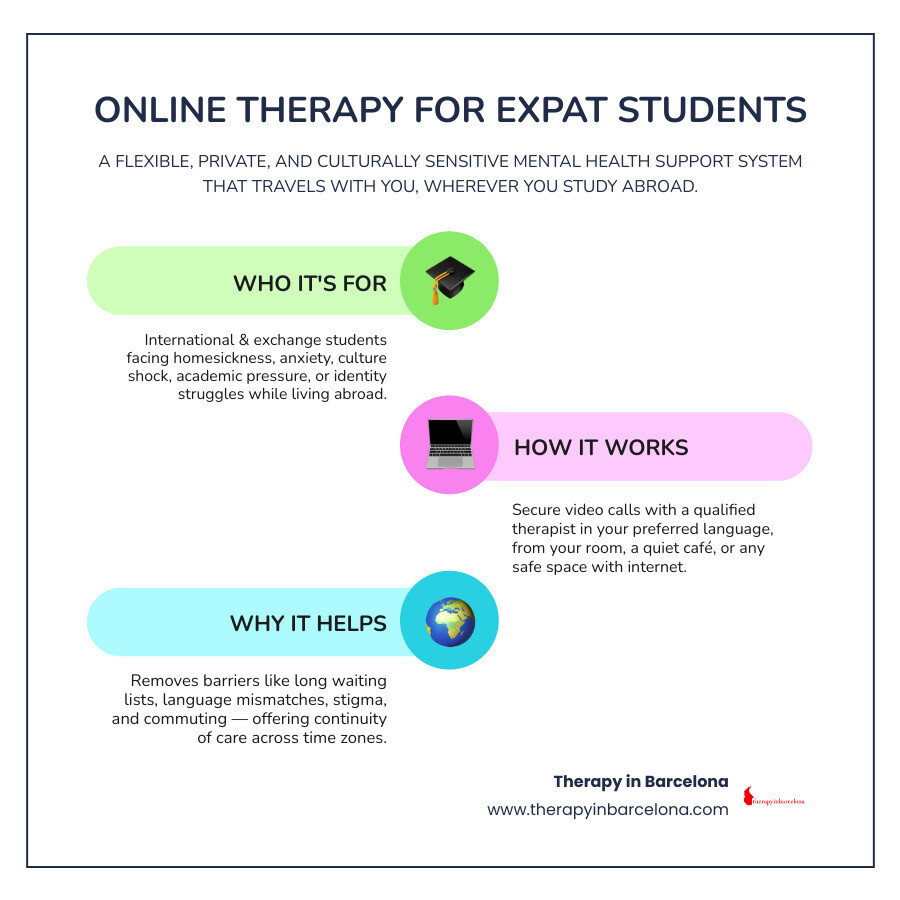
Online therapy for expat students is a flexible, private, and culturally sensitive way to access mental health support — no matter where in the world you’re studying.
Here’s what it typically involves:
- Who it’s for: International and exchange students studying outside their home country who are struggling with homesickness, persistent worry, academic pressure, culture shock, or identity questions.
- How it works: You meet with a qualified therapist via secure video call, in your preferred language, from your room, a quiet café, or wherever feels safe.
- Why it helps: It removes the barriers that stop most students from getting support — long waiting lists, language mismatches, fear of stigma, and the logistical headache of commuting to in-person appointments.
- Where to start: Look for a therapist who has experience working with international students, offers flexible scheduling across time zones, and understands the cultural adjustment process — not just the surface-level struggles.
You packed your bags, booked your flights, and told yourself this was going to be the experience of a lifetime. And in many ways, it is. But somewhere between the new campus, the unfamiliar academic system, and the evenings spent alone in a city that doesn’t quite feel like yours yet, something shifted.
Maybe you’re exhausted in a way that’s hard to explain. Maybe you’re sending cheerful updates home while quietly wondering if you made a mistake. Maybe you’re sitting in a library surrounded by people and still feeling completely invisible.
Research consistently shows that expats are 50% more likely to experience overwhelming worry and low mood than those who stay in their home country.
For students, the pressures are even more layered — visa stress, academic performance, financial strain, and the daily effort of simply functioning in a culture that isn’t your own. That’s a lot to carry, especially without your usual support network close by.
The good news is that support doesn’t have to be local to be real. Whether you’re studying in Barcelona, Valencia, Madrid, or on the other side of the world entirely, online therapy can meet you exactly where you are.
The Hidden Struggles of Studying Abroad
To outsiders, your life probably looks glamorous. Social media feeds are filled with sunny photos of historic European plazas or weekend trips to coastal towns. But behind the curated highlights lies a complex psychological reality.
When you relocate for university, you don’t just change your address; you leave behind your entire support system, your daily routines, and your familiar cultural reference points. This sudden lack of structure can make you flounder and feel overwhelmed much faster than you would at home. Psychologists refer to this profound sense of disorientation as acculturative stress.
To help understand what is happening, it is useful to look at the different types of pressures international students face. These are generally split into two categories:
- Extrinsic Stressors (External Pressures):
- Academic Pressure: Navigating a completely foreign university system, different grading standards, and unfamiliar classroom dynamics.
- Sociocultural Adjustment: The constant, exhausting mental effort of “performing belonging” — trying to decode local customs, slang, and unwritten social rules.
- Financial Concerns: Managing a tight budget in a foreign currency, often while restricted in your ability to work.
- Intrinsic Stressors (Internal Pressures):
- Identity Shifts: Wondering who you actually are when you are completely removed from the cultural context that originally shaped you.
- Visa Status Anxiety: Knowing that your legal right to remain in the host country is strictly tied to continuous full-time academic enrollment.
- Post-Graduation Uncertainty: The nagging worry about what happens next, visa renewals, and career choices.
Consider a 21-year-old student from the UK who moved to Valencia for an Erasmus year. They spent their first month adapting to Spain’s late-night social schedule and a different style of university lectures.
While family back home thought they were living the dream, they were secretly experiencing intense panic before exams and deep isolation in their student flat, along with guilt about speaking up for fear of seeming ungrateful or weak.
This internal conflict is what we call Invisible Baggage: Unpacking the Mental Health Crisis Among International Students. Struggling to cope is not a sign of personal weakness; it is a natural response to a massive life transition.
If you are finding things difficult, exploring Beyond Borders: A Guide to Understanding International Student Mental Health can help you understand the systemic pressures at play, while learning how to transition From Homesick to Hopeful: Tackling Mental Health as an International Student can give you a roadmap back to feeling like yourself.
Why Online Therapy for Expat Students is the Perfect Fit
When life abroad already feels overwhelming, finding a local therapist or navigating public healthcare can feel impossible. Remote counselling offers a simpler, more accessible alternative.

According to a 2025 study on the Mental Health Needs of International Students: Insights for Digital Solutions, digital mental health solutions are uniquely positioned to overcome the barriers that prevent students from seeking help. The primary advantages include:
- Enhanced Privacy: Many students worry about mental health stigma. Online therapy offers private access to professional support without visiting a campus clinic where classmates might see you.
- Scheduling Flexibility: Your university schedule can be hectic, filled with lectures, study groups, and part-time work. Online sessions can easily be scheduled during gaps in your timetable, early mornings, or evenings.
- Comfort and Safety: You can speak with a therapist from the safety and comfort of your own bedroom, using a secure, confidential video link.
- Continuity of Care: Student life is transient. Online therapy keeps your care consistent through moves, internships, and study abroad, so you do not have to start over with a new therapist.
By choosing Teletherapy for Students: Connect with Counselors from Anywhere, you gain access to a stable anchor in an otherwise rapidly changing environment.
If you want to dive deeper into the practical advantages of this format, you can read about What are the benefits of online therapy for internationals living in Spain? to see how remote support simplifies the adjustment process.
Finding the Right Cultural and Linguistic Match
Finding a therapist who understands your cultural background can be difficult. Explaining your life context every session leaves less time for meaningful therapy.
For expat students, culturally empathetic therapists—especially those with expat experience—can better understand the stress of cultural adjustment, identity shifts, and starting over abroad.

When searching for support, look for directories and practices that focus specifically on the international experience. Finding a specialist who aligns with your journey is explored in detail in The Expat’s Guide to Online Therapy: Bridging Distances, Building Connections, which shows how virtual platforms can bridge geographical divides to find your perfect match.
What to Look For in Online Therapy for Expat Students
When evaluating potential therapists or online platforms, keep the following criteria in mind:
- Relevant Professional Training: Ensure the therapist is fully qualified, registered, and has specific experience working with young adults and international populations.
- Evidence-Based Approaches: Look for practitioners who utilise established modalities like Cognitive Behavioural Therapy (CBT) for managing exam-related worry, or Acceptance and Commitment Therapy (ACT) for managing major life transitions.
- Somatic and Body-Based Tools: High-pressure transitions can keep your nervous system on high alert. Somatic and polyvagal therapies can help you calm your body and feel grounded.
- Linguistic Fit: It is highly beneficial to work with a therapist who speaks your preferred language fluently, allowing you to express complex emotional states without a mental translation delay.
For a comprehensive checklist on choosing the right virtual setup, refer to Finding a Therapist Online: Your Guide to Virtual Support.
Overcoming the Language Barrier in Remote Support
Even if you speak the local language of your host country well enough to buy groceries or follow a university lecture, conducting therapy in a second language is a different challenge entirely.
Stress can make it harder to find the right words, leaving you feeling “lost in translation” and causing delays in expressing complex thoughts or humour.
Therapy is most effective when you can speak freely, using the slang, idioms, and emotional nuances that feel natural to you. Working with multilingual therapists or accessing support in your native tongue ensures that nothing gets lost.
If you are looking for English-language support, you can read Mind Your Language: A Guide to Online Therapy in English to understand why linguistic comfort is so vital for deep therapeutic connection.
Navigating Costs, Insurance, and Practical Alternatives
As a student, budget is almost always a primary concern. It is easy to assume that private therapy is out of reach, but there are several pathways to make mental health support financially accessible.
First, check your international student health insurance policy. Many comprehensive student plans include coverage or reimbursement for psychological and therapeutic sessions. If your policy allows this, your therapy provider can supply the necessary invoices and session confirmations to facilitate your claims.
Additionally, while private therapy is generally a private-pay service, many independent practitioners and group practices understand the financial vulnerability of students, au pairs, and language assistants.
Some therapists offer sliding scale fees or discounted student rates for those with genuine financial need. When you reach out to a practice, do not hesitate to ask if they have student-friendly pricing options available.
To learn more about managing these logistical details, consult Your Compass for Care: Navigating Therapy as an International Student.
Comparing Your Mental Health Support Options
When looking for support, it is helpful to understand how different systems compare. Here is a direct, mobile-friendly breakdown of your options:
- Public System Clinicians
- The Reality: Most European public health systems are heavily strained. You may face soul-drainingly long waiting lists stretching for several months.
- The Challenges: There is often a significant language barrier, and public clinicians rarely have specialised training in expat-specific issues like acculturative stress or visa-related worry.
- Large Online Platforms
- The Reality: These are corporate, high-volume subscription apps designed for mass matching.
- The Challenges: They often use automated algorithms rather than human insight to match you, experience high therapist turnover, and have raised serious data privacy concerns regarding how student data is managed.
- Other Local Practices
- The Reality: Traditional private clinics in your host city.
- The Challenges: While professional, they are primarily designed for the local domestic population and may lack a deep, lived understanding of the unique international student experience.
- Therapy in Barcelona
- The Reality: A trusted, specialised group practice established in 2011.
- The Advantages: We provide personalised therapist matching, psychology-trained expat therapists, strict confidentiality, and flexible online therapy worldwide, including the USA and Canada.
Practical Steps to Start Online Therapy for Expat Students
Taking the first step can feel daunting, but setting up your remote sessions is a straightforward process.
Here are the practical steps to help you prepare:
- Secure a Private Space: Find a quiet, confidential space where you will not be interrupted. This could be your bedroom, a private study room in the library, or even a quiet spot outdoors.
- Check Your Tech: Ensure you have a stable internet connection, a laptop or smartphone with a working camera, and a pair of headphones for added privacy.
- Coordinate Time Zones: If you are working with a therapist based in a different country, use a time zone converter to double-check your appointment times.
- Reflect on Your Goals: Before your initial consultation, take a few minutes to note down what you are struggling with and what you hope to achieve. You do not need to have everything figured out; simply having a rough idea helps.
- Book an Initial Chat: Most reputable practices offer a brief, free initial conversation — often called a Free Discovery Call — to help determine if the therapist is a good fit for your needs.
For a detailed guide on making this transition as smooth as possible, read Unlock Your Best Self: Online Therapy Made Easy for Students.
Frequently Asked Questions about Studying Abroad and Mental Health
Do I need to be in a crisis to start therapy?
No, you absolutely do not need to be in a crisis to benefit from therapy. In fact, seeking support early is one of the best forms of preventative care.
Waiting until you are completely burned out, failing your classes, or experiencing severe feelings of panic makes recovery much harder. Talking to a professional when you first notice feelings of persistent loneliness, academic stress, or difficulty sleeping can give you the tools to manage these challenges before they turn into a crisis.
Will seeking therapy affect my student visa status?
Private-pay therapy is completely confidential. Sessions and records are not shared with universities, government, insurers, or visa authorities, so your visa status and academic standing remain private.
Can my parents pay for my online therapy sessions?
Yes, this is very common. Many international students have their therapy funded by their parents or family members as part of their overall educational and health expenses. Since payments are handled securely online, your parents can easily cover the costs from home while you access the care you need abroad.
Finding Your Anchor While Studying Abroad
Studying abroad is a profound adventure, but it is also a major disruption to your identity and your sense of safety. Having a space where you do not have to “perform” strength, where you can speak your native language, and where your struggles are met with genuine empathy is life-changing.
Founded in 2011 by Australian psychologist Leigh Matthews, Therapy in Barcelona was created to provide high-quality, English-speaking psychological care that understands the expat experience.
Over the last 15 years, Therapy in Barcelona has grown into a trusted hub of support. Our team consists of highly qualified, psychology-trained expat professionals who bring both clinical expertise and personal expat experience to their work.
We offer personalised therapist matching, ensuring you are paired with a practitioner who aligns with your specific personality, background, and goals.
Whether you are studying in Barcelona, adjusting to life in Madrid, Valencia, Málaga, Alicante, Sevilla, Marbella, Gran Canaria, or Zaragoza, our online therapy services are designed to travel with you.
You do not have to carry the quiet weight of relocation alone. If you’d like support, book a Free Discovery Call today, and let us help you find your footing abroad.
