


What is Emotional Resilience Therapy and Why Does It Matter?
Emotional resilience therapy focuses on building skills to help you adapt and bounce back from life’s challenges—whether it’s moving abroad, coping with stress, managing a difficult situation, or overcoming loss. Unlike other therapies, it doesn’t just help you deal with problems; it teaches you how to strengthen your emotional “muscles” so you can face future challenges more confidently.
If you’re looking for a quick overview, emotional resilience therapy includes:
- Building coping skills to handle stress and anxiety.
- Strengthening mental flexibility to adapt easily.
- Learning mindfulness and cognitive-behavioural techniques.
- Developing a supportive network and relationships.
- Overcoming personal and external barriers like loneliness, isolation, discrimination, or chronic illness.
According to recent studies, nearly one in three Americans reported feeling anxious or nervous in the preceding week, highlighting the growing need for effective resilience support. Indeed, as Dr Domingues emphasises:
“Returning to the baseline means returning to the emotional state you had before a stressful event. It doesn’t mean you’re not experiencing stress, distress, or anxiety.”
As an international in Barcelona—or anywhere else—building emotional resilience is vital for navigating cultural challenges, loneliness, and stress. Whether you’re like Emily, who struggles with loneliness in a new city, or David, who feels overwhelmed balancing work and personal challenges abroad, emotional resilience therapy offers practical tools and strategies to help you thrive.
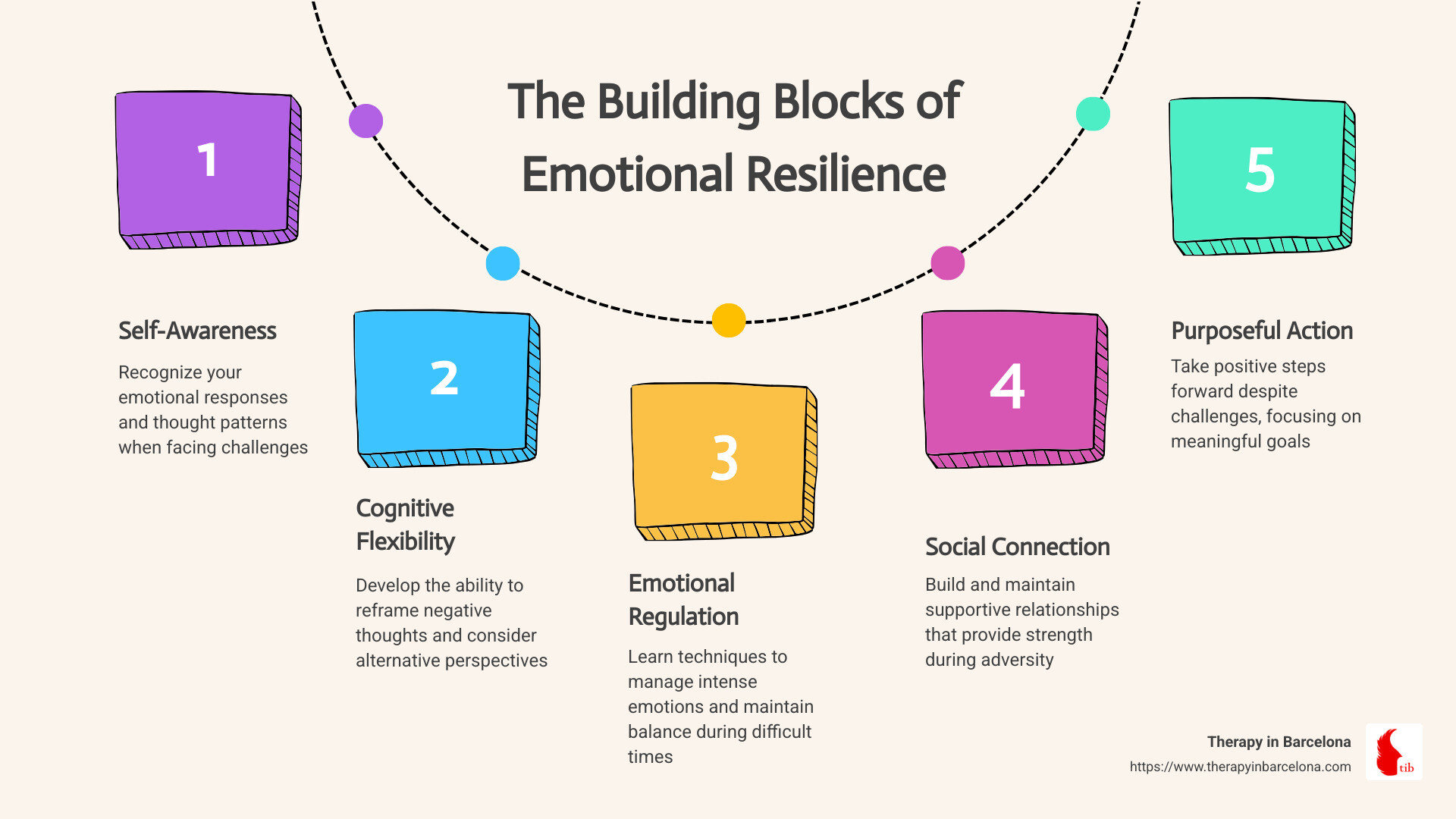
What Is Emotional Resilience Therapy?
Emotional resilience therapy is a specialised therapeutic approach designed to help you build the inner strength and flexibility to steer life’s inevitable ups and downs. Life abroad can amplify the stressors you face, from cultural adjustments and loneliness to language barriers and feeling disconnected. Emotional resilience therapy provides you with practical tools to adapt and flourish despite these challenges.
So, what exactly is emotional resilience? According to the APA Dictionary of Psychology, resilience is “the process and outcome of successfully adapting to difficult or challenging life experiences, especially through mental, emotional, and behavioural flexibility.” In simpler terms, it’s your ability to bounce back, adapt, and even grow stronger in response to life’s setbacks.
At its heart, emotional resilience therapy blends several evidence-based therapeutic methods to help you develop this vital skill. It integrates cognitive-behavioural therapy (CBT) to reshape negative thinking patterns, mindfulness practices to ground you in the present moment, and elements of positive psychology to boost your outlook and wellbeing. The ultimate goal is not merely to survive hardship but to thrive in the face of adversity.
Leigh Matthews, founder of Therapy in Barcelona and an Australian psychologist living in Barcelona since 2011, knows how vital emotional resilience is for expats. She explains, “Moving to a new country creates a unique set of challenges that can test even the most adaptable person. As an immigrant myself, I experienced how cultural adjustment, language barriers, and distance from support networks can impact mental wellbeing.”
Many expats resonate with these feelings. Perhaps you relate to Emily—a fictionalised representation of many who move abroad. At 34, Emily relocated from the UK to Barcelona craving trip and connection. Instead, she found herself struggling with loneliness, isolation, and stress. While Emily’s experience isn’t real, it mirrors the very real challenges countless expats face. Emotional resilience therapy offers practical strategies to help individuals like Emily—and perhaps someone like you—build strength, self-awareness, and adaptability in navigating life abroad.
How Emotional Resilience Therapy Differs from Other Therapeutic Approaches
You might wonder what sets emotional resilience therapy apart from other types of therapy. Where traditional therapeutic methods often aim to resolve past issues or relieve current symptoms, emotional resilience therapy goes a step further. It empowers you with lasting skills to continually adapt and respond flexibly to life’s changing circumstances.
Unlike therapies that offer short-term solutions or focus mainly on healing past wounds, emotional resilience therapy emphasises a blend of practical skill-building and inner growth:
- Dynamic adaptation—Instead of giving you a one-time fix, this approach teaches you to continuously adjust to life’s evolving situations, equipping you with resilience for the long haul.
- Skill cultivation—You’ll learn practical, versatile skills like mindfulness, cognitive reframing, and problem-solving strategies that can be applied to various challenges throughout your life abroad and beyond.
- Growth mindset—Rather than viewing obstacles purely as negative events, you’ll accept challenges as opportunities for personal development, finding your inner strengths.
- Holistic approach—By addressing the mental, emotional, and behavioural aspects of resilience, the therapy supports your overall wellbeing, helping you build a strong foundation for thriving in any situation.
One client at Therapy in Barcelona beautifully summed up her experience: “My therapist not only helped me through my immediate crisis but gave me tools I now use daily. I feel more confident facing challenges because I know I have the skills to adapt.”
For expatriates, who often live in a state of continual transition, uncertainty, and adaptation, emotional resilience therapy is particularly valuable. It goes beyond simply easing immediate distress—it helps you cultivate a lasting ability to cope with life’s complexities and changes, ensuring you don’t just survive expat life, but thrive within it.
Core Techniques Used in Emotional Resilience Therapy
Building emotional resilience involves developing practical skills to manage life’s ups and downs. Emotional resilience therapy uses a variety of engaging techniques designed to help you adapt and thrive, especially valuable for internationals navigating the unique challenges of living abroad. Let’s explore some of the core approaches used at Therapy in Barcelona.
Cognitive Reframing: Changing Negative Thought Patterns
One of the foundational skills taught in emotional resilience therapy is cognitive reframing. This technique is about becoming aware of negative or unhelpful thoughts and consciously shifting them to more balanced, positive views.
Imagine you’re an expat feeling discouraged by thoughts like, “I’ll never make meaningful connections here.” Through cognitive reframing, you might learn to shift this thought to something more empowering, like, “Building friendships takes time, but I’m taking positive steps by joining local community groups.” This gentle shift in perspective doesn’t deny your struggles—it simply opens the door to a more hopeful outlook and proactive attitude.
At Therapy in Barcelona, our therapists work closely with internationals to identify common “thinking traps” that fuel stress and anxiety in expat life—whether it’s navigating cultural misunderstandings, language barriers, or settling into a new professional environment. As one client shared: “I used to catastrophise every small misunderstanding. Now, thanks to cognitive reframing, I’m able to catch those thoughts early and handle situations with much more calm and confidence.”
By learning to reinterpret challenging situations, you’ll find an inner strength that helps you better handle future setbacks, creating lasting emotional resilience.
Mindfulness and Stress Reduction in Emotional Resilience Therapy

Another essential pillar of emotional resilience therapy is mindfulness practice. Mindfulness helps you stay grounded in the present rather than becoming overwhelmed by past regrets or anxieties about the future.
Our therapists at Therapy in Barcelona introduce mindfulness in practical, accessible ways—like teaching you paced breathing techniques where you breathe deeply through your nose and slowly exhale through your mouth. This simple exercise activates your body’s natural relaxation response, soothing anxiety and stress.
Clients also learn body scan meditations, gently focusing awareness on different areas of the body to release tension and foster relaxation. Practising present-moment awareness—observing sensations, feelings, and thoughts without judgment—helps expats let go of worries and comparisons that often arise when navigating unfamiliar cultures.
As Leigh Matthews, founder of Therapy in Barcelona and herself an international, explains, “When adjusting to life abroad, it’s easy for your mind to fill with anxieties and worries. Mindfulness practices help you to pause, step back, and respond thoughtfully, rather than reacting impulsively.”
Research shows that mindfulness significantly reduces anxiety and depression symptoms and improves overall wellbeing. For internationals looking to dive deeper, our article Mindfulness for Expats offers additional insights on incorporating mindfulness into daily routines abroad.
Building Support Networks and Positive Relationships
Strong, supportive relationships are another cornerstone of emotional resilience therapy. Having trusted connections around you can make all the difference in managing stress and adapting positively to new environments.
However, building these connections in a foreign country isn’t always easy. At Therapy in Barcelona, we understand that forming meaningful bonds abroad requires patience, support, and thoughtful guidance. Our therapists help you identify opportunities to connect meaningfully—whether that’s through community groups, language exchanges, or professional networks aligned with your interests and values.
Additionally, our therapists support you in enhancing communication skills, allowing you to better steer and bridge cultural differences. We also explore how to balance keeping in touch with loved ones at home while creating fulfilling relationships in your new community.
One client at Therapy in Barcelona shared their experience: “Initially I felt isolated and overwhelmed moving to Barcelona. My therapist helped me realise that building my support network is a process—and now I’m happy to say I have both local and international friends who support me in different ways.”
The quality of your relationships matters far more than quantity. Even a few meaningful connections can significantly boost your emotional resilience, making life’s challenges far more manageable.
By integrating these core techniques—cognitive reframing, mindfulness practices, and cultivating supportive relationships—emotional resilience therapy provides internationals with essential tools not merely to survive abroad, but to thrive.
Benefits of Building Emotional Resilience Through Therapy
When you engage in emotional resilience therapy, you’re not just learning to cope with today’s challenges—you’re building a psychological foundation that will support you throughout life’s journey. For internationals navigating the complexities of life abroad, these benefits can be truly transformative.
Research consistently shows that resilience interventions significantly improve not just personal resilience, but overall mental health and performance. For expats, this can make the profound difference between merely surviving in Barcelona and genuinely thriving in your new home.

Think of emotional resilience therapy as building your psychological immune system. When you develop these skills, you create a natural buffer against conditions like depression and anxiety—challenges that often intensify when you’re living far from familiar support systems. One client at Therapy in Barcelona expressed this perfectly: “Since working on my resilience, I’ve noticed that I bounce back from setbacks much faster. What used to derail me for weeks now might affect me for a day or two before I can regroup and move forward.”
The benefits extend far beyond just managing difficult emotions. As an international, you’re constantly navigating change—from new cultural systems to building fresh relationships. Through resilience therapy, you develop a remarkable flexibility that helps you adjust to these changes with less stress and greater confidence. You’ll find yourself equipped with specific techniques for managing stress effectively, preventing the buildup of tension that can lead to burnout or health problems.
Perhaps one of the most valuable gifts of emotional resilience therapy is the deeper self-awareness and emotional intelligence it fosters. Through your therapeutic journey, you’ll develop a richer understanding of your emotional responses and triggers, allowing you to steer challenging situations more effectively—whether that’s a cultural misunderstanding, workplace tension, or relationship difficulty.
Your relationships benefit tremendously too. As you build resilience skills, you become better equipped to maintain healthy connections despite distance or cultural differences. This is particularly crucial for internationals who need to construct new support networks while maintaining connections back home.
Professional success often follows as well. Resilience enables you to handle workplace challenges, cultural differences in professional settings, and career transitions with significantly greater ease. Many of our clients report that the skills they develop in therapy translate directly to increased confidence and effectiveness in their work lives.
The ripple effects of resilience extend to families as well. Families who develop resilience together often report stronger bonds and better adjustment to international moves. Children and teenagers with resilient parents tend to develop their own resilience skills through modeling—creating a powerful cycle of emotional strength that benefits everyone.
At Therapy in Barcelona, we’ve seen how emotional resilience therapy can transform the expat experience from one of struggle to one of growth and fulfillment. The skills you develop don’t just help you survive difficult moments—they empower you to create a rich, meaningful life abroad.
Coping with Stress and Anxiety: How Emotional Resilience Therapy Helps
Being an international brings unique sources of stress. From navigating unfamiliar healthcare systems and professional environments to missing important family events back home, these pressures can quickly feel overwhelming. This is where Emotional Resilience Therapy steps in, offering practical strategies and meaningful support to help you steer life’s challenges abroad with greater ease.
One of the ways Emotional Resilience Therapy supports expats is by helping you identify and overcome common “thinking traps”—those negative thought patterns that intensify stress and anxiety. You might recognise some of these unhelpful patterns from your own experiences:
- Catastrophising: “If I don’t become fluent in Spanish quickly, my career here will fail completely.”
- Black-and-white thinking: “Either I fit in perfectly or I’m a complete outsider.”
- Mind-reading: “Everyone at this gathering thinks I don’t belong.”
- Overgeneralising: “I made one cultural mistake; I’ll never understand how things work here.”
At Therapy in Barcelona, our therapists work with you to become aware of these automatic negative thoughts and gently challenge them. By learning to replace them with more balanced perspectives, you’ll find that your stress reduces and your confidence grows.
As Dr Domingues insightfully points out, “It might not seem like much, but we do have some control” over how we interpret and respond to stressful situations. When we learn to pause, reflect, and reframe, even challenging circumstances become more manageable. If you’re seeking additional strategies, our article How to Find Calm as an International: Techniques to Manage Anxiety provides further guidance custom specifically for expats. You can also sign up for our free resource on Finding Calm as an International Living Abroad in Spain.
Practical Exercises for Building Emotional Resilience
Emotional Resilience Therapy isn’t just about talking—it also includes practical exercises you can easily weave into your daily life. These evidence-based techniques help you gradually build your emotional resilience, giving you tools to handle stress more effectively and bounce back quicker from life’s setbacks.
One powerful exercise is paced breathing, a simple yet effective technique for managing anxiety. When stress hits, you gently breathe in deeply through your nose for a count of four, hold it briefly, and exhale slowly through your mouth for a count of six. This practice activates your body’s natural relaxation response, easing the physical symptoms of anxiety and restoring calm.
Another daily habit is gratitude journaling. Spending just five minutes a day noting down three things you appreciate about your international experience can gradually shift your mindset. Instead of being overwhelmed by challenges, you start to notice and savour the positive aspects of life abroad, making your overall experience richer and less stressful.
Behavioural activation involves intentionally engaging in activities that lift your mood—even when motivation is low. This might mean signing up for a language class, exploring a new Barcelona neighbourhood, or joining an expat community group. Taking proactive steps to stay engaged with life helps counteract feelings of isolation and low mood.
During challenging times, having a personal coping mantra can be particularly grounding. These short, reassuring statements—such as “I’m doing the best I can, and I’m going to be OK”—offer quick emotional support and remind you of your inner strength when life’s pressures mount.
Lastly, setting clear digital boundaries can significantly reduce your anxiety. We know how tempting it is for expats to constantly check news from home or scroll through social media, but too much exposure can trigger homesickness and comparisons. Try setting specific, limited times for engaging with these platforms instead of continuous monitoring.
One Therapy in Barcelona client shared how transformative these practical techniques have been: “The breathing exercise seemed too simple at first, but now it’s my go-to when I feel overwhelmed by cultural misunderstandings at work. It gives me those crucial moments I need to respond thoughtfully rather than impulsively.”
Incorporating these small, manageable habits into your daily routine can profoundly impact your emotional resilience and overall well-being, empowering you to face your international journey with confidence and calm.
Addressing Specific Challenges with Emotional Resilience Therapy
Life abroad can be exciting, but it also comes with unique challenges—especially when you’re facing discrimination, managing chronic illness, or dealing with past trauma. Emotional resilience therapy recognises these distinct obstacles and provides custom strategies and compassionate support to help you build resilience, even in the face of situations you can’t control.
Here’s how Therapy in Barcelona helps clients tackle these specific life problems with warmth, empathy, and practical tools.
Overcoming Discrimination and Social Barriers
Living as an international means you might encounter prejudice based on your nationality, accent, ethnicity or other personal factors. Even subtle forms of discrimination, known as “microaggressions,” can deeply affect your sense of belonging and emotional wellbeing. One individual in resilience research shared their experience:
“I believe the root cause of my anxiety and stress was racism, which worsened due to microaggressions at school and university.”
At Therapy in Barcelona, emotional resilience therapy doesn’t dismiss these experiences or tell you to “tough it out.” Instead, our therapists validate the real and painful impact of discrimination and microaggressions. Together, you’ll identify situations you can influence and distinguish them from those rooted in larger societal structures, where change takes longer and requires collective effort.
Therapists also help clients develop healthy coping strategies to protect their wellbeing and connect them with supportive communities that share similar experiences or advocate for social justice. At times, therapy might even support you in engaging in community action if you wish to respond constructively and honour your values.
As Leigh Matthews, Australian Psychologist and founder of Therapy in Barcelona, explains:
“When clients face discrimination, we acknowledge that resilience isn’t about just ‘toughening up.’ Instead, it involves recognising injustice, protecting your mental health, and finding meaningful ways to respond.”

Managing Chronic Illness and Building Resilience
Coping with a chronic illness is challenging anywhere, but as an international, you might find yourself navigating unfamiliar healthcare systems, language barriers, and a lack of established support networks. This can feel overwhelming, stressful, and isolating—making emotional resilience even more essential.
At Therapy in Barcelona, therapists understand that resilience doesn’t mean ignoring your illness or pushing yourself beyond your limits. Instead, it’s about compassionate adaptation—learning to manage your condition effectively while still embracing life abroad. Emotional resilience therapy helps you advocate for yourself within new medical environments, even in a different language and culture, and empowers you to build contingency plans for moments when symptoms flare up.
An essential part of therapy is also building a local support network—people who understand your unique health needs and can provide practical and emotional assistance when needed. Therapists guide you in balancing necessary self-care activities with engaging in community life, so you don’t feel isolated or defined by your illness.
A Therapy in Barcelona client with a chronic condition shared: “My therapist taught me resilience isn’t about pushing through at all costs. It’s about knowing when to rest, when to ask for help, and how to still find joy despite my health limitations.”
Healing from Trauma Through Emotional Resilience
Past trauma doesn’t just disappear when you move abroad—in fact, the stress of cultural adjustment and distance from familiar support systems can sometimes cause unresolved issues to resurface. The emotional upheaval of relocation can leave you feeling vulnerable, anxious, or unsettled.
Emotional resilience therapy offers an empathetic space to process trauma safely and at your own pace. It’s not about forcing you to relive painful memories, but rather gently equipping you with trauma-informed coping skills and helping you create feelings of safety and stability in your new environment.
Therapists at Therapy in Barcelona support you in gradually processing experiences and integrating traumatic events into your life’s narrative, without letting those events define you. Together, you’ll rebuild a sense of meaning and purpose, even as you cope with the echoes of past difficulties.
Dr. Domingues’s advice resonates strongly here:
“Honestly, in this time, just about everyone would benefit from talking to a professional.”
Indeed, seeking therapy doesn’t mean you’re weak—it means you’re brave enough to ask for the support you need to thrive in a new country. At Therapy in Barcelona, our therapists are here to guide you gently and compassionately through these challenges, so you can build emotional resilience, refind your inner strength, and fully accept your international life.
Integrating Emotional Resilience into Daily Life
Building resilience doesn’t just happen in therapy sessions. It becomes truly meaningful when you weave resilience practices into your daily routine. For internationals living abroad, actively integrating emotional resilience into everyday habits can transform your experience from simply getting by to genuinely thriving.

Setting Realistic Goals and Making Daily Life Meaningful
A core part of emotional resilience therapy is learning to set realistic goals that give you steady encouragement and a sense of progress. As an expat, setting achievable, meaningful objectives can help you celebrate small victories and build your confidence over time.
For instance, instead of feeling overwhelmed by the pressure to “fit in perfectly,” you might set yourself manageable, rewarding goals such as learning five new local phrases each week or exploring a different Barcelona neighbourhood every month. Perhaps your aim could be connecting with one potential new friend or professional contact every two weeks, or mastering a local recipe each month.
Breaking larger ambitions into bite-sized tasks helps reduce feelings of overwhelm and provides ongoing motivation. One Therapy in Barcelona client shared how powerful this practice was for them: “At first, I felt discouraged that I wasn’t adapting quickly enough. But setting these smaller, achievable goals completely changed my outlook. I started celebrating my progress instead of focusing on what I hadn’t done yet.”
Connecting your goals to deeper personal values also makes daily life more meaningful. For instance, if you deeply value community engagement back home, consider ways you can express that value in your new environment—perhaps through volunteering, joining local community groups, or attending cultural events. Finding alignment between your goals and your values can enrich your experience abroad and fuel your motivation.
Cultivating Self-Care and Mindfulness Practices
When routines are disrupted by an international move, self-care often slips down the priority list. But prioritising self-care is vital for building emotional resilience. Emotional resilience therapy guides you to establish personalised self-care practices suited to your new circumstances.
Physical wellbeing forms a solid foundation. Practicing consistent sleep habits, finding enjoyable physical activities in Barcelona (like cycling along the beach, yoga in local parks, or joining a hiking group), and adapting your diet to balance comforting foods from home with exciting local cuisine can all make a significant difference in your overall wellbeing.
Emotional self-care is equally important. Taking time to notice and express your feelings about your international experience—whether through journaling, artistic outlets, or honest chats with friends—helps reduce emotional build-up and anxiety. Sharing your experiences with a therapist who understands expat life, like those at Therapy in Barcelona, also provides invaluable emotional support.
Maintaining social connections is another key practice. Balancing relationships from home with building new local and international friendships can deeply enrich your sense of belonging and resilience. It’s natural to experience loneliness as an expat, but making consistent efforts to stay socially engaged can significantly ease these feelings.
Lastly, spiritual or contemplative practices offer grounding and continuity. Whether it’s meditation, prayer, quiet reflection in nature, or practicing simple mindful breathing exercises, these routines can provide comfort and stability amid constant change. Leigh Matthews, founder of Therapy in Barcelona, emphasises: “Mindfulness practices help you stay present, reducing anxiety about the future or regrets about the past. This presence makes it easier to accept and enjoy your life abroad, despite its challenges.”
For further guidance on finding meaning during periods of transition and uncertainty, explore Therapy in Barcelona’s helpful article, Stay Calm and Carry On: Essential Expat Stress Management Tips.
Frequently Asked Questions about Emotional Resilience Therapy
What Qualifications Should I Look for in an Emotional Resilience Therapist?
When you’re exploring emotional resilience therapy, especially as an international navigating life abroad, choosing the right therapist is key. Firstly, make sure the therapist is a licensed mental health professional. This means they should have qualifications like a registered psychologist, counsellor, or clinical social worker.
It’s also important to find someone who has specialised training in therapeutic techniques known to build resilience. Look for a professional experienced in Cognitive Behavioural Therapy (CBT), mindfulness-based strategies, and positive psychology. These approaches are fundamental in helping you develop the flexibility and coping skills needed in times of stress and change.
As an expat, you’ll want a therapist who genuinely understands what it’s like to live overseas. Choosing a professional who has cross-cultural experience can make a huge difference. They should either have personal experience living abroad or specialised training in supporting expats.
Language matters too. Therapy works best when you’re able to comfortably discuss complex, personal issues. So, ensure your therapist speaks your preferred language fluently.
At Therapy in Barcelona, all our therapists are highly qualified, psychology-trained professionals with extensive experience working with internationals. Being expats and immigrants themselves, they deeply understand the unique challenges you face and are equipped to support you effectively.
Can Emotional Resilience Therapy Help with Anxiety?
Absolutely. Emotional resilience therapy is particularly effective for managing anxiety, especially the stress that often accompanies life in a new country. Research consistently shows that building resilience can significantly ease anxiety symptoms.
In therapy, you’ll learn practical tools to reduce physical symptoms of anxiety—like paced breathing exercises and mindfulness techniques. You’ll also uncover ways to challenge unhelpful thought patterns that fuel anxiety, empowering you to cope better with uncertainty and stressful situations.
Take Emily, a 34-year-old professional from the UK who moved abroad for new trips. Although Emily is a fictional example reflecting common expat experiences, her struggles with loneliness and anxiety echo reality for many internationals. She found that resilience therapy didn’t magically eliminate stress entirely, but it helped her feel better equipped to handle life abroad with less anxiety and more confidence.
Resilience therapy offers you a toolkit of coping strategies custom to your unique situation, making anxiety much more manageable.
How Can Emotional Resilience Therapy Be Custom to Individual Needs?
One of the strengths of emotional resilience therapy is how adaptable it is to your individual story and specific needs. Everyone’s experience abroad is unique, influenced by factors like your country of origin, the culture you’re adapting to, your reason for relocating, family situation, or language skills.
At Therapy in Barcelona, we appreciate how complex and varied expat life can be. That’s why we start every therapeutic relationship with a detailed intake process, listening closely to your experiences, challenges, and hopes. This detailed understanding helps us match you with a therapist who not only fits professionally, but also personally and culturally.
Maybe you’re a digital nomad trying to juggle work-life balance, or perhaps you’re an international student coping with homesickness. You might be a family adjusting together to life in Spain, or someone facing the cultural nuances of an intercultural relationship. Whatever your situation, we tailor therapy specifically for you.
As one client shared: “I really appreciated how thorough the intake was. It felt reassuring to know I’d been matched with a therapist who truly understood my experiences and could help me build the right skills.”
In short, emotional resilience therapy at Therapy in Barcelona isn’t one-size-fits-all. It’s a personalised journey designed around you, your circumstances, and your goals.

Conclusion
Building emotional resilience isn’t about making your life completely stress-free—especially as an international where change is always around the corner. Instead, it’s about developing the skills, flexibility, and support networks that help you adapt gracefully to life’s inevitable ups and downs.
Throughout this guide, we’ve explored how emotional resilience therapy offers practical skills and strategies to help you steer challenges and thrive abroad. By combining techniques like cognitive reframing, mindfulness practices, and encouraging supportive relationships, this therapy approach gives you the tools to handle stress, anxiety, and adversity effectively.
At Therapy in Barcelona, we specialise in supporting internationals just like you. We combine evidence-based resilience strategies with our deep understanding of the expat experience. Leigh Matthews, founder of Therapy in Barcelona and an Australian psychologist who has steerd expatriate life herself, shares: “I’ve been in your shoes—adjusting to a new culture, feeling lonely, and facing daily challenges. I finded just how essential resilience is—not just for surviving abroad, but truly thriving.”
Taking the step to seek therapy isn’t a sign of weakness; it’s an empowering choice that can profoundly improve your quality of life. As one of our clients shared: “My time with my therapist has genuinely changed my life. I was struggling in darkness and despair, but now I feel equipped with the tools and understanding to manage life’s challenges. I’ll always be grateful for that.”
Whether you’ve recently moved abroad or you’ve been an expat for years, it’s never too late to strengthen your emotional resilience. When you work on these skills, you’ll carry them with you wherever life takes you next, making every new chapter easier and more fulfilling.

Ready to build your resilience and create a happier, healthier international experience? Visit our comprehensive guide, Thriving Abroad: A Guide to Expat Mental Health, or reach out directly to Therapy in Barcelona today.
And if you’re navigating the unique challenges of relationships abroad, our specialised expat relationship support and couples counselling can help you and your partner find strength and connection.
You’re not alone—Therapy in Barcelona is here to help you thrive wherever you call home, now and into 2025 and beyond.
