


What Expats Need to Know: Spanish Traditions Explained

Spanish traditions explained in brief — here are the key customs you’ll encounter living in or visiting Spain:
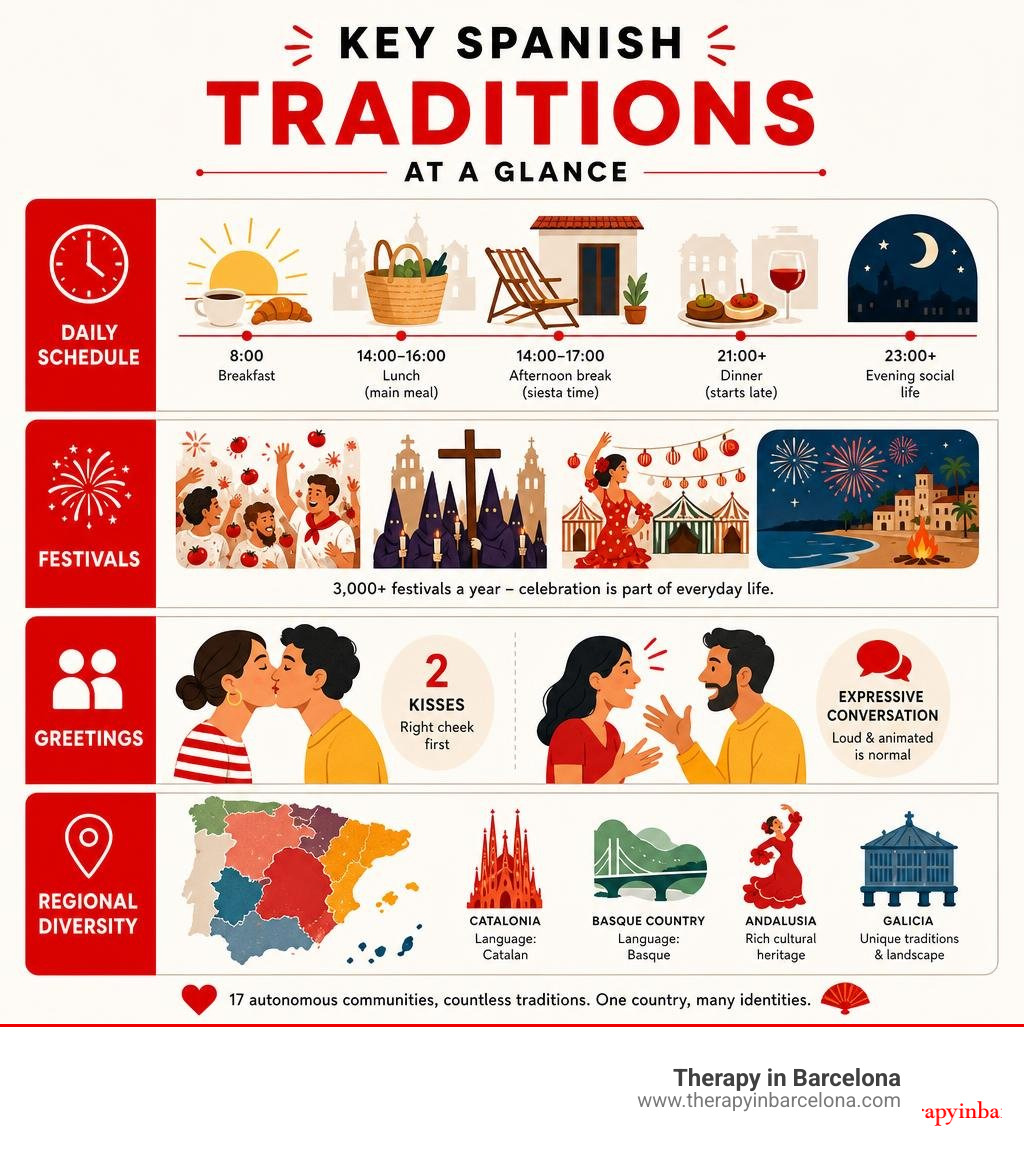
- Late mealtimes: Lunch is the main meal, often eaten between 2-4 PM. Dinner rarely starts before 9 PM.
- Sobremesa: The post-meal tradition of lingering at the table for conversation, sometimes for hours.
- Two-kiss greeting: Friends and acquaintances often greet each other with a kiss on each cheek, usually right cheek first.
- The siesta: Less common than the stereotype suggests, especially in big cities, but many shops and businesses still close for part of the afternoon.
- Expressive conversation: Loud, animated talk is usually a sign of engagement, not conflict.
- Relaxed punctuality: Being 10-15 minutes late to a social event is often normal and not considered rude.
- Thousands of festivals a year: From the tomato-throwing chaos of La Tomatina to the solemn processions of Semana Santa, celebration is woven into everyday life, with many events highlighted on Spain’s official tourism portal.
- Strong regional identity: Spain’s 17 autonomous communities each have distinct languages, customs, and cultural pride. There is no single, uniform “Spanish” experience.
Spain doesn’t just have a culture — it has a rhythm. And if you arrive expecting things to work the way they do back home, you’ll likely find yourself confused, slightly hungry at 7 PM, and wondering why the restaurant is still empty.
Moving to Spain can feel disorienting at first. The schedule is different, the social rules are often unspoken, and customs vary widely between Barcelona, Valencia, Madrid, Andalusia, the Basque Country, and beyond.
This guide walks you through the traditions, customs, and social norms that shape daily life in Spain. Whether you’re navigating your first dinner invitation, trying to understand why your neighbours are still making noise at midnight on a Tuesday, or simply want to feel less like an outsider, this is a practical starting point.
The Daily Rhythm: Late Dinners, Siestas, and Spanish Traditions Explained
Adapting to the daily schedule is often the first major hurdle for anyone relocating to Spain. The country operates on a timeline that runs significantly later than the rest of Europe. Spain has the latest bedtimes on the continent, and this late-night energy is deeply baked into the social fabric.
This unique schedule is partly due to Spain’s geography and historical decisions. Despite being geographically aligned with Portugal and the UK, Spain operates on Central European Time (CET). This means the sun rises and sets later than in neighbouring countries, pushing daily activities further into the evening.
Furthermore, Spanish working hours are notoriously long. A typical office day can run from 9 AM to 8 PM, featuring a two- or three-hour break in the afternoon. This split-shift system means that people finish work late, which naturally pushes dinner, socialising, and sleep back.

The Art of Sobremesa: Why We Don’t Rush Meals
In many cultures, finishing a meal signals that the social interaction is over. In Spain, the end of the meal is just the beginning.
This brings us to the beloved concept of the sobremesa, which literally translates to “over the table.” As explained in this guide to Spanish dinner culture, sobremesa is the sacred time spent lingering at the table after the food has been cleared. Instead of rushing to pay the bill, Spaniards stay seated to drink coffee, sip digestifs, and talk.
On weekdays, a sobremesa might last a relaxed 30 to 45 minutes. On weekends, family gatherings and lunches with friends can easily stretch for two to three hours. Rushing away from the table is considered incredibly rude; it signals that you value your schedule more than the company of your dining companions. For expats, embracing this practice is a wonderful way to practice mindfulness and build genuine social connections.
The Siesta Myth vs. Reality
Perhaps no Spanish stereotype is more persistent — or more misunderstood — than the daily siesta.
In reality, the siesta as a daily sleep ritual is largely a myth in modern, urban Spain. Many people work standard office hours, commute, or use the afternoon break for lunch, errands, or family time rather than sleep. In smaller towns, some shops may still close after lunch before reopening later.
So why do shops still close? The afternoon break, often around 2 PM to 5 PM, began as a way to avoid the midday heat. Today, many city office workers continue through, but small shops, family businesses, and some pharmacies may still shut for lunch, rest, or family time.
From La Tomatina to Semana Santa: Festivals That Define the Soul
To understand Spain, experience its festivals. As Spain’s official tourism portal shows, celebrations range from small patron-saint fiestas to world-famous events. They are not just tourist attractions, but community rituals where families gather, traditions continue, and local pride takes center stage.

Understanding Spain’s Sacred Holy Week
Few events are as visually striking or emotionally intense as Semana Santa (Holy Week), the run-up to Easter Sunday. If you are new to the country, these celebrations can catch you completely off guard, as quiet streets suddenly fill with the heavy scent of incense and the solemn beat of drums.
As detailed in Miguel Balsa Campos’s historical analysis, Spanish Holy Week is a living fragment of Counter-Reformation Catholicism. It relies on immersive, highly visual rituals that contrast sharply with simpler Protestant traditions.
Semana Santa processions are organized by local brotherhoods, or cofradías and hermandades. Members wear robes and tall pointed hoods called capirotes, which symbolize penance, humility, and anonymity.
These brotherhoods carry massive, ornate floats (pasos) bearing centuries-old religious sculptures. To understand how these traditions vary across regions, you can read The Olive Press’s Semana Santa explainer. For instance, in Málaga, these giant floats (tronos) can weigh several tonnes and require hundreds of carriers (hombres de trono) to bear the physical burden on their shoulders as an act of devotion.
Quirky Spanish Traditions Explained: From Pooping Logs to Tomato Fights
Alongside solemn religious rites, Spain is home to some of the most wonderfully bizarre, lighthearted traditions in the world. Many of these customs highlight the playful, communal, and sometimes satirical nature of Spanish culture.
For a deeper dive into these unusual customs, you can read about the weird Spanish traditions that surprise international students. Here are a few of the most famous:
- La Tomatina: Held on the last Wednesday of August in Buñol, this epic food fight attracts over 20,000 people who throw roughly 120 tons of overripe tomatoes at each other, according to the official La Tomatina website, turning the town streets into a sea of red puree.
- The Tió de Nadal (Catalonia): A beloved Christmas character in Catalan homes. Children “feed” this small wooden log with a painted smiley face every night in December. On Christmas Eve, they beat the log with sticks while singing a traditional song, prompting it to “poop” out small gifts and candies.
- The Caganer (Catalonia): A small ceramic figurine of a man in traditional Catalan garb, caught in the act of defecating. Tucked away in the corner of nativity scenes, this cheeky figure is a traditional symbol of good luck, fertilising the earth for a prosperous year ahead.
- The 12 Grapes of New Year’s Eve: As midnight strikes on December 31st, Spaniards eat one green grape for every chime of the clock. This ritual, which you can read about in this Spanish New Year traditions guide, is believed to bring good fortune for each of the twelve months ahead.
Navigating Social Etiquette: Two Kisses, Loud Voices, and Punctuality
Socialising in Spain is warm, highly physical, and deeply relational. However, the unspoken codes of everyday interaction can sometimes lead to minor culture shock for expats who are used to more reserved social climates.
The Two-Kiss Greeting and Personal Space
When meeting someone in a social setting, do not go in for a firm handshake or a full-body hug. The standard greeting in Spain is the dos besos (two kisses).
You touch cheeks — first the right, then the left — while making a light kissing sound. It is important to note that you do not actually kiss the person’s skin with your lips; it is a cheek-to-cheek gesture. This greeting is used between women, and between men and women, while men usually greet each other with a warm handshake or a pat on the shoulder.
To help you feel more at ease, keep these basic social etiquette rules in mind:
- Always greet shopkeepers: When entering a small local shop, bakery, or pharmacy, say a warm Buenos días (morning) or Buenas tardes (afternoon). It is considered polite to acknowledge the person behind the counter.
- Do not request the restaurant bill immediately: Wait staff in Spain will rarely bring you the bill unless you specifically ask for it (La cuenta, por favor). To them, rushing you out the door is bad service.
- Bring a host gift: If you are invited to a Spanish home for dinner, always bring a small token of appreciation, such as a bottle of wine, some high-quality chocolates, or flowers.
- Embrace “No pasa nada”: This common phrase translates to “no worries” or “it’s fine.” If you make a minor social gaffe, drop something, or run late, you will likely hear this comforting phrase.
Why Loud Conversations Mean Passion, Not Anger
One of the first things expats notice in Spanish restaurants, plazas, and public transport is the volume. Conversations are fast, expressive, and incredibly loud.
For newcomers from more reserved cultures, this can easily be mistaken for anger, impatience, or conflict. However, in Spain, speaking loudly and interrupting one another is a sign of engagement, passion, and interest in the conversation.
If a Spaniard is quiet and waiting patiently for their turn to speak, it often means they are disengaged or bored. Do not be intimidated by the volume; it is simply a reflection of a highly expressive, communicative society.
Regional Pride: How Local Identities Shape the Nation
One of the most important aspects of Spanish traditions is that there is no single, uniform “Spanish” culture. Spain is divided into 17 autonomous communities, each with its own distinct history, culinary heritage, and regional pride. Under the Franco dictatorship (1939–1975), regional cultures and languages were heavily suppressed. Following the transition to democracy, these regional identities surged back with immense strength.
Today, roughly 58% of Spaniards were born after Franco’s death, according to demographic data from the National Statistics Institute (INE), and this younger generation views regional pride not as a political statement, but as a natural part of their daily identity.
Regional Languages and Spanish Traditions Explained
While Castilian Spanish is the official language spoken by virtually all citizens, at least 11% of the population speak a local regional language as their first tongue, as recorded by the National Statistics Institute (INE). Six of the autonomous communities have co-official languages alongside Spanish.
In Catalonia, for example, language is a cornerstone of daily life. According to official statistics from Idescat, roughly 80% of the region’s population can speak Catalan, with 36.3% using it as their primary language.
For expats moving to the Catalan capital, understanding this linguistic landscape is crucial. You can read more about navigating the language labyrinth in Catalunya to understand how Catalan and Spanish coexist.
This linguistic diversity is closely tied to unique regional traditions. In Barcelona, you will encounter castells (human towers) and the Festa Major de Gràcia, which you can read about on Meet Barcelona’s culture guide.
Meanwhile, in Galicia, the culture is heavily influenced by Celtic roots, featuring the traditional gaita (bagpipes), while the Basque Country boasts its own entirely unique language (Euskera) and traditional rural sports.
Adapting to Life in Valencia, Málaga, and Beyond
As an expat, the city you choose to call home will dictate the cultural rhythms you experience.
If you settle down south, you can explore Málaga’s rich cultural traditions or the upscale coastal lifestyle of Marbella. The southern region of Andalusia is the birthplace of flamenco, a complex art form combining cante (song), baile (dance), and toque (guitar) that is recognised as a UNESCO Intangible Cultural Heritage.
If you head to the east coast, you can dive into the most authentic Valencian traditions, including the explosive Las Fallas festival in March, where massive, satirical paper-mâché sculptures are built and ceremonially burned.
Further south on the coast, Alicante offers a family-friendly, relaxed Mediterranean lifestyle, while the island of Gran Canaria boasts a unique history and culture shaped by its volcanic landscape and Atlantic location.
No matter where you choose to live, adjusting to these local customs can take a psychological toll. It is completely normal to experience culture shock, frustration, or a sense of isolation as you try to find your footing. To help navigate this transition, you can check out this guide to moving to Spain for Americans or this guide to moving to Spain for British expats.
Frequently Asked Questions about Spanish Customs
Why do Spaniards eat dinner so late?
The late dining schedule is a mix of climate, working hours, and time zones. Because Spain operates on Central European Time but sits far to the west, the sun sets later in the evening. During the hot summer months, it is simply too warm to eat a heavy meal before the sun goes down. This, combined with long working hours that often run until 8 PM, naturally pushes dinner back to 9 PM or 10 PM.
Is the siesta still practiced in modern Spain?
Not in the old-fashioned “everyone naps after lunch” way. In big cities, most people work modern office hours and do not go home for a daily sleep. What still exists is the afternoon pause, especially in smaller towns and family-run shops, where businesses may close from around 2 PM to 5 PM for lunch, errands, rest, or family time.
What is the significance of the two-kiss greeting?
The dos besos (two kisses) is a warm, informal greeting that signifies social trust, openness, and community connection. It is used in social settings between women, and between men and women, when meeting for the first time or greeting friends. It is a vital part of Spain’s highly relational and physically expressive social fabric.
Finding the Right Support: Comparing Expat Mental Health Options in Spain
Moving to a new country and adapting to a completely foreign set of social norms can be an incredibly rewarding adventure. But let’s be honest: it can also be exhausting, overwhelming, and deeply isolating.
When the initial excitement of moving wears off, many expats find themselves struggling with homesickness, identity loss, relationship strain, or feeling anxious and persistently down. If you find yourself in this position, it is important to know that you do not have to navigate this transition alone.
To help you understand the mental health landscape in Spain, here is a comparison of the primary care options available for English-speaking internationals.
Public System Clinicians (Seguridad Social)
The Spanish public healthcare system is highly regarded and provides free or low-cost mental health care. However, accessing support through Seguridad Social requires registering at your local public health centre and getting a referral from your GP.
The primary drawback for expats is the potential for significant language barriers, as very few public system clinicians speak fluent English. Additionally, the system faces long waiting times (often several weeks or months for an appointment) and is generally restricted to basic, short-term support rather than long-term, specialised therapy.
Large Online Platforms
In recent years, massive global digital therapy platforms have become highly popular. These services offer convenient, fast access to therapists via video calls or text messaging.
These platforms are convenient, but continuity, local Spanish context, and data privacy can be concerns. You may not get a therapist who understands expat life in Spain.
Individual Local Private Practices
You can also seek out independent private therapists practicing in your local city. These professionals can offer high-quality, personalised care in English.
However, finding the right fit on your own can be a daunting trial-and-error process. Independent practitioners have varying levels of expat-specific experience, and they do not have a larger team or matching system to ensure that their therapeutic style actually aligns with your specific needs. If the connection isn’t right, you have to start your search all over again.
Therapy in Barcelona
Established in 2011, Therapy in Barcelona is a trusted private-pay group practice that offers a unique, culturally sensitive sanctuary specifically designed for the international community.
We stand out by offering a bespoke therapist matching service. Instead of simply placing you with the next available professional, we take the time to understand your unique background, struggles, and goals during our intake process, matching you with the therapist best suited to your needs.
Our collaborative team consists of highly qualified, psychology-trained expat professionals who understand the challenges of living abroad firsthand, providing culturally sensitive support in your native language.
Unlike large online platforms, we maintain strict privacy standards and guarantee that we never sell or share your personal data. We offer face-to-face sessions at our central Eixample office in Barcelona, as well as online therapy worldwide for clients navigating life across Spain and beyond.
Embracing Your New Spanish Life
Adapting to a new culture is a journey of patience, curiosity, and self-compassion. Learning to navigate Spain’s late mealtimes, vibrant festivals, and unique social rhythms takes time. There will be days when you feel like a local, and days when you feel completely out of place — and that is a completely normal part of the expat experience.
If you are struggling to find your footing, feeling isolated, or finding the adjustment to Spanish life more challenging than expected, reaching out for professional support can make all the difference.
Founded by Australian psychologist Leigh Matthews, Therapy in Barcelona offers culturally sensitive, English-speaking support for internationals navigating life in Spain. Leigh’s own expat experience shapes a team approach focused on helping clients feel understood, grounded, and at home.
If you would like support on your journey, we invite you to take the first step. You can explore our practical guide to moving to Spain for more tips, or contact us today to book a Free Discovery Call. Let’s work together to help you feel at home in your new life.
