


Why More Americans Are Choosing Life in Spain

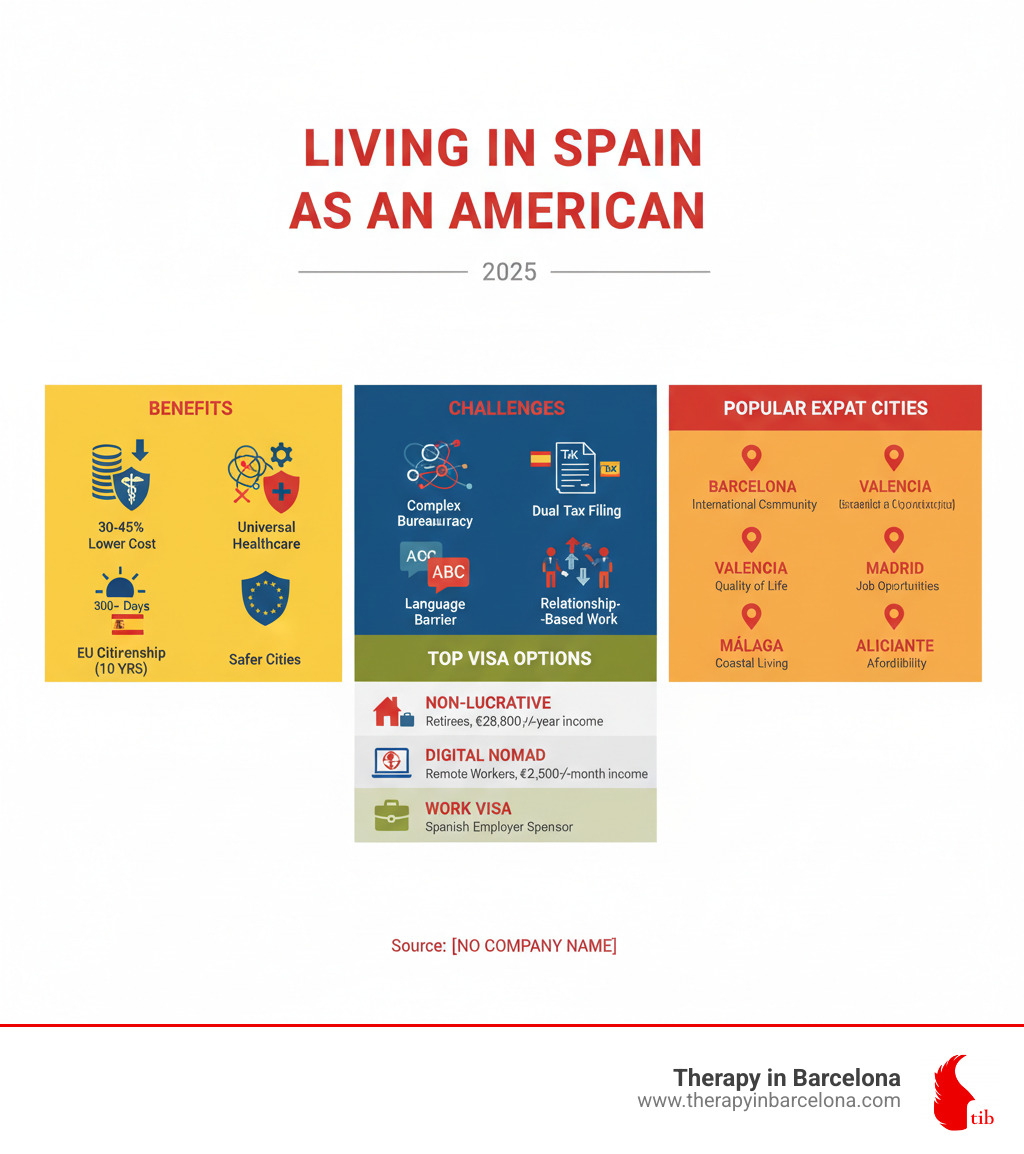
Living in Spain as an American offers a compelling blend of affordability, culture, and quality of life that draws thousands of US citizens across the Atlantic each year. The appeal is straightforward: a Mediterranean climate with over 3,000 hours of annual sunshine, a cost of living that can be 30-45% lower than in the US, and a pace of life that prioritises connection over productivity.
However, the move involves more than just logistics. Key considerations include securing the right visa—such as the Non-Lucrative Visa for retirees or the Digital Nomad Visa for remote workers—and understanding your dual tax obligations. You will file taxes in both Spain and the US, though credits can prevent double taxation. While Spain offers a universal public healthcare system to residents alongside affordable private options, you will also face cultural adjustments like language barriers, slow-moving bureaucracy, and a relationship-focused work culture.
This guide explores the practical steps and the emotional journey of moving to Spain. We cover everything from visas and housing in popular hubs like Barcelona, Valencia, and Málaga to managing finances and building a support network. Understanding both the requirements and the psychological shifts will help you build a fulfilling life in your new home.
Why Americans Are Moving to Spain: The Pros and Cons
The Spanish Lifestyle: What Attracts Americans?
The rhythm of life in Spain is often what Americans find most attractive. People here generally work to live, not the other way around. This is felt in everything from longer lunch breaks to an emphasis on evening plans over late-night emails. The spirit of the siesta—a space for rest and connection—remains, even if the practice itself is less common in major cities.
Spain’s Mediterranean climate provides over 3,000 hours of sunshine annually in cities like Madrid, which many expats report lifts their mood. The country’s deep history is part of daily life, from Roman ruins to Gaudí’s masterpieces. Importantly, living in Spain as an American often means feeling safer. Spain consistently ranks higher than the US in the Global Peace Index, with lower crime rates.
The food culture centres on fresh ingredients and the social ritual of sharing meals, whether it’s seafood in coastal Málaga or tapas in a neighbourhood bar in Alicante. Expat communities in cities like Valencia and Gran Canaria are often welcoming, and many find Spanish people are curious and open to building friendships.
Practical Benefits: Cost of Living and Healthcare

One of the most compelling reasons for moving is the lower cost of living. Most expats report spending 30% to 45% less than in comparable US cities. Housing is a major factor; renting in Spain is about 40% cheaper on average. A one-bedroom flat in Madrid’s city centre might cost around €800 monthly, compared to €1,400 in a similar US city.
Groceries are also affordable, with fresh produce from local markets often costing less than at home. A meal at a neighbourhood restaurant can be as little as €10.
Spain’s public healthcare system, the Sistema Nacional de Salud (SNS), is another significant advantage. Legal residents who contribute to social security get access to doctors and subsidised prescriptions. For those not yet eligible or who want extra coverage, private health insurance is remarkably affordable, typically €50 to €200 monthly.
Common Challenges and Cultural Adjustments
Despite the benefits, living in Spain as an American involves real frustrations. Spanish bureaucracy is famously slow, involving extensive paperwork and long waits. The language barrier also affects daily life more than many anticipate. Outside of tourist areas, proficiency in Spanish is essential for everything from dealing with utility companies to visiting a doctor.
Spain’s job market is challenging, with an unemployment rate of 11.8% in early 2025. While sectors like tech and healthcare are hiring, finding a job can be difficult without fluent Spanish or specialised skills. The work culture is also different. As Erin Meyer notes in The Culture Map, Spain is a relationship-based culture where building personal rapport can be more important than immediate task completion.
Daily rhythms are different, too. Dinner is at 10 pm, not 6 pm, and social punctuality is more relaxed. These cultural shifts, while part of Spain’s charm, can trigger culture shock and loneliness. At Therapy in Barcelona, we have supported internationals through these transitions since 2011. We offer online therapy worldwide and in-person sessions in Barcelona, with therapists who understand the expat experience. Learn more about our individual therapy services or meet our team of psychology-trained therapists.
The Practicalities of Moving: Visas, Residency, and Housing
Once you’ve decided that living in Spain as an American is right for you, the practical side of the move begins. Understanding visa requirements, navigating the residency process, and finding somewhere to live are the three pillars of a successful transition. Each requires patience, preparation, and a willingness to work through Spanish bureaucracy—but the reward is a legal, stable foundation for your new life.
Spanish Visas: Your Pathway to Residency
To stay in Spain for more than 90 days, you will need a visa. Choosing the right one is crucial.
- Non-Lucrative Visa (NLV): For those who can support themselves without working in Spain, like retirees. You must prove an annual income of at least €28,800, plus extra for dependents. You can find the official financial requirements here.
- Digital Nomad Visa (DNV): For remote workers employed by non-Spanish companies. You need a monthly income of at least €2,762 and a university degree or three years of professional experience.
- Work Visa: For those with a job offer from a Spanish company. Your employer typically handles most of the application.
- Student Visa: For full-time study or training. It may allow for part-time work (up to 30 hours per week) with authorisation.
- Self-Employment Visa: For entrepreneurs starting a business in Spain. This requires a solid business plan and sufficient funds.
The Golden Visa programme, which offered residency for property investment, has now ended for new applicants.
The Residency Process: Steps and Documents
You must apply for your visa at a Spanish consulate in the US, usually at least three months before your move. The process involves significant paperwork.
Key documents generally include a completed application form, a valid US passport, proof of financial means, and proof of private health insurance valid in Spain. You will also need an apostilled FBI criminal background check and a medical certificate, both translated into Spanish by a sworn translator.
Once you arrive, you will need two key identification numbers. The NIE (Número de Identificación de Extranjero) is your foreigner’s identification number, required for almost all official transactions. If you are staying longer than six months, you must also apply for a TIE (Tarjeta de Identidad de Extranjero), which is the physical card that proves your legal residency.
Finding a Home: Renting and Buying in Spain

Finding a place to live is a major step. Most expats start by renting to get a feel for different neighbourhoods.
Renting is the most common starting point. As of March 2025, average monthly rent for an 80m² flat in Madrid is around €1,669, while Barcelona is slightly less at €1,606. Other cities offer better value: Valencia (€1,158), Málaga (€1,227), and Alicante (€782). The main property search platforms are Idealista and Fotocasa.
Buying property is also an option for Americans. Prices per square metre in city centres vary widely, from €4,930 in Madrid and €4,520 in Barcelona to €2,785 in Valencia and €2,560 in Alicante. You will need a NIE and should hire a lawyer to handle the legal complexities. Securing your home, whether renting or buying, is the milestone where your new Spanish life truly begins.
Managing Your Finances: A Guide for Americans Living in Spain
Getting a handle on your finances is one of the most important steps when planning your move. Beyond the day-to-day costs, you’ll need to understand how taxation works across two countries—something that catches many Americans off guard.
Cost of Living: Spain vs. the US
As mentioned, living in Spain as an American is significantly more affordable. Spain is roughly 41% cheaper than the US before rent, and 52% cheaper with rent included. A comfortable monthly budget for an individual, excluding rent, is often between €1,200 and €1,500.
Rent is the biggest variable, ranging from €800-€1,400 for a one-bedroom flat in Madrid or Barcelona’s centre, to €500-€800 in cities like Valencia or Málaga. Other typical monthly costs include groceries (€200-€300), utilities (€100-€150), and a public transport pass (€30-€50). For a detailed breakdown, Numbeo’s cost of living comparison is a useful tool.
US and Spanish Tax Considerations for Expats

Tax is one of the most complex aspects of moving abroad. The US taxes its citizens on worldwide income, so you must file a US tax return every year, even while living in Spain.
However, mechanisms exist to prevent double taxation. The Foreign Tax Credit (FTC) allows you to credit taxes paid to Spain against your US tax liability. Since Spanish tax rates are generally higher, this often eliminates your US tax bill. Alternatively, the Foreign Earned Income Exclusion (FEIE) lets you exclude a significant portion of foreign-earned income from US taxes.
You must also comply with reporting requirements like FBAR (for foreign bank accounts over $10,000) and FATCA (for significant foreign assets). These are informational forms, but penalties for not filing are severe. You can find official guidance on filing US taxes from abroad on the IRS website.
In Spain, you become a tax resident if you spend more than 183 days in the country in a calendar year. As a resident, you are taxed on your worldwide income at progressive rates from 19% to 47%. You may also need to file Form 720 to declare foreign assets over €50,000. Given the complexity, consulting a tax professional specialising in US expat taxes is highly recommended.
Special Tax Regimes and Financial Problems
Spain’s Beckham Law allows eligible new residents to be taxed as non-residents at a flat rate of 24% on Spanish income for up to six years, which can be beneficial for high earners.
However, financial planning can be tricky. US tax-advantaged accounts like Roth IRAs and 401(k)s are not recognised by Spain, meaning distributions may be taxed. Spanish gift and inheritance tax also differs greatly from the US system, with no spousal exemptions and rates varying by region. Furthermore, EU regulations like MIFID II can prevent you from buying US-based mutual funds and ETFs, complicating investment strategies. These issues require careful planning, ideally before you move.
Building a Life in Spain: Work, Education, and Healthcare
Beyond paperwork and financial planning, building a fulfilling life in Spain means understanding how you’ll work, where your children might study, and how you’ll access healthcare. These practical elements shape your daily experience as much as any visa requirement.
The Spanish Job Market and Work Culture
Spain’s job market can be challenging, with an unemployment rate of 11.8% in early 2025. However, sectors like technology, healthcare, and education are actively hiring. English teaching roles are consistently available in cities like Madrid, Barcelona, and Valencia. Job search platforms like InfoJobs and LinkedIn are the best places to start. Fluency in Spanish dramatically expands your opportunities.
The work culture itself prioritises work-life balance. While the workday can be long, there is a genuine emphasis on disconnecting after hours. With around 30 days of paid leave and public holidays, Spain is generous with time off. Colleagues tend to prioritise family and social life, a refreshing change from the ‘always-on’ culture in many US workplaces.
Healthcare in Spain: What Expats Need to Know
Spain’s healthcare system, the Sistema Nacional de Salud (SNS), provides universal coverage to legal residents and is ranked among the world’s best. If you are employed or a long-term resident, you and your dependents typically qualify for the public system by registering for a health card (TSI).
While the public system is comprehensive, you may face wait times for non-urgent procedures. For this reason, many expats also use private health insurance. It is affordable, with premiums from major providers like Sanitas and Adeslas typically ranging from €50 to €200 monthly. Private plans offer faster access to specialists and a wider choice of facilities. Many visa applications require proof of private health insurance, so this should be factored into your initial costs.
Education Options for American Families
For families, Spain offers several excellent education pathways.
- Public schools are free for all resident children and offer full immersion in the Spanish language and culture. This is often the fastest way for children to integrate.
- Private schools (concertados) are semi-private, receiving some public funding. They are more affordable than international schools, often offer bilingual programmes, and may have a religious affiliation.
- International schools are popular in cities like Barcelona, Madrid, and Málaga. Many offer an American curriculum in English, which can ease the transition for children. Tuition is higher, ranging from €6,000 to over €20,000 annually.
Spain’s public universities are also remarkably affordable compared to the US, with undergraduate tuition starting around €1,000 per year. If you plan to claim US education tax credits, ensure your chosen institution is on the Federal School Code List.
Nurturing Your Well-being as an Expat in Spain
The practicalities of visas, housing, and tax forms are tangible challenges with clear solutions. But living in Spain as an American also involves a quieter, more complex journey—one that touches your sense of self, your relationships, and your emotional resilience. These internal shifts can catch you off guard, even when everything on paper looks perfect.
The Emotional Journey of Living in Spain as an American
Consider Sarah, a 30-year-old from Seattle who moved to Barcelona. She is fictional, but her story mirrors the experience of many expats. The first few months felt like a holiday, but then the novelty faded. The bureaucracy became exhausting, and every conversation outside her expat bubble required mental effort. She missed the directness of American friendships and felt caught between cultures—not quite American anymore, but not Spanish either.
This experience is common. Culture shock can manifest as a persistent sense of being out of step. Loneliness can creep in even when you are surrounded by people, and your identity shifts in unsettling ways. Homesickness is not just about missing family; it is about missing the ease of being understood without effort.
If you are in a bicultural relationship or raising Third Culture Kids—children growing up outside their parents’ passport country—the challenges can multiply. These children are often adaptable but may struggle with questions of identity and belonging. For families facing these dynamics, professional support can make a real difference. You can learn more about our services for expat families at Therapy in Barcelona.
Finding Your Support System in Spain
Building a support network is essential for your well-being. This can mean joining expat groups in cities like Barcelona or Valencia, or immersing yourself in local community events.
Sometimes, however, informal support is not enough. When culture shock deepens or loneliness becomes chronic, professional help is a valuable resource. You have several options: public system clinicians offer services through the national health system, but you may face long waits and language barriers. Large online therapy platforms offer convenience, but often lack the personalised, culturally sensitive approach expats need. Local practices vary in their understanding of the expat experience.
Specialised, culturally aware therapy can help. At Therapy in Barcelona, we understand what living in Spain as an American actually feels like because our international team of psychology-trained therapists are expats ourselves. We work in English, and some of our therapists also offer sessions in German, French, Spanish, Afrikaans, Portuguese, Swedish, Austrian-German, and Swiss-German. We do not just assign you to the next available therapist; we take the time to match you with someone who understands your specific situation, whether you are adjusting to life in Málaga or raising children in Alicante. We use evidence-based approaches like Cognitive Behavioural Therapy (CBT) and Acceptance and Commitment Therapy (ACT), tailored to your needs. We work with adults, couples, teens, and families, online worldwide or face to face in our Barcelona office.
If you are struggling, seeking professional help can provide the tools you need. You can find more about individual therapy and meet our team of therapists. This is a private-pay service, though some therapists offer sliding scale fees. The first step is often the hardest. If you’d like support, book a Free Discovery Call.
Conclusion
Living in Spain as an American is a journey that reshapes daily life. The rewards are genuine: the Mediterranean sun, an unhurried rhythm, affordable healthcare, and a culture that values connection. Whether you are drawn to the coastal charm of Málaga, the energy of Madrid, or the balance of Valencia, Spain offers a compelling alternative to American life.
However, the practical and emotional challenges are real. Visa applications require patience, dual-country tax obligations are complex, and bureaucracy moves at its own pace. Culture shock, loneliness, and feelings of isolation are normal parts of the adjustment, not a sign that you have made the wrong choice.
Acknowledging these struggles and seeking the right support is key. While you can turn to public system clinicians, large online platforms, or local practices, Therapy in Barcelona offers tailored support for internationals. We provide careful therapist matching, expat-specific cultural and linguistic sensitivity, strict privacy (we never sell your data), and high-quality private-pay care. We are a group practice of psychology-trained therapists who work with adults, couples, teens, and families.
We support clients across Spain—including in Barcelona, Madrid, Valencia, Málaga, and Alicante—both online and in person. Our online therapy services are available worldwide, including in the USA and Canada.
If you’d like support, book a Free Discovery Call.
