


Why Adults Feel Stuck and What to Discuss in Therapy

If you are unsure what to talk about in therapy, you can start with common concerns such as anxiety, relationship difficulties, boundaries, family dynamics, grief, life transitions, or feeling disconnected from your values. You do not need a mental health diagnosis or a crisis to benefit from therapy; it can also help you understand patterns, cope with change, and improve your emotional wellbeing.
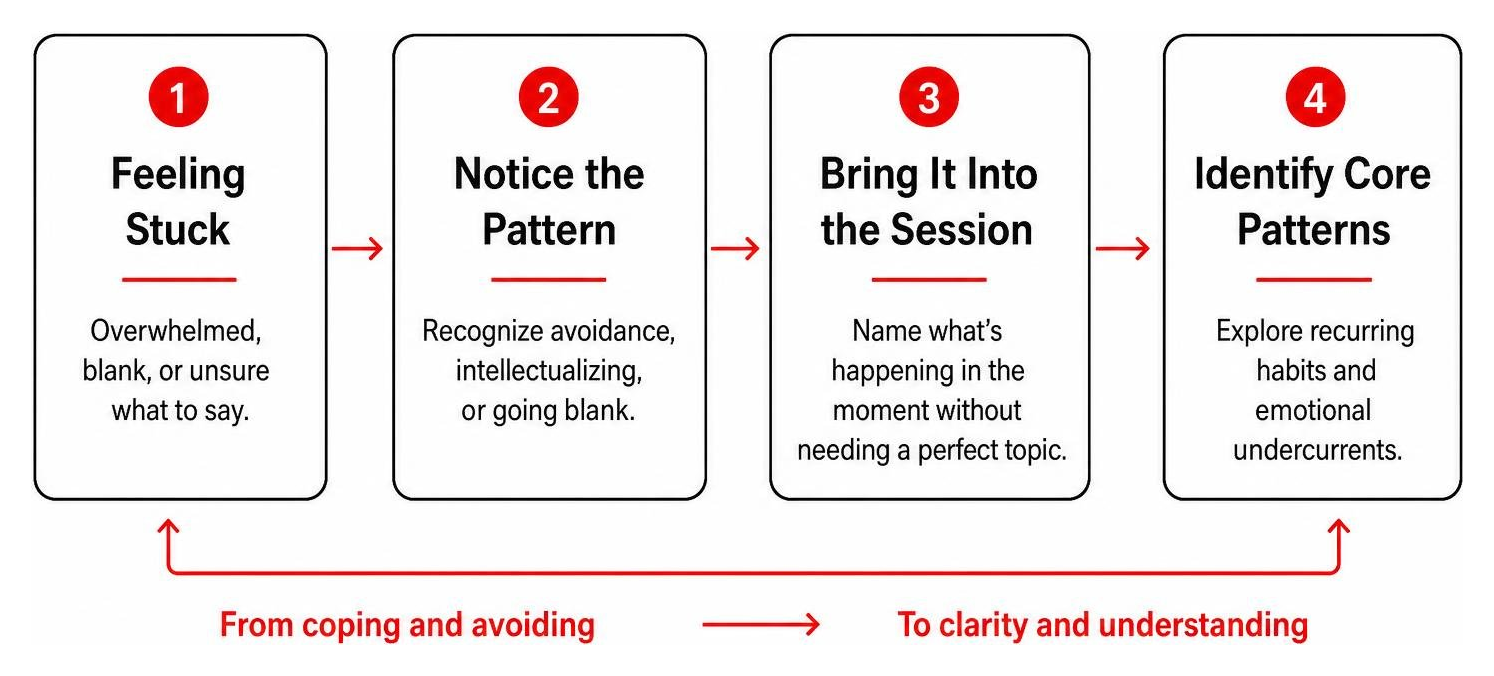
It is common to arrive at therapy after a difficult week and suddenly feel like you have nothing to say. You may find yourself giving a factual update rather than exploring what is happening underneath. This can be a way of staying organised and composed when you feel overwhelmed.
When emotional avoidance takes over, arriving at meaningful subjects can feel intimidating. Setting an agenda does not mean writing a rigid script for your 50 minutes. Instead, it is about identifying the emotional undercurrents that need attention.
Navigating the Blank Mind in Adult Counseling
A blank mind in a session is rarely an absence of thoughts. More often, it is a sign of performance anxiety or unconscious self-protection. When you feel pressure to produce a profound insight or make good use of every minute, your nervous system can quietly shift into a freeze response.
Treating inner silence as useful communication rather than a failure creates room for real therapeutic safety. Instead of forcing an elaborate topic, focus on present-moment awareness:
- Notice your physical state right now (for instance, a clenched jaw, shallow breathing, or tight shoulders).
- Name the blankness directly: “I felt overwhelmed all week, but sitting here right now, I feel numb.”
- Adjust the emotional pacing with your therapist so you do not have to tackle the heaviest subject in the first five minutes.
Moving from Symptom Relief to Core Patterns
Many people begin counselling looking for quick strategies to stop feeling anxious, irritable, or exhausted. While practical tools are vital, lasting growth happens when you move beyond basic symptom management and begin examining underlying behavioural loops.
Through targeted individual therapy support, you can look at the long-standing self-narratives and defense mechanisms that drive your day-to-day reactions. Rather than asking only “How do I calm down today?”, the work expands into questions of personal agency: “What purpose has this constant vigilance served in my life?” and “What would I have to face if I put this defence down?”
Core Categories of Therapy Topics for Adults
Finding meaningful discussion themes becomes much easier when you break your life into distinct psychological domains. Therapy is a collaborative container where somatic signals, major crossroads, and core values intersect.
Essential Therapy Topics for Adults Managing Anxiety and Stress
Persistent worry and nervous exhaustion are among the most frequent reasons adults seek therapeutic support. Whether you are establishing a life in your hometown or building a career in international hubs like Madrid, Valencia, or Barcelona, everyday pressures can easily tip into feeling constantly overwhelmed.
Key angles to explore with your therapist include:
- The Anatomy of a Worry: Breaking a runaway thought into its component parts (trigger, bodily sensation, catastrophic prediction, and coping behaviour).
- Useful Alert vs. The Loop: Learning to tell the difference between functional anxiety that calls for practical action and recursive rumination that solves nothing.
- Avoidance Mapping: Charting what you avoid (such as opening certain emails, social invitations, or difficult boundaries) and examining how avoiding temporary discomfort maintains long-term distress.
- Behavioural Activation: Scheduling small, value-aligned activities to gently reboot your nervous system when feeling overwhelmed, unmotivated, or persistently down.
- The Perfectionism Trap: Exploring the belief that you are only safe or lovable when you make zero mistakes.
Foundational Therapy Topics for Adults Exploring Relationships and Family History
Our early environments establish subconscious roadmaps for how we give and receive care. Exploring these patterns helps untangle old survival strategies from your current adult choices.
Using evidence-based couples counseling frameworks and individual relational lenses, you can explore:
- Attachment Styles in Daily Life: How your instinctive response to closeness or conflict (anxious, avoidant, or disorganised) plays out with partners, friends, and colleagues.
- The Invisible Emotional Load: Who carries the mental burden in your household, and how unacknowledged effort builds silent resentment.
- Unspoken Contracts: The implicit rules you live by (e.g., “I will anticipate all your needs if you promise never to get angry with me”) that have never been spoken aloud.
- Family-of-Origin Roles: The role you were assigned as a child (the peacekeeper, the achiever, the invisible one) and whether you are still playing it today.
- The Thing You Were Not Allowed to Say: Uncovering early taboos around anger, sadness, money, or affection that still influence your voice.
Midlife Re-Evaluation, Identity Shifts, and Ambiguous Loss
Between the ages of 35 and 60, many adults enter what psychologists call the “long middle.” This phase often involves shedding identities that no longer fit and making peace with unlived potential.
- Career Burnout and Worth: Disconnecting your human value from your professional output.
- Caring for Aging Parents: Navigating role reversals, boundary changes, and anticipating loss while managing your own adult household.
- Ambiguous Loss: Grieving losses that lack formal social rituals or clear endings, such as a relationship that quietly drifted away, the loss of an imagined future, or living thousands of miles away from your roots.
- The Second-Half Question: Asking yourself: “What did I build the first half of my adult life around, and is that still the right organising principle for who I am becoming?”
Comparing Options for Adult Therapy Support
When exploring these themes, adults have several distinct pathways for care. Finding the right setting depends on your personal circumstances, language preferences, and cultural background. It is worth knowing what else is out there before deciding where to invest your time and trust.
Expat-Focused Private Practices (Such as Therapy in Barcelona)
Best Suited For: Internationals, Third Culture Kids, accompanying partners, and professionals seeking culturally sensitive therapy in English or their native language.
Key Differentiators: Bespoke therapist matching conducted through human clinical intake, a deep understanding of expat-specific transitions, strict confidentiality with no data selling, and dedicated, high-quality private-pay care.
Considerations: This route involves a private investment in ongoing care without state healthcare subsidies.
Public Healthcare System Clinicians
Best Suited For: Long-term residents fully fluent in the local language seeking publicly funded psychological care.
Considerations: This option often involves longer waiting periods, capped session numbers, and potential communication hurdles if navigating subtle emotional nuances in a second language.
Large Online Platforms and General Directories
Best Suited For: Individuals looking for broad, general access to a large directory of independent practitioners.
Considerations: These platforms often rely on automated matching rather than bespoke clinical assessment, with variable continuity of care and differing data privacy practices depending on the corporate provider.
Whichever path feels right, the most important factor is finding a therapist you trust, whether that is here in Barcelona, in a city such as Valencia or Sevilla, or through a public clinic closer to home.
Adapting Individual Therapy Topics and Between-Session Continuity
Therapy works best when it is treated as a continuous thread rather than an isolated 50-minute event once a week. The insights gained during a session need practical bridges into everyday life.
Consider a fictional example based on common expat challenges. A professional living in Spain frequently arrived at sessions feeling scattered by work emergencies. By ending each session with three simple steps—identifying one key insight, choosing one small behavioural experiment, and setting a review question for the following week—they were able to stay focused on their goal of setting healthier workplace boundaries without being derailed by weekly crises.
Structuring Therapy Topics Across the Course of Therapy
A productive course of therapy generally moves through three natural phases:
- Early Sessions (Safety and Assessment): Focusing on stabilisation, learning nervous system regulation tools, identifying current coping mechanisms, and building therapeutic rapport.
- Middle Sessions (Deepening and Processing): Untangling family-of-origin patterns, working through ambiguous loss, challenging core beliefs, and running behavioural experiments in your relationships.
- Ending Phase (Consolidation and Future Planning): Reviewing what you brought in versus what you are leaving with, identifying remaining vulnerabilities, and anchoring your internal resources for the road ahead.
Pacing Treatment Plans and Preventing Avoidant Topic Switching
It is completely normal to want to switch topics when a discussion touches an uncomfortable nerve. However, jumping to a brand new crisis every week can sometimes be an unconscious form of avoidance.
Clinicians often recommend staying with a single core theme across two to four sessions to achieve meaningful emotional shifts. If you are attending online therapy sessions while balancing a busy travel schedule or living in regions like Gran Canaria or Marbella, keeping a written list of your primary treatment goals helps maintain focus and prevents avoidance from dictating the room.
Frequently Asked Questions About Therapy Topics for Adults
What should I talk about if I have nothing prepared for therapy?
You do not need to arrive with an essay or an organised agenda. Start by sharing exactly what is happening in the room: mention that your mind feels blank, that you felt rushed getting to the session, or notice where you are holding physical tension in your body. Discussing the therapeutic relationship itself—how it feels to sit in the room with your therapist—is often one of the richest starting points for self-discovery.
How do I know if we are focusing on the right topics in session?
You can tell your therapy is on track when the topics you discuss feel emotionally resonant rather than merely intellectual. If you leave sessions with greater clarity about your reactions, notice small shifts in your daily habits, or find yourself responding differently to old triggers, you are addressing the right material. It is good practice to review your treatment goals with your therapist every few months to make sure the work remains aligned with your needs.
Is it safe to bring up deep childhood trauma early in therapy?
Pacing is essential when working with difficult memories. It is generally safer to establish emotional regulation skills, grounding techniques, and mutual trust (resourcing) before delving into the granular details of past traumatic events. Moving too quickly into intense trauma processing without sufficient baseline safety can leave you feeling dysregulated between sessions.
If you or someone you know is experiencing an acute psychological crisis, immediate emergency resources are available. In Spain, you can call 024 (National Suicide and Crisis Prevention Hotline) or 112 (General Emergency). In the UK, call 111 or 999. In the US and Canada, dial or text 988.
Finding the Right Support
Facing persistent patterns and untangling long-held beliefs takes both patience and the right therapeutic environment. When you have a dedicated space to put down your everyday roles and speak openly, feeling stuck gradually transforms into curiosity, insight, and genuine emotional relief.

Therapy in Barcelona is an international psychology practice founded in 2011 by Australian psychologist Leigh Matthews. Its psychology-trained therapists support adults, couples, teens and families, offering personalised therapist matching in English and several other European languages.
Whether you prefer face-to-face sessions at the central Barcelona office or online therapy accessible worldwide (including the USA and Canada), you can find a dedicated space to explore your goals.
If you’d like support, book a Free Discovery Call.
