


How Therapy for Jealousy Creates Lasting Relief

Therapy for jealousy helps you understand what sets off suspicion, challenge thoughts that are not supported by evidence, and stop behaviours that briefly soothe anxiety but keep the cycle going. A therapist may use Cognitive Behavioural Therapy (CBT), mindfulness and acceptance skills, or couples work to help you communicate needs without accusations, checking, or repeated reassurance-seeking.
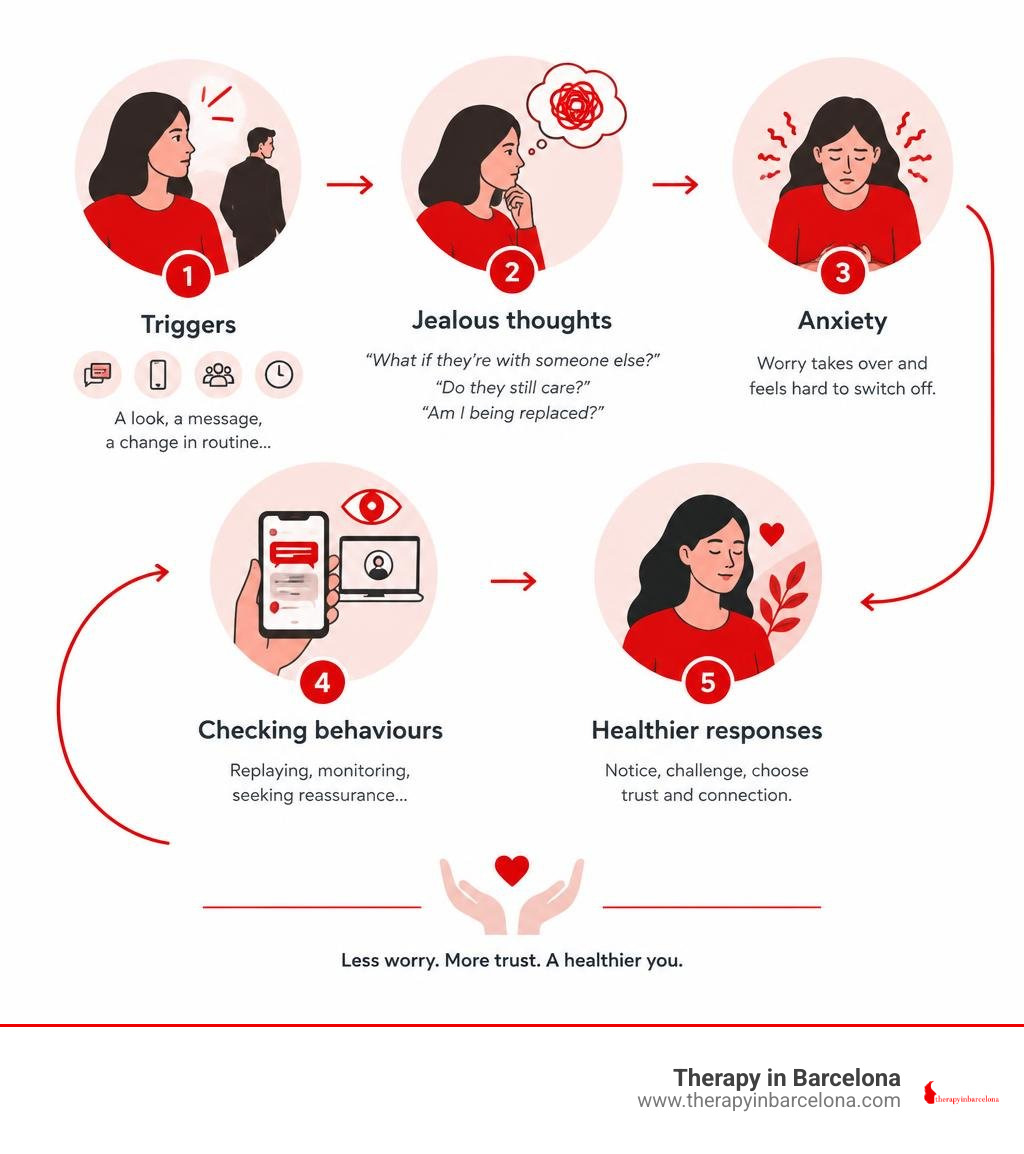
Jealousy is a common human response when a valued relationship feels threatened. It can sometimes prompt a useful conversation about boundaries or unmet needs. However, it becomes painful when worry takes over: you may replay interactions, imagine the worst, monitor a partner’s phone or social media, or feel compelled to seek certainty that no relationship can fully provide.
Moving countries, living between cultures, working long hours, or feeling isolated can make existing relationship fears feel louder. Therapy offers a confidential space to look beneath the immediate trigger, whether that is fear of abandonment, past betrayal, low self-worth, uncertainty, or a difficult pattern between partners.
The aim is not to eliminate every jealous feeling. It is to build the ability to notice it, respond thoughtfully, and act in ways that support trust, safety, and the kind of relationship you want. Therapy in Barcelona has provided psychology-led support in Spain since 2011, with English-speaking therapy available in person in Barcelona and online worldwide, including the USA and Canada.
Understanding the Roots: Why Jealousy Develops and Persists

Jealousy often feels like an unpredictable emotional storm. From an evolutionary perspective, jealousy evolved as an adaptive alarm system designed to protect vital social bonds and parental investment. In ancient environments, losing a partner or community standing threatened survival. Today, that same internal wiring can misinterpret ordinary ambiguous moments as severe threats to our emotional security.
Underneath distressing jealousy lies a mix of attachment insecurity, deep-seated emotional schemas, and an intolerance of uncertainty. When someone cannot tolerate ambiguity, the mind creates worst-case scenarios to avoid being caught off-guard. Metacognitive beliefs also play a significant role.
If a person believes that worrying or checking keeps them safe from betrayal, they are more likely to fuel ruminative spirals. As explored in Jealousy: An Emotional Schema Model, how we interpret and judge our internal feelings determines whether an emotion stays manageable or turns into overwhelming panic.
Living abroad can heighten these vulnerabilities. For example, when an expat’s partner begins building a vibrant local social circle, it may trigger feelings of inadequacy or insecurity. Without the familiar support network they had back home, their mind may interpret their partner’s growing independence as a sign of possible abandonment.
Differentiating Productive from Unproductive Jealousy
Not all jealousy is harmful. Therapy helps separate productive emotional signals from unproductive mental rumination.
- Productive Jealousy: Acts as an internal signal that highlights personal values, connection, or a genuine boundary crossing. It leads to calm self-reflection, assertive communication, and mutual problem-solving.
- Unproductive Jealousy: Manifests as chronic, agitated worry focused on catastrophic outcomes. It fuels destructive surveillance, social media snooping, interrogation, and mental replay.
Unproductive jealousy relies on “safety behaviours”—actions like repeatedly asking “Do you still love me?” or checking a partner’s location. While these behaviours temporarily ease anxiety, they reinforce the belief that danger was present, keeping the anxious cycle spinning.
Attachment Styles and Interpersonal Dynamics
Attachment theory shows how childhood bonds and relationship history shape adult security. Individuals with an anxious attachment style often remain on high alert for cues of rejection, misinterpreting a delayed text message as a loss of affection. Conversely, avoidant partners often withdraw when faced with emotional intensity, which inadvertently triggers their partner’s fears even further.
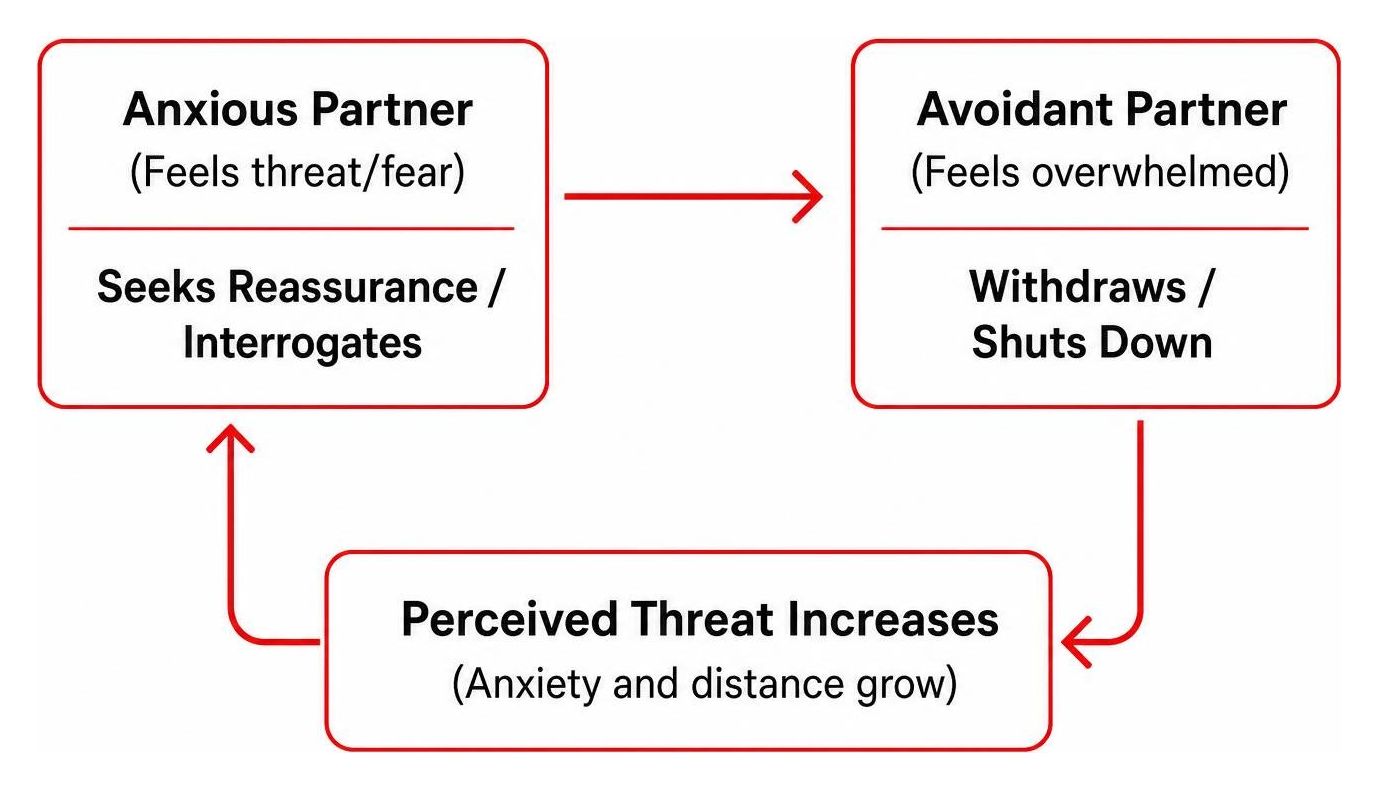
This dynamic can also fuel retroactive jealousy—an obsessive fixation on a partner’s past relationships. In these situations, intrusive thoughts about an ex-partner provoke reassurance seeking, comparison, and guilt, trapping both partners in a painful loop.
Evidence-Based Approaches in Therapy for Jealousy

Targeted psychological support can help reduce relationship distress and jealousy-related behaviours. Rather than relying on reassurance alone, therapy can combine cognitive restructuring, acceptance-based practices, and relational repair to address the underlying patterns driving insecurity and jealousy.
Comparison of Core Therapeutic Approaches
Cognitive Behavioural Therapy (CBT)
- Primary Mechanism: Identifying and restructuring cognitive distortions, reducing safety behaviours, and testing catastrophic assumptions.
- Core Benefits: Meaningful reductions in intrusive jealous thoughts and controlling behaviours over 12 to 16 weeks.
- Best Suited For: Thought-driven rumination, suspicious thoughts, retroactive jealousy, and compulsive phone checking.
Acceptance and Commitment Therapy (ACT)
- Primary Mechanism: Developing cognitive defusion, mindfulness, emotional willingness, and values-based relationship actions.
- Core Benefits: Substantial relief from experiential distress and emotional struggle by building psychological flexibility.
- Best Suited For: Obsessive jealousy patterns, severe internal shame, and struggle with emotional suppression.
Emotionally Focused Therapy (EFT)
- Primary Mechanism: De-escalating destructive conflict cycles, fostering emotional vulnerability, and rebuilding secure attachment bonds.
- Core Benefits: Lasting improvements in relationship satisfaction, closeness, and relational security over 12 to 20 weeks.
- Best Suited For: Couples caught in blame-and-withdrawal loops, trust recovery, and misaligned attachment needs.
Cognitive Behavioural Therapy for Jealousy and Emotional Schemas
Cognitive Behavioural Therapy is one of the most researched interventions for emotional regulation. In Cognitive Behavioral Therapy for Jealousy, therapists help clients identify common thinking errors:
- Mind-reading: Assuming you know a partner is bored or attracted to someone else without evidence.
- Catastrophising: Believing that an unanswered call means the relationship is over.
- Personalisation: Viewing a partner’s tiredness or quiet mood as proof of waning attraction.
Clients learn to track these thoughts using structured thought logs and test their accuracy. Exposure and Response Prevention (ERP) is also applied: clients practice tolerating a jealousy trigger (such as a partner going out with friends) without resorting to safety behaviours like calling repeatedly.
Acceptance and Commitment Therapy (ACT) and Mindfulness
When we fight jealous feelings, we often amplify them. Acceptance and Commitment Therapy (ACT) teaches clients to step back from distressing thoughts rather than debate them endlessly.
As highlighted in The Jealousy Cure, mindfulness allows individuals to observe jealousy without immediately reacting to it. By using cognitive defusion—shifting from “My partner is pulling away” to “I am noticing the thought that my partner is pulling away”—individuals create space between emotion and action. This allows them to choose behaviours aligned with their core values, such as warmth and honesty, even while feeling anxious.
Emotionally Focused Therapy (EFT) for Relational Trust
When jealousy disrupts partnership, couples counselling using Emotionally Focused Therapy helps partners look past reactive anger. Beneath accusations of infidelity or secrecy, there is almost always a vulnerable plea: “Do I still matter to you?”
EFT helps couples step out of toxic attack-defend cycles. Partners learn non-defensive listening, enabling the anxious partner to express fear without hostility, and helping the withdrawing partner offer reassurance without feeling micromanaged.
Clinical Frameworks: Assessment, Formulation, and Practical Skills
Effective therapy begins with a personalised case formulation. Working through individual therapy, a therapist maps out the origins of jealousy: childhood attachment history, past experiences of betrayal, and core schemas such as “I am easily replaced” or “People always leave.”
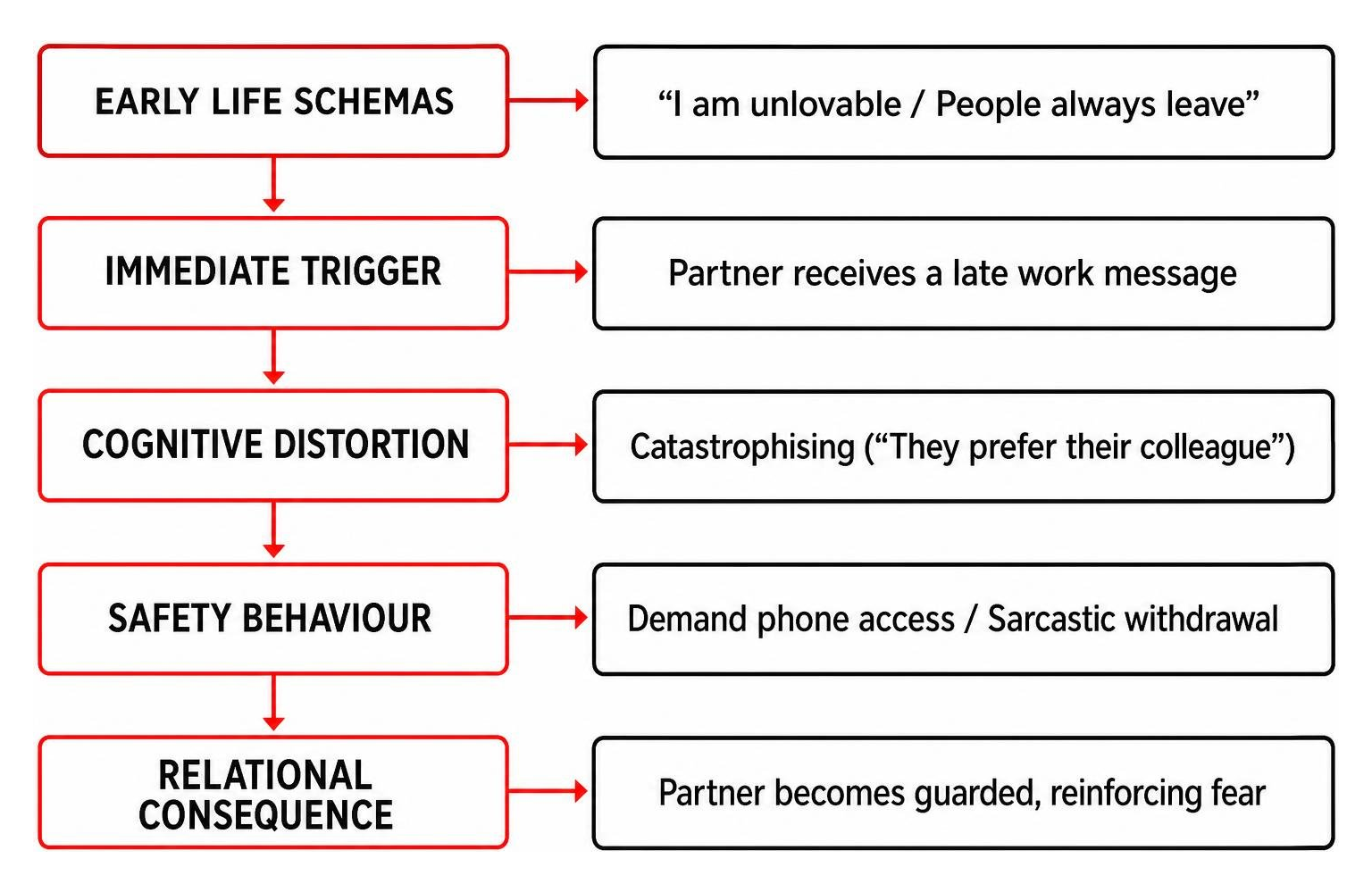
By mapping this cascade, therapy replaces reactive behaviour with clear, shared agreements on boundaries and expectations, removing ambiguity.
Navigating Diverse Relationship Structures and LGBTQ+ Dynamics
Therapy must adapt to modern relationship frameworks. In consensual non-monogamy and polyamory, jealousy is not seen as a sign of failure, but as an expected emotion to be explored. Therapists help non-monogamous clients build compersion—the positive feeling derived from a partner’s joy with someone else—while navigating boundary agreements.
For LGBTQ+ individuals, jealousy can be complicated by minority stress, smaller community networks, or remaining in contact with former partners within the same social group. Culturally sensitive therapy provides an open environment to explore these dynamics without heteronormative assumptions.
Building Tolerance for Relationship Uncertainty
A core goal in treating jealousy is increasing tolerance for ambiguity. No amount of checking can guarantee absolute certainty about the future. Uncertainty training helps clients accept this fundamental reality.
In clinical practice, uncertainty training exercises teach clients to sit with ambiguous thoughts without reacting. In an evidence-based case evaluation, a client practising uncertainty tolerance once a day reported that their relationship anxiety dropped significantly within one week. At a one-year follow-up, the individual maintained these gains, experiencing minimal jealousy-based worry.
Useful practical strategies include:
- The 20-Minute Pause: Delaying any urge to interrogate or check devices for twenty minutes while practising paced breathing.
- Thought Labelling: Silently saying, “I am having the worry that I will be abandoned,” reminding yourself that thoughts are mental events, not facts.
- Direct Needs Communication: Replacing “Who was that messaging you?” with “I am feeling a little disconnected today; could we spend some quality time together this evening?”
Frequently Asked Questions About Jealousy in Relationships
How Long Does Therapy for Jealousy Typically Take?
Most clients experience noticeable relief within 12 to 20 weekly sessions of focused CBT, ACT, or EFT. Initial progress—such as reducing phone checking and heated arguments—often happens within the first 4 to 6 weeks. Deeper shifts around long-standing attachment insecurities and trust rebuilding typically develop over several months of steady practice.
Should We Choose Individual Therapy or Couples Therapy for Jealousy?
The best approach depends on where the distress originates:
- Individual Therapy is ideal when jealousy is driven by personal trauma, low self-esteem, or obsessive retroactive jealousy tied to a partner’s past.
- Couples Therapy is most effective when jealousy is rooted in communication breakdown, current boundary ambiguity, recovery from infidelity, or a mutual pursue-withdraw dynamic.
In many cases, combining both formats offers comprehensive support.
What Can We Do Between Therapy Sessions When Jealousy Spikes?
When a jealousy spike occurs:
- Name the sensation: Acknowledge your bodily response (e.g., tight chest, racing pulse) without immediate judgement.
- Avoid immediate interrogation: Step away from the situation for 15 minutes to allow adrenaline to settle.
- Check the facts: Ask yourself: “Is there objective evidence right now, or is my mind anticipating threat based on past experiences?”
- Initiate a calm conversation: Use non-blaming language to share your internal state rather than accusing your partner.
Finding the Right Support
Experiencing relationship distress while living in a different country brings unique pressures. When seeking help, internationals have various routes. Public healthcare systems offer dedicated care, though language barriers and waiting times can present hurdles.
Large international digital platforms provide broad directory access, though they may lack local cultural insight and consistent care models. Local practices offer regional context, but finding an English-speaking practitioner experienced in expat life can be challenging.
Therapy in Barcelona was founded in 2011 by Leigh Matthews, an Australian Psychologist who has lived in Barcelona since 2011. From her experience supporting internationals, the practice provides bespoke therapist matching with psychology-trained professionals who understand expatriate life first-hand.
Whether navigating life in Barcelona, living as an expat in Valencia, adjusting to work in Málaga, or settling in hubs like Alicante and Madrid, clients receive private-pay, culturally sensitive support in their native language with strict privacy standards (including no data selling).
The practice provides in-person sessions at its central Barcelona office as well as secure online therapy across Spain and worldwide, including the USA and Canada. Sessions are primarily held in English, with therapists also offering care in French, German, Spanish, Portuguese, Afrikaans, Austrian-German, and Swiss-German. For those experiencing financial hardship, some therapists offer sliding scale fees, which can be discussed during initial contact.
(Please note: If you or someone you know is in immediate crisis, please reach out to your local emergency services, such as 112 in Europe, or call a local crisis support line, as private therapy practices do not provide emergency crisis care).
Learning to manage jealousy allows you to protect what matters most: your peace of mind and your connection with those you love. If you’d like support, book a Free Discovery Call to connect with an English-speaking therapist online worldwide, including the USA and Canada, or in-person in Barcelona.
