


Why Your Connections Matter

Build healthier relationships and you’ll likely notice something shift—less loneliness, more confidence, and a clearer sense of who you are. Whether you’re living as an expat in Barcelona, adjusting to Valencia’s pace, or feeling isolated in Madrid, the quality of your connections shapes your emotional and physical well-being more than you might realise.
Here’s what building healthier relationships involves:
- Understanding yourself first – Self-awareness, emotional regulation, and knowing your values
- Establishing trust and respect – Honesty, vulnerability, and showing up authentically
- Communicating effectively – Active listening, expressing needs clearly, and understanding love languages
- Setting and respecting boundaries – Knowing your limits and honouring others’
- Managing conflict constructively – Fighting fair, taking breaks when needed, and making repair attempts
- Spotting red and green flags – Recognising unhealthy patterns and celebrating healthy dynamics
- Investing time and effort – Quality time, shared interests, and small acts of care
- Seeking support when needed – Professional guidance for recurring issues or major transitions
Research shows that people in healthy relationships experience fewer feelings of anxiety and low mood, stronger self-esteem, and even better immune function. Studies confirm they’re also more likely to feel satisfied with their lives and recover faster from difficult times. Yet many of us—especially when living abroad—struggle to create the connections we crave.
Emily, 34, is a composite based on common expat experiences in Barcelona. She came for adventure, but loneliness surprised her. Many internationals face the same challenge: building real connections in a new culture while adapting to a different language, social norms, and daily pace. If this feels familiar, you are not the only one.
Healthy relationships aren’t about perfection. They’re about consistent effort, self-awareness, and learning to steer conflict without losing respect for each other. They’re built on a foundation of trust, honesty, and the courage to be vulnerable—even when it feels risky.
This article will guide you through the building blocks of healthier connection: understanding your patterns, communicating needs clearly, setting boundaries, noticing red flags, and knowing when professional support can help. You will get practical, research-informed strategies drawn from attachment theory and Gottman-style relationship tools (like repair attempts and the Aftermath of a Fight exercise), plus insights from decades of relationship psychology on what helps couples and families thrive.
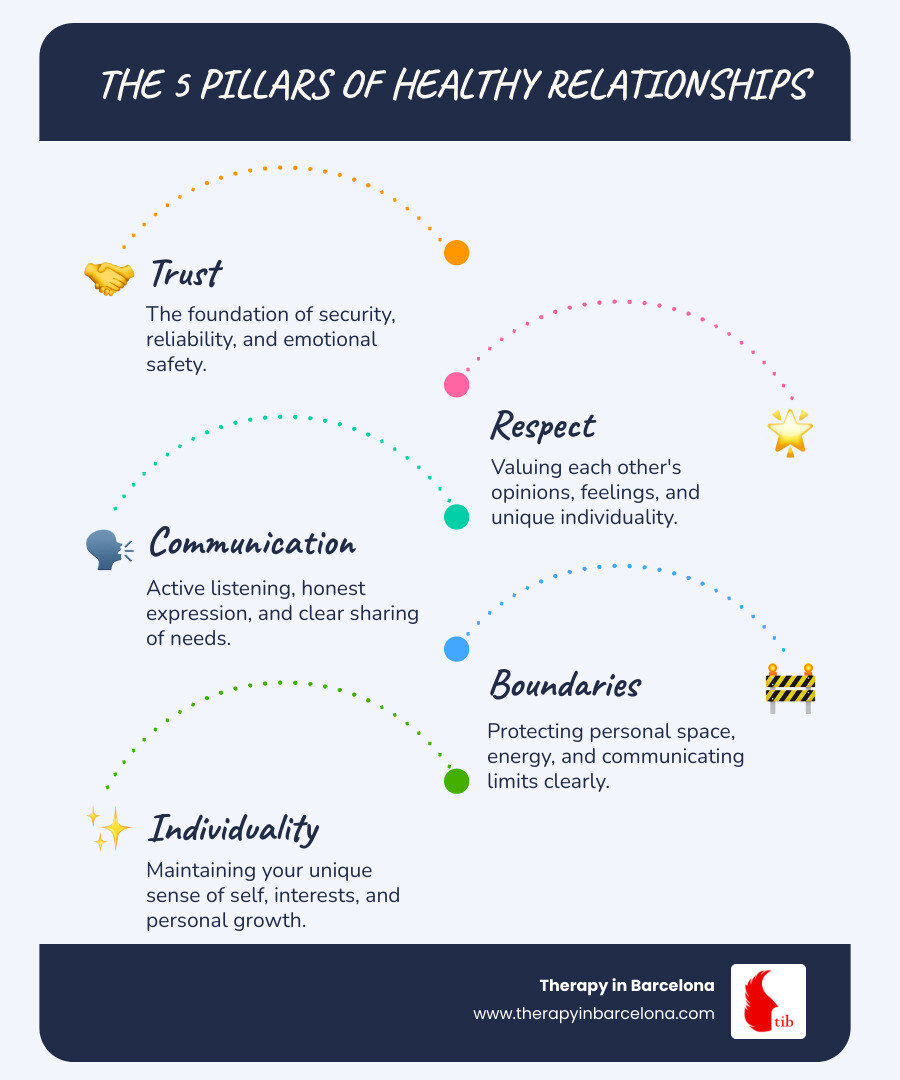
The Foundation: Building a Strong Relationship with Yourself First
Before you can build healthier relationships, it helps to start with the one you have with yourself. That means getting clearer on your values, noticing your patterns and triggers, and learning basic emotional regulation and self-soothing so you can respond instead of react. It also includes building comfort with solitude: not as isolation, but as proof you can feel steady on your own. From that place, relationships become a choice rather than a rescue mission, and you’re more likely to connect with people who fit the real you.
For expats, like those finding their feet in Madrid or Zaragoza, this foundational work can be particularly challenging and rewarding. Relocating often strips away familiar comforts and forces a confrontation with one’s inner world, offering a unique opportunity for profound self-discovery. If you’re exploring your individual journey, our team at Therapy in Barcelona provides bespoke support through individual therapy services.
How to build healthier relationships by understanding your own patterns
Self-reflection helps you see how your past shows up in your relationships today. A simple journal can reveal patterns in your emotions, reactions, and recurring conflicts. Over time, you may notice an attachment style at play: the learned ways you seek closeness, handle distance, and respond to uncertainty. When early bonds felt steady, trust often comes easier. When they didn’t, “trust injuries” can make connection feel risky, even with safe people.
It’s also important to unpack and process emotional baggage from past relationships or childhood traumas. These unresolved issues can lead to projecting your fears and unmet needs onto your current partners, causing you to see them as reflections of your unresolved past rather than as individuals. This projection can manifest as attempts to control or reshape them, creating conflict and distance.
Understanding your triggers—the specific words, actions, or situations that evoke strong emotional responses—is vital for managing your reactions constructively. As highlighted in “Why We Turn Into Children in Relationships (and Expect a Fairy Tale)”, understanding how personal history shapes your reactions requires deep reflection, and it’s a key step in fostering healthier connections. Research consistently shows that individuals with high self-awareness in relationships are better equipped to steer conflict, express needs clearly, and maintain their individual identity within a partnership.
The importance of maintaining your identity in a partnership
A healthy relationship is not about two halves making a whole; it’s about two whole individuals choosing to share their lives. Maintaining your individual interests, hobbies, and friendships outside of the relationship is not a sign of distance, but a vital component of interdependence. It enriches your life, provides diverse sources of fulfilment, and brings fresh perspectives back into the partnership.
Dr. John Gottman’s research on successful couples shows that partners who maintain individual interests and can self-soothe during stress are better equipped to support each other without becoming emotionally dependent.
This balance prevents codependency, where one’s sense of self becomes enmeshed with their partner’s. Instead, it fosters interdependence, allowing both individuals to grow and thrive. Whether you’re pursuing a passion like painting or exploring the hiking trails near Málaga, nurturing your sense of self and personal goals ensures you bring your best, most authentic self to the relationship.

The Pillars of Connection: Trust, Respect, and Honesty
The foundation of any healthy relationship rests firmly on trust, mutual respect, and honesty. These aren’t just abstract concepts; they are daily practices that build emotional safety and allow vulnerability to flourish.
- Trust is the baseline: believing the other person will be reliable and act with integrity. It grows through consistent follow-through and can be rebuilt only with accountability and time. This often includes forgiveness, which research links to self-esteem as a support in that process.
- Mutual respect is treating each other’s feelings, boundaries, and individuality as real and important, even in disagreement. It shows up in listening, fair language, and not trying to “win” at the other person’s expense.
- Honesty keeps trust intact. It’s sharing what’s true (needs, worries, mistakes) without hiding behind people-pleasing or silence. When honesty includes vulnerability, emotional safety and intimacy tend to deepen.
The role of effective communication in building trust
Effective communication is the lifeblood of trust. It goes beyond merely exchanging information; it’s about truly connecting and understanding each other.
- Active listening is paramount. This means listening to understand, not just to respond. Give your full attention, ask clarifying questions, and reflect back what you’ve heard to ensure comprehension. This makes your partner feel valued and understood.
- Expressing emotions clearly and constructively is vital. Using “I” statements (“I feel frustrated when…” instead of “You always make me frustrated…”) allows you to own your feelings without placing blame. This approach encourages dialogue rather than defensiveness.
- Non-verbal cues—body language, tone of voice, facial expressions—often communicate more than words. Ensure your non-verbal communication aligns with your verbal message to avoid misunderstandings. A comforting touch, eye contact, or an empathetic nod can convey support and understanding far more powerfully than words alone.
- Empathy is the ability to understand and share the feelings of another. When you communicate with empathy, you validate your partner’s experience, even if you don’t agree with their perspective.
- Asking open-ended questions invites deeper sharing and shows genuine interest in your partner’s inner world. Instead of “Did you have a good day?”, try “What was the best part of your day, and what felt most challenging?”.

Understanding how you and your partner give and receive love
People express and experience love in different ways. Dr. Gary Chapman’s concept of the “5 Love Languages” offers a simple framework for understanding those differences. When you know your own love language and your partner’s, you can choose daily actions that land well for them, not just for you, which helps strengthen your bond. If you want a quick overview, start here: The 5 Love Languages (official site).
The five love languages are:
- Words of affirmation: Expressing affection through spoken words, praise, or appreciation.
- Quality time: Giving your partner your undivided attention and engaging in meaningful activities together.
- Acts of service: Showing love by doing things for your partner, like chores or running errands.
- Receiving gifts: Expressing love through thoughtful presents or tokens of affection.
- Physical touch: Communicating love through physical closeness, hugs, kisses, or holding hands.
If your partner values Words of Affirmation, a sincere “I appreciate you” may land better than a big gesture. If they prefer Physical Touch, a hug after a hard day might mean more than a note. Knowing how each of you gives and receives love helps your care feel clearer, not missed. For more, see The 5 Love Languages®.
How to Build Healthier Relationships Through Boundaries and Conflict
Boundaries are not walls; they are guidelines that define what you are comfortable with and what you need in a relationship. They protect your energy, maintain your sense of self, and foster respect. Learning to set and maintain healthy boundaries, and to respectfully respond to others’ boundaries, is fundamental to building healthier relationships.
Conflict is an inevitable part of any human connection. The presence of conflict doesn’t signal a broken relationship; rather, how you manage it determines the health and longevity of your bond. It presents an opportunity for deeper understanding, growth, and compromise.
Strategies for managing conflict constructively
Successful couples do not avoid conflict; they learn to “fight well.” Dr. John Gottman’s research shows that it is not the absence of disagreement, but how you handle it (especially your ability to repair and reconnect), that predicts relationship success (learn more at The Gottman Institute).
Here are some strategies:
- “Fighting fair”: Focus on the specific issue at hand, avoid personal attacks or bringing up past grievances, and use “I” statements to express your feelings and needs.
- Taking a break: If emotions run too high, suggest a 20-minute break to calm down. This prevents “flooding,” where intense emotions overwhelm your ability to communicate rationally. Use this time for self-soothing, perhaps by listening to music or going for a short walk.
- Avoiding the Four Horsemen: Dr. Gottman identified four destructive communication patterns that predict relationship failure: criticism (attacking character), contempt (disrespect, sarcasm), defensiveness (blaming others), and stonewalling (withdrawing). Actively work to eliminate these from your interactions.
- Focusing on the present issue: Keep the discussion centred on the current problem rather than escalating it by introducing unrelated past issues.
- Repair attempts: These are crucial. A repair attempt is any statement or action—verbal or non-verbal—that prevents negativity from escalating out of control. It could be humour, an apology, a change of topic, or a simple “I’m sorry, I’m getting overwhelmed.” Learning to make and receive repair attempts is vital for healing ruptures. The Gottman Institute provides a helpful guide on repairing after a fight.
How to build healthier relationships by setting clear boundaries
Setting clear boundaries involves communicating your limits and expectations in a respectful, assertive way. This protects your well-being and teaches others how to treat you.
- Communicate limits: Clearly articulate what you are and are not comfortable with. This could be about time, personal space, emotional energy, or how you want to be spoken to.
- Protecting your energy: Saying ‘no’ when you need to is an act of self-care. It prevents burnout and resentment, allowing you to show up more fully when you do say ‘yes.’
- Stating your needs clearly: Don’t expect others to read your mind. Express what you need from the relationship. This could be more quality time, specific types of support, or a different approach to shared responsibilities.
- Responding to others’ boundaries: Just as you set your own, respect the boundaries others communicate to you. This demonstrates mutual respect and fosters trust.
For couples navigating these complex dynamics, especially those facing the unique pressures of expat life, couples counselling can provide invaluable tools and a neutral space to develop these skills. Our couples counselling services at Therapy in Barcelona can help you and your partner learn to communicate more effectively and build stronger, healthier bonds.
Nurturing Your Connections and Spotting Red Flags
Relationships, like gardens, require consistent nurturing to flourish. Investing time and effort, showing appreciation, and maintaining intimacy are vital for long-term health. However, it’s equally important to recognise signs that a relationship might be unhealthy or even abusive, and to celebrate the “green flags” that indicate a thriving connection.
- Investing time and effort: Healthy relationships take time to build and need work to keep them healthy. Prioritise quality time together, even if it’s just a shared meal or a quiet evening. Find shared interests and hobbies to enjoy, but also support each other’s individual pursuits.
- Showing appreciation: Regularly express gratitude and acknowledge your partner’s positive contributions. Small acts of kindness and words of affirmation go a long way.
- Physical intimacy: Affectionate touch and physical intimacy are crucial for bonding. Studies on infants have shown the importance of regular, affectionate contact for brain development, and these benefits extend into adulthood. Affectionate contact boosts the body’s levels of oxytocin, a hormone that influences bonding and attachment.
Signs of an unhealthy or abusive relationship
It’s not always easy to recognise the signs of an unhealthy relationship when you’re in one, especially if you’re an expat feeling isolated or vulnerable. An unhealthy relationship is characterised by an imbalance of power, disrespect, and often, abuse.
Warning signs include:
- Control: One partner tries to control the other’s actions, friendships, finances, or decisions.
- Disrespect: Dismissing opinions, minimising feelings, name-calling, or yelling.
- Dishonesty: Frequent lying, deceitfulness, or a lack of transparency.
- Isolation: One partner tries to cut the other off from friends, family, or outside interests.
- Gaslighting: Manipulative behaviour that makes you question your own reality, memory, or sanity.
- Emotional abuse: Shaming, humiliating, constantly criticising, or threatening.
A relationship isn’t healthy if it’s abusive, coercive, or violent. If any of this is happening, getting help quickly matters. In Spain, you can call 112 for emergencies. For gender-based violence support, call 016 (free, 24/7) or visit 016-online information. If you need help locating local services, see the Catalonia 112 service directory or your local town hall’s social services. Therapy in Barcelona doesn’t provide crisis care, but we can help you find appropriate specialist resources. For more detail, consult guides on unhealthy relationships.
Recognising ‘green flags’ that signal a healthy dynamic
Just as there are red flags, there are also “green flags” – positive indicators that signal a healthy, thriving dynamic. These are the behaviours and qualities that make you feel safe, valued, and loved.
- Taking responsibility: Both partners acknowledge their mistakes and take accountability for their actions, rather than blaming or making excuses.
- Emotional regulation: Partners can manage their emotions constructively, even during disagreements, and return to a calm state.
- Respecting boundaries: Both individuals honour each other’s stated boundaries without resentment or manipulation.
- Showing genuine interest: Partners actively listen, ask questions, and show curiosity about each other’s lives, thoughts, and feelings.
- Celebrating successes: Partners genuinely cheer each other on and take joy in each other’s achievements, big or small.
When and How to Seek Professional Support
While building healthier relationships is an ongoing journey of self-improvement and mutual effort, there are times when professional support can be invaluable. You might consider seeking help if you’re experiencing recurring conflicts, communication breakdowns that seem impossible to resolve, a persistent feeling of being stuck, betrayal of trust, or if you’re navigating significant life changes as an expat that are straining your connections.
For expats, relationship stress can hit harder: you are adapting to a new culture, often in a second language, without your usual support network. Therapy in Barcelona exists to offer culturally sensitive, English-speaking support for internationals navigating these pressures with more clarity and connection. We provide therapy for individuals, couples, and families in Barcelona and online.
Comparing your options for relationship support
When considering support for your relationships, several options are available, each with its own advantages:
- Public health system: In Spain, the public health system may offer free or low-cost psychological support. However, this often comes with potentially long wait times, limited availability of English-speaking therapists, and a less personalised approach, which can be challenging for internationals seeking culturally sensitive care.
- Large online platforms: These platforms can offer convenience and accessibility, providing a broad choice of therapists from various locations. However, they may lack a deep understanding of local cultural nuances or the specific challenges faced by expats in Spanish cities like Sevilla or Gran Canaria. The matching process might be less bespoke, and privacy policies can vary, sometimes involving data sharing.
- Private therapy (like Therapy in Barcelona): A good fit if you want tailored support: bespoke therapist matching, culturally sensitive care for internationals, strict privacy, and the option of online sessions or in-person appointments in Barcelona, with therapy available in English and several other languages.
What to expect from couples therapy
Couples therapy offers a structured, neutral space for partners to work through their challenges with the guidance of a trained professional. It’s not about choosing sides, but about fostering understanding and growth.
You can expect to:
- Improve communication: Learn active listening, “I” statements, and strategies to express yourselves more clearly and effectively.
- Resolve conflict: Develop healthier ways to manage disagreements, move past destructive patterns, and make repair attempts.
- Rebuild connection: Find ways to reignite intimacy, appreciation, and shared purpose.
- Gain new skills: Acquire practical tools for emotional regulation, boundary setting, and mutual support.
Couples therapy can help partners steer tough times, such as financial stress (a leading cause of relationship conflict), or major life changes like adapting to a new country. It helps you face challenges as opportunities for growth and take more accountability for your actions. Family therapy services can also provide support for broader family dynamics.
Your Next Step Towards Healthier Connections
Building healthier relationships is undoubtedly a journey, not a destination. It requires ongoing practice, self-compassion, and a willingness to learn and adapt. No relationship is perfect, but the effort you invest in understanding yourself, communicating effectively, and handling challenges constructively will lead to more fulfilling and resilient connections.
For internationals, this journey can be particularly complex, interwoven with the unique experiences of cultural adaptation, language differences, and forging a new community. Support is available for these specific challenges.
Take the first step
If you’re an expat in Barcelona, another Spanish city like Madrid, or living abroad, and you want support with building healthier relationships, our culturally sensitive therapists can help. Our psychology-trained team (including therapists with expat experience) understands the pressures of international life. In a private, supportive space, you’ll explore relationship patterns, strengthen communication, and build more secure, satisfying connections.
We invite you to take the first step towards cultivating the healthy relationships you deserve. Book a Free Discovery Call to start your journey. Our online therapy services are available worldwide, ensuring accessible support wherever you are.
