


Why Understanding Attachment Changes Everything for Your Relationship

Attachment-based couples therapy is a powerful, evidence-based approach that helps couples understand and heal the emotional patterns driving their conflicts. Instead of focusing only on communication skills, this therapy addresses the deeper attachment needs and early relationship blueprints that shape how you connect.
Research shows that 70-75% of couples move from distress to recovery through attachment-focused therapy, with approximately 90% showing significant improvements .
Quick Answer: What is Attachment-Based Couples Therapy?
- Core focus: Healing emotional bonds and unmet attachment needs, not just surface-level conflicts.
- Main approach: Often uses Emotionally Focused Therapy (EFT), a highly researched model.
- Key insight: Your childhood experiences created an ‘internal working model’ that influences your adult relationships.
- The goal: To develop ‘earned secure attachment’ through corrective emotional experiences in therapy.
- Typical duration: 8-20 sessions, depending on the couple’s level of distress.
- Success rate: 70-75% of couples recover from distress, with 90% showing significant improvement .
- Best for: Couples stuck in repetitive arguments, feeling emotionally distant, or recovering from betrayal.
Have you ever wondered why some arguments with your partner feel so much bigger than the issue at hand? Why a simple disagreement can suddenly feel like your entire relationship is at stake? These moments tap into something deeper: our primal need for emotional safety and connection.
For many internationals living in cities like Barcelona, Valencia, or Málaga, these tensions can feel amplified. The stress of cultural adjustment and being far from familiar support systems can make even secure partnerships feel shaky. When you’re building a life abroad, your partner often becomes your primary anchor, making the relationship feel even more crucial.
Attachment-based couples therapy views these struggles differently. It sees arguments not as failures, but as ‘attachment protests’—desperate attempts to restore connection when you feel emotionally unsafe. This framework is grounded in decades of research, pioneered by psychologists John Bowlby and Mary Ainsworth.
This approach is about understanding, not blame. By recognising attachment patterns and creating new emotional experiences together, couples can build a more secure and resilient relationship.
Attachment 101: Understanding Your Relational Blueprint
Do you and your partner seem to follow the same script during arguments, no matter how much you promise it will be different? This isn’t a coincidence. We all carry invisible blueprints for relationships, formed long before we met our partners. Understanding these patterns is the first step toward changing them.
From Cradle to Couple: The Origins of Attachment Theory
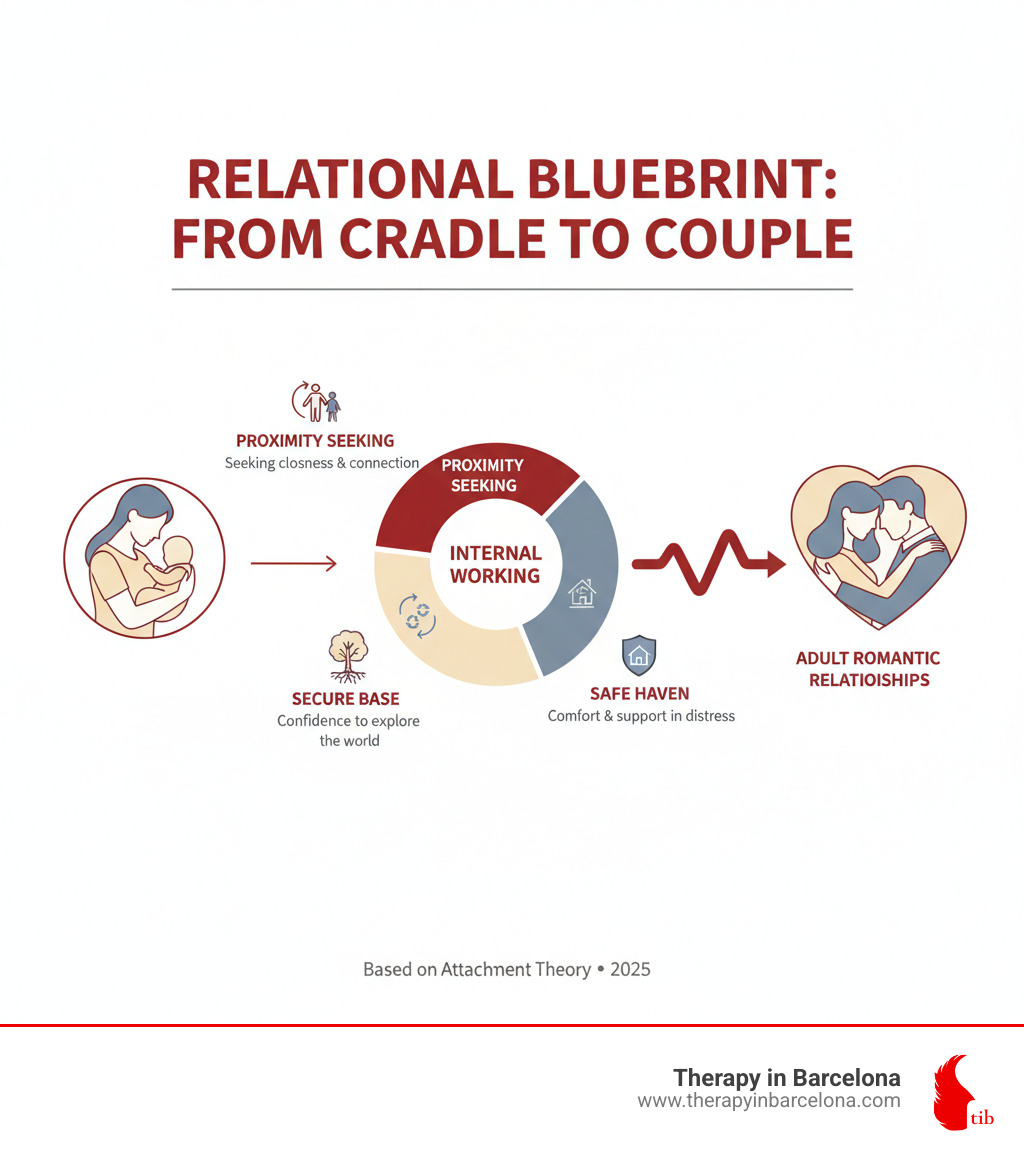
In the 1950s, psychologist John Bowlby observed that the way infants bond with caregivers is a survival mechanism. He proposed that humans are biologically wired for connection, and these early bonds shape how our brains process relationships for life.
His colleague, Mary Ainsworth, identified distinct attachment patterns by observing how babies responded to separation and reunion with their mothers. She found that these early experiences create an ‘internal working model’—a blueprint that guides how we see ourselves, others, and what we expect from relationships.
If your caregivers were consistently responsive, you learned the world is generally safe and that others will be there for you. If your early experiences were inconsistent or frightening, you developed other strategies to cope—strategies that may cause problems in your adult relationships.
Throughout life, we need two things from our closest relationships: a safe haven to turn to for comfort and a secure base that gives us the confidence to explore the world. These early patterns travel with us into our adult partnerships, often without us realising it.
The Four Adult Attachment Styles
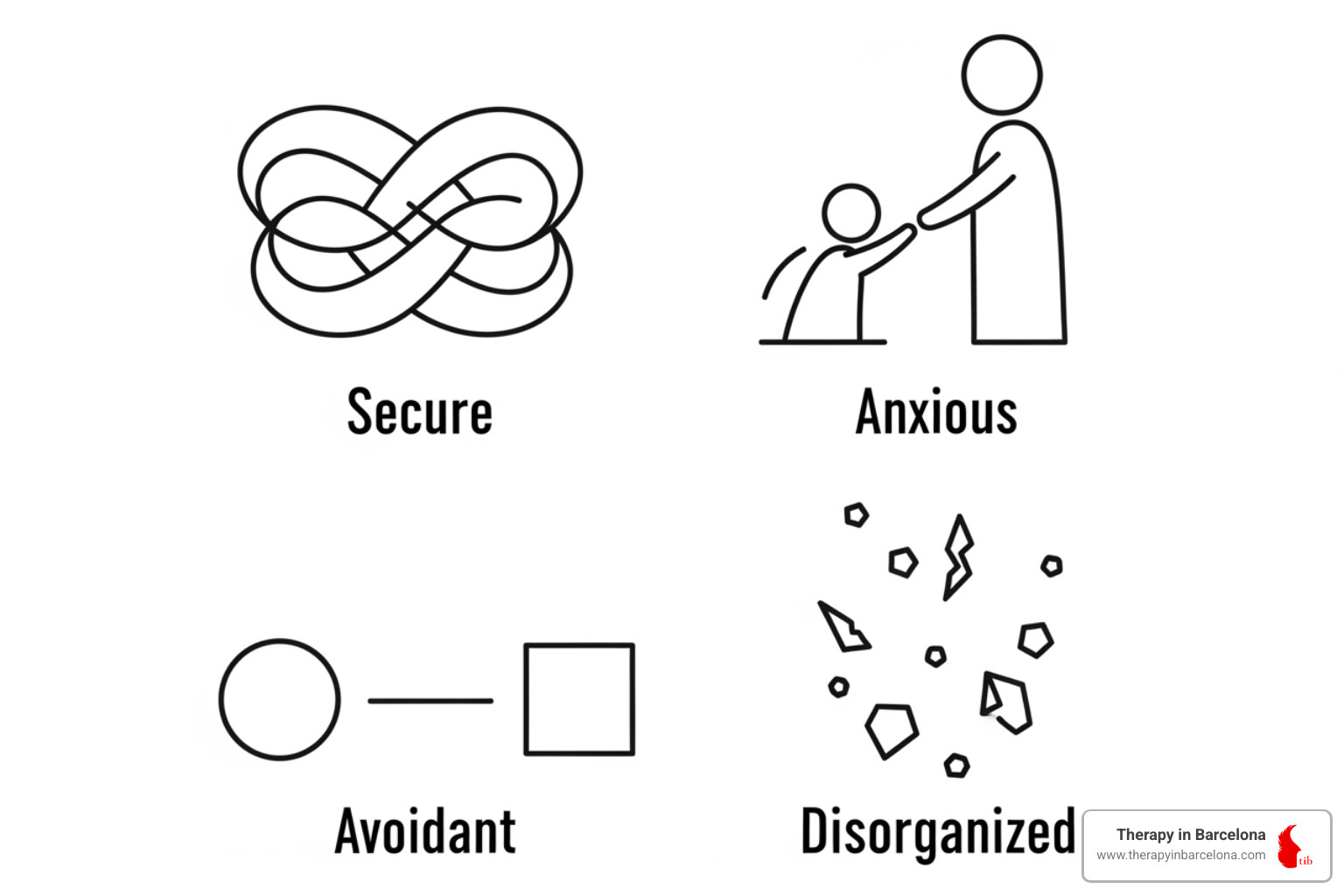
Your early relationships shaped how you approach intimacy today. Understanding these attachment styles can help you recognise your own patterns and your partner’s. Most people have a dominant style with elements of others.
Many expat couples experience relationship challenges after relocating abroad. The following example illustrates how different attachment styles can influence communication and connection.
Secure attachment: Characterised by trust and emotional balance. People with a secure attachment style generally feel confident in their relationships, communicate their needs openly, and are comfortable with both closeness and independence.
Anxious-preoccupied attachment: Marked by a fear of abandonment and a strong need for reassurance. People with this attachment style may worry that a partner is pulling away and frequently seek validation because they fear they are not loved enough.
Dismissive-avoidant attachment: Prioritises self-reliance and emotional distance. People with this attachment style may withdraw during conflict or feel overwhelmed by too much closeness, often coping by suppressing their own needs and handling problems alone.
Fearful-avoidant (disorganised) attachment: A mix of wanting closeness while also fearing it. People with this attachment style may send mixed signals, craving connection one moment and pulling away the next because they expect to be hurt.
For many expat couples, these patterns can become more intense. When you’re far from home, a partner often becomes your main source of support. As a result, one person’s need for space may feel like abandonment, while the other’s need for reassurance can feel overwhelming.
Is Your Relationship in Distress? Signs to Watch For
Many couples who seek attachment-based therapy feel stuck in the same painful dance. These patterns are often signs of attachment distress, where core needs for safety and connection aren’t being met. For internationals in Barcelona or Málaga, these struggles can feel especially acute.
Recurring arguments that never get resolved: You fight about the same surface issues (dishes, money) because they are ‘attachment protests’ about deeper needs not being met.
Feeling lonely within the relationship: You might share a home but feel an emotional chasm between you, as if you’re going through the motions without real connection.
Growing emotional or physical distance: You spend less quality time together, intimacy wanes, and you may start avoiding each other. The relationship feels more like a flatshare than a partnership.
The ‘pursue-withdraw’ dance: This is a common, painful cycle. One partner (often anxious) pushes for connection, while the other (often avoidant) pulls away, seeking space. The more one pursues, the more the other withdraws.
Difficulty recovering from disagreements: Small issues escalate into big fights, and it takes a long time to repair the rupture and feel close again.
Betrayal or breaches of trust: Infidelity or significant dishonesty can shatter a relationship’s security, creating deep attachment wounds that require skilled support to heal.
Compulsive behaviours or substance use: Using pornography, substances, or gambling in a way that feels out of control can be a way of coping with overwhelming emotions or numbing attachment pain.
If you recognise these patterns, you’re not alone, and you’re not stuck. A distressed relationship can reinforce insecure attachment, but with the right support, these cycles can change. That’s what couples therapy is designed to address.
How Does Attachment-Based Couples Therapy Create Change?
This section details the therapeutic process, focusing on how it helps couples heal and reconnect.
The Goal: Moving Towards “Earned Secure Attachment”
The good news is your attachment style isn’t a life sentence. While early experiences are influential, you can heal old wounds and build a more secure way of relating. The main goal of attachment-based therapy is to help you and your partner create an “earned secure attachment.”
Thanks to ‘neuroplasticity,’ your brain can form new pathways throughout life. In therapy, through consistent, positive emotional experiences with your partner and therapist, you can change how your brain responds to intimacy and stress. This means learning to co-regulate with each other and building a new, secure way of connecting.
The safe, trusting relationship you build with your therapist is also a vital part of this journey. This new experience of safety helps to overcome the effects of past attachment difficulties.
De-escalating the Negative Cycle with Emotionally Focused Therapy (EFT)
One of the most effective types of attachment-based therapy is Emotionally Focused Therapy (EFT), developed by Dr. Sue Johnson. EFT gets to the root of the destructive patterns that keep couples feeling stuck.
At its heart, EFT helps couples identify their ‘negative cycle’—the predictable, painful interaction that appears when core attachment needs feel threatened. Your therapist acts as a guide, helping you both see this cycle from a new perspective.
Here’s how it works:
- Identify the destructive pattern: You’ll learn to recognise the repetitive actions and reactions that lead to distress.
- Understand triggers vs. surface issues: An argument about chores is often a symbol for deeper fears like “I feel unappreciated” or “I don’t matter.”
- Move from blame to vulnerability: The sessions create a safe space to express the fears, loneliness, or sadness beneath anger and withdrawal, helping both partners better understand each other.
The results of EFT are impressive: studies show that 70-75% of couples move from distress to recovery, with about 90% showing significant improvements. These changes tend to last long-term.
What to expect in your sessions
Attachment-based couples therapy is an active, collaborative journey. Your sessions are a confidential space where you both feel heard and validated. Your therapist’s role is to guide you through a process of emotional exploration and relational restructuring.
Here’s what you can generally expect:
- A safe space: Your therapist creates a non-judgemental environment, which is especially important for expats in cities like Alicante or Zaragoza, where outside pressures can feel heavy.
- Exploring emotions: You’ll be encouraged to explore your feelings and past experiences to understand how they shape your reactions today.
- Guided conversations: Instead of just talking about problems, you’ll engage in ‘enactments’—facilitated interactions with your partner in the session. These are powerful moments for creating new, positive emotional experiences.
- Learning to connect: A key part of the process is learning to ask for what you need and respond to your partner’s needs with compassion, changing old negative patterns into new, loving ones.
The therapy journey typically involves an initial assessment, de-escalating conflict, restructuring your interactions, and consolidating your new, secure bond. For more information, please explore our couples counselling services.
The Benefits of a Secure Bond
Achieving a secure attachment bond does more than just stop arguments. It fundamentally changes how you experience each other and the world, with ripple effects touching every part of your lives.
A Stronger Partnership and Deeper Intimacy

When you develop a secure bond, you build a resilient foundation for your daily life together.
- Communication becomes more honest. You learn to express your needs without defensive walls. You can hear each other even when you disagree.
- Conflict becomes constructive. Disagreements stop feeling like threats and become opportunities to grow closer. The goal shifts from “winning” to “understanding.”
- Intimacy deepens naturally. As trust grows, so does your willingness to be vulnerable. This creates space for richer emotional connection and often revitalises physical intimacy.
- You feel like a real team. A sense of shared purpose makes you feel more united when facing life’s challenges. Your partner becomes someone you turn toward, not away from.
Increased Resilience for Life’s Challenges
A secure attachment provides a vital buffer against stress, which is especially important for expats when far from home.
When you feel securely connected, you can lean on each other during difficult times. A strong emotional bond can help both partners feel calmer, safer, and better able to cope with life’s challenges.
For internationals in Barcelona, Valencia, or Málaga, the challenges of expat life—cultural shock, homesickness, language barriers—can feel overwhelming. A secure relationship provides a reliable anchor. You have someone who understands what you’re going through, someone you can turn toward as an anchor in tough times.
Whether you’re becoming parents, relocating, or supporting each other through career changes, a secure bond ensures you can face these transitions together, not just side-by-side.
Better Overall Well-being
The benefits of a secure relationship extend to your individual wellbeing and physical health.
- Feelings of stress and anxiety can lessen. Secure attachment is linked to lower instances of persistent low mood and overwhelming worry.
- Your body responds to this security. Secure connections can lower cortisol (the stress hormone) and promote oxytocin (the bonding hormone), helping your body function in a healthier, less stressed state .
- Overall happiness increases. A secure, loving relationship is a foundation that supports everything else you do, fostering genuine wellbeing.
For expats building a life in a new country, this sense of partnership can make the difference between thriving and merely surviving abroad.
Finding the Right Support for Your Relationship
When you’re ready to seek help, especially as an international in Spain, understanding your options is key. The therapy landscape is varied, and finding the right fit is crucial.
Your Therapy Options in Spain
The public health system offers valuable mental health services, but wait times can be long, and finding an English-speaking therapist may be difficult. The system isn’t always designed for the specific needs of internationals.
Large online therapy platforms promise convenience but often use a “next available” model instead of thoughtful matching. The therapist may not understand the unique pressures of expat life, and data privacy can be a concern.
Local private practices vary in quality. Finding a therapist in cities like Barcelona, Madrid, or Valencia who speaks fluent English, understands the expat experience, and specialises in attachment-based couples therapy can be a challenge.
Why Specialised Attachment-Based Couples Therapy Matters for Expats
At Therapy in Barcelona, our approach is specifically designed with internationals in mind. Founded by Australian Psychologist Leigh Matthews, in Barcelona since 2011, we are a trusted group practice supporting internationals in Spain and beyond.
We understand the expat experience. Our team is made up of psychology-trained therapists, many of whom are expats themselves. They have lived experience with the challenges of building a life abroad, from cultural differences to feeling isolated. We get it.
Languages and cultural sensitivity. We speak English, and some of our therapists also speak German, French, Spanish, Afrikaans, Portuguese, Austrian-German and Swiss-German.
Personalised therapist matching is key. We don’t just assign you to the next available therapist. We take time to understand your situation to connect you with the right person. This careful process improves the chances of a positive outcome from the start. You can meet our team of expat therapists here.
Collaborative expertise across life stages. We are a group practice working with adults, couples, teens and families.
Your privacy is protected. As a private practice, your confidential information stays confidential. We don’t sell your data or use your personal struggles to train algorithms.
We offer evidence-based expertise. Our therapists are qualified professionals who tailor their approach to each couple, integrating methods such as the Gottman Method and Imago Relationship Therapy where appropriate.
This is a private-pay service, which allows us to provide more personalised, responsive care. Some of our therapists offer sliding scale fees, so please inquire when you book your Free Discovery Call.
Whether you’re in Barcelona, living as an expat in Málaga, or connecting with us online from anywhere in the world—including the USA and Canada—we’re here to provide culturally sensitive, attachment-focused support. We also offer face-to-face sessions in our Barcelona office. For more information, please explore our couples counselling services.
Frequently Asked Questions about Attachment-Based Couples Therapy
Can our attachment styles really change?
Yes. Attachment patterns are learned, not fixed. The brain’s ability to form new neural pathways, known as neuroplasticity, means that change is possible. Through awareness, new experiences in therapy, and responsive interactions with your partner, you can develop an “earned secure” attachment style. Therapy creates corrective emotional experiences that help rewire old patterns.
How long does couples therapy usually take?
It depends. Most couples complete between 8 and 20 sessions. The timeline is influenced by the depth of distress in the relationship, any past trauma, and how engaged you are in the process. Couples who actively practise new skills between sessions often see progress more quickly. Your therapist will work with you to assess progress and adjust as needed.
What if my partner is reluctant to try therapy?
This is a common concern. It often helps to frame therapy not as “fixing” one person, but as a joint effort to improve the relationship for both of you. It’s about learning new skills for connection together.
Suggesting a no-obligation Free Discovery Call can also help. It allows your partner to meet a therapist and ask questions without committing to a full course of therapy. Our team at Therapy in Barcelona is experienced in helping couples handle this initial reluctance with compassion.
Start Building a More Secure and Loving Connection
You’ve taken an important step just by reading this. Understanding how attachment patterns shape your relationship is powerful, but you don’t have to do this work alone.
Every couple deserves to feel safe, seen, and secure. The patterns causing distress right now are understandable, and more importantly, they can change. Attachment-based therapy provides a clear, compassionate map to help you and your partner find your way back to each other.
At Therapy in Barcelona, our team of psychology-trained therapists specialises in guiding international couples through this process. We understand that being an expat adds unique layers of stress.
We work online with clients worldwide, including the USA and Canada, and offer face-to-face sessions in our Barcelona office. Whether you’re in Valencia, Málaga, Alicante, or anywhere else, we’re here to support you.
This is a private-pay service, though some therapists offer sliding scale fees. You’re welcome to inquire about this during your initial conversation.
If you’re ready to build a stronger, more loving bond—or are just curious if this approach might help—we invite you to start with a Free Discovery Call. It’s a no-pressure conversation to help you find the right fit, because the right match matters.
