


Relationship Therapists Can Help You Understand the Pattern, Not Just the Argument

Therapists for relationship issues help individuals, couples and families understand the patterns beneath recurring arguments, distance, trust concerns and major life changes. This can include communication problems, intimacy concerns, infidelity, parenting disagreements, dating patterns, separation, and the added pressure of living between cultures or languages.
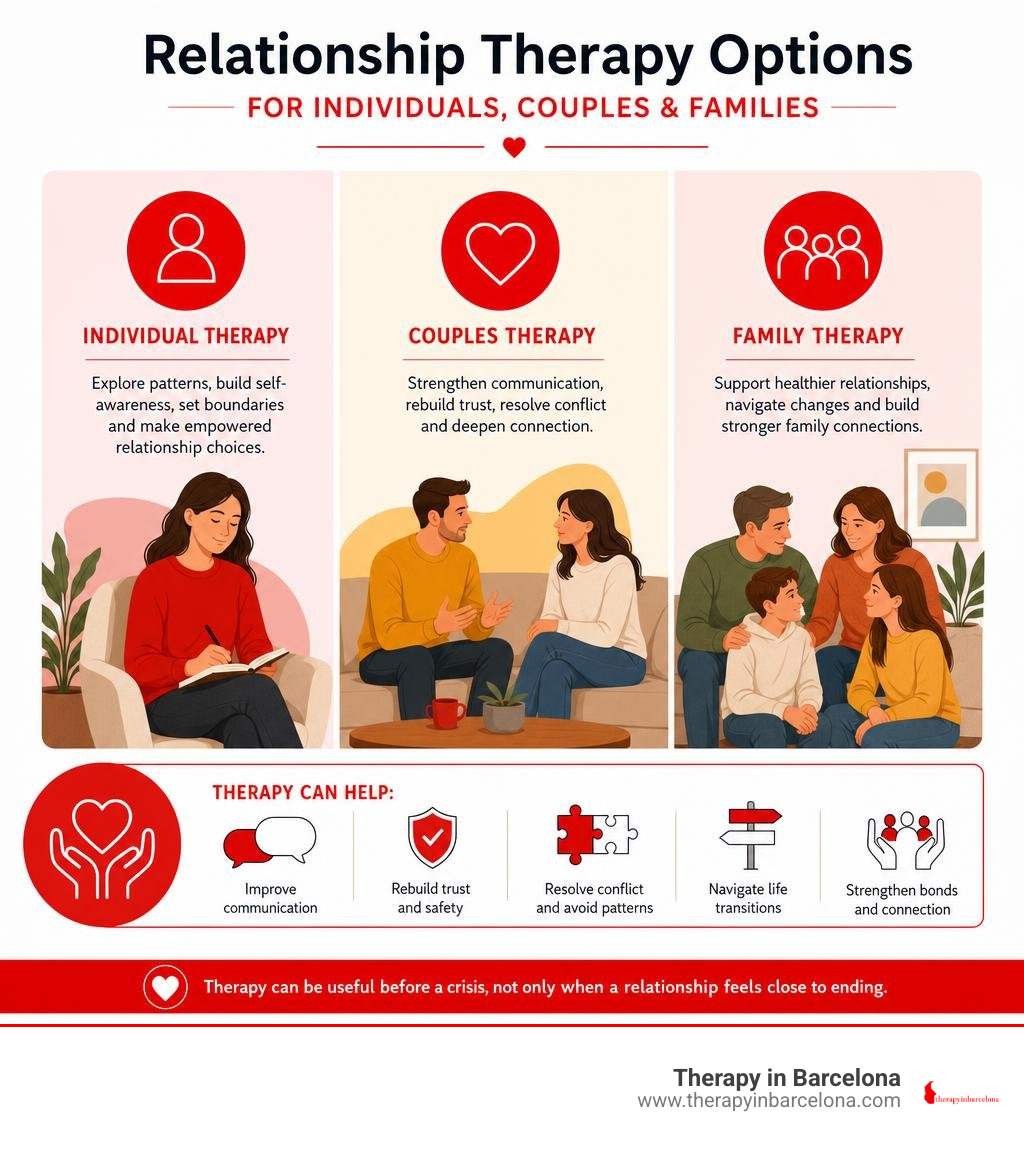
- Couples therapy focuses on the interaction between partners and the goals they share.
- Individual therapy can help one person explore attachment patterns, boundaries, past experiences and relationship choices.
- Family therapy can support parents, children and relatives affected by changing roles, conflict or relocation.
- Relationship therapy can be useful before a crisis, not only when a relationship feels close to ending.
For many international couples in Barcelona, a disagreement about chores, money, family or social plans may also carry deeper questions: “Do you understand how hard this move has been for me?” or “Can I rely on you when I feel alone?” A relationship therapist provides a structured, neutral space to slow these conversations down and identify what each person is trying to protect, ask for or avoid.
Therapy in Barcelona is a trusted group practice in Spain, established in 2011. It offers psychology-trained, multilingual care in English, German, French, Spanish, Afrikaans, Portuguese, Austrian-German and Swiss-German, with face-to-face sessions in its Barcelona office and online therapy for clients worldwide. Adults, couples, teens and families are carefully matched with a therapist based on their needs.
If you’d like support, book a Free Discovery Call.
Understanding What Therapists for Relationship Issues Actually Do
Many people assume relationship therapy is only for partners on the verge of separation. In reality, therapists for relationship issues act as objective guides who help clients understand the subtle dynamics governing their interactions. Rather than taking sides or determining who is “right”, a trained clinician examines the invisible dance between partners. They help you notice how individual reactions spark defensive counter-reactions in the other person.

Relationships often get bogged down in repetitive communication loops. One partner might push for an immediate answer when feeling anxious, while the other partner withdraws to regulate their nervous system. Over time, this pursue-withdraw pattern creates emotional distance. A skilled therapist slows down these fast-moving exchanges in real time, helping both people see what is really happening beneath the surface.
Beyond conflict de-escalation, relationship therapists help clients rebuild intimacy, navigate major life transitions, and establish healthier boundaries. Whether you are working through parenting differences, career shifts, or the stress of adjusting to life in a new country like Spain, therapy offers practical tools to transform friction into emotional connection.
When to Seek Help from Therapists for Relationship Issues: Key Signs and Challenges
Knowing when to consult professional therapists for relationship issues can prevent minor misunderstandings from turning into chronic resentment. Research from The Gottman Institute shows that couples often wait an average of six years before seeking help. During this time, unaddressed frustration quietly erodes trust and affection. Seeking support early allows you to address core concerns before emotional exhaustion sets in.
Common signs that it may be time to seek guidance include:
- Recurring circular arguments: Having the exact same fight over and over without ever reaching a satisfying resolution.
- Emotional distance or feeling like roommates: Experiencing a loss of affection, warmth, or physical intimacy over extended periods.
- Trust breaches and betrayal: Recovering from physical infidelity, emotional affairs, broken promises, or financial secrecy.
- Life transitions and environmental stress: Adapting to marriage, parenthood, career changes, or relocating to cities like Madrid, Valencia, or Barcelona.
- Desire discrepancies: Navigating differences in sexual intimacy, affection, or emotional availability.
Understanding if your relationship could benefit from external support often starts with self-reflection. You can read more about evaluating your dynamic in our article on Does Love Need a Therapist? Evaluating Couples Counselling. Relationship experts also emphasise how nervous system regulation and pattern awareness help couples break free from chronic argument cycles.
How Therapists for Relationship Issues Address Attachment, Trauma, and Diversity
Modern relationship therapy looks beyond surface behaviours to examine how personal histories shape adult partnerships. Attachment theory shows that our early experiences with caregivers influence how we respond to intimacy, conflict, and distance today. An anxiously attached partner may crave constant reassurance, whereas an avoidantly attached partner might pull away when emotional intensity rises.
Therapists also recognise how past trauma affects nervous system regulation. When a partner experiences a trigger, their body may enter a fight, flight, or freeze state. In these moments, rational problem-solving becomes almost impossible. Relationship counselling helps partners learn how to co-regulate, creating a calm environment where difficult subjects can be discussed safely.
Additionally, effective therapy must be identity-affirming and culturally sensitive. Inclusive relationship care actively addresses the distinct needs of diverse partnerships:
- LGBTQ+ relationships: Navigating societal stigma, family acceptance, and unique relational dynamics in a non-judgemental space.
- Neurodivergent partners: Bridging communication gaps between autistic or ADHD partners and neurotypical spouses through tailored interaction strategies.
- Consensual non-monogamy and polyamory: Offering knowledgeable support for open relationships, polycule dynamics, and clear boundary agreements.
- Expat and intercultural couples: Balancing different cultural expectations, language barriers, and the isolation of living far from native support networks.
To learn more about specialised care for diverse dynamics, expat and intercultural couples facing cross-cultural adjustment will find useful insights in our guide on Couples Therapy: Navigating the Unique Challenges for Expat and Intercultural Couples.
Evidence-Based Modalities for Relationship Counselling
Not all relationship therapy follows the same format. Professional therapists for relationship issues rely on structured, evidence-based frameworks to help clients achieve lasting behavioural change. These frameworks provide practical tools rather than just open-ended talk therapy.
Key Approaches: Gottman Method, EFT, RLT, and Discernment Counselling
Several clinical modalities have proven highly effective for relationship therapy. Below is an overview of the primary approaches used by specialised practitioners:
The Gottman Method Grounded in over 50 years of empirical research, this approach focuses on building thorough relationship maps, strengthening fondness and admiration, and managing conflict. It identifies four destructive communication habits known as the “Four Horsemen”: Criticism, Contempt, Defensiveness, and Stonewalling. Therapy helps couples replace these behaviours with constructive communication skills.
Emotionally Focused Therapy (EFT) Based on attachment science, EFT helps partners identify the underlying emotional needs driving their arguments. Groundbreaking work in attachment science demonstrates how slowing down conflict cycles allows partners to express vulnerability safely and rebuild secure emotional bonds.
Relational Life Therapy (RLT) RLT focuses on directness and personal accountability. It addresses power imbalances, social conditioning, and self-esteem issues in relationships. The therapist actively guides partners to drop defensiveness, step out of grandiosity or shame, and cultivate genuine relational equality.
Discernment Counselling Designed specifically for couples where one partner is leaning out of the relationship while the other wants to reconcile. Rather than jumping directly into traditional couples counselling, this short-term framework helps partners decide whether to commit to six months of therapy or pursue a constructive separation.
To understand how these methods help repair relationships, read our detailed article on The Truth About Marriage Counselling: Can It Save Your Relationship?.
Individual Therapy vs. Couples Therapy: Working On Relationships Alone
A common question is whether you can work on relationship issues if your partner refuses to join you. While joint therapy is ideal for shifting interactive cycles, individual relationship therapy is still effective.
When you participate in individual therapy for relationship concerns, the focus shifts to your own personal growth and relational patterns. Consider how these two formats compare:
- Focus of Couples Therapy: Treats the relationship itself as the client. Prioritises joint interaction loops, shared goals, emotional co-regulation, and mutual communication skills.
- Focus of Individual Relationship Therapy: Focuses on the individual person. Helps you identify your attachment triggers, establish healthy boundaries, process personal trauma, and decide how you want to show up in your relationship.
When one person changes how they react, the entire relationship system naturally shifts. Practising self-awareness and learning healthier communication habits independently can alter long-standing argument cycles, even if your partner has not yet entered therapy. Learn more about how joint sessions work in our guide on The Art of Healing: How Couples Therapy Works.
What Happens in Relationship Therapy: Expectations, Timelines, and Format
Starting therapy can feel intimidating if you do not know what to expect. Understanding the structure and typical timeline helps remove uncertainty and allows you to prepare effectively.
Preparing for Your First Session and Session Duration
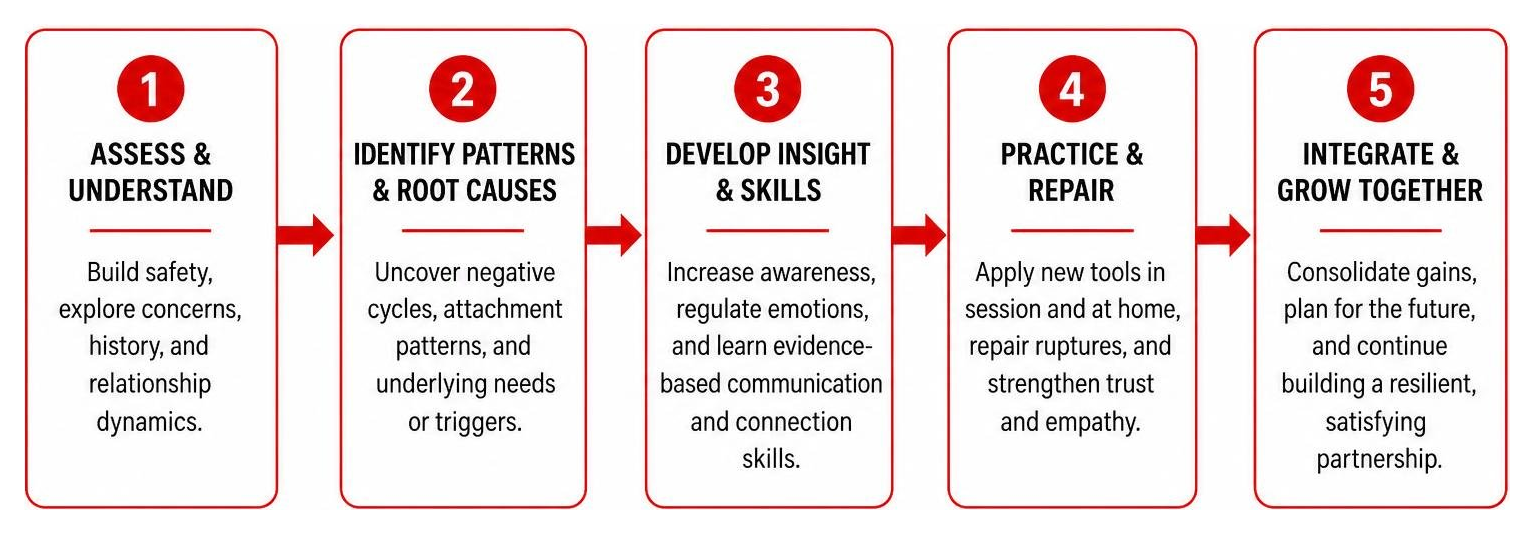
The therapeutic process usually begins with an initial intake session. During this first meeting, the therapist gathers information about your relationship history, current challenges, and personal goals. In couples therapy, clinicians often hold a joint session first, followed by individual background sessions with each partner, before coming back together to create a customised treatment plan.
Therapy duration varies based on the depth of the issues being addressed:
- Content-Oriented Therapy (6 to 12 sessions): Focuses on resolving specific short-term problems, such as improving chore distribution or making a concrete co-parenting decision.
- Process-Oriented Therapy (6 to 16 sessions): Focuses on building communication skills, interrupting argument loops, and learning emotional regulation techniques.
- Connection-Oriented Therapy (12 to 20+ sessions): Focuses on deep attachment healing, processing past betrayals, repairing complex trauma, and rebuilding long-term emotional safety.
To illustrate how this works, consider the fictional composite example of Elena and Mark (this is a fictional composite example representing common expat challenges, not a real client). Elena, an expat software engineer living in Málaga, felt chronically unheard by Mark, who worked long hours in finance. They kept fighting over household responsibilities. Through process-oriented therapy, they realised their arguments were not actually about household chores. Instead, Elena felt isolated living abroad, while Mark felt overwhelmed by financial pressure. Identifying these underlying feelings allowed them to support each other rather than criticise.
Online vs. In-Person Relationship Counselling
Both online and in-person sessions offer proven benefits for relationship counselling. Choosing the right format depends on your lifestyle, location, and personal comfort.
In-person counselling provides a dedicated physical space away from daily home distractions. Being in the same room with a therapist makes it easier to observe subtle body language and non-verbal cues. This format suits couples dealing with high conflict or those who prefer face-to-face connection.
Online therapy offers convenience and flexibility. It eliminates travel time, making it easier for busy professionals or parents to attend consistently. It also allows partners who are travelling or living in different cities across Spain, such as Marbella, Sevilla, or Alicante, to join sessions together seamlessly. Online relationship therapy platforms frequently use visual tools, shared digital diagrams, and guided exercises to keep sessions interactive and focused.
How to Choose an Effective Therapist for Your Relationship Needs
Finding the right practitioner is key to a successful therapy experience. When searching for therapists for relationship issues, consider these key steps:
- Verify Clinical Credentials and Specialised Training: Ensure the therapist holds recognised psychological qualifications and explicit post-graduate training in evidence-based couples frameworks like Gottman, EFT, or RLT.
- Prioritise Cultural Sensitivity: If you live abroad, choose a therapist who understands the nuances of expat life, cultural adaptation, and language differences.
- Assess the Therapeutic Fit: Use free initial calls or discovery consultations to ask about their approach, how they handle high-conflict conversations, and whether their style feels supportive to both partners.
- Clarify Financial Details: Therapy in Barcelona operates as a private-pay service. While private fees apply, some clinicians offer sliding scale options for individuals and couples with financial need, which prospective clients are encouraged to ask about.
It is helpful to consider your care options carefully. While public health systems offer vital community care, they often face long waiting lists and rarely cover non-diagnostic couples counselling. Large online platforms provide broad choices, but they may lack localised expat expertise and rely on automated algorithms. Private group practices like Therapy in Barcelona stand out by offering bespoke therapist matching, strict privacy (no data selling), and culturally sensitive support in the client’s native language.

Frequently Asked Questions
How do I know if couples therapy is right for my relationship?
Couples therapy is right for your relationship if you want to improve communication, break circular argument loops, rebuild emotional intimacy, or navigate major life changes together. You do not need to be in a severe crisis to benefit from therapy. Proactive couples frequently use relationship counselling as a routine check-in to strengthen their foundation, clarify shared goals, and address minor tensions before they become deeply rooted resentment.
Can couples therapy save a relationship after infidelity?
Yes, couples therapy can help repair a relationship after infidelity, provided both partners are committed to the healing process. Trust recovery requires a structured multi-phase framework. Therapy helps the unfaithful partner establish complete transparency and accountability, while creating a safe emotional space for the betrayed partner to process grief and trauma. Over time, therapy allows couples to rebuild emotional safety and form a stronger, more honest partnership.
How long does relationship counselling typically take?
The duration of relationship counselling depends on your goals and the complexity of your concerns. Short-term, content-focused therapy aimed at solving a specific decision or communication issue usually takes between 6 and 12 sessions (but varies). Deeper process-focused therapy aimed at changing established argument patterns typically takes 6 to 16 sessions. If you are working to heal severe attachment wounds or rebuild trust after betrayal, therapy may last 12 to 20 sessions or more.
Finding the Right Support for Your Relationship
Relationship struggles can feel overwhelming, especially when managing the added adjustments of living abroad. Having expert, culturally sensitive guidance helps you move past repetitive conflicts and build a deeply fulfilling connection.
Therapy in Barcelona was founded in 2011 by Leigh Matthews, an Australian Psychologist who moved to Barcelona in 2011. Having experienced the challenges of adjusting to a foreign culture firsthand, Leigh established the practice to offer accessible, high-quality mental health support to international residents. Today, Therapy in Barcelona is a trusted group practice in Spain, offering psychology-trained multilingual care in English, German, French, Spanish, Afrikaans, Portuguese, Austrian-German, and Swiss-German.
The practice provides face-to-face sessions at its central office in Barcelona as well as flexible online therapy worldwide. Every client undergoes a careful, personalised matching process to pair them with a therapist best suited to their individual, couples, teen, or family needs.
If you are looking for specialised support to navigate relationship challenges, explore our couples counselling Barcelona services.
If you’d like support, book a Free Discovery Call today. What small step can you and your partner take today toward building a safer, more connected relationship?
